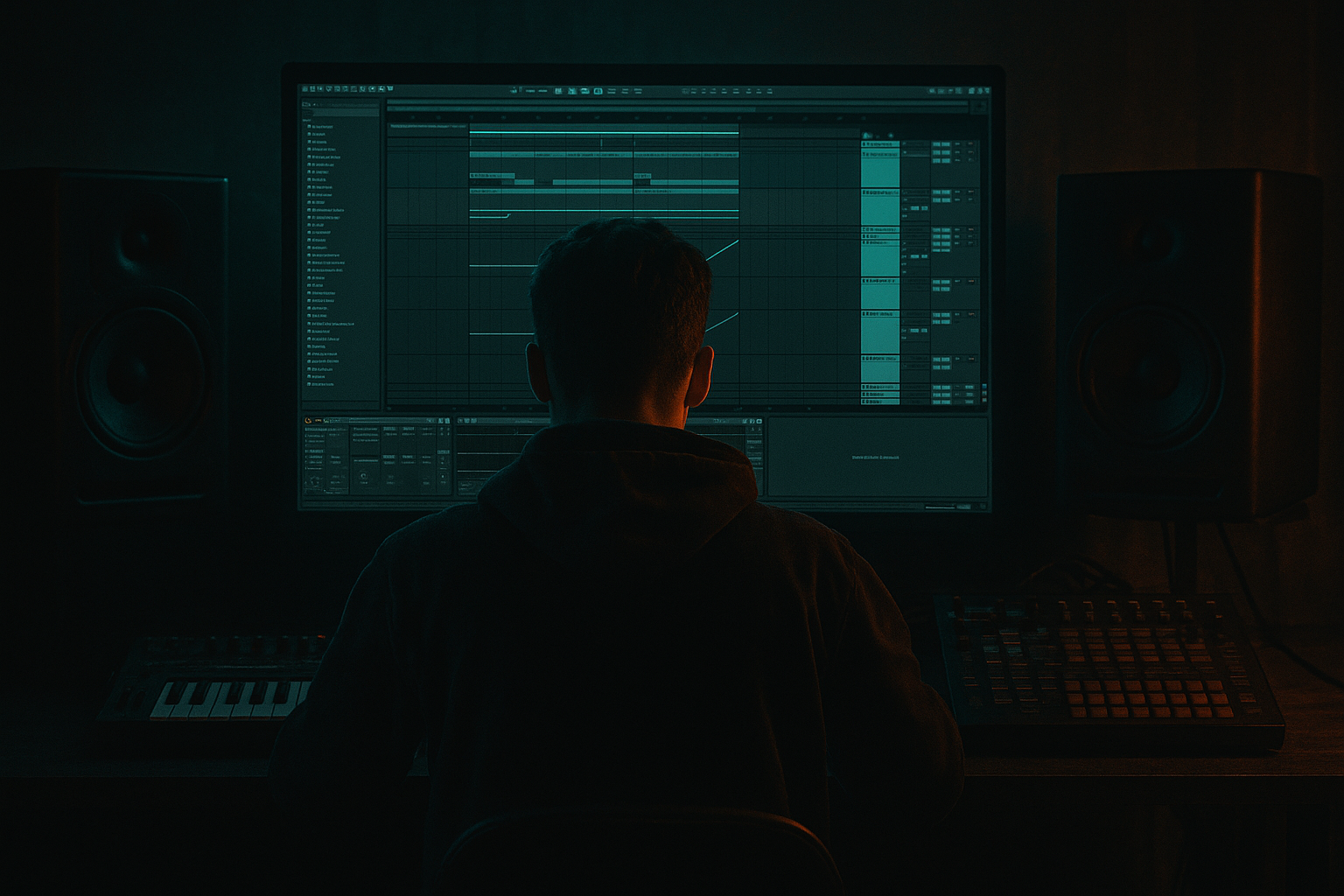
Main tutorial
Lesson Overview
Rebuilding a jungle breakbeat is one of the fastest ways to give a Drum & Bass idea that oldskool rave pressure: fast, chopped drums, broken-up swing, and a sense of movement that feels urgent but still musical. In Ableton Live 12, this is a perfect beginner-friendly edit exercise because you are not trying to invent a whole track from nothing — you are taking one classic break, cutting it into playable pieces, and reshaping it into a modern DnB loop.
This matters because in jungle and rollers, the drum edit often carries the whole vibe. A good break edit can make a simple bassline feel bigger, more nostalgic, and more alive. It also teaches you essential DnB skills: slicing audio, tightening timing, adding ghost hits, shaping transients, and building tension through arrangement. These are the same skills used in darker rollers, oldskool revival tunes, and even neuro-inspired halftime sections.
In this lesson, you’ll use Ableton Live 12 stock tools to rebuild a jungle break so it hits with oldschool rave energy but still feels clean enough for a modern mix. Light, practical, and very repeatable. 🔥
What You Will Build
By the end of this lesson, you will have:
- One edited jungle break loop, usually 1 or 2 bars long
- A stronger kick/snare backbone with shuffled hats and ghost notes
- A version that sounds tighter, punchier, and more “rave pressure” than the original raw break
- A basic drum group with EQ, saturation, and compression
- A loop that can sit under a sub, reese, or amen-style bassline
- A simple arrangement idea: intro, drop, fill, and switch-up
- Making the break too quantized
- Overloading the low end with the break
- Using too many layers
- Destroying transients with too much compression
- Ignoring velocity
- Forgetting arrangement
- Use saturation before heavy compression
- Keep sub separate from the break
- Use call-and-response phrasing
- Try filter automation on the drum bus
- Add one brutal fill, not ten tiny ones
- Check mono compatibility
- Resample your edited break
- A strong jungle break edit is a core DnB skill, especially for oldskool rave pressure.
- In Ableton Live 12, slice the break, rebuild the groove, and shape it with velocity, swing, and light processing.
- Keep the snare strong, the ghosts lively, and the low end clean.
- Use stock tools like Simpler, Drum Rack, Groove Pool, EQ Eight, Glue Compressor, Saturator, Auto Filter, and Utility.
- Finish with arrangement thinking: intro, drop, switch-up, and outro so the edit works inside a full track.
Musically, the result should feel like a classic jungle break rebuilt for a modern DnB track: busy enough to feel alive, but controlled enough to work under bass. Think intro tension for 16 bars, then a drop where the break locks with a deep sub and the snare cracks through the mix.
Step-by-Step Walkthrough
1. Find a break with the right attitude
Start with a classic break sample in your browser or sample pack. For this lesson, look for an amen-style or funk-style break with a strong snare and busy ghost notes. Good starting points are breaks with lots of natural velocity change, because jungle feels more alive when the hits are not perfectly even.
Drag the break into an audio track in Arrangement View or Session View. Set the project tempo somewhere in the DnB range, like 170–174 BPM. If the sample was originally recorded at a slower tempo, that is fine — Ableton will time-stretch it.
Use the break as your raw material, not as the final sound. The goal is to edit it into a custom loop that feels intentional.
2. Warp the break and choose the right loop length
Double-click the sample and make sure Warp is on. For a drum break, try Beats warp mode first. This usually keeps the transients crisp, which matters a lot in jungle and rollers.
Set the loop length to 1 bar for a tight, repeating classic feel, or 2 bars if the break has more natural variation and you want extra movement. If the sample feels too loose, reduce the loop length and focus on the strongest section: a kick-snare-ghost-note phrase often gives the best results.
In Beats mode, try:
- Preserve: Transients
- Transient Loop Mode: Off
- Envelope: around 8–20 ms if the break sounds too clicky
Why this works in DnB: the drum break must stay punchy at high tempos. If the transients smear, the groove loses its snap and the bass won’t lock properly underneath.
3. Slice the break into MIDI for full control
Right-click the audio clip and choose Slice to New MIDI Track. This is the beginner-friendly way to rebuild the break because it lets you trigger each hit as its own pad-like slice.
In the slice settings:
- Slice by Transient
- Create a new MIDI track with Simpler
- Keep the default drum rack structure if you want speed over complexity
Now you have a playable break kit. Each slice can be triggered in the MIDI clip, which is perfect for edit-style jungle programming.
Don’t worry about making it “perfect” right away. You are building a groove first, then polishing it.
4. Program the main break pattern
Create a new MIDI clip and start placing the key hits:
- Main kick on the strong downbeats
- Main snare on the backbeats
- Extra ghost notes and hat hits between them
For an oldskool pressure feel, aim for a pattern that still suggests the original break rather than turning it into a sterile drum machine loop. Keep some of the messy energy.
A simple beginner rule:
- Keep the original snare character in the main backbeat
- Add 2–4 small ghost notes around it
- Use short repeated slices to create forward motion
Try nudging a few notes slightly off the grid. In Ableton, select notes and use Alt/Option + Arrow keys or manually drag them a tiny amount. Very small timing shifts can add swing and human feel.
If your edited break feels too rigid, listen to how the hats and ghost notes breathe. Jungle is often about controlled chaos, not perfect alignment.
5. Shape the groove with Groove Pool and velocity
Open the Groove Pool and try a subtle groove from Ableton’s stock grooves. A swing amount around 54–58% is a useful starting point for jungle-style movement, but keep it subtle. You want bounce, not drunken timing.
Then adjust note velocities in the MIDI clip:
- Strong hits: higher velocity
- Ghost notes: lower velocity
- Accent the second snare slightly if the loop needs more push
If you used Simpler slices, velocity can also affect how hard each slice triggers. That gives you more drum realism without adding any extra plugins.
This is one of the biggest “edit” secrets in DnB: the groove is often more important than adding more layers. A well-placed ghost note can do more than another sample.
6. Clean the break with Drum Rack processing
Put your sliced break inside a Drum Rack or group the drum track and process it as a unit. Start with a basic cleanup chain using stock devices:
- EQ Eight
- High-pass very low rumble if needed, around 25–35 Hz
- Cut muddy boxiness around 200–400 Hz if the break feels crowded
- If the snare is dull, add a gentle boost around 2–5 kHz
- Glue Compressor
- Attack: 10–30 ms
- Release: Auto or around 0.1–0.3 s
- Keep gain reduction light, around 1–3 dB
- Saturator
- Drive: 2–6 dB
- Soft Clip: On
- Use it to thicken the drum body, not destroy the transients
This gives your break more unity and helps it cut through dense bass music arrangements. The goal is not “loud”; the goal is solid and readable.
7. Add extra jungle character with layers and micro-edits
Once the core loop works, add a few small layers:
- A closed hat on offbeats
- A rim or wood hit for extra groove
- A tiny reverse cymbal or noise swell into the snare
- A second snare layer for impact if the original is weak
Keep layers quiet. In jungle and darker DnB, too many layers can kill the break’s personality. Use them like seasoning.
You can also edit the loop by muting one or two hits every 4 or 8 bars. That creates variation without changing the core identity. For example:
- Bar 4: remove a kick before the snare
- Bar 8: add a quick fill with two extra snare ghosts
- Bar 16: drop out the hats for one beat before the drop
That kind of micro-editing is what makes a loop feel like a real arrangement, not just a repetitive sample.
8. Make space for the bassline
In DnB, the break and bassline must work together. If the drums are too thick in the low mids, the sub and reese lose authority.
Create a separate bass track and think of the relationship like call-and-response:
- Let the kick and snare own the first attention
- Let the bass answer in the gaps
- Avoid constant bass notes fighting the snare hit
For bass routing, keep your sub in mono and your drums mostly centered. If you have a reese or mid bass, use Utility to narrow low frequencies or the whole bass if needed. A simple starting point:
- Bass sub: mono
- Mid bass: narrow stereo, if any
- Drums: strong center image
This is why jungle edits work so well in DnB: the break creates rhythmic tension, and the bassline fills the empty spaces. Together they make the drop feel bigger than either part alone.
9. Automate tension and build an arrangement
Turn your loop into a usable track section. A beginner-friendly DnB arrangement could look like this:
- Intro: 16 bars — filtered break, atmosphere, maybe just the snare and hats
- Drop A: 16 bars — full break and bass
- Switch-up: 8 bars — remove one kick or add a fill
- Drop B: 16 bars — same break but with one extra layer or variation
- Outro: 8–16 bars — strip it back for DJ mixing
Use automation for simple tension:
- Auto Filter on the break for intro filtering
- Reverb send on the snare fill before a drop
- Utility gain to pull the drums down before impact and bring them back in
- Filter frequency opening over 4–8 bars
Keep automation simple and musical. Oldskool pressure often comes from anticipation, not overcomplication.
10. Do a quick mix check and export-ready polish
Before you move on, check the loop at full tempo and at low volume.
Quick beginner checklist:
- Is the snare clearly hitting?
- Is the kick still defined under the bass?
- Are ghost notes audible but not noisy?
- Is the break too bright or harsh?
- Does the loop feel like it wants to repeat without fatigue?
If it feels harsh, soften with EQ Eight:
- Tame harshness around 6–9 kHz
- Reduce fizzy top end only if needed, by a couple dB
If it feels weak, add a little Saturator or push the Glue Compressor slightly harder. Stop as soon as the loop feels confident. In DnB, overprocessing can flatten the excitement.
Common Mistakes
- Fix: move a few ghost notes slightly off-grid and use subtle groove swing.
- Fix: high-pass unnecessary rumble and leave proper sub weight for the bass track.
- Fix: keep the original break character and add only 1–2 supporting layers.
- Fix: use light Glue Compression and let the kick/snare breathe.
- Fix: lower ghost notes and vary accents so the break feels human.
- Fix: make one 8-bar switch-up and one fill so the loop can function inside a real track.
Pro Tips for Darker / Heavier DnB
- A little Saturator drive can make the break feel denser without washing it out.
- Let the kick suggest impact; let the true sub live on its own track. This keeps the low end clean and powerful.
- In darker rollers, let the break leave space for a bass stab or reese movement every few bars. That contrast creates weight.
- A slow low-pass opening in the intro, then full brightness on the drop, instantly creates tension/release.
- One strong 1-beat snare fill before the drop can feel more powerful than lots of clutter.
- Use Utility on your drum group to collapse the low end if the loop feels wide and unstable. Heavy DnB relies on focused center energy.
- Once the edit works, freeze/flatten or resample it to audio. This makes it easier to further chop, reverse, and process for more underground texture.
Mini Practice Exercise
Set a timer for 15 minutes and do this:
1. Load one jungle break into Ableton Live 12.
2. Slice it to MIDI using transients.
3. Build a 1-bar loop with a strong snare backbeat.
4. Add at least 3 ghost notes and 1 hat variation.
5. Process the drum group with EQ Eight, Glue Compressor, and Saturator.
6. Create an 8-bar section where bars 1–4 are normal and bars 5–8 add one fill or mute one kick.
7. Put a simple bass note on the drop section and check whether the break leaves enough room.
Goal: make the break feel like it belongs in a real DnB drop, not just a sample demo.

