Main tutorial
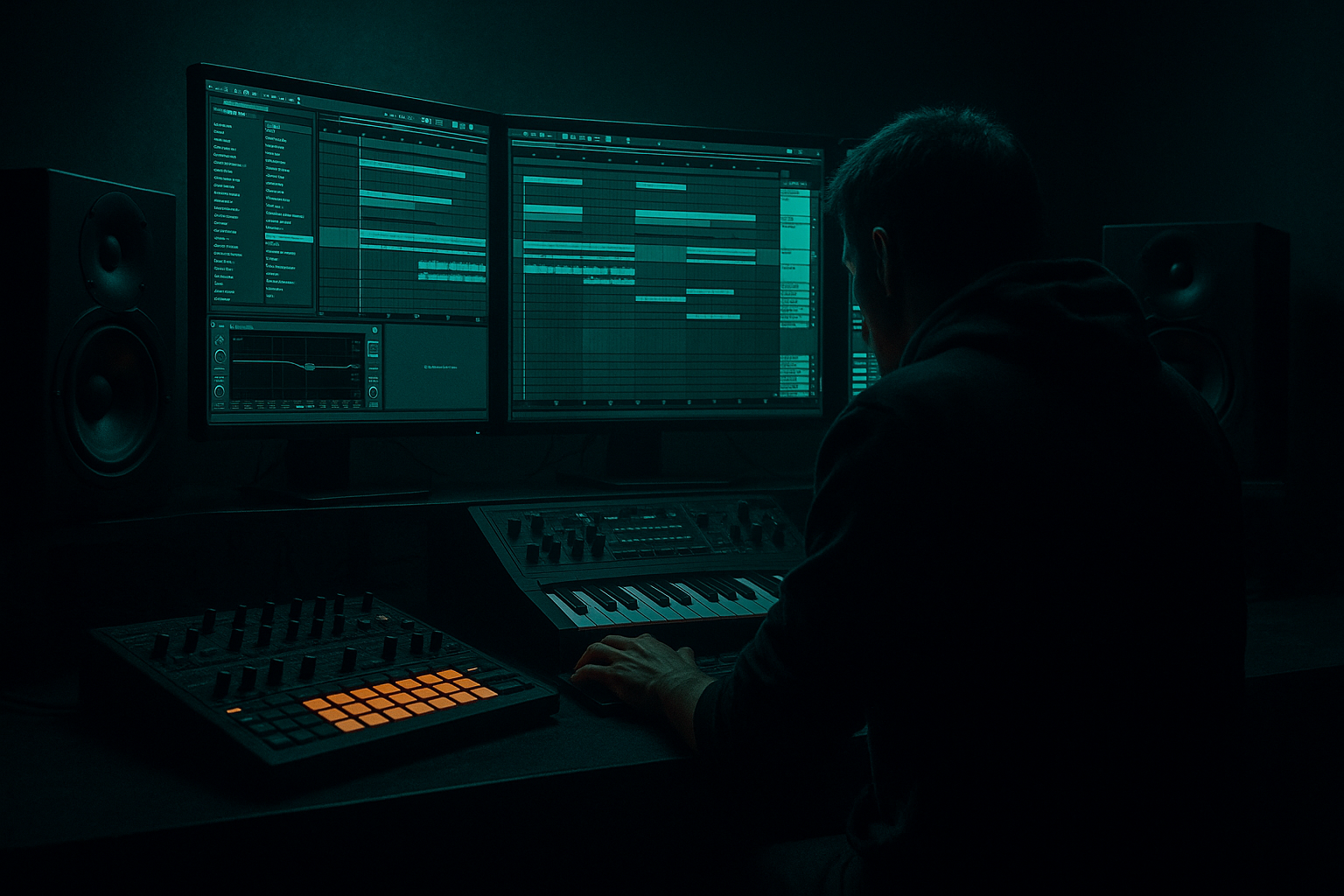
Rebuild an Oldskool DnB Jungle Arp with Breakbeat Surgery in Ableton Live 12
1. Lesson overview
In this lesson, you’ll recreate that classic oldskool jungle / early DnB arp-and-break hybrid: bright, tense MIDI arpeggios sitting on top of sliced breakbeats, with the whole thing feeling raw, fast, and dangerous. We’re aiming for the kind of energy you’d hear in ’93–’95 jungle or early drum and bass: rapid percussion edits, sharp tonal movement, and a vocal-style approach to rhythm where the arp behaves like a call-and-response phrase rather than a generic synth pattern.
Even though this lesson is under the Vocals category, we’re approaching it from a production angle where the “vocal” role is played by a hooky, expressive arp line—something that can later support actual vocal chops or jungle-style MC phrases. This is very common in DnB: the melodic hook often acts like a lead vocal, cutting through the break and bass.
You’ll use Ableton Live 12 stock devices to:
- slice and reshape a breakbeat
- build a gritty arp sound
- layer and process for movement
- make the rhythm feel “played” rather than looped
- arrange it into a proper DnB intro/drop section
- a 2-bar jungle break loop with surgical edits
- an oldskool-style arp hook using Ableton’s stock synths and MIDI tools
- a layered drum+bass groove that feels alive
- a basic drop arrangement with tension-building automation
- a workflow you can reuse for jungle, liquid-intense intro sections, or dark roller hooks 🔥
- chopped Amen / Think / Apache-style breaks
- a bright, hollow, or slightly detuned arp
- short reverb throws and filter movement
- a roomy but punchy mix
- rhythmic imperfections that feel intentional
- an imported classic break sample, or
- a drum rack made from one-shot break hits
- repeat the snare into a drum roll
- cut the kick just before the snare
- insert a tiny hat pickup before a crash
- reverse one break slice into the next hit
- mute every 4th kick for variation
- add a single ghost snare on the “and” before 2 or 4
- Split clips with `Cmd/Ctrl + E`
- Consolidate useful fragments with `Cmd/Ctrl + J`
- Use Slip mode to move the audio inside a clip without changing length
- Add fade handles to smooth harsh edits
- Nudge slices by tiny amounts for groove
- slightly late ghost snares
- swung hats
- kicks that feel pushed forward
- a break that has “elastic” timing
- keep the main downbeats tight
- let the fills and ghosts be looser
- use groove only lightly if needed
- a thin top break for hats and shuffles
- or a filtered loop for texture
- EQ Eight to remove low-end
- Auto Filter with a high-pass around 250–500 Hz
- subtle saturation from Saturator or Drum Buss
- saw waves
- pulse waves
- slightly detuned unison
- simple synth tones with movement
- Arpeggiator MIDI effect
- Note Echo for machine-like repeats
- Chord MIDI effect for simple stack shapes before arpeggiating
- Scale to keep the harmony jungle-safe and dark
- minor triads
- minor 7ths
- sus2 / sus4
- pedal tones with passing notes
- D–F–A
- D–G–A
- D–F–C
- F–A–C
- phrase
- response
- emphasis
- breathing space
- Leave small gaps at the end of phrases.
- Use filter automation to “open” the hook on important hits.
- Accent certain notes by changing:
- Add call-and-response by duplicating the arp and changing the last two notes.
- Drum Buss
- Glue Compressor
- EQ Eight
- Auto Filter for movement
- Saturator for density
- Utility to narrow low-mids and widen highs if needed
- filtered break
- tiny arp fragments
- noise risers
- vocal-style one-shots or atmosphere
- open the arp filter gradually
- add more break chops
- introduce bass hints or sub pulses
- full break surgery
- arp hook at full strength
- heavier bass or reese underneath
- strip drums back
- let the arp breathe
- use reverb throw on the final phrase
- variation in the last 4 bars
- more aggressive edits
- alternate arp ending
- stronger drum fills
- mute the arp for 1 bar before the drop
- use a reverse cymbal into the first hit
- automate filter cutoff open over 8 bars
- add a new break variation every 4 or 8 bars
- remove the kick for 1 half-bar to create a “pull”
- lower the arp by an octave
- detune one oscillator slightly flat
- use a band-pass or low-pass with resonance
- add subtle distortion before reverb
- use a minor key with chromatic passing notes
- Redux very lightly for digital crunch
- Roar if available in your Live 12 setup for controlled aggression
- parallel distortion on a Return track
- minor 2nd or minor 9th intervals
- repeated notes with occasional semitone movement
- a low octave layer tucked underneath the main arp
- one clean
- one saturated and filtered
- use Utility to keep low end mono
- avoid widening below about 120 Hz
- slice a vocal phrase
- pitch it down or up
- place it rhythmically in gaps between arp hits
- filter it heavily so it feels like part of the texture
- Version A: cleaner, more retro
- Version B: darker and rougher
- Version C: more chopped and aggressive
- start with a tempo and break that support DnB momentum
- surgically edit the break so it feels alive
- create a short, hooky arp that acts like a vocal phrase
- process both elements with stock Ableton tools
- arrange with clear tension, release, and variation
- use darkness, filtering, and vocal-style phrasing to make it hit harder
- a step-by-step Ableton session template
- a MIDI and device chain recipe
- or a dark jungle version with Reese bass and vocal chops ✅
---
2. What you will build
By the end, you’ll have:
Target sound
Think:
---
3. Step-by-step walkthrough
Step 1: Set the project up for DnB
1. Create a new Live 12 set.
2. Set tempo to 170–174 BPM.
- For more oldskool jungle energy, try 165–171 BPM.
- For more modern pressure, push 174–176 BPM.
3. Work in 4/4 with a 2-bar or 4-bar loop.
4. Turn on Warp only when needed for imported audio breaks.
Step 2: Build the breakbeat source
Use either:
#### Option A: Audio break surgery
1. Drag a breakbeat loop into an Audio Track.
2. In Clip View:
- enable Warp
- set warp mode to Beats
- start with Transient Loop or Transient preserved
3. Manually place warp markers so the break locks to the grid without killing its swing.
4. Duplicate the loop over 2 bars.
#### Option B: Drum Rack reconstruction
If you want maximum control:
1. Load the break into Simpler inside Drum Rack.
2. Use Slice mode with:
- Transient slicing for natural hits
- Beat slicing if the source is messy
3. Route slices to pads and rearrange them in MIDI.
This is more flexible for surgical edits and is often the better choice in advanced DnB workflows.
---
Step 3: Perform the break surgery
Now we make it feel like jungle, not just a loop.
#### Suggested editing strategy
Work in 1-bar phrases and create tension by cutting, repeating, and ghosting hits.
Common jungle edit ideas:
#### Practical Ableton methods
#### Make it breathe
Don’t quantize everything perfectly. Classic jungle often has:
A good workflow:
#### Add a second layer
Layer a second break or percussion track:
Process it with:
---
Step 4: Build the jungle arp
Now for the melodic hook. This should feel like it’s answering the break.
#### Sound choice
Oldskool arp textures often come from:
#### Stock device chain option 1: Wavetable arp
1. Load Wavetable on a MIDI track.
2. Start with:
- Osc 1: saw
- Osc 2: square or pulse
- slight detune between oscillators
3. Set filter to a low-pass with moderate resonance.
4. Add Envelopes:
- Amp attack: 0–5 ms
- Decay: short to medium
- Sustain: low or moderate
- Release: short
5. Add LFO to:
- filter cutoff
- wavetable position
- fine pitch very subtly
#### Stock device chain option 2: Analog for more retro grit
1. Load Analog.
2. Use a saw + pulse combo.
3. Slightly detune oscillators.
4. Use envelope modulation on filter cutoff for that brassy/jungly bite.
5. Add a touch of noise if you want extra edge.
#### Make it arp-like
You can build the rhythmic motion in multiple ways:
- Rate: 1/16 or 1/32
- Gate: 35–60%
- Style: Up, Up/Down, or Random
- Distance: minor or minor 7th intervals for classic tension
#### Good oldskool note choices
Try simple shapes:
Example in D minor:
Keep the phrase short: 1 bar or 2 bars. Jungle hooks often work because they repeat obsessively while the drums mutate around them.
---
Step 5: Make the arp behave like a vocal hook
Because this lesson sits under vocals, think like a vocalist:
Even if it’s synth-only, shape the arp as though it were a sung motif.
#### Practical phrasing tips
- velocity
- MIDI note length
- octave jumps
#### Add vocal-style processing
On the arp bus, try:
Chain example
1. EQ Eight
- HP around 120–200 Hz
- small cut around 250–400 Hz if muddy
- gentle presence boost around 2–5 kHz if needed
2. Saturator
- Drive: 1–4 dB
- Soft Clip: on
3. Chorus-Ensemble
- subtle width, not obvious wobble
4. Echo
- short sync delay, low feedback
- filter the repeats so they sit behind the lead
5. Reverb
- short room or plate
- decay modest, pre-delay 10–25 ms
6. Compressor or Glue Compressor
- only enough to control peaks
If the arp starts fighting the break, sidechain it lightly to the kick/snare or to the main drum bus.
---
Step 6: Glue the break and arp together
This is where it starts sounding like jungle instead of two separate loops.
#### Bus processing on the drum group
Group the break layers and try:
- Drive lightly
- Crunch low to moderate
- Boom if needed, but be careful in DnB
- slow attack, medium release
- aim for subtle cohesion, not pumping
- clean low-end mud
- notch harsh break frequencies if necessary
#### Bus processing on the arp group
#### Sidechain workflow
For modern clarity, sidechain the arp to the kick and/or snare:
1. Add Compressor on the arp bus.
2. Enable sidechain input from the kick.
3. Use a quick attack and medium release.
4. Don’t overdo it—oldskool jungle can tolerate some overlap, but the groove still needs space.
---
Step 7: Arrange it like a proper DnB tune
Now build an arrangement with contrast. DnB thrives on energy shifts.
#### Basic arrangement idea
Intro (8–16 bars)
Build (8 bars)
Drop 1 (16 bars)
Breakdown (8 bars)
Drop 2
#### Arrangement tricks
---
Step 8: Add darkness and weight if needed
If you want the result to lean darker/heavier, the arp should feel less “pretty” and more menacing.
Try:
For extra grit:
---
4. Common mistakes
1. Over-quantizing the break
If every slice snaps perfectly to the grid, the break loses its jungle identity.
Fix: keep the main hits tight, but leave ghosts and fills a touch loose.
2. Too much low end in the arp
Oldskool hooks are bright and cutting, not muddy.
Fix: high-pass the arp and keep sub duties separate.
3. Arp rhythm too busy
A hyperactive arp can clash with the break.
Fix: simplify the pattern and let the drums do the talking.
4. Reverb drowning the groove
Big reverb can smear fast rhythms.
Fix: use short rooms, pre-delay, or send-based effects.
5. No contrast between sections
If the intro, drop, and breakdown all feel the same, the tune won’t land.
Fix: automate filters, remove elements, and create clear energy shifts.
6. Break edits with clicks
Hard cuts on audio slices can click badly.
Fix: use fades, crossfades, or consolidate cleaner clips.
---
5. Pro tips for darker/heavier DnB
Tip 1: Make the arp more threatening
Use:
That creates tension without sounding too melodic or uplifting.
Tip 2: Process the arp in parallel
Duplicate the arp and distort one layer:
Blend them together. This keeps clarity but adds weight.
Tip 3: Use the break as a rhythmic lead
In darker DnB, the break itself can become the hook.
Let the arp answer the snare pattern rather than sitting on top of everything.
Tip 4: Keep the sub mono and separate
Even if the arp is wide and animated, the sub should stay focused:
Tip 5: Use automation on filter resonance
A tiny move in resonance can create that oldskool “speak-and-scream” energy, especially on short arp phrases.
Tip 6: Try ghost vocal chops
Since this is in the vocals category, a killer move is to:
This works especially well with a jungle arp because it turns the hook into a call-and-response between voice and machine 🎤
---
6. Mini practice exercise
Exercise: 8-bar jungle hook study
Build an 8-bar loop with:
1. A chopped breakbeat
- at least 6 edited slices
- one fill every 2 bars
2. A 1-bar arp phrase
- use a minor triad or minor 7th
- repeat it with a variation in the last bar
3. A vocal-style response
- either a vocal chop, reverse vocal, or synthetic stab
- place it in the gaps, not over everything
4. Processing
- drum bus with Drum Buss + EQ
- arp with EQ Eight + Saturator + Echo
- automation on filter cutoff over the 8 bars
Challenge version
Make 3 variations:
Compare which one feels most like an actual DnB drop starter.
---
7. Recap
You’ve now got a practical workflow for rebuilding an oldskool jungle arp with breakbeat surgery in Ableton Live 12:
The big takeaway: in jungle and drum and bass, the arp is not just a melody—it’s part of the rhythm section. Treat it like a percussive lead vocal, and the track instantly gets more movement and identity.
If you want, I can also turn this into:

