Main tutorial
Lesson Overview
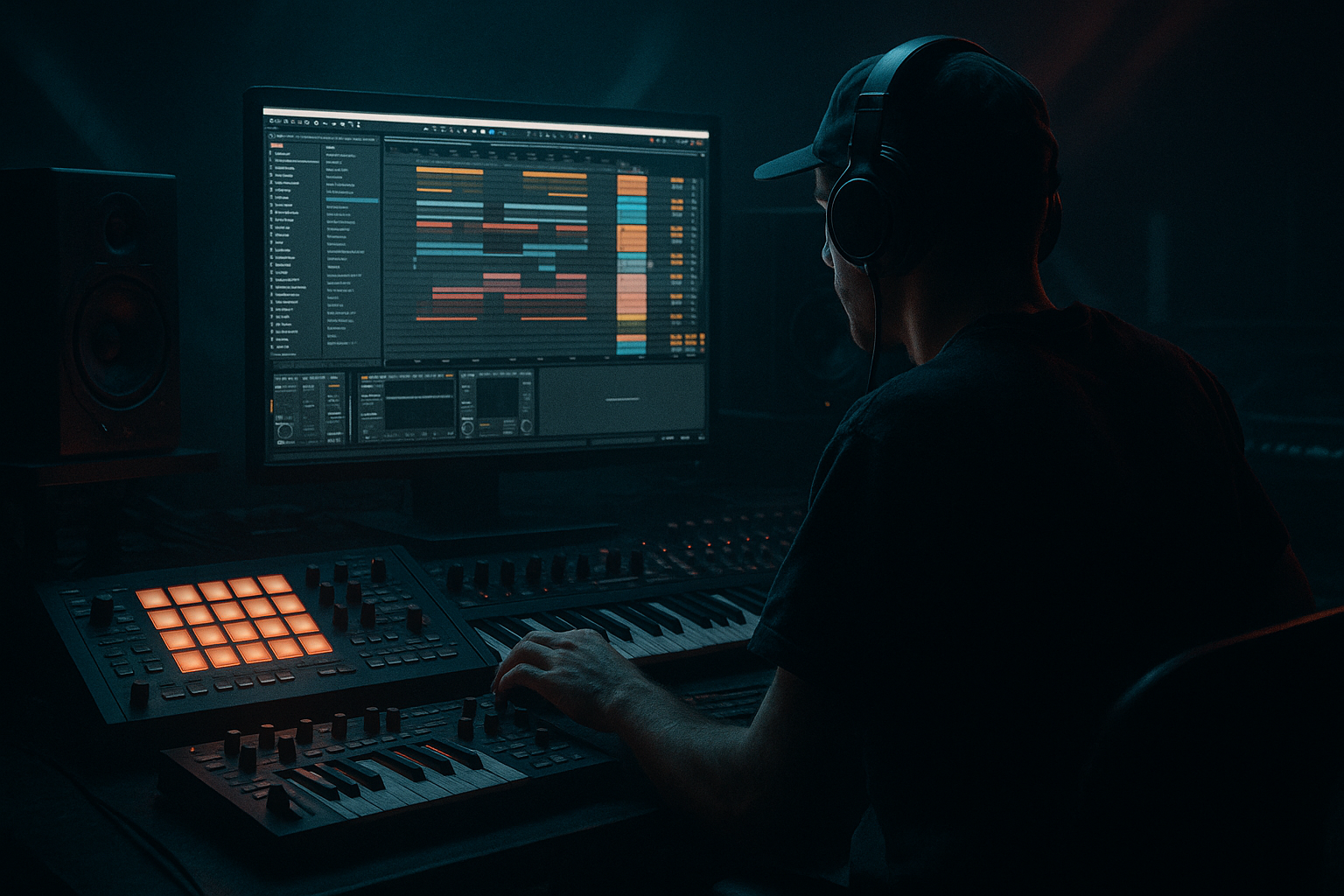
This lesson is about rebuilding an oldskool ragga-style DnB cut and giving it VHS-rave color using Ableton Live 12 stock tools. The goal is not to make a clean modern jump-up edit, but to create that gritty, tape-warped, pirate-radio energy you hear in jungle, early techstep, and ragga-infused rollers: chopped vocal hits, smeared transitions, rough edges, and a slightly unstable top end that feels like it came off a dusty cassette or a warped dubplate.
In a Drum & Bass track, this kind of FX work usually lives in three places:
- Into the drop: building tension with vocal cuts, tape-style pitch movement, and degraded atmospheres
- Between phrases: filling the empty bars with character so the arrangement keeps moving
- After the drop: adding switch-ups, rewinds, and VHS-style breakdowns that make the tune feel lived-in instead of over-polished
- a chopped ragga vocal phrase with tape-ish degradation
- a VHS-rave transition layer made from filters, wobble, and pitch drift
- a stuttered echo throw that lands on the snare or last kick of a phrase
- a downlifter / rewind-style tail for 1-bar and 2-bar switch-ups
- a resampled FX rack you can reuse in rollers, jungle, neuro intro edits, or darker halftime sections
- a ragga MC or toaster sliced into the groove
- the top end slightly smeared, like old tape or a cheap camera mic
- transitions that sound unstable, but still controlled
- enough dirt and movement to support heavy drums and a sub-led bassline without masking the low end
- Overloading the low end of the FX
- Too much reverb washing out the groove
- Making the vocal too clean
- Clashing with the snare or drum break
- Using too much stereo width on the main cut
- Automation that never resolves
- Layer a tiny bit of vinyl crackle or tape noise under the FX bus, but keep it very low. It can help the VHS illusion without clutter.
- Use Echo feedback as a tension lever: automate from 15% to 40% only on the last word of a phrase, then pull it back hard.
- Drive the FX into Saturator before Echo for a more aggressive, smeared repeat. This helps it feel like a broken sampler line.
- Keep the sub mono and untouched while the vocal FX gets all the degradation. That contrast is what makes the track hit harder.
- Use Drum Buss carefully on the FX return for punch and thump, but don’t flatten the transients so much that the vocal loses character.
- For neuro or darker rollers, pair the ragga cut with a restrained reese or moving mid-bass so the vocal acts like a hook while the bass does the mechanical pressure.
- Try call-and-response with the bassline: place the vocal on one bar, then let the bass phrase answer in the next. That creates the classic rave dialogue without overcrowding the mix.
Why it matters: DnB is fast, so every 1/2-bar or 1-bar gesture counts. Oldskool ragga FX cuts are powerful because they bring call-and-response, movement, and culture into the arrangement without needing a full new bassline or drum loop. If you can make a two-bar ragga cut feel like a moment, your tune instantly sounds more authored and more like a proper system tune 🔥
What You Will Build
You’ll build a compact ragga vocal FX chain and arrangement system that works over a DnB drop or intro:
Musically, the result should feel like:
Step-by-Step Walkthrough
1. Start with a tight DnB arrangement frame
Set up a simple 16-bar scene structure inside Ableton Live:
- Bars 1–4: intro tease
- Bars 5–8: build
- Bars 9–12: drop A
- Bars 13–16: switch / fill / reset
For this exercise, place your vocal cut and FX on a separate audio track called Ragga FX. Keep it away from the main drum bus and bass bus so you can process it aggressively without wrecking the groove.
If your track is around 172–174 BPM, work to 1-bar and 2-bar phrasing. That tempo range makes short vocal chops feel urgent and lets the FX sit in the same rhythmic language as the drums. For an oldskool vibe, think in call-and-response: vocal hit on bar 1, answer on bar 2, then a little hole for the snare and bass to breathe.
2. Choose and slice a ragga vocal with attitude
Drop in a vocal phrase with strong consonants, a drawn-out vowel, or a DJ-style shout. It does not need to be pristine. In fact, a little room sound or roughness helps sell the VHS feel.
Use Slice to New MIDI Track if you want quick control:
- Slice by transient for fast vocal cuts
- Or slice by 1/8 note if the sample already has a strong rhythmic feel
On the resulting Simpler, set:
- Trigger mode for punchy one-shots
- Mono if the phrase should behave like a single voice
- Glide only if you want a stretched, tape-warp effect between slices
Then make a short phrase from 3–5 slices. A classic pattern is:
- hit
- short answer
- gap
- longer tail
- repeat with variation
This works in DnB because vocal chops can lock to the snare grid and act like a rhythmic layer, not just a sample. In fast music, the ear reads repeated vocal fragments almost like percussion.
3. Build the VHS-rave degradation chain
On the Ragga FX track, insert this stock-device chain:
- Auto Filter
- Saturator
- Echo
- Redux
- Hybrid Reverb or Reverb
- Utility
Suggested starting settings:
- Auto Filter: low-pass at 6–10 kHz, resonance around 0.7–1.2
- add slow filter movement with Envelope Follower or automate the cutoff manually across 1–2 bars
- Saturator: Drive +2 to +6 dB, Soft Clip on
- Redux: Bit reduction mild, around 12–16 bits feel, sample rate reduction subtle enough to retain intelligibility
- Echo: Time synced to 1/8 or 1/4 dotted, Feedback 18–35%, Filter On, mode leaning darker
- Reverb / Hybrid Reverb: short-to-medium decay, around 1.0–2.4s, low cut up around 250–500 Hz
- Utility: narrow width if the sample gets too washier than the track
The idea is not to bury the vocal. You want degradation that feels like a VHS dub tape: top-end smear, a little wobble, and a slightly crushed transient profile. Keep the vocal readable enough that it punches through the drums for one or two beats, then blurs into the transition.
4. Create movement with automation, not just processing
The most convincing ragga FX cuts in DnB usually come from automation over time. In Arrangement View, draw automation on:
- Auto Filter cutoff
- Echo feedback
- Echo dry/wet
- Saturator drive
- Reverb decay or dry/wet
- Utility gain for momentary dips
Practical move:
- On the last half of bar 8, sweep the filter from 10 kHz down to 2.5–4 kHz
- At the same time, increase Echo dry/wet from 12% to 35–45%
- Push Saturator drive up slightly for the final word or shout
- End the phrase with a quick gain dip of -3 to -6 dB just before the drop lands
You can also automate a tiny pitch drop by using Clip Transpose on a resampled audio clip, or via Simpler if your source is chopped into MIDI notes. Even a -1 to -3 semitone fall on the final vocal tail gives that tape-roller sensation.
Why this works in DnB: the arrangement is so dense that a small automation move reads as a big event. A 1-bar ramp in DnB feels dramatic because the listener is hearing it at high speed against drums and sub.
5. Add a rewind / pullback effect for switch-ups
Oldskool cuts often benefit from a fake rewind or pullback before the next section. You can make this in Ableton without external tools by resampling.
Method:
- Arm a new audio track called FX Resample
- Set its input to Resampling or route from the Ragga FX track
- Record the final vocal hit, echo tail, and reverb tail for 1–2 bars
- Consolidate the best take
Then on the resampled audio clip:
- reverse it
- add Warp if needed
- automate Filter Delay or Echo on the return
- use Pitch Envelope via clip transposition or a short audio fade into a lower pitch if needed
If you want a crude VHS pullback, duplicate the resampled clip, reverse one copy, and crossfade into the original. Add Redux lightly to the reversed clip so the tail feels more degraded than the source.
This is especially effective before a drop reset, breakdown, or 2-bar DJ-friendly turnaround. It gives the track that “rewind the tape, reload the bars” feeling associated with jungle and rave culture.
6. Layer the FX with drums, not over them
Place the ragga cut so it complements the drum phrasing:
- vocal hit on the offbeat before the snare
- short echo throw after the second snare
- reverse tail leading into a kick pickup
- one-shot shout on the final bar of a 4-bar phrase
If your drum loop is busy, leave holes for the vocal. A common DnB move is to place the FX in the gap between the snare backbeat and the next kick, where the ear can catch the phrase without masking the transient energy.
For extra glue, route the vocal track to a Return track with:
- Drum Buss lightly driven
- Auto Filter
- Echo
Keep the return subtle. The point is to make the vocal feel embedded in the same room as the drums, not pasted on top. If the vocal is competing with snares, reduce 2–5 kHz a little with EQ Eight around the transient zone.
7. Use bus shaping to make it feel like one record
If the FX needs more “track identity,” create a dedicated FX Bus:
- Route Ragga FX, reverse tails, and atmos hits to a group
- Add Glue Compressor with gentle reduction, around 1–2 dB
- Add Saturator or Drum Buss for cohesive grit
- Add EQ Eight to clean low-mid mud below 150–250 Hz
Use very light compression so the vocal chops and atmos layers feel like one object. In oldskool DnB, the FX often sound like they were bounced together through hardware, tape, or a sampler. Bus treatment helps recreate that shared fingerprint.
If the track is bass-heavy, high-pass the FX bus around 120–200 Hz so the sub and kick remain fully authoritative.
8. Turn the VHS color into arrangement moments
Don’t keep the FX always-on. Place it where it changes the energy:
- Intro: filtered, distant vocal fragments with low-pass and delay
- Pre-drop: one clear ragga line, then a degraded tail
- Drop A: short call-and-response edits every 4 bars
- Switch-up: rewind tail, reversed echo, or a half-bar stop
- Outro: strip it back to a filtered vocal and tape noise feel
A practical arrangement example:
- Bars 1–4: filtered ragga shout with Echo on 1/4
- Bars 5–8: vocal chop becomes more present; filter opens
- Bars 9–12: drop lands, vocal only appears on bar 11 as a call-out
- Bars 13–16: reverse the last phrase into a mini rewind before the next section
This is the difference between FX as decoration and FX as arrangement architecture. In DnB, strong arrangement FX helps DJs mix your tune and helps listeners feel the drop cycle more clearly.
9. Print a final FX performance and choose the best version
Once the chain feels good, resample the best 8-bar or 16-bar FX pass. This is where you make decisions like a producer, not a preset tweaker.
Record a version with:
- more filter movement
- more echo spill
- a dirtier degraded tail
Then record a cleaner version with:
- less distortion
- shorter delays
- more vocal clarity
Pick the version that best supports the section. For a darker, heavier tune, the dirtier version usually wins in the intro or switch-up, while the cleaner version can work in the main drop if the bassline is already dense.
Save the best take as an audio clip named something useful like:
- `ragga_vhs_intro_174bpm`
- `rewind_cut_drop_fill`
- `vocal_tail_switch_1bar`
Good naming speeds up future arrangements massively.
Common Mistakes
- Fix: high-pass the ragga chain or FX bus above 120–200 Hz so it doesn’t fight the sub and kick.
- Fix: shorten decay, increase pre-delay slightly, or automate reverb only on phrase endings.
- Fix: add controlled saturation, subtle bit reduction, and slight filter movement. Oldskool character needs some edge.
- Fix: move the vocal hit by a few milliseconds, cut around 2–5 kHz if needed, or leave more space on the backbeat.
- Fix: keep the core vocal more centered, then widen only the tail or reverb return.
- Fix: make sure the filter, delay, and gain movements have a clear destination by the end of the bar or phrase.
Pro Tips for Darker / Heavier DnB
Mini Practice Exercise
Set a 15-minute timer and do this:
1. Pick one ragga vocal phrase or spoken shout.
2. Slice it into 4–6 usable hits.
3. Build a 2-bar phrase at 174 BPM using only those slices.
4. Add Auto Filter, Saturator, Echo, and Redux.
5. Automate the filter cutoff from open to darker across the 2 bars.
6. Add one echo throw on the final word or hit.
7. Resample the result and reverse the last tail.
8. Place it before a drop or 4-bar switch in your current DnB project.
Goal: make it sound like a real arrangement moment, not just an FX loop. If it feels like it could live in an intro, fill, or pre-drop, you nailed it.
Recap
The core idea is simple: in Ableton Live, build a ragga vocal FX cut that sounds like an old rave tape by combining slicing, degradation, automation, and resampling. Keep the low end clean, use the FX as an arrangement tool, and let the vocal interact with the drum phrasing. In DnB, a well-placed ragga cut can carry as much energy as a new bassline — especially when it’s gritty, rhythmic, and controlled.

