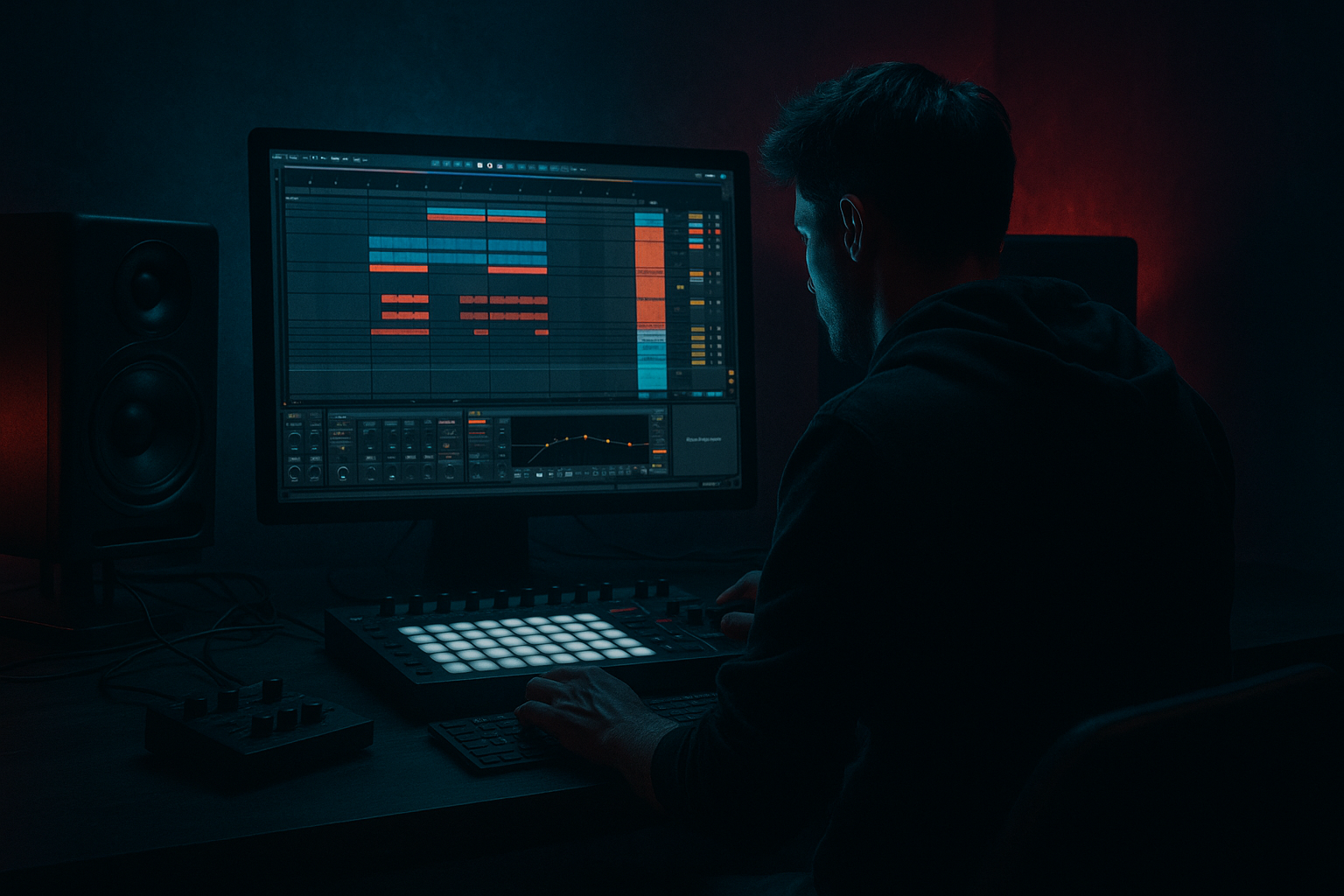
Main tutorial
Reese + Amen Variation Offset Tutorial (Ableton Live 12)
Beginner Groove Lesson — for rewind-worthy DnB drops 🔥
---
1. Lesson overview
In drum & bass, the drop hits hardest when two things feel alive at the same time:
- A rolling Reese bass that evolves and pushes forward
- An Amen-style break that never loops the exact same way twice
- Amen variation
- micro-offsets (tiny timing shifts)
- intentional bar-to-bar change (without wrecking the groove)
- A Reese bass loop that subtly changes every 2 bars
- An Amen break chopped into musical parts and offset for variation (ghosty push/pull)
- A tight drum-bass lock (kick/snare staying solid while fills and hats shift)
- A clean, workable device chain for punch + darkness
- Osc 1: Saw (or “Basic Shapes” → Saw)
- Osc 2: Saw
- Detune: 10–20 cents
- Unison: 2–4 voices (don’t overdo it)
- Type: LP24
- Cutoff: ~200–800 Hz (set to taste)
- Drive: 3–7 dB
- Envelope amount: small (just a touch)
- Attack: 0–5 ms
- Decay: 200–500 ms
- Sustain: -6 to -12 dB
- Release: 80–150 ms
- Clip length: 2 bars
- Notes: use F or G as root (DnB-friendly), add a couple of passing notes
- Rhythm idea: mostly 8ths, with a few 16th pickups
- Bar 1: “da—da-da—da—da—da”
- Bar 2: slight variation at the end (important!)
- Slicing preset: Transient
- Create one slice per transient
- In the new sliced MIDI track, create a 2-bar MIDI clip
- Draw in the typical Amen structure:
- Identify your main snare slice(s) (Amen has those iconic cracky snares)
- Make sure snare hits stay exactly on beats 2 and 4 (no offsets yet)
- Select a hit → nudge it earlier/later by 5–20 ms
- In Live, you can:
- Duplicate the Amen slices into two Drum Racks:
- Apply Track Delay to Rack B: +10 ms (or -10 ms)
- A (bars 1–2): standard pattern
- B (bars 3–4): offset hats earlier, add one extra ghost snare
- A (bars 5–6): back to standard (makes it hit again)
- C (bars 7–8): swap one snare slice + late ghost kick
- Repeat with more intensity in bars 9–16
- Sidechain: Amen track (or a Kick track if you have one)
- Attack: 1–5 ms
- Release: 80–140 ms
- Ratio: 4:1
- Threshold: set for 2–5 dB gain reduction on hits
- A couple notes late by 5–15 ms (heavier feel)
- Or a couple early (aggressive push)
- EQ Eight
- Return A Reverb (short):
- Return B Delay:
- Resample your Reese to audio and do micro-chops
- Add a parallel distortion chain on the Reese
- Amen grit without killing transients
- Create “pre-drop breath”
- Swing: use it selectively
- You built a Reese + Amen drop where variation is intentional, not random.
- You learned Variation Offset:
- You used stock tools: Wavetable, EQ Eight, Saturator, Auto Filter, Drum Buss, Glue Compressor, Utility, Compressor sidechain
- You arranged it like real DnB: repeat with evolution for maximum impact 🔁
This lesson shows you a practical, repeatable method in Ableton Live 12 to create that “wait… run that back!” energy using:
You’ll use mostly stock Ableton devices and simple arrangement tricks.
---
2. What you will build
By the end you’ll have a 16-bar drop with:
Genre vibe: rolling DnB / jungle-influenced rollers 🥁🖤
---
3. Step-by-step walkthrough
A) Project setup (the “DnB defaults”)
1. Set tempo: `172–176 BPM` (try 174)
2. Time signature: 4/4
3. Create tracks:
- MIDI Track: Reese Bass
- Audio Track: Amen Break
- Audio Track: Kick (optional layered)
- Return A: Short Room
- Return B: Delay/Space
Workflow tip: Color-code bass (dark), drums (red/orange), FX (blue). It speeds decisions up.
---
B) Build a solid Reese (simple but legit)
#### 1) Create the Reese in Wavetable (stock)
On Reese Bass MIDI track, add:
Wavetable
Filter
Amp envelope
#### 2) Add movement + weight (device chain)
After Wavetable, add:
1. Saturator
- Drive: 3–6 dB
- Soft Clip: On
2. Auto Filter
- LP12 or LP24
- Map cutoff to a slow LFO (rate: 1/2 or 1 bar, amount subtle)
3. Glue Compressor
- Attack: 10 ms
- Release: Auto
- Ratio: 2:1
- Aim for 1–2 dB reduction
4. Utility
- Bass Mono: On (if available)
- Width: 70–100% depending on how wide it got
#### 3) Write a classic rolling bass pattern
Example rhythm (feel, not exact notes):
---
C) Load and prep the Amen break (clean + sliceable)
#### 1) Import and warp correctly
1. Drop an Amen break audio file into the Amen Break track
2. In Clip View:
- Warp: On
- Warp Mode: Beats
- Preserve: Transients
- Transient Loop Mode: try Forward
- Set the loop length: 1 bar (or 2 if your amen is longer)
Important: Make sure the break is truly on-grid before slicing. Zoom in and confirm snare hits land cleanly on 2 and 4.
#### 2) Slice to a Drum Rack (fast control)
Right-click the audio clip → Slice to New MIDI Track
Now you have the Amen mapped across pads in a Drum Rack. This is where variation becomes easy.
---
D) The core technique: “Variation Offset” (what makes it rewind-worthy)
We’ll do controlled timing shifts on select Amen hits while keeping the backbeat steady.
#### 1) Create a 2-bar Amen MIDI clip
- Keep the main kick/snare anchors consistent
- Use extra ghost hits/hats as “spice”
If you don’t know where to start: drag your original sliced MIDI (created by slicing) into a clip and clean it up.
#### 2) Lock the important hits (kick + snare)
In MIDI editor:
This keeps the groove readable and heavy.
#### 3) Offset the supporting hits (the secret sauce)
Now pick 3–6 non-essential hits per 2 bars (ghost snares, hats, little kicks).
Apply micro-timing offsets:
- Turn off grid (or use very small grid)
- Nudge note start times slightly
- Or use the Delay control per Drum Rack pad (great for consistency)
Recommended beginner method (clean + repeatable): Drum Rack pad Delay
1. Open Drum Rack → click the chain for a slice
2. Use the pad’s Delay (if visible) or add Track Delay alternatives:
- Ghost hats: -5 to -12 ms (push ahead = urgency)
- Ghost snares: +8 to +18 ms (lay back = swagger)
- Extra kicks: +0 to +10 ms (don’t rush the low end)
If you can’t find per-pad delay easily, do this:
- Rack A: “On-grid”
- Rack B: “Ghost/Offset”
Then only put ghost notes in Rack B. Super simple.
#### 4) Add “offset variation” every 2 bars
Create 4 variations across 16 bars:
Arrangement tip: Variation is most effective when it returns to something familiar. Don’t constantly change everything.
---
E) Make the Reese respond to the Amen (call-and-response groove)
This is where it becomes musical instead of “two loops stacked.”
#### 1) Sidechain the Reese to the kick (or the whole drum bus)
On the Reese track add Compressor
This creates space and makes the drop bounce 🏎️
#### 2) Create micro “Reese offsets” via note starts
Take 2–3 bass notes per 2 bars and nudge:
Rule: If the Amen is getting pushed earlier, consider laying the Reese slightly back—or vice versa. That tension feels expensive.
---
F) Glue it together (basic mix moves for impact)
#### 1) Drum bus processing (stock)
Group drums (Amen + kick layer) → Drum Bus Group
Add:
1. EQ Eight
- Cut rumble: High-pass at 20–30 Hz
- If harsh: small dip around 3–6 kHz
2. Drum Buss
- Drive: 5–15%
- Crunch: light
- Boom: 0–20% (don’t overdo; it can smear)
3. Glue Compressor
- 1–3 dB reduction
#### 2) Bass cleaning
On Reese track:
- Low cut? Only if needed (Reese usually is the low)
- Check 200–400 Hz for mud and tame gently if needed
#### 3) Atmos + space (returns)
- Decay: 0.4–0.9s, low cut 200–400 Hz
- Ping Pong or Simple Delay
- Filter it dark (high cut ~ 3–6 kHz)
Send only a few Amen ghost hits to the delay/reverb. Keeps the groove clean but cinematic.
---
4. Common mistakes
1. Offsetting the main snare
If the 2 and 4 move around, beginners lose the drop’s punch.
2. Too much timing shift
More than ~20 ms on key hits starts to feel sloppy instead of funky.
3. Random variation with no reset
If everything changes every bar, the listener can’t latch onto the groove.
4. Reese too wide in the sub
Wide low end = weak drop. Keep low frequencies mono (Utility helps).
5. Over-warped Amen
If Warp markers are messy, you’ll get flams and weird transients.
---
5. Pro tips for darker/heavier DnB 🖤
Slice a 2-bar Reese phrase, reverse tiny bits, or re-trigger one growly moment before snare hits.
Duplicate track → high-pass at 150–250 Hz → Saturator / Roar → blend quietly.
(Ableton Roar is perfect here.)
Use Saturator lightly + Drum Buss crunch, then tame harshness with EQ Eight instead of smashing with a limiter.
In bar 16 (before drop), cut the Amen for half a beat and leave a reverb tail. Then drop hits harder.
Global groove swing can be nice, but for this technique, use micro-offsets first so you stay in control.
---
6. Mini practice exercise (15 minutes)
1. Make a 1-bar Amen loop sliced to Drum Rack.
2. Create two 2-bar MIDI clips:
- Clip A: on-grid, clean
- Clip B: same pattern but:
- 3 hats -10 ms
- 2 ghost snares +12 ms
- 1 kick ghost +6 ms
3. Arrange: A A B A (8 bars)
4. Add Reese sidechain and automate Auto Filter cutoff slightly up in the B section.
Export an 8-bar audio and listen on headphones: does B feel more “alive” without losing the backbeat?
---
7. Recap
- Keep main snare locked
- Offset ghost elements by 5–20 ms
- Rotate patterns every 2 bars for replay value
If you want, tell me what style you’re aiming for (rollers, jump-up, techy, jungle), and I’ll suggest a specific 16-bar drop arrangement map and a Reese patch tailored to that vibe.

