Main tutorial
Lesson Overview
A rewind moment in jungle / oldskool DnB is one of the most important tension-release tools you can use. It’s that instant where the track stops feeling like a straight run and starts feeling like a DJ moment: bass drops out, drums stutter, space opens up, and then the full re-entry hits harder because the listener just lost their footing for a second. In an advanced mix, the challenge is not just making the rewind feel exciting — it’s making it balanced so the reese, sub, drums, and FX all clear each other without wrecking the groove.
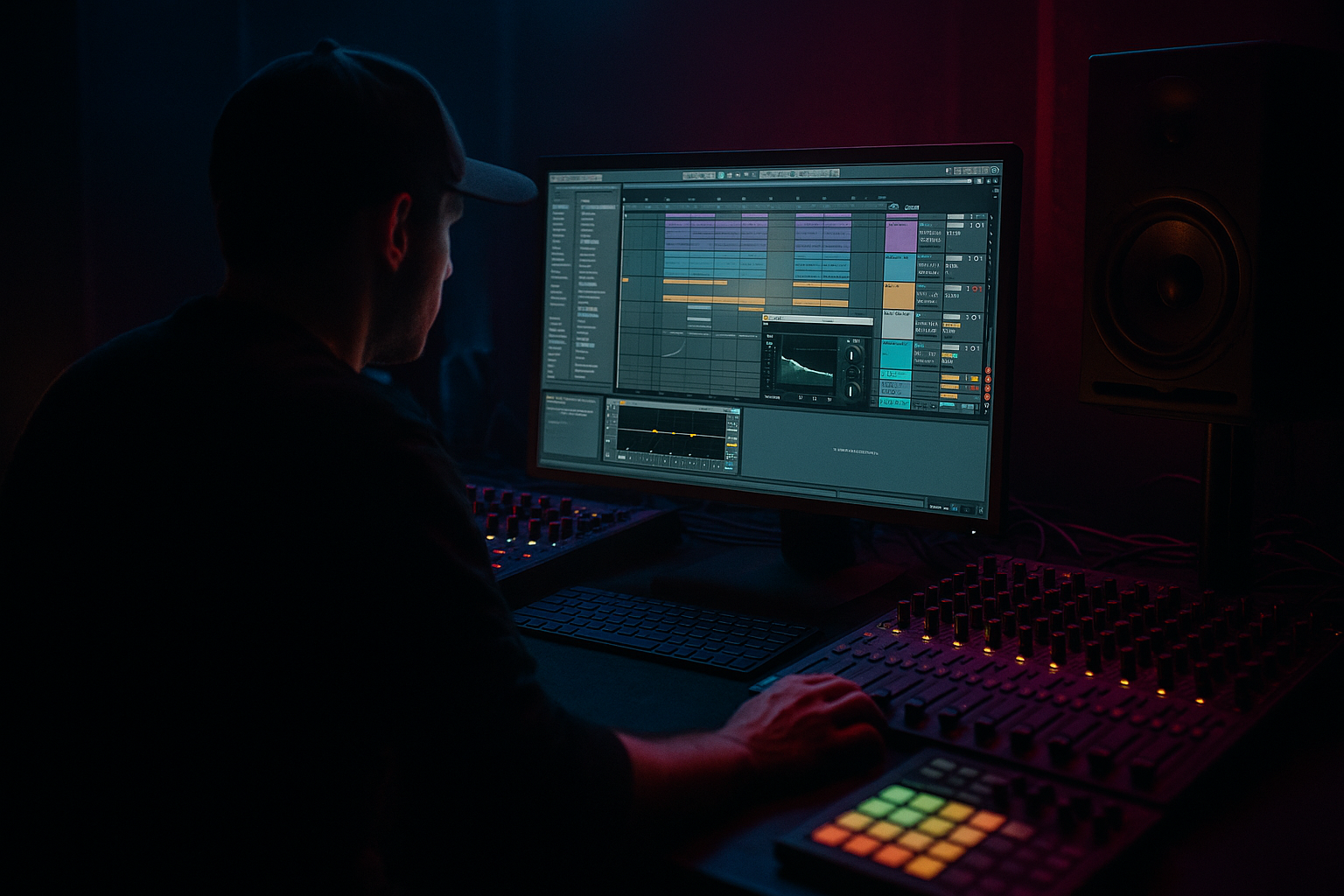
In Ableton Live 12, this means designing the rewind as a mixing event, not just an arrangement trick. You’re shaping energy with automation, gain staging, stereo management, and transient control so the breakdown has contrast, but still feels like it belongs to a proper DnB system. This is especially important in jungle and oldskool-inspired tunes, where the rewind is often paired with chopped breaks, dubwise delay tails, and a reese that returns with menace.
Why this matters: in DnB, the drop only lands if the breakdown creates real negative space. If the bass stays too wide, the drums are too busy, or the FX smear the low mids, the rewind loses impact. Done right, the listener should feel the track inhale, glance backward, and then launch forward again.
What You Will Build
You’ll build a rewind-safe breakdown section for a jungle / oldskool DnB track where:
- a reese bass narrows and drops out in a controlled way
- sub weight is implied rather than continuously full
- break edits and ghost notes keep motion alive during the gap
- a tape-stop / reverse-feel transition leads into the rewind point
- the re-entry hits with tighter mono low end, clearer transient drums, and a stronger sense of “back in the tune”
- the mix stays clean enough for club playback while still feeling murky, rude, and nostalgic 😈
- Making the rewind too empty
- Letting the reese stay too wide in the breakdown
- Overusing reverb on the bass or drums
- Dropping the bass without adjusting the drums
- Using a huge FX riser that sounds more trance than DnB
- Forgetting mono compatibility
- Print the bass movement to audio if the modulation feels too neat. Resampling a reese tail into a new clip can make the rewind feel more human and more oldskool.
- Use slight pitch instability on a rewind FX hit with Clip Transpose or by resampling the source. Tiny bends can add grime without turning into a gimmick.
- Try saturation in stages: a mild Saturator on the bass bus, then a touch of Drum Buss or Glue Compressor on the drum group. Stacking subtle color often works better than one heavy device.
- Let the sub disappear before the reese body does. That order often sounds more powerful in darker DnB because the ear perceives the low-end absence first.
- Use call-and-response in the breakdown. A chopped break answer can follow a filtered reese phrase, which makes the rewind feel like a conversation rather than a stop-start edit.
- Automate atmosphere instead of adding more notes. A filtered noise bed, vinyl-style texture, or distant amen tail can make the rewind feel deeper without cluttering the center.
- For neuro-leaning darkness, keep the reese movement tight in the mids and let the sub stay plain. The rewind can then act as a brief “reset” before the bass returns with more bite.
- For jungle authenticity, preserve the break’s swing. Even if you mute the bass, the rhythmic feel should keep breathing. Quantize only as hard as necessary.
- Collapse and re-balance the reese before the rewind
- Keep the break alive with ghost motion and smart edits
- Use returns for dubby space, but high-pass aggressively
- Re-enter with mono-safe low end and sharper transient focus
- Always check the rewind in mono and in context
This is not about making a massive cinematic breakdown. It’s about creating a DJ-friendly rewind moment that still preserves drive, pressure, and underground character.
Step-by-Step Walkthrough
1. Set up the rewind as a dedicated mix section, not a random edit
In Arrangement View, carve out a 4, 8, or 16-bar section where the rewind will happen. For oldskool jungle, 4 bars is often enough if the track is already high-energy; for deeper rollers, 8 bars gives more breathing room.
Create a locator for:
- pre-rewind pressure
- the rewind hit
- post-rewind re-entry
Keep your project organized with separate groups for:
- DRUMS
- BASS
- FX
- ATMOS
On the master, keep headroom conservative; aim for the mix to peak around -6 dBFS before mastering. The rewind section will often feel louder emotionally, so you need actual space for the transition to breathe.
Why this works in DnB: rewinds are all about perceived impact. If the track is already pinned at the ceiling, the listener won’t feel the drop in density when the bass pulls back.
2. Design the reese to “unhook” from the groove before the rewind
Use your main reese as the star of the moment, but make it behave differently in the 1–2 bars before the rewind. In Ableton Live 12, automate the reese’s movement with stock devices such as:
- Auto Filter
- Saturator
- Utility
- Echo or Delay
- Corpus for subtle metallic resonance if needed
Practical setup:
- Put Utility first and automate Width from about 100% down to 0–30% over the last bar before the rewind
- Use Auto Filter to close the top end slightly; try a low-pass movement from around 8–12 kHz down to 3–6 kHz depending on how bright the bass is
- Add a touch of Saturator before the filter with Drive around 2–5 dB for harmonic density, then automate the Dry/Wet or drive down slightly during the actual drop-out so the bass feels like it is stepping back
- If the reese is mid-heavy, notch a little around 250–500 Hz with EQ Eight so the breakdown doesn’t cloud the kick/snare area
For the actual rewind moment, don’t leave the bass totally dead unless the track style demands it. Instead, let a short tail or filtered swell remain for one beat or one half-bar. That tiny residue helps the listener feel the “pull” without filling the gap too much.
Suggested automation ranges:
- Utility Width: 100% → 20%
- Auto Filter cutoff: 12 kHz → 4 kHz
- Bass track volume: 0 dB → -inf over 1 bar, or a stepped dip to -8 to -12 dB if you want some shadow still present
3. Build the rewind hit using break edits and a controlled silence
The rewind usually feels best when the drums do something slightly wrong on purpose. In oldskool jungle, that means chopped break fragments, reverse-feel hits, or a sudden edit that sounds like the record physically got pulled back.
In the DRUMS group:
- Slice your break to MIDI with Slice to New MIDI Track
- Keep the main snare or rim accent on the rewind bar, but thin out the kick density for a beat
- Add a short ghost snare or late break tick before the silence
- Use Gate or Drum Buss to make the drum tail snap shut
A strong technique is to create a 1-beat pre-rewind fill:
- 3/4 bar of break groove
- final beat with snare flam or chopped hat roll
- then a 1/4 bar gap or near-gap where only a tiny FX tail remains
Use Reverse on a small percussion hit or a reverb return printed to audio, then line it up so the reverse swell points directly at the rewind. You can also use Simpler in One-Shot mode to trigger a reverse crash or vocal stab if the tune calls for it.
Musical context example: imagine an 8-bar breakdown after a first drop where the last bar strips to only break fragments, a filtered reese tail, and a delayed snare echo. The rewind happens on the “one” with a short stop, then the groove returns with the original break pattern, but slightly more aggressive.
4. Shape the bass/drum balance during the breakdown, not just at the drop
The real trick is that the rewind moment should be mixed like a mini section change. Your bass shouldn’t simply vanish; it should re-balance. If drums continue at full energy while bass drops out completely, the breakdown can feel empty rather than dramatic. If bass stays too present, the rewind won’t read.
Use track automation and group processing:
- On the BASS group, keep a Utility with a gain trim so you can duck the entire bass section by 2–6 dB in the final bar
- On the DRUMS group, use Drum Buss with Drive at 5–15% and Boom low or off, depending on whether you want the break to feel punchy or lean
- Use EQ Eight on the drum bus to carve low end if the kick and break are fighting the sub space
For jungle oldskool vibes, the balance often wants:
- more midrange bite from breaks
- less sustained low bass during the rewind
- enough ghost groove to keep dancers locked in
Good reference point:
- Bass group before rewind: full-range reese + sub
- Bass group during rewind: reese collapsed to mono, filtered, and reduced
- Drums during rewind: transient-forward, lightly saturated, but not overly compressed
If your kick is sample-based, layer it with a snappy transient from a break slice rather than boosting EQ too much. In DnB, the kick often needs to feel like it’s part of the break machinery, not a separate EDM-style thump.
5. Use return tracks for dubwise space, but keep the low end clean
Rewinds often sound expensive when the space around them is handled like a dub system. Set up return tracks in Ableton Live 12 such as:
- Return A: Short Room/Plate
- Return B: Ping-Pong or Echo
- Return C: Long Filtered Reverb
- optional Return D: Dirt / Lo-Fi texture
On the reverb return:
- High-pass the return with EQ Eight at around 200–400 Hz
- Roll off some top if it gets fizzy, often around 8–12 kHz
- Keep decay short enough that it doesn’t blur the rewind, usually 0.6–1.8 s for short rooms, 2–4 s for larger atmosphere if filtered aggressively
On the delay return:
- Use Echo with Sync on
- Try 1/8 Dotted or 1/4 for dub-style throwbacks
- Filter the repeats so they live in the mids, not the sub
- Add Ping Pong only if the bass itself is centered; otherwise, the stereo movement can feel messy
A smart move is to automate send levels on the last snare or vocal stab before the rewind:
- Increase reverb send for one hit
- Cut the send to near zero on the rewind beat
- Let the return tails continue while the dry signal disappears
This creates the sensation of space opening up without sacrificing mix control.
6. Automate the rewind moment as a contrast event
In advanced DnB mixing, the rewind is strongest when several things change at once, but not all in the same way. The listener should feel a shift in density, width, tone, and rhythmic certainty.
Automation targets:
- Utility Width on the bass collapses before the rewind
- Auto Filter on the bass or drum bus closes slightly, then snaps open after
- Volume automation on the bass group drops hard right before the cue
- Echo freeze-style tail on a snare or percussion hit, if used subtly
- Master or group gain trim for a tiny pre-drop dip, not a visible limiter-style wall
A useful trick is to automate the drum bus by a very small amount, usually -0.5 to -1.5 dB, in the last half-bar before the rewind, then restore instantly. That tiny move can make the return feel stronger without obvious pumping.
If you want a tape-stop feel without overdoing it, combine:
- a quick pitch fall on a printed FX hit or sampled break fragment
- a hard cut to near silence
- the original groove returning on the next downbeat
Keep it tasteful. The rewind is more believable when it sounds like a system transition, not a cartoon effect.
7. Re-enter with a fuller but still disciplined low end
The post-rewind drop should not just be louder. It should be better organized. Bring the bass back in layers:
- sub first or sub with the root note
- then reese body
- then any top-layer grit or modulation
In Ableton, use EQ Eight and Utility to re-establish mono discipline:
- Keep everything below roughly 120 Hz centered
- Make sure the reese width comes back gradually, not instantly at full stereo
- If using a layered bass rack, automate the top layer’s send or track volume back in over 1/2 to 2 bars
For the drums, make the re-entry hit through:
- a cleaner transient on the snare
- a stronger break accent
- maybe a short Drum Buss transient push or Drive bump on the first bar only
This is where the balance matters most: the listener must feel that the rewind was a setup for a more satisfying return, not a break in momentum.
8. Check the mix in mono and on a small system mindset
This is the advanced part many people skip. During the rewind and the return, do a mono check with Utility on the master or a monitor chain:
- toggle Mono on to test low-end solidity
- verify the reese doesn’t disappear when width collapses
- make sure the drum break still has a clear snare identity
In the rewind section, a slightly narrowed bass often translates better because the arrangement is already creating space. But when the drop returns, you need the bass to remain strong even if stereo width is reduced.
Listen for:
- low-mid buildup around 180–400 Hz
- harshness in the reese around 2–5 kHz
- snare crack competing with bright bass harmonics
If the break and bass collide, use surgical cuts, not broad over-compression. In DnB, compression can flatten the urgency that makes rewinds effective.
Common Mistakes
- Fix: leave one rhythmic or tonal thread alive, like a ghost break slice, filtered tail, or short delay throw.
- Fix: automate Utility Width down before the rewind and bring it back gradually after the drop.
- Fix: high-pass return tracks and keep tails shorter than you think; jungle space should feel deep, not smeared.
- Fix: rebalance the break, snare, and ghost notes so the groove still feels intentional.
- Fix: keep transition FX gritty, short, and system-like; think tape, dub echo, reverse hit, or chopped break motion.
- Fix: check the rewind and re-entry with mono engaged; sub and snare must survive.
Pro Tips for Darker / Heavier DnB
Mini Practice Exercise
Spend 15 minutes building a rewind moment in an 8-bar loop:
1. Take an existing DnB loop with drums, reese, and sub.
2. Choose bars 7–8 as the rewind zone.
3. Automate the bass group:
- Utility Width from 100% to 25%
- Volume down 3–8 dB in the final bar
- Auto Filter cutoff down to around 4–6 kHz
4. Chop the drum break so the last beat before the rewind has a tiny fill or ghost hit.
5. Add one short delay throw on a snare using Echo on a return track.
6. Insert a brief silence or near-silence on the rewind beat.
7. Bring the bass and drums back on bar 1 with a stronger snare and slightly cleaner sub.
8. Check the whole loop in mono and fix any low-end blur.
Goal: make the rewind feel intentional, not just edited. If it sounds like a DJ moment, you’re on the right track.
Recap
The core idea is simple: a rewind moment works when the bass narrows, the drums stay expressive, and the space is controlled. In Ableton Live 12, use automation, stock devices, and disciplined routing to make the breakdown feel like a real mix event.
Most important takeaways:
If the listener feels the track inhale, stop, and surge back harder, you’ve nailed the balance.

