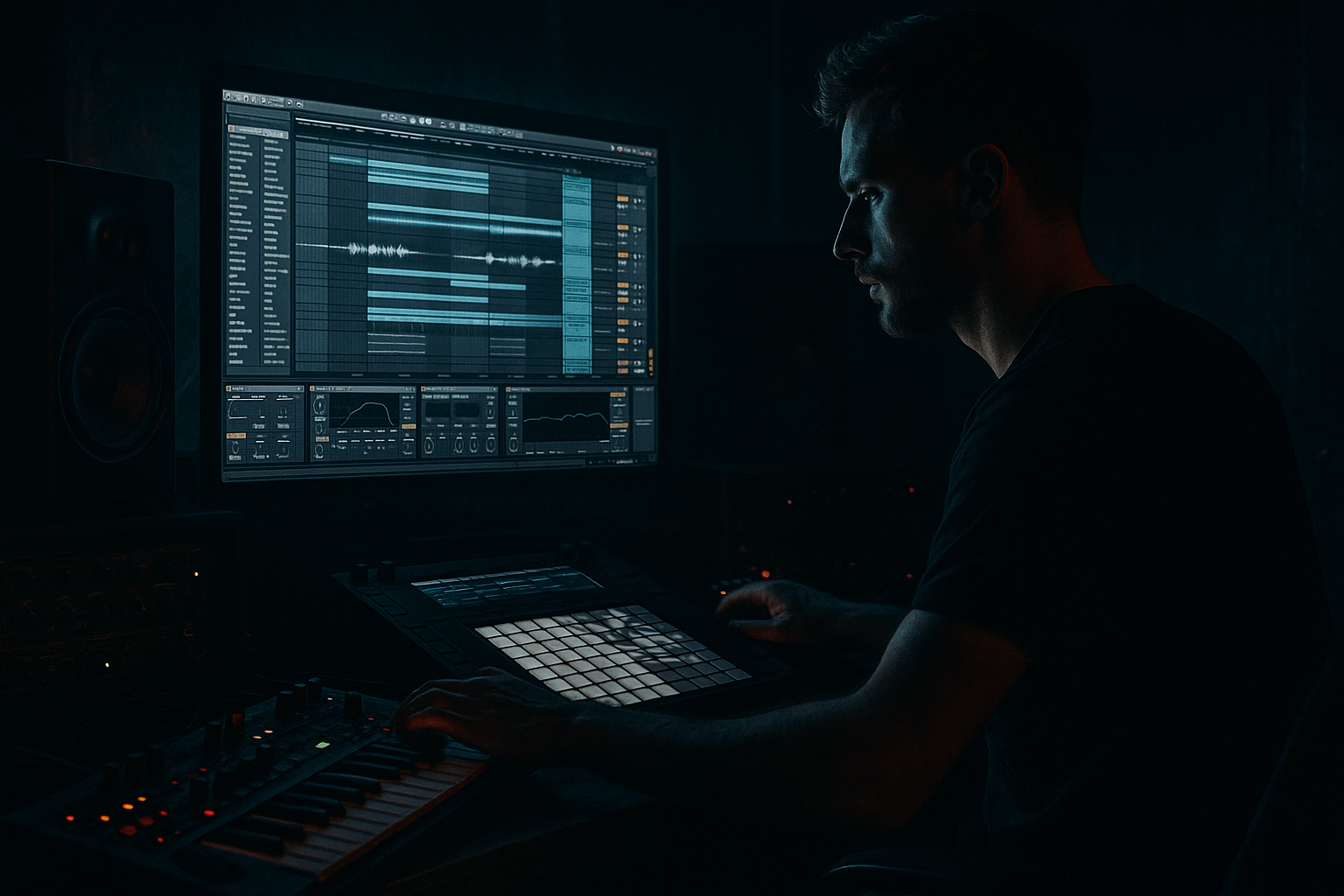
Main tutorial
Reese Patch Polish Framework (Modern Punch + Vintage Soul)
Ableton Live 12 • Advanced • Breakbeats • Jungle/Oldskool DnB vibes 🔥
---
1. Lesson overview
This lesson is a repeatable framework for taking a raw Reese bass patch and polishing it into something that hits like modern DnB (tight, controlled, punchy) while still carrying vintage jungle soul (movement, grit, tape-ish weight, a little chaos). 🧬
You’ll build a Reese that:
- Sits under chopped breaks without masking snares/ghosts
- Feels wide and alive in the mids but mono-solid in the sub
- Has controllable movement (LFO wobble + filter drift + pitch micro-instability)
- Translates on club systems and keeps that oldskool “rubbery” character
- A macro-controlled polish chain (Drive, Movement, Width, Bite, Sub Tightness)
- A sidechain system tuned for breakbeats (not generic 4x4 pumping)
- Arrangement-ready automation lanes for classic jungle phrasing (16/32 bar evolution)
- Add Operator
- Add Auto Filter
- Add Utility
- Add Wavetable (or Analog if you want more oldskool feel; Wavetable is more controllable)
- Add Auto Filter
- Add Chorus-Ensemble
- Add Wavetable (or duplicate BODY chain and modify)
- Add Saturator
- Add Amp
- Add EQ Eight
- SUB chain EQ:
- BODY chain EQ:
- GRIT chain EQ:
- Utility
- Map filter Freq to a rack Macro called MOVEMENT
- Add LFO modulation:
- Add a touch of Envelope (if using Wavetable filter env): short decay for note punch.
- Add very slight Pitch LFO:
- Downsample: 2–6
- Bit reduction: 0–2 (tiny)
- Mix: 10–25% (don’t obliterate)
- Low band: duck more (sub clears for kick)
- Mid band: duck lightly (keep Reese present)
- Drum Buss on the resampled Reese (yes, on bass)
- Bars 1–4: Reese stable, low movement, narrow-ish stereo
- Bars 5–8: Increase MOVEMENT macro + slight extra drive
- Bars 9–12: Add a “call-and-response” by automating filter cutoff down on bar endings
- Bars 13–16: Quick dropouts + one bar with heavier grit (fill into next phrase)
- MOVEMENT (filter cutoff/LFO amount)
- GRIT level (chain volume macro)
- WIDTH (only mids/highs)
- Drive (Roar/Saturator mix)
- Widening the sub: massive in headphones, gone in clubs. Keep <120 Hz mono.
- Too much detune/unison: the Reese loses punch and becomes “blurry.”
- Over-distorting full-range: distortion should be band-managed (sub protected).
- Ignoring breakbeat masking: the snare lives around 180–250 Hz (body) + 2–5 kHz (crack). Don’t park your Reese there constantly.
- Sidechain that pumps like house: jungle needs groove—duck to the break’s accents, not a steady 1/4 throb.
- No headroom: Reese layers + distortion stack fast. Gain stage early.
- Negative harmony trick (tone shift): try pitching the BODY chain down -12 and raising filter cutoff—sometimes darker without becoming subby.
- Parallel “metal” layer: duplicate GRIT chain, use Roar with harsher mode, then band-limit 1–4 kHz and keep it very low in the mix. Adds menace. 😤
- Movement tied to break swing: modulate filter/LFO rate so changes land on 2-bar or 4-bar boundaries—feels intentional, not random.
- Mid/side discipline:
- Clip-to-tape illusion: gentle Saturator (Soft Clip) into Glue Compressor at low GR can mimic “printed” bass.
- Build a Reese like a mix engineer: SUB (mono clean) + BODY (movement) + GRIT (translation + aggression).
- Use crossovers + Utility Bass Mono to keep it club-safe.
- Add “vintage soul” via slow drift, subtle degradation (Redux), and resampling commitment.
- Polish with Roar / Glue / Saturator in controlled amounts and break-aware sidechain.
- Arrange with automation arcs every 8–16 bars for proper jungle progression. 🥁⚡
All using Ableton stock devices (plus Live 12’s modern workflow features).
---
2. What you will build
A 3-layer Reese rack:
1. SUB (mono sine/triangle core, clean and consistent)
2. BODY (the “Reese” saw detune + phasing movement)
3. GRIT/AIR (distorted/filtered harmonics that read on small speakers)
Plus:
---
3. Step-by-step walkthrough
A) Session + routing setup (DnB-first workflow)
1. Tempo: 165–174 BPM (try 170 for classic jungle pace).
2. Create groups:
- DRUMS (Breaks)
- BASS (Reese Rack)
- MUSIC
- FX/Atmos
3. On the Master, insert:
- Limiter (Ceiling -0.3 dB, lookahead 1 ms) as safety only.
- Keep it quiet—don’t mix into a slammed limiter.
> Goal: Build the bass to sit with breaks before heavy master processing.
---
B) Build the Reese core (Instrument Rack = control center)
Create a MIDI track: “Reese Rack” → drop an Instrument Rack. Inside, make 3 chains:
#### Chain 1: SUB (mono + stable)
- Osc A: Sine (or Triangle if you want a touch more harmonics)
- Level: -6 to -12 dB (leave headroom)
- Pitch: 0 semitones
- Type: LP24
- Freq: 120 Hz
- Drive: 0–3 dB (subtle)
- Bass Mono: ON (Live 12 Utility has Bass Mono; set Freq ~120 Hz)
- Width: 0% (full mono for sub chain)
✅ This layer should be boring. That’s the point.
---
#### Chain 2: BODY (the Reese)
- Osc 1: Basic Shapes → Saw
- Osc 2: Basic Shapes → Saw
- Detune: start 10–25 cents
- Unison: 2–4 voices, Amount low, keep it focused
- Type: LP12 (more “musical” than LP24 for Reese)
- Freq: 200–800 Hz (we’ll modulate)
- Res: 10–20%
- Mode: Chorus
- Rate: 0.15–0.35 Hz
- Amount: 15–30%
- Width: 120–160%
- Mix: 15–35%
Movement tip: Reese magic is slow phase + detune, not just distortion.
---
#### Chain 3: GRIT/AIR (speaker translation + aggression)
- Same oscillators, but:
- Filter higher (start 500–2kHz region)
- Mode: Analog Clip
- Drive: 3–10 dB
- Soft Clip: ON
- Type: Bass or Rock
- Gain: taste (start low)
- HP: 150–250 Hz (remove low mud)
- Gentle peak around 1–3 kHz if you need “growl read”
This chain is where you get the “modern” edge while keeping the sub clean.
---
C) Crossovers + phase-safe layering (make it club-ready)
Inside the rack, add EQ Eight on each chain and enforce roles:
- Low-pass around 90–120 Hz
- No stereo widening here
- High-pass 90–120 Hz
- Low-pass 2–5 kHz (depending on how bright your grit layer is)
- High-pass 150–250 Hz
- Let it own 700 Hz–4 kHz (careful with harshness)
Then on the rack output, add:
- Width: 80–120% (overall)
- Bass Mono ON ~120 Hz (extra safety)
🎯 This prevents the classic Reese problem: “Huge in headphones, weak in mono.”
---
D) Add “vintage soul” movement (controlled chaos)
Now we add subtle instability like old samplers/tape without wrecking pitch.
#### 1) Filter motion (classic jungle pulse)
On BODY chain Auto Filter:
- If using Live’s modulation (or Max for Live LFO if available):
- Rate: 1/2 or 1 bar
- Amount: small (aim for ~50–200 Hz swing, not huge sweeps)
#### 2) Micro pitch drift (subtle!)
On BODY Wavetable:
- Rate: 0.05–0.2 Hz
- Amount: 2–6 cents
This gives that alive, “older hardware” feel. Keep it subtle—too much = seasick bass.
#### 3) “Sampled” vibe (without resampling… yet)
Add Redux on GRIT chain:
Oldskool character comes from a hint of degradation, not full crunchy destruction.
---
E) Polish chain: punch, weight, and control (DnB mix reality)
After the Instrument Rack (on the same track), insert this chain:
1. EQ Eight (cleanup + focus)
- HP at 25–35 Hz (24 dB slope) to remove rumble
- Small dip if needed:
- 200–350 Hz (mud zone)
- 500–800 Hz (boxy honk)
- Small boost (optional) 80–100 Hz on BODY (not sub) if it lacks weight.
2. Roar (modern punch + tone shaping) 😈
Use it like a controlled distortion bus:
- Start with a single band or 2 bands:
- Low band: minimal drive (keep clean)
- Mid band: more drive for growl
- Drive: 5–15% to start (depends on mode)
- Tone/Filter: keep lows protected
- Mix: 30–60%
If Roar gets too savage, back off and let the GRIT chain do the talking.
3. Glue Compressor (tighten dynamics, don’t squash)
- Attack: 10 ms (lets transient through)
- Release: Auto or 0.2–0.4 s
- Ratio: 2:1
- Gain reduction: 1–3 dB max
- Soft Clip: OFF (use Saturator/limiter for clipping instead)
4. Saturator (final “knit + density”)
- Mode: Soft Sine or Analog Clip
- Drive: 1–4 dB
- Soft Clip: ON
- Output: trim to match level
5. Limiter (optional on bass bus only)
- Use only if you need safety for resampling, not for loudness.
- Aim for < 2 dB GR.
---
F) Sidechain that respects breakbeats (not 4-on-the-floor)
You want the bass to breathe around kick + snare and let ghost notes speak.
Option 1: Classic sidechain from a “drum key” track
1. Create a MIDI track called “SC Key”
2. Load Drum Rack with a clicky short sample (or Ableton’s test click)
3. Program a pattern matching your break emphasis:
- Strong hits on kick spots and snare spots
- Optional lighter hits where the break has loud ghost clusters
4. On the Reese track, add Compressor
- Sidechain: SC Key
- Attack: 1–3 ms
- Release: 60–140 ms (tune to tempo)
- Ratio: 4:1
- GR: 2–6 dB depending on how dense the break is
Option 2: Multiband sidechain (better: ducks only low end)
Use Multiband Dynamics:
This keeps your Reese audible while preventing low-end collisions.
---
G) Resampling for that oldskool “committed” sound (but with modern control) 🎛️
This is where polish becomes record-like.
1. Freeze + Flatten the Reese track (or record resample into audio).
2. In the audio clip:
- Try Complex Pro OFF (use Beats warp mode if you want gritty time artifacts)
- Or keep it unwarped if it’s steady notes.
3. Add Clip gain automation for note-to-note consistency (micro-mixing like hardware days).
Then do a second-stage texture pass:
- Drive: 2–6
- Crunch: 0–10 (tiny)
- Boom: OFF (usually) unless you’re very careful
- Transients: +5 to +15 (adds punch in upper bass)
---
H) Arrangement ideas (jungle phrasing + rolling evolution)
A Reese that doesn’t evolve gets boring fast in jungle/DnB.
16-bar framework example:
Automations to prioritize:
Keep sub consistent; evolve the mids.
---
4. Common mistakes
---
5. Pro tips for darker/heavier DnB
- Add EQ Eight in M/S mode after the rack
- High-pass the Side around 200–400 Hz (tightens stereo without collapsing vibe)
---
6. Mini practice exercise (15–25 minutes)
1. Build the 3-chain Reese Rack (SUB/BODY/GRIT).
2. Create two 8-bar loops:
- Loop A: classic Amen chop pattern
- Loop B: Think break variation (or another tight oldskool break)
3. Set sidechain using an SC Key pattern that matches your break accents.
4. Automate over 16 bars:
- MOVEMENT macro from 20% → 55%
- GRIT chain volume up by ~2 dB in bars 9–16
- WIDTH from 85% → 115% (but keep Bass Mono on)
5. Resample the bass to audio and do one more pass with Drum Buss (light).
Deliverable: a 16-bar phrase where the Reese evolves and the breaks stay crisp.
---
7. Recap
If you want, tell me which synth you prefer for the Reese core (Wavetable vs Analog vs Operator-only), and what break you’re using (Amen/Think/Hot Pants), and I’ll tailor exact macro mappings + a rack layout for your specific vibe.

