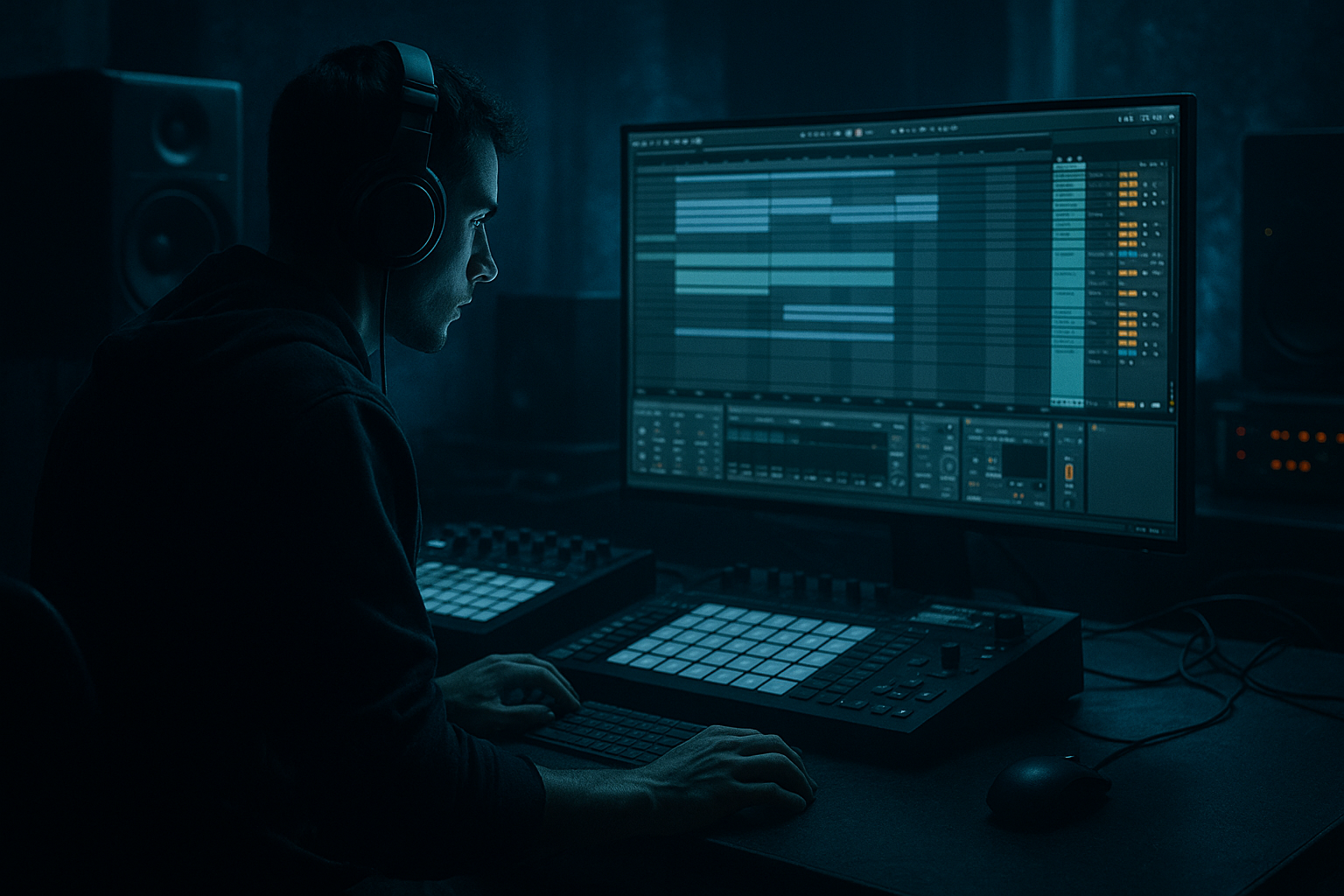
Main tutorial
```markdown
Reese Patch Push Guide for Deep Jungle Atmosphere (Ableton Live 12) 🎛️🌫️
Skill level: Beginner
Category: Mixing (with sound-design steps that directly support the mix)
---
1. Lesson overview
In jungle and rolling drum & bass, a Reese bass isn’t just a bassline—it’s a moving wall of low-mid energy that pushes the track forward. In this lesson you’ll build a classic Reese patch using Ableton stock devices, then learn how to push it in the mix so it feels deep, wide, and atmospheric without killing your kick + sub.
We’ll focus on:
- Building a Reese that has motion + grit
- Splitting it into sub / mid layers for clean mixing
- Using Live 12 stock devices to create width and foggy jungle vibe
- “Push” techniques: saturation, compression, and controlled reverb/space
- Add a new MIDI track → load Wavetable.
- Osc 1: Saw (Basic Shapes → Saw or a saw-ish wavetable)
- Osc 2: Saw
- Detune:
- Level balance:
- Enable Unison in Wavetable:
- Filter: LP24 (24 dB low-pass)
- Cutoff: start around 200–600 Hz (you’ll automate later)
- Drive: 2–6 dB (adds edge)
- Add an LFO to the filter cutoff:
- Optional: LFO a tiny amount of Osc 2 detune for organic drift.
- In Wavetable, reduce brightness:
- Add EQ Eight:
- Add Utility:
- Add EQ Eight:
- Keep Unison on (this is where width lives)
- This layer will get the “push” processing.
- High-pass: already done (120–180 Hz)
- If boxy: small dip around 250–450 Hz (-2 to -4 dB, Q ~1.2)
- If harsh: tiny dip around 2–4 kHz
- Mode: Soft Clip ON
- Drive: start 3–6 dB
- Output: reduce to match level (don’t just get louder)
- Attack: 3 ms (lets transient movement through)
- Release: Auto or 0.3 s
- Ratio: 2:1
- Aim for 1–3 dB gain reduction on peaks
- Make-up: match perceived loudness
- Use Warm or Noise style lightly
- Drive low to moderate (don’t nuke it)
- Focus on low-mids by placing Roar after EQ and before final filtering
- If it gets fizzy, tame with EQ after.
- Filter type: LP12 or LP24
- Envelope OFF, use LFO:
- This creates that rolling “wah” energy behind breaks.
- Width: 80–120% (don’t go crazy)
- If phase feels weird, reduce width.
- High-pass 250–400 Hz (24 dB)
- Optional low-pass 6–10 kHz to keep it dark.
- Algorithm: try Hall or Plate
- Decay: 2–4 s
- Pre-delay: 10–25 ms
- Mix: since it’s a send, keep device 100% wet.
- Time: 1/8 or 1/4
- Feedback: 10–25%
- Filter: dark (low-pass around 3–6 kHz)
- Sidechain: Kick
- Ratio: 2:1 to 4:1
- Attack: 5–15 ms
- Release: 60–120 ms
- Aim for 1–4 dB gain reduction
- Similar settings, but allow a bit more movement (2–6 dB) if you want that rolling bounce.
- SUB only (simple notes) + filtered break
- Automate MID filter cutoff slowly rising
- Bring in MID layer quietly + small Atmos send
- Add note variation (call/response)
- MID louder, more saturation
- Slightly open filter LFO amount
- Add occasional pitch bends (small: ±1–2 semitones for “growl” moments)
- Pull back Atmos send
- Close filter a touch for tension
- Use a short fill (1 bar) where Reese drops out for drum impact
- MID filter cutoff
- Atmos send amount
- Saturator Drive (tiny moves: 1–2 dB)
- Utility Width (narrow in breakdown, wider in drop)
- Add subtle pitch instability: In Wavetable, modulate fine pitch by a tiny amount with a slow LFO for a “tape-worn” jungle feel.
- Midrange “presence band”: Try a gentle boost around 700 Hz–1.2 kHz on the MID layer only if it disappears behind breaks.
- Parallel crush (mid only): Create an Audio Effect Rack with a dry chain + a heavily saturated chain (Saturator Drive 10+ dB, then low-pass). Blend quietly for weight.
- Make it speak rhythmically: Instead of constant notes, use short 1/8 or 1/16 gaps so the break transients pop through.
- Darkness = less top end, not less energy: Low-pass the MID slightly (e.g. 7–10 kHz) so it feels deeper while staying loud.
- A jungle Reese is movement + density, not just “a bass sound.”
- Split into SUB (mono, clean) and MID (wide, gritty) for mix control.
- Use Saturator + Glue Compressor to push the Reese forward without wrecking headroom.
- Keep atmosphere on a send with heavy high-pass filtering to avoid low-end wash.
- Automate filter, width, and send amount to build that deep rolling jungle mood. 🌫️🥁
---
2. What you will build
By the end you’ll have:
✅ A two-layer Reese (SUB + MID) in Ableton
✅ A push chain that makes it feel loud and present without clipping
✅ A jungle atmosphere approach: movement + space + call-and-response
✅ A short 16-bar arrangement idea that sits correctly under breaks
---
3. Step-by-step walkthrough
Step A — Set the project up (DnB context) 🥁
1. Set tempo to 165–172 BPM (try 170).
2. Create a simple drum loop (even a placeholder):
- Kick on 1 and 3 (classic DnB grid)
- Snare on 2 and 4
- Add a break loop if you have one; otherwise use a Drum Rack loop.
Why: You need drums playing to judge whether the Reese is pushing or just muddy.
---
Step B — Build a clean Reese patch (Ableton stock only)
We’ll use Wavetable (fast + perfect for Reese fundamentals).
#### 1) Create the instrument
#### 2) Oscillator setup (classic detuned pair)
In Wavetable:
- Set Osc 2 Detune to about +10 to +20 cents (or use Unison below)
- Osc 1 at ~0 dB, Osc 2 slightly lower (e.g. -2 dB) to keep it stable.
#### 3) Unison for width (but keep it controlled)
- Voices: 2–4
- Amount: ~15–30%
- Stereo: low to moderate (start 20–40%)
Goal: movement without turning the bass into a wide, phasey mess.
#### 4) Filter for jungle darkness
#### 5) Add slow movement (the “push” feel starts here) 🌊
- Rate: 1/4 or 1/8 (sync) or 0.2–0.5 Hz (free)
- Amount: small at first (5–15%)
This gives that rolling “breathing” Reese movement under the drums.
---
Step C — Split into SUB and MID layers (mixing power move) 🎚️
A huge mistake is trying to make one bass do everything. Jungle needs sub weight and mid character separately.
#### Option 1 (simple): Duplicate track approach
1. Duplicate your Reese MIDI track.
2. Name tracks:
- `Reese SUB`
- `Reese MID`
#### SUB track settings (clean + mono)
On `Reese SUB`:
- Filter cutoff lower (e.g. 80–150 Hz)
- Turn down Unison (or Stereo = 0%)
- Low-pass around 120–160 Hz (24 dB slope)
- Width = 0% (mono sub)
- Gain adjusted so it’s stable.
Tip: You can even switch sub to a sine/triangle for maximum cleanliness, but keep it Reese-derived for vibe.
#### MID track settings (grit + width)
On `Reese MID`:
- High-pass around 120–180 Hz (24 dB slope)
---
Step D — The “Reese Patch Push” chain (MID layer) 🚀
Here’s a strong stock chain you can copy:
Device Chain (Reese MID):
1) EQ Eight → 2) Saturator → 3) Glue Compressor → 4) Roar (optional) → 5) Auto Filter → 6) Utility
Let’s dial it in.
#### 1) EQ Eight (shape before distortion)
#### 2) Saturator (the “push” core) 🔥
This adds density so the Reese reads on smaller speakers.
#### 3) Glue Compressor (make it feel forward)
#### 4) Roar (optional, but amazing for jungle grit) 🐗
If you have Roar (Live 12 Suite):
No Roar? Use Overdrive or Pedal instead.
#### 5) Auto Filter (post-grit movement)
- Rate: 1/8
- Amount: subtle
#### 6) Utility (final control)
---
Step E — Space + atmosphere without washing the low end 🌫️
Jungle bass can feel humid and deep if you add space to the mids only.
#### Create a “Reese Atmos Send” return track
1. Create Return Track A → name it `Reese Atmos`.
2. Add devices on the return:
Return Chain:
1) EQ Eight → 2) Hybrid Reverb → 3) Echo → 4) Compressor (optional)
EQ Eight (important):
Hybrid Reverb:
Echo:
Send only the MID layer to this return. Keep send amount modest (start around -20 to -12 dB).
---
Step F — Sidechain so drums stay king 👑
#### Sidechain the SUB (subtle)
On `Reese SUB` add Compressor:
#### Sidechain the MID (more obvious pumping if desired)
On `Reese MID`:
---
Step G — Arrangement ideas (deep jungle vibe) 🧱
Try a simple 16-bar plan:
Bars 1–4:
Bars 5–8:
Bars 9–12 (drop feel):
Bars 13–16:
Automation to focus on:
---
4. Common mistakes
1. Wide sub bass
- If your sub is wide, it will phase out and disappear in mono. Keep sub Width = 0%.
2. No layer split = constant mud
- One Reese doing sub + mid usually becomes a mess. Split and process separately.
3. Over-distorting before EQ
- Distortion magnifies ugly frequencies. Shape first with EQ, then distort, then re-check EQ.
4. Too much reverb on the bass
- Reverb on low end kills punch. High-pass your return aggressively.
5. Ignoring gain staging
- If every device adds loudness, you’ll think it “sounds better” but it’s just louder. Level match often.
---
5. Pro tips for darker/heavier DnB 🖤
---
6. Mini practice exercise (15 minutes) ⏱️
1. Build the two-layer Reese (SUB + MID).
2. Program a 2-bar rolling pattern in A minor (example notes):
- Bar 1: A1 (1 bar), quick G1 (1/8), back to A1
- Bar 2: A1 (1/2), C2 (1/2)
3. Add your push chain to the MID layer.
4. Create the `Reese Atmos` return and send MID to it lightly.
5. Sidechain SUB to kick and adjust until the kick is clean.
6. Export a 16-bar loop and listen on low volume:
- Can you still feel the bass movement?
- Does the kick remain clear?
- Does the reverb stay out of the low end?
---
7. Recap ✅
If you want, tell me what style you’re aiming for (90s jungle, techstep, modern rollers), and I’ll suggest a specific Reese note pattern + automation plan that matches it.
```

