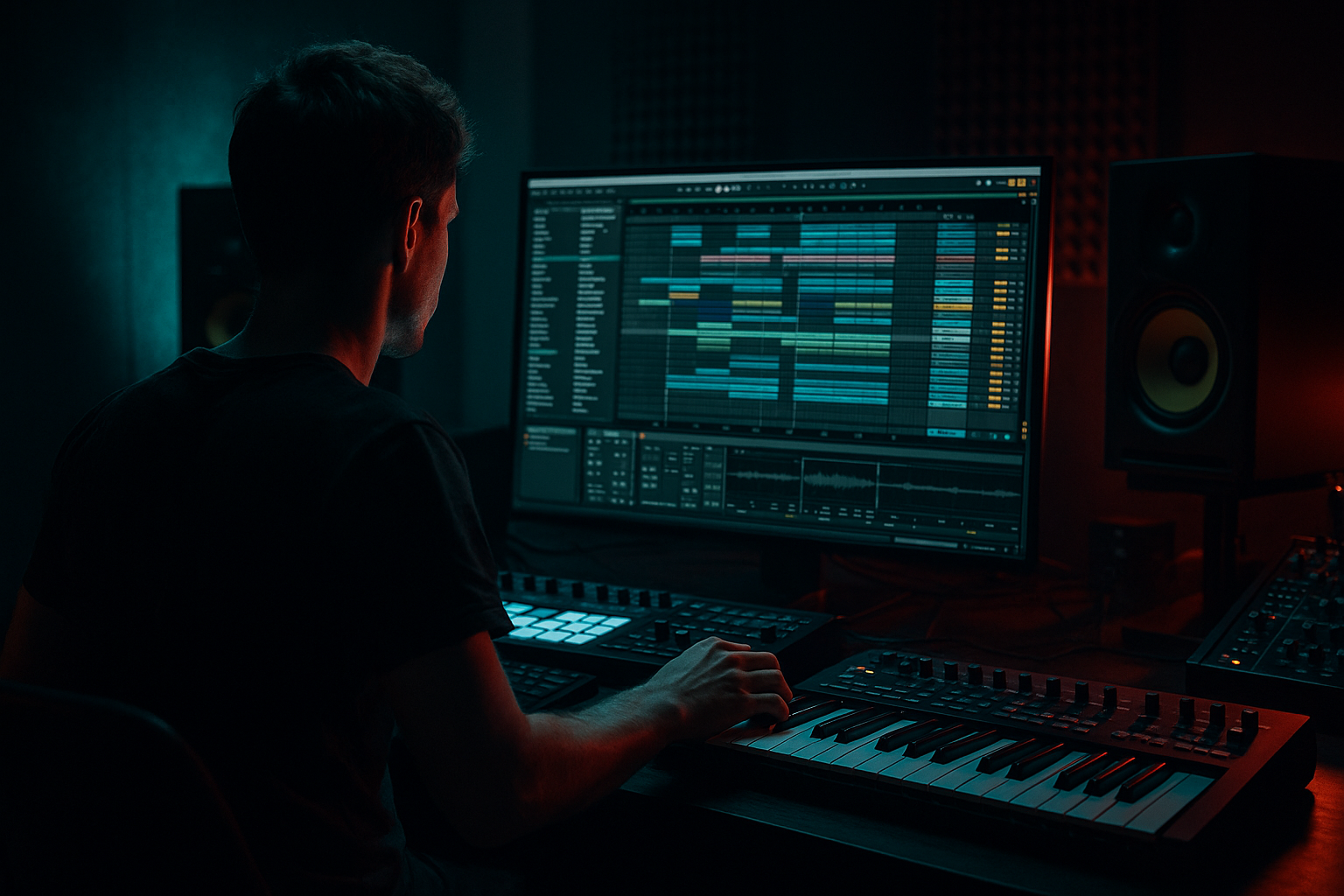
Main tutorial
Lesson Overview
A Reese riser pitch session is one of the cleanest ways to create tension before a drop in Drum & Bass, especially if you’re aiming for jungle oldskool energy with floor-shaking low end. Instead of relying on a generic noise riser, you’re animating a Reese bass texture so the build feels connected to the drop’s weight and character.
In DnB, this matters because the listener should feel the low-end pressure building before the drop even arrives. A well-executed Reese pitch rise can do three jobs at once:
- create harmonic tension
- signal arrangement change
- keep the bass identity consistent from build to drop
- a wide, detuned Reese layer
- a sub-supported mono foundation
- pitch movement that rises over 1 to 4 bars
- optional filter opening, distortion drive, and stereo narrowing/widening
- a drop-ready transition that can lead into:
- Making the Reese too wide in the low end
- Using a riser that feels disconnected from the bassline
- Too much filter opening too fast
- Overdistorting the riser
- No drum interaction
- Ignoring mono compatibility
- Letting the riser clutter the drop
- Layer a quiet octave-down sub shadow
- Automate Saturator Drive in the last half-bar
- Use a short Delay after the Reese, not before it
- Try a parallel distortion bus
- Use Drum Buss carefully on the bass bus
- Make the last note more emotionally important
- Pair the rise with a break chop
- Use automation clips as reusable DJ tools
- Build the riser from a Reese bass, not generic noise, for stronger DnB identity.
- Keep the sub mono and let the Reese provide motion and tension.
- Use pitch movement, filter automation, and resampling to create a club-ready transition.
- Tie the riser to the drum arrangement so it feels like part of the track, not an overlay.
- Always check mono compatibility, low-end clarity, and drop handoff before calling it done.
For DJ tools and club-ready writing, this is especially useful because it translates well in a mix, works with breakdowns, and gives you a strong cue point for transition energy. In oldskool jungle and rollers, that “moving bass turning into impact” feeling is a classic tactic: the bass line isn’t just playing notes, it’s leaning forward into the drop.
We’ll build this in Ableton Live 12 using stock devices, resampling, automation, and a simple arrangement workflow that keeps the result heavy but controlled.
What You Will Build
You’ll create a Reese-based pitch riser that starts as a tight, gritty bass tone and gradually climbs into a tense pre-drop or transition moment. The result will feel like:
- an oldskool jungle break drop
- a dark roller switch-up
- a neuro-inspired bass section
- a DJ-friendly breakdown-to-drop moment
Musically, think of it as the last 2 bars before the drop where the bass line becomes more urgent, the break fills space, and the audience feels the floor ready to lift. You’ll also learn how to keep the pitch rise dancefloor-effective without turning into muddy low-end chaos.
Step-by-Step Walkthrough
1. Build the core Reese instrument in Ableton Live 12
Start with a new MIDI track and load Wavetable or Analog. For oldskool DnB vibes, Wavetable gives you more control, but Analog is great if you want a rawer, simpler tone.
In Wavetable:
- Osc 1: saw wave
- Osc 2: saw wave or square-saw blend
- Detune slightly: around 8–18 cents
- Unison: 2 to 4 voices
- Spread: keep moderate, around 20–40%
- Filter: low-pass, around 120–250 Hz cutoff depending on how dark you want it
- Drive: 5–20% if needed
Add Chorus-Ensemble after Wavetable if you want a wider Reese movement, but keep it subtle. In jungle and rollers, too much spread can erase the punch.
Why this works in DnB: the Reese is all about moving harmonics. DnB drops hit harder when the bass has width and motion in the upper low-mids, while the actual sub stays stable underneath.
2. Write a short bass phrase that actually feels like a DnB transition
Don’t start with a long held note. Create a phrase that already has a bit of intent. Try a 1-bar or 2-bar MIDI clip with:
- root note held for the first half
- a small movement up a semitone or tone
- then a return or passing note
Example in a darker roller context:
- bar 1: F1 held
- bar 2: F1 to G1 movement on the last quarter
- last 1/8 or 1/16: lead into A1 or F#1 depending on key
Keep the notes low enough to maintain pressure but not so low they disappear. A practical range is often F0 to G#1 for the core bass line, depending on tuning and speaker translation.
If your track is in a specific key, make the pitch riser follow the harmony rather than just an arbitrary climb. Oldskool jungle often feels best when the bass rise implies the drop root note clearly.
3. Separate sub and Reese motion for control
Make a second MIDI track for a dedicated sub layer. Load Operator or Wavetable with a sine wave. Keep it mono and simple.
Suggested settings:
- Oscillator: sine
- Octave: usually -1 relative to the Reese layer
- Amp envelope: short attack, no sustain weirdness, clean release
- Saturator after it: very light, just enough to make the sub audible on smaller systems
Then route both tracks into a group called Bass Bus. This lets you control the relationship between the moving Reese and the stable sub.
Practical mix rule:
- Reese layer: focus on movement, grit, stereo texture
- Sub layer: focus on mono, consistency, and weight
This separation is crucial in DnB because pitch automation on a wide bass can easily cause low-end smear. The sub stays authoritative while the Reese does the expressive work.
4. Create the pitch session with clip automation or MIDI note movement
You have two strong Ableton-native approaches here:
Option A: MIDI note pitch movement
- Draw the bass notes climbing over 1, 2, or 4 bars.
- Use stepwise movement for jungle tension.
- Use a more dramatic glide if the drop wants a modern dark-bass feel.
Option B: Pitch automation
- In the instrument rack or device chain, automate the pitch control if your synth workflow supports it cleanly.
- Alternatively, resample the Reese and pitch the audio clip up over time.
For an intermediate workflow, the most reliable approach is often:
- make the Reese MIDI phrase
- resample it to audio
- then use clip automation or warp envelope style editing if needed
If you want a classic “rise into impact” motion:
- start at root note
- rise by 2 to 5 semitones over 2 bars
- last half-bar can accelerate to create urgency
A strong oldskool move is to have the Reese pitch gradually climb while the drum break gets thinner. That contrast makes the drop feel bigger.
5. Resample the Reese and edit it like a DJ transition tool
This is where the lesson becomes really practical. Create a new audio track, set its input to resample or the Reese group output, and record the movement.
Once you have audio:
- consolidate the clip
- warp if necessary
- use fade handles to keep edges clean
- trim silence
- name the clip clearly: `Reese_PitchRise_2bar_Fm` or similar
As a DJ tool, this gives you a reusable transition asset you can drop into future arrangements. You can also reverse it, duplicate it, or layer it with break fills.
Good audio-editing targets:
- keep the riser between 1 and 4 bars
- make the final 1/4 bar slightly louder or denser
- cut any sub rumble before the rise if it muddies the intro
Why resample? Because resampling lets you commit the motion and shape it faster. In DnB, speed matters: once the vibe is right, turn it into a reusable element rather than endlessly tweaking the synth patch.
6. Shape the tone with stock Ableton devices
Now refine the resampled audio with a tight chain. A solid starting point:
- EQ Eight
- high-pass around 25–40 Hz on the Reese layer only
- small cut around 200–400 Hz if it clouds the mix
- tame harshness around 2–5 kHz if the pitch rise gets buzzy
- Saturator
- Drive: 2–6 dB
- Soft Clip: on if the transition needs more density
- Auto Filter
- low-pass opening during the rise, or band-pass if you want a more synthy tunnel effect
- map cutoff to automation and move from roughly 200 Hz to 2–6 kHz over the build
- Utility
- Width: keep the sub track at 0% width
- For the Reese layer, you can widen a bit, but check mono later
For jungle oldskool vibes, filtering is often more effective than extreme sound design. A filtered Reese that opens up into the drop feels authentic and mixable.
7. Add automation that interacts with drums, not just the bass
A pitch riser works best when it’s tied to the drum arrangement. In DnB, the bass build should react to the break edits and fills.
Try automating alongside the pitch rise:
- drum bus volume down by 1–2 dB in the last bar
- snare roll density up
- reverb send on a fill hit
- filter on break loop closing slightly to make the bass rise stand out
- bass bus saturation increasing in the final half-bar
Musical arrangement example:
- Bars 1–8: full break and bass groove
- Bars 9–10: bass drops out except for filtered Reese
- Bar 11: Reese rises over a break fill
- Bar 12: kick/snare stop or impact
- Drop lands on the root with full sub and drums
This is the kind of phrasing that works in a DJ set: the listener gets a clear tension cue, but the groove language stays locked to the track’s identity.
8. Control stereo and mono carefully for club translation
Reese basses can sound huge in stereo but fall apart if the low end gets too wide. Use a mono-check habit every time.
On the Bass Bus:
- put Utility at the end
- set the sub layer to Width 0%
- keep the Reese layer only moderately wide
- test mono by toggling Utility width or using a mono monitoring approach
A good rule:
- below about 120 Hz, keep it effectively mono
- the movement and width should live above that region
If your riser loses power in mono, reduce chorus width, lower unison spread, or high-pass the Reese layer a bit more aggressively. The point is impact, not just size.
In a DnB club context, mono compatibility is non-negotiable because the system needs a solid anchor in the sub.
9. Design the final drop handoff
The best Reese pitch risers don’t just end—they hand off into the drop.
Good handoff ideas:
- final pitch note lands right before the drop root
- let the last riser note cut abruptly into a kick/snare impact
- reverse a tiny slice of the Reese into the downbeat
- use a short reverb tail that ducks out when the drop lands
For an oldskool jungle vibe, you can have the riser collapse into a break edit right before the downbeat, then slam the sub and drums in together. That creates a classic “system pressure” feeling.
For a darker roller, let the pitch rise resolve into a new bass motif instead of a full stop. That keeps tension alive and gives the drop motion from bar one.
Common Mistakes
- Fix: keep sub mono, high-pass the Reese layer, and check Utility width.
- Fix: base the pitch movement on the actual key/root of the track.
- Fix: slow the automation curve and keep the final brightness controlled.
- Fix: add saturation in stages; a little at the synth, a little on the bus, not all at once.
- Fix: thin the break, add a fill, or reduce drum energy in the final bar so the riser has space.
- Fix: always test the Bass Bus in mono before committing.
- Fix: make sure the riser ends cleanly or ducks out before the first full drum hit.
Pro Tips for Darker / Heavier DnB
- Keep it very subtle, but it can make the pitch rise feel physically heavier.
- A small increase, like +1 to +3 dB, can make the riser feel more aggressive without extra harmonics clutter.
- Try Echo or Delay very lightly for tail movement, but filter the delay heavily so it doesn’t mess with the low end.
- Send the Reese to a return with Amp, Saturator, or Drum Buss for added grit, then blend under the clean layer.
- Amount low, Drive modest, Crunch controlled. Great for grime, but too much will flatten the pitch movement.
- In dark DnB, the final pitch target often matters more than the whole rise. Hitting the drop root with intent is what makes the transition feel lethal.
- A chopped Amen or classic break fill underneath the riser makes the whole section feel more authentic and less EDM-like.
- Save your best pitch-rise audio as an arrangement asset. You’ll reuse it in intros, pre-drops, fakeouts, and mixdown transitions.
Mini Practice Exercise
Spend 10–20 minutes making a reusable Reese pitch riser for an oldskool DnB drop.
1. Build a simple Reese patch in Wavetable or Analog.
2. Write a 2-bar MIDI phrase in a dark key, using only 2–4 notes.
3. Add a dedicated sine sub layer on a second track.
4. Resample the Reese movement to audio.
5. Add EQ Eight, Saturator, and Auto Filter to shape the rise.
6. Automate the filter opening over 2 bars.
7. Add a break loop underneath and remove a few hits in the last bar.
8. Check the whole thing in mono.
9. Export or consolidate the result as a reusable DJ transition tool.
Goal: by the end, you should have a clean, heavy, 2-bar pitch riser that can slot into a jungle intro, a roller switch-up, or a drop transition.
Recap
If you get this right, your Reese pitch session becomes more than a riser — it becomes a DJ tool for tension, weight, and drop impact in authentic jungle and darker DnB arrangements.

