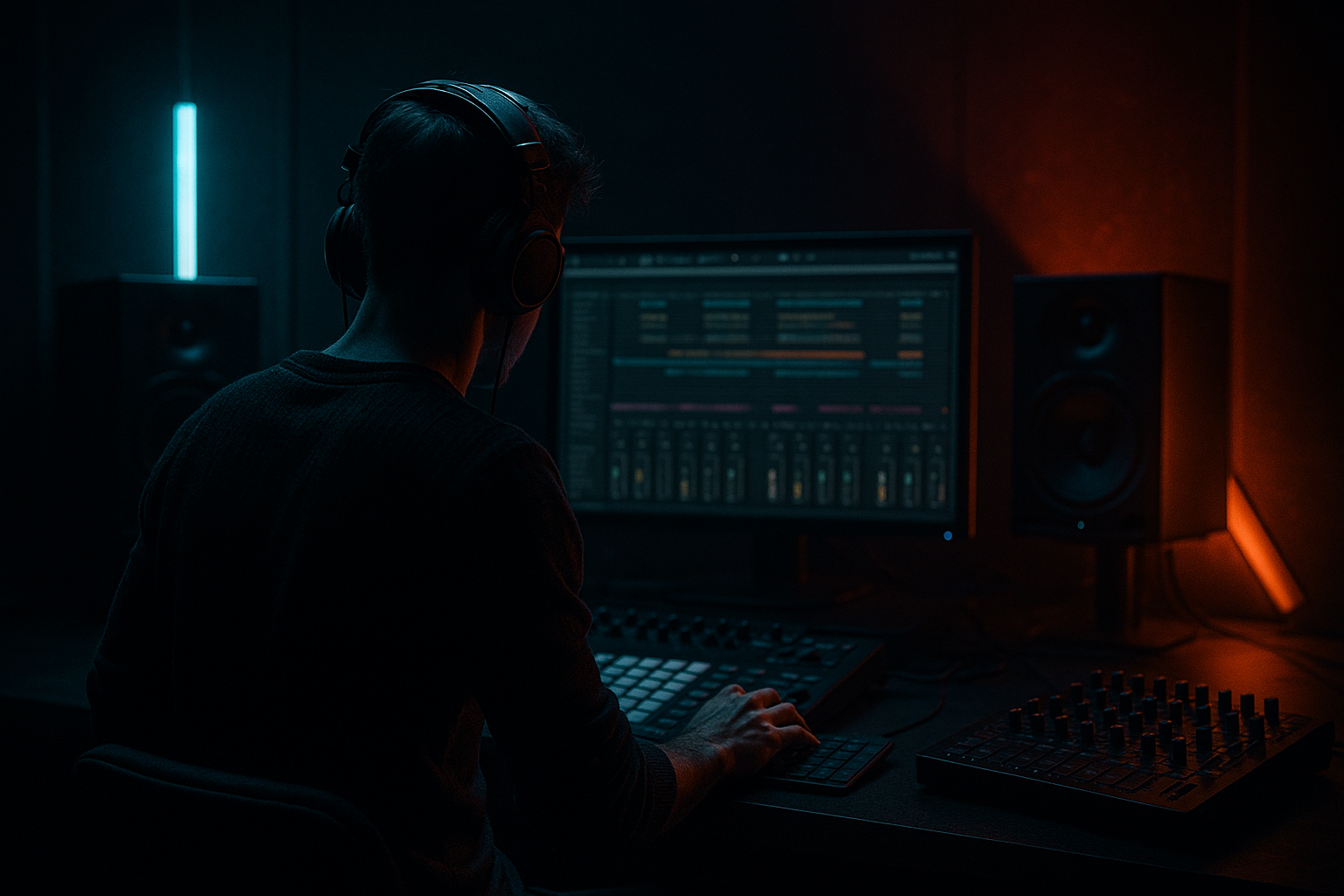
Main tutorial
Reference Track Workflows for Smoky Late‑Night Moods (DnB in Ableton Live) 🌒🎛️
1. Lesson overview
A great “smoky late-night” DnB track feels controlled, warm, and deep, with tight drums, rolling low-end, and just enough haze (reverb/saturation/texture) without washing out the groove. The fastest way to hit that target consistently is a reference-driven workflow—but done the right way, so you don’t copy the song, you copy the mix decisions, energy curve, and tonal vibe.
In this lesson you’ll build an Ableton Live workflow to:
- pick and prep reference tracks (gain-matched, segmented, and analyzed)
- compare drums/bass/atmosphere accurately
- translate “smoky” into concrete production moves (EQ, saturation, transient control, space)
- use Live stock devices to keep it fast and repeatable ✅
- A Reference Track lane routed to a REF bus (never touching your master chain)
- Gain-matched A/B switching (your track vs reference) 🎚️
- A section marker map (Intro / Drop / Breakdown / 2nd Drop / Outro)
- A simple analysis toolset using stock devices:
- A practical arrangement skeleton for smoky rolling DnB:
- Warm low-mids (bass harmonics around 150–400 Hz, controlled)
- Sub is strong but not overhyped
- Drums are tight + dry-ish, with small room/ambience rather than huge halls
- Atmospheres are wide and textured, often vinyl/noise/field layers
- Rolling / minimal rollers (deep, restrained top end)
- Jungle-leaning atmospheric rollers (pads, breaks, haze)
- Half-time dark sections but still club-focused
- On your Master, you may have processing (limiter, glue, etc.).
- You want the reference to avoid your master chain, otherwise you’re comparing apples to oranges.
- Route your entire project to a PREMASTER group (Audio To: Master)
- Keep your master clean (or minimal)
- Route references to Master, but keep project audio going through PREMASTER so you can bypass processing easily.
- Loop the drop of the reference and your drop.
- Toggle between them while adjusting Utility gain until the kick/snare feel equally loud.
- Typical reductions: -6 to -10 dB depending on how mastered the reference is.
- Put a Limiter after Utility on `REF BUS` (Ceiling -0.3 dB) so you don’t blast yourself when switching.
- Solo `REFERENCE` to compare, then unsolo.
- Put your entire music into a group called `MIX BUS`
- Map keys or a MIDI controller:
- Now A/B is instant and consistent.
- How bright are hats in the first drop?
- How long is the pre-drop tension?
- How “busy” is the bass rhythm vs drums?
- In EQ Eight, enable a Low Cut at 25–30 Hz temporarily to hear what remains.
- Compare how loud the audible sub fundamental feels vs your track.
- Watch Spectrum:
- Sweep a gentle bell in EQ Eight at 200–300 Hz to hear how present it is in the reference.
- Compare your mix: if yours sounds “boxy,” you likely have competing bass harmonics + reverb + pad mud.
- controlled air
- hats present but not razor sharp
- less 12k sparkle than you think
- more focus around 6–10 kHz instead of ultra-air
- Atmos pad, vinyl/noise texture, filtered break ghost
- Sparse kick or ride hints
- Bass teaser (reese filtered, 1-note)
- Add full drum groove but keep hats filtered
- Automate reverb send up slightly on a stab
- Short riser + snare roll (tasteful)
- Full drums + bass groove
- Introduce call/response bass phrases every 8 bars
- Add a quiet “smoke layer” (noise/room) that glues everything
- Strip to pad + vocal chop or distant stab
- Filter down drums, keep a shuffled percussion loop low
- Rebuild tension with automation, not more layers
- Same groove, but heavier: add a mid-bass layer or switch break
- A few fills at 16/32 bar points
- Slightly more distortion/saturation, more movement
- Remove bass, keep drums and atmosphere for mixing out
- Hybrid Reverb
- EQ Eight after reverb
- Saturator
- Utility
- Instrument: Operator
- EQ Eight
- Saturator (very subtle)
- Instrument: Wavetable (or Operator/Analog)
- Auto Filter for movement
- Saturator or Roar (if Live 12 Suite) for grit
- EQ Eight
- Utility
- Not gain-matching the reference: you’ll chase loudness instead of tone.
- Referencing through your master limiter: makes your mix seem smaller/less bright than it is.
- Comparing the wrong section: don’t compare your intro to their drop.
- Over-reverbing drums to get “smoke” 🌫️
- Ignoring low-mid buildup (150–400 Hz): the vibe dies when it gets muddy.
- Too much top-end “air”: late-night rollers often have restraint; harsh hats kill mood fast.
- Mono discipline below ~120 Hz
- Use parallel distortion on mids, not on sub
- Let breaks add “smoke”
- Automate filter + reverb throws at phrase ends
- Transient hierarchy
- Use 1–3 relevant references and gain-match them. 🎚️
- Route references so they don’t lie (avoid your master processing).
- Segment the reference with markers and compare matching sections.
- Translate “smoky late-night” into measurable targets:
- Build your arrangement around the reference’s energy curve, not its melodies.
---
2. What you will build
You’ll create a reusable Reference System inside your Ableton project:
- Spectrum
- EQ Eight
- Utility
- Limiter (for safe auditioning)
- 32-bar intro, 64-bar drop, 16–32-bar breakdown, 64-bar second drop
---
3. Step-by-step walkthrough
Step 1 — Choose the right reference (2–3 tracks max)
Pick references that match your subgenre and mood, not just “good DnB.”
Smoky late‑night reference traits:
Suggestions (vibe categories):
Tip: Avoid referencing a track with a totally different drum language (e.g., neurofunk smashers) if you’re making a liquid/roller vibe.
---
Step 2 — Import references the “safe” way (routing that won’t lie)
1. Create an Audio Track named `REFERENCE`.
2. Drag in your reference WAV/AIFF/MP3.
3. Create a new Audio Track named `REF BUS`.
4. Set `REFERENCE` track Audio To → REF BUS.
5. On `REF BUS`, set Audio To → Ext. Out (or your Master, if you don’t have a dedicated monitor out).
Now the crucial part:
Best practice option (recommended):
---
Step 3 — Gain-match the reference (non-negotiable) 🎚️
Your ear prefers “louder.” If your reference is louder, you’ll make bad decisions.
On `REF BUS`, insert:
1. Utility
2. Set Gain to match perceived loudness to your current mix
Practical method:
Optional safety:
---
Step 4 — Create fast A/B switching (so you actually use it)
Method A (simple):
Works but interrupts flow.
Method B (pro workflow):
- `MIX BUS` mute
- `REF BUS` mute
Bonus: Map a macro to both mutes in opposite states if you use an Audio Effect Rack (advanced, but worth it).
---
Step 5 — Segment the reference: markers + loop points = speed 🚦
In Arrangement View:
1. Play the reference and drop Locator markers:
- `Intro start`
- `Drums in`
- `Drop 1`
- `Break`
- `Drop 2`
- `Outro`
2. Color them.
3. Loop 8/16 bars around each key moment.
Now you can ask specific questions:
---
Step 6 — Analyze “smoky” with stock devices (no guesswork) 🔍
On `REF BUS` insert these (after Utility):
1. EQ Eight
2. Spectrum
Use these practical checks:
#### A) Sub balance check (30–90 Hz)
- Many smoky rollers have a solid hump around 45–60 Hz but not a huge cliff.
#### B) Low-mid warmth (120–400 Hz)
This is where “smoke” lives… and where mud lives too.
#### C) Top end restraint (8–16 kHz)
Smoky late-night tracks often have:
Check if the reference has:
---
Step 7 — Build your track around the reference’s energy curve (not its notes)
Here’s a reliable late-night roller arrangement template (пример rooted in DnB):
Intro (0:00–0:32, 32 bars)
Pre-drop (0:32–0:48, 16 bars)
Drop 1 (0:48–1:52, 64 bars)
Break (1:52–2:24, 32 bars)
Drop 2 (2:24–3:28, 64 bars)
Outro (3:28–end)
Reference workflow: Place your locators to match the reference’s big moments, then adjust lengths—not to clone, but to keep that “late-night pacing.”
---
Step 8 — “Smoky mood” device chains you can actually use 🧱
#### A) Smoke Atmos Bus (pads, noise, field textures)
Create a return track `SMOKE VERB`:
- Mode: Convolution
- IR: small/medium Room (not huge hall)
- Decay: 1.2–2.2 s
- Pre-delay: 10–25 ms
- High Cut: 6–9 kHz
- Cut lows below 150–250 Hz
- Small dip around 2–4 kHz if harsh
- Soft Clip ON
- Drive: 1–3 dB (subtle)
- Width: 120–160% (keep this return wide, but not insane)
Send pads/stabs/noise lightly. Keep drums mostly drier.
#### B) Drum “Late-Night Tightness” Chain (Drum Group)
On your Drum Group:
1. Drum Buss
- Drive: 5–15%
- Boom: 0–10% (careful; don’t fake sub if you have a proper sub bass)
- Transients: +5 to +15 (snap without harshness)
2. Glue Compressor
- Attack: 3–10 ms
- Release: Auto or 0.1–0.3 s
- Ratio: 2:1
- GR: 1–2 dB on peaks
3. EQ Eight
- Small dip 250–400 Hz if boxy
- Optional tiny shelf 8–10 kHz if hats are dull
#### C) Bass “Warm but Controlled” (Instrument Group)
Common smoky roller bass: sub + mid layer.
Sub track
- Osc A: Sine
- Envelope: short attack, medium release
- Low-pass around 90–120 Hz (depending on your design)
- Drive 0.5–2 dB
Mid/Reese track
- LP12/LP24
- Envelope or LFO slow (4–8 bars)
- High-pass 120–180 Hz to leave sub clean
- Width: 0–30% (keep low mids mostly mono-ish)
Reference check: When you A/B, focus on whether the bass is present without stepping on the kick/snare, not just “big.”
---
4. Common mistakes
Smoke is mostly tone + texture + controlled space, not washing your snare.
---
5. Pro tips for darker/heavier DnB 🖤
Use Utility on bass group: Width 0% (or use EQ Eight M/S cautiously).
Split bands: keep sub clean, make mids angry.
Blend a low-passed break loop under clean drums. Jungle-rooted vibe instantly.
1-bar moments = depth without clutter.
In dark/heavy DnB, the snare/clap transient placement is everything. If reference snare feels “forward,” your drums probably need either:
- less reverb tail
- slightly more transient (Drum Buss Transients)
- less competing 2–5 kHz content from bass
---
6. Mini practice exercise (15–25 min) ⏱️
1. Import one reference track.
2. Gain-match it using Utility on `REF BUS`.
3. Add locators for: Intro / Drop / Break / Drop 2.
4. Loop the first 16 bars of the drop.
5. In your own track, build only:
- kick + snare
- hats
- sub (Operator sine)
- simple reese (Wavetable)
6. Do three A/B checks and make one change each time:
- Check 1 (Sub): adjust sub level until it “sits” like the reference.
- Check 2 (Hats): EQ Eight shelf or notch to match perceived brightness.
- Check 3 (Space): add Hybrid Reverb send to pads/noise—not drums—until you get that haze.
Deliverable: bounce an 16-bar loop of your drop and label it `vibe-match-01`.
---
7. Recap
- controlled top end
- warm low-mids without mud
- strong mono sub
- tight drums + subtle room
If you tell me 2–3 artists/tracks that match your ideal smoky vibe (or upload a short clip), I can suggest a reference set and a tailored Ableton template layout for that exact lane.

