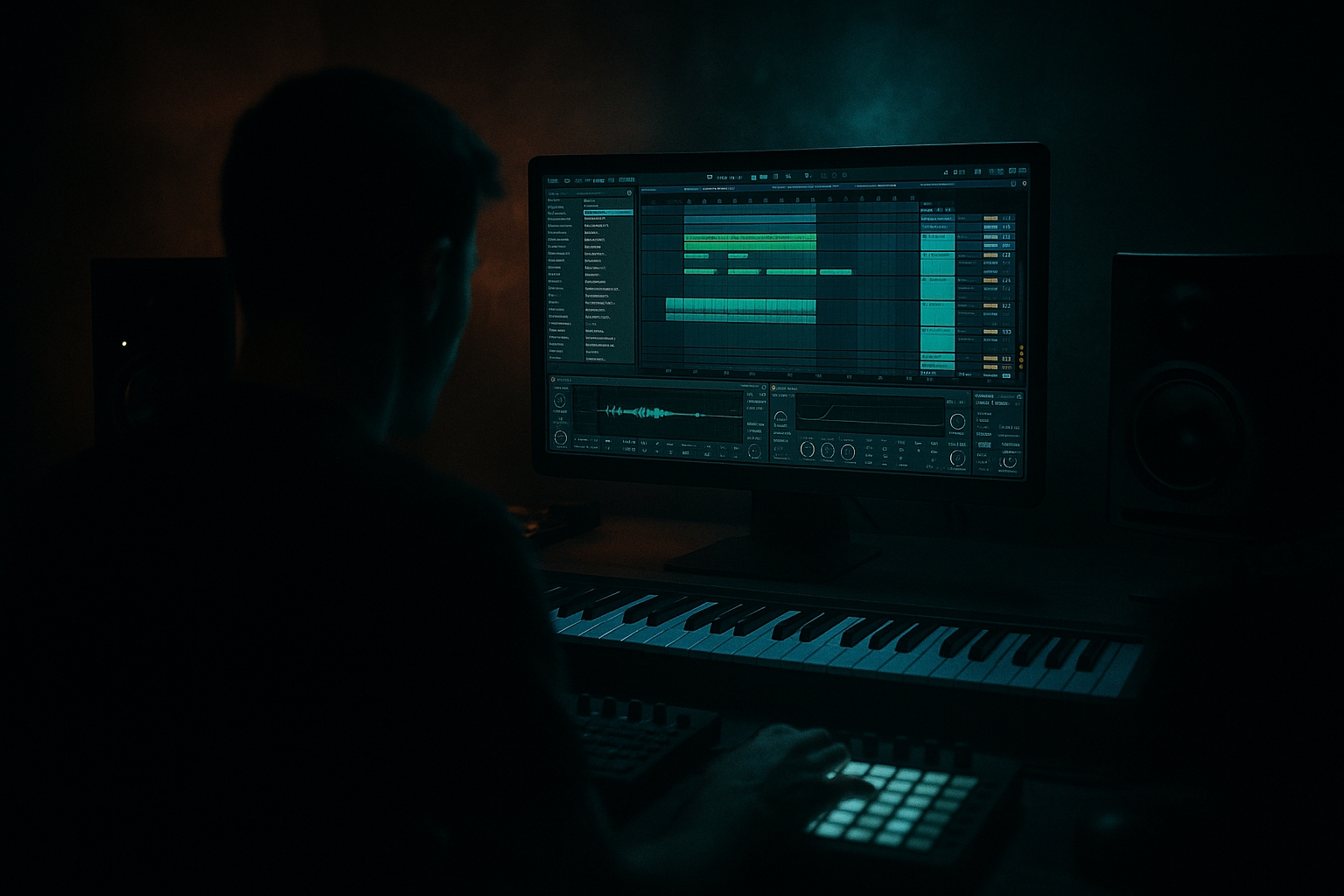
Main tutorial
```markdown
Relationship Between Phrasing and Swing (Advanced DnB Groove in Ableton Live) 🥁⚡
1. Lesson overview
In drum & bass, swing isn’t just a “shuffle knob”—it’s the micro-timing glue that supports phrasing (how your loop “speaks” across 1, 2, 4, 8, 16 bars).
At an advanced level, the magic is in how swing changes meaning depending on where you are in the phrase:
- Inside the bar: swing shapes the rolling feel (ghosts, hats, percussion).
- Across bars: phrasing shapes momentum (call/response, tension/release, fills, turnarounds).
- Across sections: swing can subtly shift to “lift” a drop, “tighten” a breakdown, or make a switch-up feel nastier.
- A 16-bar DnB drum arrangement (174 BPM) with:
- A workflow using:
- Kick (tight, short)
- Snare (classic DnB snare or crisp clap-layer)
- Optional rim/shot for spice
- Kick: 1.1.1 and 1.3.1 (classic driving)
- Snare: 1.2.1 and 1.4.1
- Closed hat
- Open hat
- Ride (optional)
- Velocity: start around 50–80, then randomize slightly.
- Timing: 30–60 (start at 45)
- Random: 2–8 (start at 4)
- Velocity: 0–20 (start at 10)
- Base: 1/16
- Remove 1–2 hats right before the snare (create a tiny breath)
- Add an open hat on the “and” after snare (e.g., around 1.2.3-ish depending on groove)
- Increase velocities slightly on hats leading into bar 1 again (turnaround energy)
- Swing = feel of the subdivision
- Phrasing = where you “talk” and where you “shut up”
- Ghost snare / low snare
- Rim / tick
- Light shaker
- Optional break chop texture (even a very quiet one)
- Before 2 and 4 (tiny pickups)
- After the snare (tiny tail responses)
- Keep the main snare locked.
- Place ghost notes on 1/16 or 1/32 grid, then use:
- Same groove as hats, but:
- In bar 4, add an extra ghost leading into the downbeat of bar 1.
- In bar 8 and 16, do a slightly more obvious pickup (without stepping on the snare).
- You’re done choosing swing feel
- You want to hand-edit phrase moments precisely
- You want to resample audio later and keep timing consistent
- Hats: medium swing
- Ghosts: minimal, just enough roll
- Add an extra percussive layer (rim ticks on offbeats)
- Slightly raise ghost velocity
- Consider increasing groove Random by +2 for grit
- Drop hats for 1/2 bar occasionally (space = impact)
- Introduce a tiny ride pattern (very low in mix)
- Tighten swing slightly on hats (Timing -5 to -10) for urgency
- Add a snare fill (keep main snare hit intact, decorate around it)
- Automate a filter to “open” into bar 1 of next section
- Auto Filter on TOPS: automate cutoff opening over bars 15–16
- Utility gain: +0.5 to +1.5 dB into the turnaround (subtle lift)
- Saturator on ghosts: automate Drive +1–2 dB in final bar for hype
- Swinging the kick/snare backbone too much
- One swing amount for every element
- Too much groove Random
- No phrase variation
- Committing groove too early
- Use “tension swing” on tops, keep subs/grid solid
- Add a barely-audible break layer for human phrasing
- Automate swing amount between sections
- Use transient shaping carefully
- Make bar 16 nasty, not busy
- Swing = micro-timing feel (how subdivisions lean and roll).
- Phrasing = macro timing and structure (where energy rises, breathes, turns around).
- Advanced DnB groove comes from designing swing to serve phrasing, not from a static groove preset.
- In Ableton Live, the winning combo is:
In this lesson you’ll build a rolling 2-step / jungle-leaning beat where swing is deliberately phrase-aware (not uniform everywhere), using Ableton Live stock tools and disciplined workflow.
---
2. What you will build
You’ll create:
- A tight kick/snare backbone
- Swung hats/ghosts that push the groove forward
- Phrase-dependent variations (every 2, 4, 8, 16 bars)
- Groove Pool (core swing control)
- MIDI note timing vs Audio warping (when to swing what)
- Drum Rack + Saturator + Glue Compressor (controlled weight)
- Utility + Auto Filter (phrase automation for movement)
End result: a loop that feels rolling and alive, but also arranged—like real DnB records where energy evolves every few bars. 🔥
---
3. Step-by-step walkthrough
Step 0 — Session setup (fast, clean, intentional)
1. Set tempo to 172–176 BPM (use 174 BPM for this lesson).
2. Set Global Quantization = 1 Bar (top left) for easy launching.
3. Create three MIDI tracks:
- DRUMS (Rack)
- TOPS (Rack or simpler hat rack)
- PERC/GHOSTS
Why separate tracks?
Because you’ll apply different swing + phrasing strategies to backbone vs tops vs ghosts.
---
Step 1 — Build the unswung backbone first (phrasing anchor)
On DRUMS track, load a Drum Rack with:
Create a 2-step foundation (1 bar):
Duplicate to 4 bars, then to 16 bars.
Important rule:
✅ Do NOT swing the kick/snare grid yet.
They are your phrase rulers. In most modern DnB, the backbone stays grid-tight while the movement lives in tops/ghosts.
---
Step 2 — Add tops as “swing carriers” (micro-groove)
On TOPS track, add a Drum Rack (or Simpler) with:
Program straight 1/16 closed hats for 1 bar (all 16ths).
Duplicate across 16 bars.
Now we’ll apply swing properly (not destructively yet).
---
Step 3 — Use Groove Pool like a pro (global feel with local control)
1. Open Groove Pool (click the wavy icon top left).
2. Drag in a groove:
- Try Swing 16-65 or MPC 16 Swing-style grooves (Ableton includes multiple swing presets).
3. Apply groove to TOPS clip (in Clip View > Groove dropdown).
In Groove Pool, set initial values:
Listen for: the hats should “lean” and roll, but not sound drunk.
🎯 Key concept:
Swing creates micro-offbeats. Phrasing decides where those micro-offbeats matter (e.g., the last bar before a turnaround).
---
Step 4 — Phrase-aware swing: “tight in the middle, looser at the edges”
Here’s a technique you’ll hear in serious rolling DnB:
bar 1–3 = stable, bar 4 = character.
#### Make a 4-bar phrase
Work in 4-bar chunks inside your 16 bars.
1. Consolidate hats into a 4-bar clip (so you can program phrase moves).
2. Keep groove applied.
#### Add phrase variation without breaking the pocket
In bar 4 of the 4-bar loop:
Now duplicate this 4-bar phrase across 16 bars, but make one of them different (e.g., bars 13–16) to set up the drop/transition.
✅ This is the relationship in action:
---
Step 5 — Ghost notes: the real swing engine (advanced)
On PERC/GHOSTS, load a Drum Rack with:
Program ghost snares around the main snare:
Timing approach (important):
- Either Groove Pool on this clip too (often slightly stronger than hats), or
- Manual micro-nudges in the MIDI editor (Alt/Option-drag notes off grid)
Suggested groove settings for ghosts:
- Timing: 50–70 (start at 60)
- Random: 3–10
- Velocity: 5–25 (ghosts should breathe)
Phrase it:
This is where swing becomes phrasing, because the ghosts create mini-sentences that lead the listener through the structure.
---
Step 6 — “Commit” swing strategically (extract groove to MIDI when needed)
If you want tighter control for edits, do this:
1. Right-click your groove in Groove Pool > Commit (or “Commit Groove” on clip).
2. Now your MIDI notes are physically moved.
Use this when:
⚠️ Don’t commit too early—keep it flexible during groove discovery.
---
Step 7 — Arrangement: make swing evolve across 16 bars 🎛️
Now make the arrangement feel like a record:
#### Bars 1–4 (establish)
#### Bars 5–8 (add pressure)
#### Bars 9–12 (variation / response)
#### Bars 13–16 (turnaround / pre-drop)
Ableton automation moves (stock):
This is a powerful phrasing trick:
🔁 tighten swing to increase forward motion before a drop, then relax after.
---
Step 8 — Glue the groove without flattening it (mix chain)
On DRUMS bus (group your drum tracks), add:
1. EQ Eight
- High-pass around 25–35 Hz (gentle) if needed
- Small cut around 250–400 Hz if boxy
2. Glue Compressor
- Attack: 3 ms
- Release: Auto
- Ratio: 2:1
- Aim for 1–3 dB gain reduction
3. Saturator
- Soft Clip: On
- Drive: 1–4 dB (taste)
4. Limiter (optional safety, not loudness)
- Just catching peaks
✅ Goal: control dynamics while keeping micro-timing clarity. Over-compressing hides swing.
---
4. Common mistakes
Makes the drop feel late and weak. Keep anchors tight; swing the “air.”
Real groove uses hierarchy: hats one feel, ghosts another, percussion another.
Random is seasoning. Too high = messy hats that don’t “roll.”
A perfectly swung 1-bar loop copied for 64 bars = static, amateur energy.
You’ll fight edits and lose the ability to quickly “tighten for impact.”
---
5. Pro tips for darker/heavier DnB 😈
Dark DnB hits hardest when low-end is disciplined and high-end is restless.
- Put a classic break (e.g., Think/Apache-style) very low
- Warp mode Complex or Beats
- High-pass aggressively (EQ Eight) so it’s mostly texture
- Let it carry micro-phrasing while your main drums stay clean
- Breakdown: tighter (less swing)
- Drop: more swing/ghost activity
This creates a psychological “release.”
- Ableton stock: try Drum Buss
- Drive lightly, Transients +5 to +15 on snare group
Too much transient destroys the softness that makes swing feel good.
A single well-placed ghost + a hat dropout + a short fill often hits harder than a full drum freestyle.
---
6. Mini practice exercise (15 minutes) ⏱️
1. Make a 1-bar 2-step with tight kick/snare (no swing).
2. Add 16th hats and apply Swing 16-65:
- Timing 45, Random 4, Velocity 10
3. Duplicate to 4 bars.
4. In bar 4 only:
- Remove two hats before snare 4
- Add one open hat after snare 4
- Add one extra ghost snare pickup into bar 1
5. Duplicate the 4-bar phrase to 16 bars.
6. In bars 15–16:
- Reduce swing Timing by -8
- Automate Auto Filter cutoff open on tops
7. Bounce a quick audio preview and listen:
Does the groove change meaning at bar 4 and bar 16 without losing the pocket?
---
7. Recap
- Tight backbone
- Groove Pool for controlled swing
- Ghost notes for “speech”
- 4/8/16-bar phrase edits + subtle automation
If you want, tell me your target subgenre (rollers, techstep, jungle, neuro-ish) and I’ll suggest a specific swing amount + ghost placement map for that style. 🧠🥁
```

