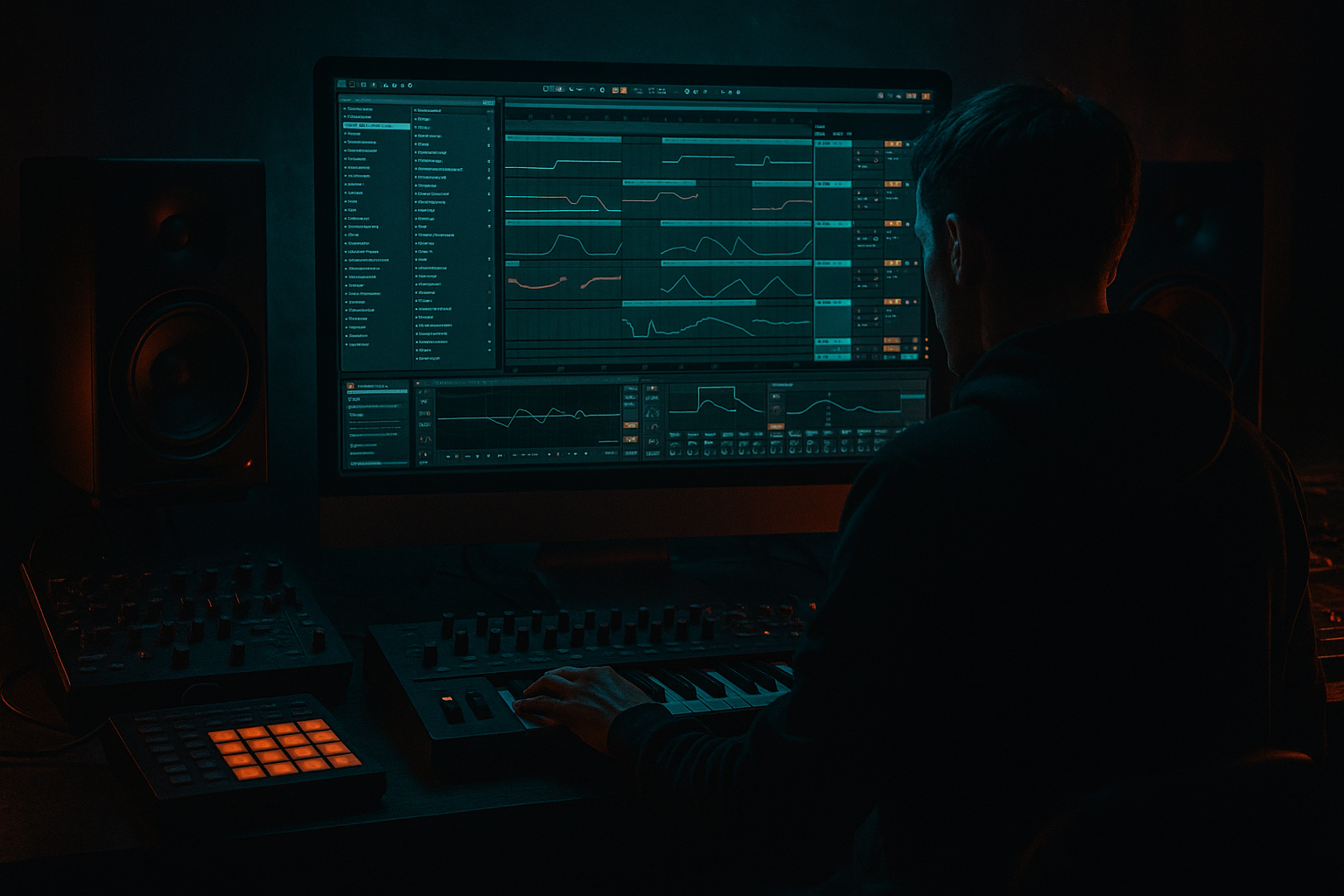
Main tutorial
```markdown
Resample a Fill for Deep Jungle Atmosphere in Ableton Live 12 (Automation)
1. Lesson overview
In jungle and DnB, fills aren’t just transitions—they’re texture generators. In this lesson you’ll take a drum fill (think: 1-bar Amen-style or a modern kick/snare fill), resample it, and then automate time, tone, space, and movement to create that deep, foggy, late-night jungle atmosphere. 🌫️🥁
We’ll focus on a clean, repeatable Ableton Live 12 workflow using stock devices and arrangement-friendly automation.
---
2. What you will build
By the end, you’ll have:
- A resampled audio “atmo fill” derived from your drum fill
- A controlled device chain that turns drums into atmosphere:
- A DnB-ready arrangement move: the fill blooms into a cloud that carries you into the next phrase (perfect for 16/32-bar structure)
- Use an Amen-style snippet, or any break fill.
- Warp mode: Complex Pro (good general choice) or Beats (if you want tighter transients).
- Drum Rack with kick/snare/perc.
- Add velocity variation and little ghost hits (very jungle).
- High-pass: 24 dB/oct, around 120–200 Hz (keep subs out)
- Add a resonant “jungle whistle” area:
- Mode: Low-Pass
- Filter type: OSR or MS2 (MS2 adds nice bite)
- Drive: 2–6 dB
- Resonance: 20–40%
- Start cutoff around 6–10 kHz (we’ll automate it down later)
- Sync: On
- Time: 1/8 dotted or 1/4
- Feedback: 30–55%
- Filter inside Echo:
- Modulation: 10–25%
- Reverb (in Echo): 10–25% (keep it subtle; we’ll add main reverb next)
- Mode: start with Convolution for realism
- Preset idea: “Warehouse / Room / Plate” style
- Decay: 2.5–6 s
- Pre-delay: 10–30 ms (keeps transient definition)
- EQ inside reverb:
- Mix: 15–35% (depends how “washy” you want)
- Mode: Analog Clip or Soft Sine
- Drive: 2–8 dB
- Output: compensate so level stays controlled
- Width: 120–160% (but don’t go crazy; we’ll mention pitfalls later)
- Gain: trim for headroom
- Start: 9–12 kHz
- End: 800 Hz – 2 kHz
- Shape: Exponential curve (steeper near the end feels more urgent)
- Start: 25–35%
- Peak right before bar ends: 55–70%
- Optional safety: automate back down immediately after the transition to avoid runaway repeats.
- Start: 10–20%
- End: 35–55%
- If it washes too hard, reduce and increase decay instead.
- Start: 0 dB
- End: -3 to -8 dB right at the cut
- Bar 16 beat 3–4: let the atmo fill swell
- Bar 17 beat 1: hard reset to clean drums + sub, no tail (or a tiny tail)
- Warp Mode: Texture
- Grain Size: 80–200 ms
- Flux: 10–25
- Then automate Transpose down -2 to -7 semitones over the final half-bar for dread.
- Right-click printed clip → Slice to New MIDI Track
- Slice preset: Transient or 1/8 notes
- On the new Simpler slices, automate:
- Too much low end in the reverb tail: Your sub and kick will fight it. High-pass early (EQ Eight / Reverb EQ).
- Runaway Echo feedback: Fun until it wrecks your mix. Automate feedback down after the transition.
- Over-widening: Huge stereo reverb can collapse in mono and smear your snare impact.
- Printing with clipping: Resampling post-saturation can clip fast. Watch meters; leave headroom.
- Automation too linear: DnB tension loves curves—use exponential ramps for cutoff/feedback.
- Parallel “dark cloud” return:
- Use Roar (stock in Live 12) for menace:
- Band-limit for authentic jungle air:
- Micro-stutters without losing groove:
- Sidechain the atmo to the kick/snare:
- You resampled a drum fill into audio, then built a jungle atmosphere chain using EQ Eight → Auto Filter → Echo → Hybrid Reverb → Saturator → Utility.
- You used automation (cutoff, feedback, wet/dry, gain) to create movement and tension into transitions.
- You printed the processed result again so it becomes a lightweight, arrangable texture—a signature move in deep jungle/DnB production. 🎛️🥁
- filtering + resonance
- dubby echo
- reverb wash
- movement via automation (and optional LFO)
---
3. Step-by-step walkthrough
Step 0 — Set the musical context (important for DnB)
1. Set tempo to 170–176 BPM (we’ll assume 174 BPM).
2. Make a basic 16-bar loop:
- Bars 1–15: your main break/beat (rolling)
- Bar 16: a fill (the source)
Tip: A classic jungle move is to keep the groove consistent, then let the fill be the “event” before the drop/phrase change.
---
Step 1 — Choose / build a fill worth resampling
You have two good options:
#### Option A: Audio break fill
#### Option B: MIDI drum rack fill
Goal: You want a fill with character—hats, snare rush, little noisy edges.
---
Step 2 — Create a dedicated resampling track
1. Create a new Audio Track named: `RESAMPLE - FILL ATMOS`.
2. In the track’s Audio From chooser:
- Select Resampling (quick + works well),
or
- Select the specific drum group (cleaner if you want only that source).
3. Set Monitor to Off (prevents doubling/feedback).
4. Arm the track for recording.
DnB workflow suggestion: If your drum buss has heavy limiting/clipping, resampling post-chain can sound sick. If it’s too crushed, resample pre-limiter.
---
Step 3 — Print the fill (clean capture)
1. Loop just the fill region (e.g., 1 bar).
2. Hit record and capture 1–2 bars including a little tail (helpful for atmos).
3. Consolidate: select the recorded clip → Cmd/Ctrl + J.
4. Rename the clip: `Fill_Atmos_Source_174`.
Optional: Right-click the clip → Crop Sample (keeps file tidy).
---
Step 4 — Turn the fill into atmosphere (device chain)
Drop these stock devices on the resampled audio track in this order:
#### 1) EQ Eight (tone control)
- Bell boost around 1.8–3.5 kHz
- Q around 2–4
- Gain +2 to +5 dB (adjust by ear)
#### 2) Auto Filter (movement + character)
#### 3) Echo (dubby space)
- Low Cut: 200–400 Hz
- High Cut: 4–7 kHz
#### 4) Hybrid Reverb (the fog machine 🌫️)
- Low cut: 200–400 Hz
- High cut: 6–10 kHz
#### 5) Saturator (glue + density)
#### 6) Utility (gain staging + stereo control)
---
Step 5 — The key: automate it like a DnB transition
Go to Arrangement View and show automation (`A`).
Automate across the last 1 bar of the phrase (e.g., bar 16):
#### Automation lane 1: Auto Filter cutoff (classic “closing down”)
#### Automation lane 2: Echo feedback (tension into the drop)
#### Automation lane 3: Hybrid Reverb dry/wet (bloom)
#### Automation lane 4: Utility gain (clean “suck-in”)
This gives that “the room disappears” moment before the next hit.
Arrangement idea (very jungle):
---
Step 6 — Resample again (print the atmosphere as audio)
This is where it gets pro: you commit the effect chain into a playable, arrangable texture.
1. Create another audio track: `PRINT - FILL ATMOS`.
2. Set Audio From to the `RESAMPLE - FILL ATMOS` track.
3. Arm and record the processed result (include the reverb tail).
4. Consolidate + crop.
Now you have a single audio clip that is the atmosphere, without needing heavy real-time FX.
---
Step 7 — Make it feel like deep jungle: warp & slice creatively
Pick one of these approaches:
#### Approach A: Warp to smear time
#### Approach B: Slice to new MIDI track (glitchy re-triggers)
- Filter cutoff
- Start position for little stutters
This gives that old-school chopped jungle vibe without overcomplicating it.
---
4. Common mistakes
---
5. Pro tips for darker/heavier DnB
Put Hybrid Reverb + Auto Filter + Saturator on a Return track. Send the fill hard only at the transition using Send automation. This keeps your main drums cleaner. 🖤
After the first resample, add Roar (gentle) and automate:
- Drive up slightly into the transition
- Tone/Filter down for that “closing walls” feeling
Print it again so it becomes a stable asset.
Put an EQ Eight at the end and roll off highs above 8–10 kHz. Old jungle felt dark partly because of bandwidth limits.
Duplicate the printed atmo clip and nudge it earlier by 10–30 ms on one layer, lower volume. It creates psychoacoustic “push” into the drop.
Use Compressor with sidechain from the drum buss:
- Ratio: 3:1–6:1
- Attack: 5–15 ms
- Release: 60–140 ms
- Gain reduction: 2–6 dB
This makes space while keeping the fog alive.
---
6. Mini practice exercise
Goal: Build three different atmo fills from the same source fill.
1. Start with one 1-bar fill and resample it.
2. Create three variations (duplicate the resample track 3 times):
- A: “Dub Wash” — more Echo feedback + medium reverb
- B: “Filtered Panic” — aggressive Auto Filter sweep + less reverb
- C: “Tape Ghost” — lower transpose (-5), darker EQ, mild saturation
3. Print each to audio.
4. Place them at:
- bar 16 (end of phrase)
- bar 32
- bar 48
so your track develops identity every 16 bars like proper DnB arrangement.
---
7. Recap
If you want, tell me what kind of fill you’re starting with (Amen-style, modern 2-step, or metallic neuro fill) and I’ll suggest exact cutoff/feedback curves and a 16-bar automation plan that matches your groove.
```

