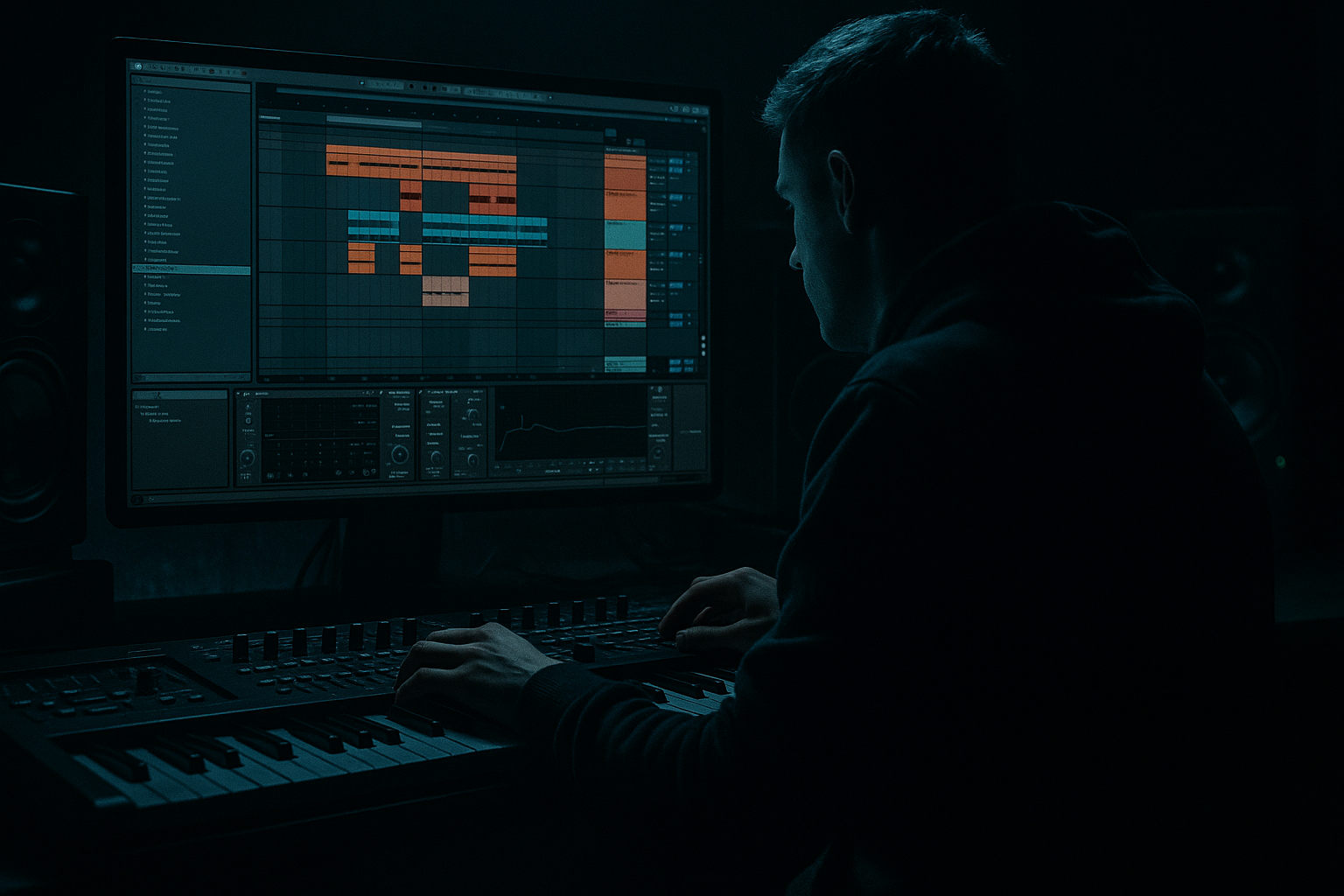
Main tutorial
Lesson Overview
This lesson is about taking a top loop, printing it into audio, and reshaping it into a bassline that carries both modern DnB punch and vintage soul. In practical terms, you’re turning a musical loop—soul chop, jazz phrase, guitar stab, Rhodes fragment, horn lick, whatever has attitude—into a bassline element that sits inside a Drum & Bass drop without sounding like a lazy sample loop.
This technique lives right in the pressure point between rhythm and harmony: the place where a bassline stops being “just low end” and starts acting like a hook, a groove engine, or a call-and-response partner to the drums. In a real DnB track, this often shows up in the drop, a switch-up before the second half of the tune, or a breakdown-to-drop transition where you want character without sacrificing impact.
Why it matters: modern DnB needs bass weight, but it also needs identity. A resampled top loop gives you harmonic texture, human timing, and a built-in emotional fingerprint. If you process it correctly in Ableton Live 12, you can keep the soul of the original while making it hit like a current club record: tight transient control, strong midrange translation, disciplined stereo, and enough movement to feel alive in the mix.
This lesson suits liquid-leaning rollers, dark soulful DnB, deeper jungle-tinged material, half-time switch sections, and even heavier tracks when you want a musical contrast before the bass gets ugly again. By the end, you should be able to hear a loop transformed into a bass element that is rhythmic, weighty, and intentional—not just “sampled,” but produced into the track.
What You Will Build
You will build a resampled top-loop bassline that feels like a chopped musical phrase fused with a modern DnB low-mid punch layer.
The finished result should have:
- a gritty, soulful character with enough edge to survive a dense drum bus
- a rhythm that locks with the kick/snare and leaves room for the sub
- a role that works as either the main bass phrase or a secondary hook layer
- a polished, mix-aware shape that can go straight into arrangement without sounding like a rough sketch
- Use a more aggressive harmonic cutoff than you think. Dark DnB bass often works better when the source sounds slightly “cornered” rather than lush. A filtered, gritty loop can feel heavier than a wide-open one because it leaves more space for the drums to dominate.
- If the loop has soul but not enough menace, print two layers: one clean-ish mid layer for phrase identity and one dirtier layer with Saturator or Overdrive for attitude. Keep the dirty layer quieter than you think. The job is menace, not fuzz for its own sake.
- For a neuro-leaning edge, automate very small filter movements or tonal shifts between phrase repeats instead of big wild sweeps. Heavy DnB often gets its motion from controlled repetition plus tiny changes, not from obvious “effect” moments.
- Shorten release and tail behavior when the bassline needs more punch. Long tails can feel emotional, but in a dense roller they often smear the next snare. Tight endings make the track feel more modern and DJ-friendly.
- If the original loop has a vintage feel that you want to preserve, avoid over-compressing the life out of it. Use enough compression to stabilize the line, then let the musical phrasing carry the soul. A dead sample with great EQ is still a dead sample.
- For extra underground character, try resampling the processed bassline again after a small change in automation. The slight print-to-print variation can create a more organic, less “copy-paste” texture, especially in darker jungle-inflected arrangements.
- Keep checking the bass against the break or drum pattern in mono. Heavy DnB often sounds massive in stereo but loses authority when the club system sums it. If the groove survives mono, you’ve got something usable.
- Use only Ableton stock devices.
- Keep the main resampled bass mostly mono.
- Use no more than three processing devices on the printed bass.
- Build exactly one 4-bar phrase, then make one variation for bar 4 or the second half of bar 4.
- one processed bassline loop
- one alternate variation
- a quick arrangement snippet with drums and sub so you can hear the interaction
- Does the bass still feel musical, not just chopped?
- Can the snare still cut through?
- Does the line stay readable when you lower the volume and listen in mono?
- Would this work in an actual drop, or does it only sound interesting soloed?
Success sounds like this: the loop still hints at its original musical source, but now it behaves like a DnB bass instrument—tight, syncopated, controlled in mono, and punchy enough that you can drop it under a break without it turning into mush.
Step-by-Step Walkthrough
1. Choose the right top loop and trim it for bass behavior
Start with a loop that has musical identity in the upper mids: vocals, keys, guitars, horns, chops, or a dusty instrumental phrase. You are not looking for full-range content here. You want something with rhythm and personality above the low end, because the bass character will come from how you reshape it, not from the source’s sub.
In Ableton, drag the loop into an audio track and immediately trim it down to the most usable phrase—usually 1 to 2 bars. If the loop has a strong tail, cut it so the phrase resolves cleanly on the bar line or at least on a musically useful offbeat. If it’s a longer sample, find a section with a clear accent pattern; top loops with obvious micro-groove tend to resample into better bass phrases than flat, even ones.
What to listen for:
- a rhythmic shape that already suggests a groove
- a tonal center you can hear without the loop being too busy
- enough space between hits that the resampled bass can breathe
If the source is too full or too wide, it will fight the kick/snare later. A clean top-loop source gives you more control when you start stripping it down.
2. Commit the loop to a version you can abuse
Before you process anything, duplicate the track or freeze your safety version. Then make a working copy for the bass treatment. In a real session, this saves you from over-processing the only usable take.
If the loop is tempo-flexible, warp it so the hits land in time with your project. For DnB, you often want the source phrase to feel locked to the grid, but not sterilized. Keep the groove human by preserving the swing inside the loop, especially if you’re building a rolling or jungle-leaning bassline.
Workflow efficiency tip: color-code the working track and rename it immediately, something like “Top Loop Bass PRINT” or “Soul Bass Resample.” Small naming discipline makes arrangement faster when you’ve got eight other drum and bass layers open.
Stop here if the sample is not rhythmic enough. If the loop has no usable pulse, it may still work as atmosphere, but it will fight the goal of turning it into a bassline. Choose a more percussive musical source rather than forcing a pad into this job.
3. Strip the loop into the bass zone with EQ and filtering
Insert EQ Eight first. High-pass the loop aggressively to remove anything that would interfere with your sub and kick. For most top-loop bass jobs, start around 150–250 Hz and adjust by ear. If the sample is especially muddy, push it higher. You are not trying to preserve body here; you’re creating a low-mid bass impression without actual sub dependency.
Then shape the remaining tone with a band focus:
- if the loop is too sharp, dip 2–5 kHz slightly
- if it needs more bark, let a small presence remain around 700 Hz–1.5 kHz
- if it sounds boxy, cut 250–500 Hz carefully
For a darker DnB feel, a gentle low-pass around 6–10 kHz can make the sample feel more “bass instrument” and less “loop on top of the beat.” If you want a more modern, present edge, leave some upper harmonics alive and let saturation do the color work instead.
Why this works in DnB: the sub lane needs clarity, so the top-loop bass should occupy the low-mid and midrange narrative, not the actual sub region. This keeps the drop readable and gives your kick/sub relationship room to breathe.
4. Decide your character lane: A or B
At this point, choose one of two valid directions depending on the flavour you want.
A. Vintage soul with modern punch
- Keep more of the loop’s harmonic detail
- Use lighter filtering
- Let the phrasing remain recognisably musical
- Best for liquid rollers, deep DnB, soulful halftime sections
B. Darker, more weaponised bass texture
- Filter harder
- Push saturation and transient shaping more aggressively
- Reduce musical detail until the loop becomes a riff engine
- Best for darker rollers, jungle-tech, neuro-adjacent groove layers, and tension sections
This is a real creative decision, not a preference test. A keeps identity and warmth. B gives you attitude and density. Both can work in DnB; the track context decides.
5. Resample the loop into audio, then chop it like a bass phrase
Once the tone is right, resample it to audio. In Ableton, record the processed loop onto a new audio track, then work from the printed result. This is where the idea becomes a playable instrument instead of a static loop.
After printing, slice the audio into small phrase fragments or single-note-feeling hits. You are looking for 1/8, 1/16, or syncopated fragments that can be rearranged into a bassline pattern. Don’t cut everything into tiny pieces unless you want a frantic jungle stutter. For a modern punchy result, keep some longer notes so the line has weight.
Suggested phrase shapes:
- a two-hit pickup into a held note
- a three-note call that resolves on the “and” of 2 or 4
- a short stab followed by a gap, then a longer sustain
- a repeated offbeat figure that locks with the snare space
What to listen for:
- whether the chopped audio still has a clear groove when muted against the drums
- whether the chops feel like bass notes, not random sample edits
If the printed result feels weak, do not immediately overlayer it. Re-chop the phrase so the accents land better. In DnB, rhythm often fixes the impression of weight more effectively than more processing.
6. Process the printed chops with a stock Ableton chain
Start with a practical chain that keeps the sample focused and club-safe. Two solid stock-device examples:
Chain 1: EQ Eight → Saturator → Drum Buss → Compressor
- EQ Eight: remove unwanted low-end, tame harshness
- Saturator: add harmonics and perceived weight
- Drum Buss: add transient density and a touch of punch
- Compressor: even out the chopped phrase so one note doesn’t jump out
Good starting suggestions:
- Saturator Drive: around 2 to 6 dB
- Saturator Color: moderate, not maxed
- Drum Buss Drive: subtle to medium
- Drum Buss Boom: usually minimal here; too much can blur the groove
- Compressor ratio: light to moderate, with fast enough control to catch peaks
Chain 2: Auto Filter → Overdrive → EQ Eight → Glue Compressor
- Auto Filter: animate the tone, especially for drops or switch-ups
- Overdrive: roughen the edges and bring the source forward
- EQ Eight: clean up the added grit
- Glue Compressor: bind the chopped phrase into a single bass gesture
This second chain is better if you want more movement and less “sample by numbers.” It works especially well when the top loop is already expressive and you want the bassline to feel like one evolving instrument.
Mix-clarity note: keep the processed loop out of the true sub area. Even if it sounds cool soloed, if it starts filling the 40–80 Hz zone too much, it will blur with the kick/sub. High-pass again after saturation if needed.
7. Shape the groove against the drums, not in isolation
Bring the bass line into context with your kick and snare early. In DnB, the relationship matters more than the solo tone. A bass chop that sounds “big” alone can be useless if it steals the snare’s impact or masks the kick’s front edge.
Place the line around the drums in a way that leaves the main drum accents intact. A common roller move is to let the bass answer the snare rather than land directly on top of it. If your snare is on 2 and 4, try bass notes that hit just before or just after those anchors to create forward motion.
If the loop has rhythmic swing, preserve that feel rather than grid-aligning every chop rigidly. A tiny timing nudge—just a few milliseconds—can make the bass feel tucked behind the drums or pushed slightly ahead of them. Use that intentionally:
- slightly behind for laid-back, weighty soul
- slightly ahead for urgency and bite
What to listen for:
- whether the snare still cracks through
- whether the kick’s attack is being swallowed by the sample’s transient
If the bass feels busy, remove notes before compressing harder. In DnB, negative space is often what makes the groove hit.
8. Add controlled movement without breaking mono
Once the chops are grooving, introduce motion carefully. Use Auto Filter automation or subtle LFO-like movement only on the midrange character, not on the low bass fundamentals.
Two useful approaches:
- keep the bass mostly centered and mono, then add tiny filter movement for life
- widen only a duplicated higher layer, leaving the core bass in mono
If you want the sample to feel more animated, automate a low-pass filter opening slightly into the peak of a phrase, then closing back down before the next snare. Typical useful movement might live in the 500 Hz to 4 kHz impression range, not in the sub area.
Mono-compatibility note: keep the important weight in mono. If the processed loop feels exciting only because of stereo widening, it will often collapse poorly on club systems and lose punch. Test it in mono or with a utility-style mono check and make sure the groove still reads.
Decision point:
- For a cleaner club roller, keep the bass center-heavy and let drums supply width through overheads, rides, and ambience.
- For a moodier intro or breakdown, allow a slightly wider top layer, then collapse it again at the drop.
9. Print variations and build a phrase with arrangement in mind
Don’t stop at one loop pass. Print at least one alternate version:
- a more filtered, darker version for the main drop
- a brighter, more open version for a fill, bridge, or second-drop evolution
Build the bassline in 4-bar phrases if possible. DnB relies heavily on phrase logic:
- bars 1–2: establish the groove
- bar 3: add a small variation or pickup
- bar 4: create tension or a call-and-response pause
- next 4 bars: repeat with one change so the drop feels alive
A good arrangement move is to let the resampled top-loop bass act as a “hook answer” to the drums in the first 4 bars, then strip it down on bar 5 or 6 to let the track breathe. For the second drop, evolve the phrase by changing one rhythmic hole, one filter position, or one octave layer.
Successful result cue: the listener should feel the bassline as part of the drum narrative, not as a pasted-on sample. It should move the drop forward and create a recognisable identity within 8 bars.
10. Commit, compare, and lock the winning version
Once you have two or three useful variations, commit the best one to audio and stop treating it like a draft. This is especially important in DnB, where over-editing can flatten the excitement out of a good groove.
Compare versions:
- Which one supports the snare better?
- Which one survives the sub lane?
- Which one feels more “track” and less “sound design”?
If one version has great character but weak low-end discipline, keep it for a breakdown or call-and-response section. If another is less flashy but makes the drop hit harder, that one probably wins for the main arrangement.
Commit this to audio if the groove is already working and you’re only making tiny gain or EQ changes. At that point, you want to move on and design the track around the bassline, not keep polishing it until it loses life.
Common Mistakes
1. Leaving too much low-end in the original loop
Why it hurts: it collides with the sub and kick, making the drop muddy and smaller than it should be.
Fix: use EQ Eight to high-pass more aggressively, often well above 150 Hz, and re-check in context with kick and sub.
2. Over-chopping the phrase into nervous fragments
Why it hurts: the line loses weight and starts sounding like edit practice instead of a bassline.
Fix: keep at least some longer notes or sustained chops so the groove has body.
3. Using too much widening on the core bass
Why it hurts: the low-mid body gets unstable in mono and weakens on club systems.
Fix: keep the main resampled bass centered; if you want width, add it only to a higher layer.
4. Saturating before cleaning up the spectrum
Why it hurts: you amplify mud and harshness, then spend too long fighting the wrong problem.
Fix: high-pass and shape first, then saturate, then re-EQ after the distortion.
5. Ignoring the snare and kick relationship
Why it hurts: the bass may sound good alone but kills the drum hierarchy.
Fix: audition the loop with the full drum break or drum pattern from the start and move notes around the snare space.
6. Making the bassline too static across 8 bars
Why it hurts: DnB drops rely on micro-variation to keep energy alive.
Fix: add one small change every 4 bars—filter, chop order, octave touch, or note omission.
7. Letting the processed loop fight the sub lane
Why it hurts: the track loses clarity and the low end stops feeling authoritative.
Fix: keep the sub separate and make sure the resampled top loop is mainly a low-mid/mid bass voice.
Pro Tips for Darker / Heavier DnB
Mini Practice Exercise
Goal: turn one 1–2 bar top loop into a usable DnB bassline phrase that can sit under drums.
Time box: 15 minutes.
Constraints:
Deliverable:
Quick self-check:
Recap
Resample the top loop after shaping it, not before.
Keep the core bass centered, clean, and low-end disciplined.
Use chopping and phrasing to create groove, not chaos.
Process with intention: harmonic grit, not random distortion.
Check the bass against drums early, because DnB lives or dies on that relationship.
Print variations, commit the winner, and build the arrangement around it.

