Main tutorial
Resample an Amen-style Call-and-Response Riff for Ragga-Infused Chaos in Ableton Live 12
1. Lesson overview
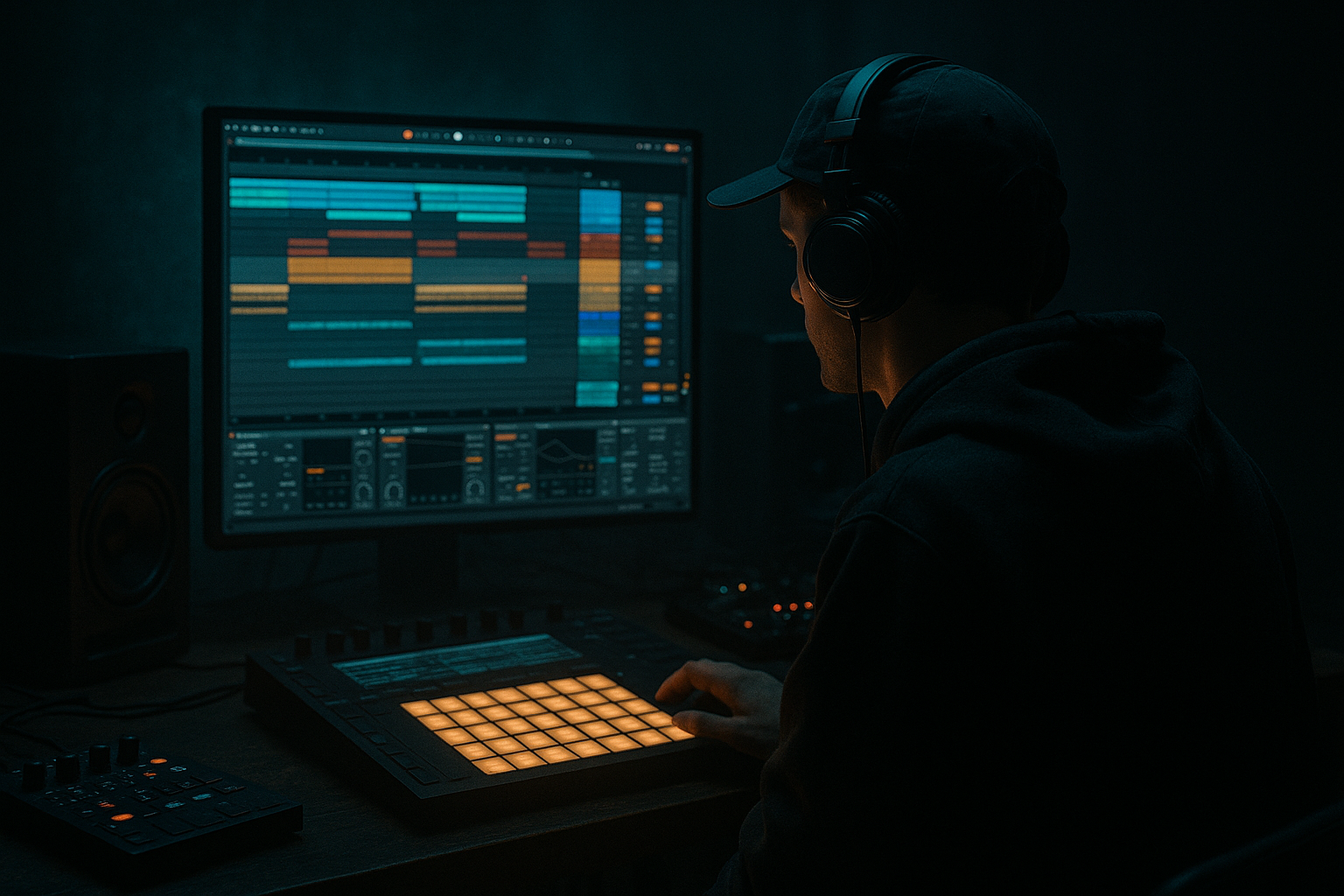
In this lesson you’re going to build a ragga-flavoured Amen call-and-response riff and then resample it into new audio material for heavier, more chaotic drum and bass arrangement ideas. The goal is not just to “make a loop,” but to create a living, unstable, rewriteable rhythmic phrase that feels like old-school jungle energy colliding with modern DnB sound design 🔥
This is an intermediate-level workflow focused on:
- Programming an Amen-style break
- Creating a call-and-response between drums, chops, and vocal/ragga snippets
- Using Ableton Live 12 stock devices to resample and mangle the result
- Turning the resampled audio into a new riff, fill, or drop element
- Shaping it for darker/heavier drum and bass arrangements
- intro tension
- drop call-outs
- mid-section fills
- rearranged break edits
- bassline interplay with ragga vocal energy
- A 2-bar Amen-based drum loop
- A call-and-response phrase between:
- A resampled audio clip of that phrase
- A processed “chaos layer” you can chop, pitch, reverse, and reassemble
- A drop-ready DnB arrangement idea that sits under a bassline
- Question: Amen slice + vocal/ragga hit + little fill
- Answer: reverse hit / ghost snare / tom stab / filtered return
- Mode: Slice
- Warp: On
- Slice by: Transient
- Playback: Classic or One-Shot depending on the slice
- Spread the slices across your MIDI keyboard
- Keep the main kick/snare structure
- Pull out one or two ghost hits
- Add a small fill at the end of bar 2
- Emphasize the snare backbeat for DnB drive
- Drive: 5–15%
- Crunch: slight
- Boom: low or off for now
- Transients: slightly up
- High-pass around 25–35 Hz
- Small cut if the break is muddy around 200–350 Hz
- Gentle boost around 5–8 kHz if the hats need bite
- Soft Clip: On
- Drive: 2–5 dB
- Output adjusted to match level
- a single vocal shout
- a short phrase
- a micro-hook
- a classic ragga/toasting one-liner
- even a chopped consonant or exclamation can work
- Warp: On
- Warp mode: Complex Pro for longer vocal phrases
- Warp mode: Beats for short chopped hits
- beat 1 or
- the “and” of 2 or
- beat 4 as a pickup into the next bar
- another drum chop
- reverse vocal
- tom hit
- rimshot
- snare flam
- reverb tail
- filtered Amen fragment
- Duplicate the vocal sample
- Reverse it
- Place it just before the next drum hit
- toss in a ghost snare
- add a tiny hat pickup
- keep it syncopated and sharp
- pitch slightly lowered
- short decay
- tight transient
- Amen hit pattern
- Ragga vocal call on beat 1 or the offbeat
- Small snare or hat fill at the end
- Amen variation
- Reverse vocal or drum response
- Small pause or syncopated hit before the loop restarts
- Swing the hats slightly
- Use ghost notes sparingly
- Offset vocal hits by a few milliseconds if needed
- Let the snare land confidently on the grid while the fill elements “wobble”
- cut new slices
- reverse individual hits
- pitch segments
- warp tiny fragments
- create variations that are harder to make in MIDI
- a strong call
- a strong response
- one or two accidental textures
- a drum tail or echo worth keeping
- Slice to New MIDI Track
- Slice by: Transient
- Create a new MIDI track with Drum Rack
- duplicate tiny fragments
- reverse selected chops
- pitch some chops down a semitone or two
- offset slices for stutter energy
- vocal consonants
- snare tails
- break fills
- tiny pickup hats
- delay throws
- reverse hits
- Mode: Low-pass
- Resonance: moderate
- Use automation for movement
- Drive: 3–8 dB
- Soft Clip: On
- Interval: 1 bar or 1/2 bar
- Grid: 1/16 or 1/32
- Chance: 20–50%
- Variation: moderate
- Mix: keep it subtle unless you want obvious stutters
- Time synced to 1/8 or 1/4
- Filter the repeats
- Add a little modulation for movement
- Use width changes to automate tension
- Narrow the break before a drop, then open it up on impact
- Redux for downsampled crunch
- Drum Buss for punch and smack
- Overdrive if you want harsher upper-mid grit
- Start with filtered fragments of the riff
- Bring in the vocal call as a teaser
- Let the response appear only once or twice
- Increase automation on filter cutoff
- Add more Beat Repeat activity
- Shorten gaps between call and response
- Bring in full drums and bass
- Let the riff punctuate the bassline every 2 or 4 bars
- Use the resampled audio as a midrange hook
- Strip back to one vocal call
- Leave a long echo tail
- Reintroduce the Amen via resampled fragments
- Operator
- Wavetable
- Analog
- or resampled bass audio
- Keep the vocal riff mostly in the midrange
- Avoid too much low end in the chop layer
- Sidechain the riff lightly to the kick/snare if needed
- Use EQ Eight to carve space around 150–400 Hz
- Put Compressor on the riff
- Use Sidechain from the kick or main drum bus
- Aim for subtle pumping, not EDM-style ducking
- tape noise
- vinyl crackle
- room tone
- filtered distortion noise
- one clean
- one distorted
- one reversed
- one filtered
- one Beat Repeat version
- bar 1 is dry
- bar 2 is filtered
- bar 3 is heavily resampled
- bar 4 drops to a single vocal hit before the loop resets
- Build the groove from an Amen foundation
- Add a ragga vocal call
- Answer it with a drum or vocal response
- Resample the phrase to audio
- Chop, reverse, filter, and process the new material
- Use the result as a drop hook, fill, or transition
- Keep the arrangement spacious, syncopated, and aggressive
- Simpler
- EQ Eight
- Saturator
- Drum Buss
- Echo
- Hybrid Reverb
- Beat Repeat
- Utility
- Compressor
- Auto Filter
- Redux
- a step-by-step Ableton screen workflow
- a rack preset recipe
- or a full 8-bar arrangement blueprint for the drop.
You’ll learn a practical workflow you can use for:
---
2. What you will build
By the end, you’ll have:
- the break
- a ragga vocal hit / stab / FX phrase
- a secondary drum response
Recommended tempo
Set your project to 174 BPM.
This keeps the energy in classic DnB / jungle territory while still giving you enough space for syncopation.
Core idea
Think in question and answer:
That back-and-forth is what gives the riff its ragga-infused personality.
---
3. Step-by-step walkthrough
Step 1: Set up the session and tempo
1. Open Ableton Live 12.
2. Set the tempo to 174 BPM.
3. Create:
- 1 MIDI track for drums
- 1 audio track for the vocal/ragga sample
- 1 audio track for resampling
- Optional: 1 return track for delay/reverb FX
Session view vs Arrangement view
For this workflow, start in Session View so you can loop and experiment quickly. Once the riff feels right, move it into Arrangement View for structuring the drop.
---
Step 2: Build the Amen foundation
Load an Amen break sample into Simpler on the drum MIDI track.
Good starting setup in Simpler
Basic Amen programming idea
Use the Amen as the skeleton, but don’t just play it straight. Try this:
Practical drum shaping
On the Amen track, after Simpler, add:
#### 1. Drum Buss
Good starting settings:
Use this to give the break more body and attitude without wrecking the transients.
#### 2. EQ Eight
#### 3. Saturator
This helps the break sit inside a modern DnB mix without sounding too thin.
---
Step 3: Add the ragga call
Now create the “call” part of the riff with a ragga-style vocal snippet, toasting phrase, or a short shouted sample.
Sample choice
Look for:
You want something rhythmic and recognizable, not a long lead vocal.
Processing the vocal
Put the vocal sample on an audio track and use:
#### Simpler or direct audio clip
#### Stock devices for tone
1. EQ Eight
- High-pass around 120–180 Hz
- Reduce boxiness around 300–600 Hz if needed
2. Saturator
- Drive: 1–4 dB
- Soft Clip: On
3. Echo
- Time: 1/8 or 1/8 dotted
- Feedback: 15–30%
- Filter the repeats so they don’t clutter the low mids
4. Redux for grit if needed
- Very subtle unless you want lo-fi roughness
Placement
Put the vocal hit on:
The key is to make it answer the drum phrase, not sit randomly on top.
---
Step 4: Program the response
Now create the “response” using either:
This response should feel like the track is talking back.
Good response techniques
Try one of these:
#### Option A: Reverse the vocal
#### Option B: Extra Amen chop
Use a sliced Amen snare or hat hit:
#### Option C: Tom or rim response
Add a single tom or rim shot with:
Device chain for response hits
A simple but effective chain:
1. EQ Eight
2. Utility
- Width: 100% or narrower if the hit is too wide
3. Saturator
4. Reverb or Hybrid Reverb
- Decay: short
- Pre-delay: 10–20 ms
- Keep it tucked in
This creates a sense that the response is bouncing inside a concrete tunnel—perfect for grimy DnB.
---
Step 5: Build the call-and-response groove
Now combine the elements into a 2-bar riff.
Example structure
Bar 1
Bar 2
Important arranging trick
Leave space.
If every 16th note is filled, the groove loses impact. In DnB, the negative space is part of the groove.
Groove tips
---
Step 6: Resample the riff
Now comes the key part: turning the programmed riff into audio so you can chop it like a jungle weapon 🔊
How to resample in Ableton Live 12
1. Create a new audio track
2. In the track’s input, select:
- Resampling
or
- route from the riff group/master if preferred
3. Arm the audio track
4. Record a few bars of the riff
Why resample?
Because audio lets you:
Resampling mindset
Don’t aim for perfection.
Aim for a few interesting bars that contain:
Those little imperfections often become the best parts.
---
Step 7: Chop the resampled audio
Drag the recorded audio into a new track or into a fresh audio clip view and start slicing.
Useful options
#### 1. Slice to New MIDI Track
Right-click the clip and choose:
Good slicing settings:
This is excellent if your resampled riff has lots of identifiable hits.
#### 2. Manual chopping
If the groove is more complex, manually cut the audio in Arrangement View and:
What to chop
Focus on:
These make the riff feel alive.
---
Step 8: Process the resampled chaos layer
Now treat the resampled audio like a new instrument.
Suggested audio chain for chaos
Try this on the resampled track:
#### 1. Auto Filter
#### 2. Saturator
#### 3. Beat Repeat
Very powerful for jungle-style edits.
#### 4. Echo
#### 5. Utility
If you want more grime
Add:
---
Step 9: Turn the resample into arrangement material
Now use the resampled chop as a musical arrangement element.
Arrangement ideas
#### Intro
#### Build-up
#### Drop
#### Breakdown
DnB arrangement principle
Your riff should complement the bassline, not fight it.
If the bass is already busy, keep the riff short and percussive.
If the bass is minimal, the riff can be more vocal and expressive.
---
Step 10: Blend with the bassline
A ragga-infused DnB riff works best when it sits around the bassline rather than overloading the same frequencies.
Bassline management
Use:
Mix placement tips
Sidechain suggestion
If your riff clashes with the drums:
---
4. Common mistakes
1. Making the riff too busy
If every bar is packed with chops and vocal bits, the groove stops breathing.
Fix:
Leave at least one clear gap per bar where the listener can feel the bounce.
---
2. Overprocessing the break
Too much saturation, compression, or distortion can kill the Amen’s punch.
Fix:
Use a light chain first, then add aggression only where it helps.
---
3. Ignoring transient timing
Even a great chop can feel weak if it lands late or too early.
Fix:
Zoom in and nudge slices until the call-and-response locks with the snare grid.
---
4. Too much low end in the vocal sample
Ragga vocals can carry muddy low mids, which fights the bassline.
Fix:
High-pass the vocal around 120–180 Hz and clean up mud around 300–600 Hz.
---
5. Not resampling enough
If you only keep the MIDI version, you miss the unstable character that makes jungle edits exciting.
Fix:
Resample early and often. Capture “mistakes” and use them as source material.
---
6. Using long delays without filtering
Uncontrolled echoes can cloud the groove quickly.
Fix:
Filter the delay return and keep feedback under control.
---
5. Pro tips for darker/heavier DnB
1. Use contrast between dry and wet
Make the call super dry and aggressive, then let the response bloom with a short reverb tail. That contrast adds menace.
2. Pitch the response down
Dropping the response by 1–3 semitones can make the riff feel heavier and more threatening.
3. Automate filter movement
For a darker drop, automate a low-pass filter so the riff opens gradually over 4 or 8 bars.
4. Layer a sub-neutral texture
If the riff is too thin, add a very quiet layer of:
This helps glue the chaos together without adding obvious musical clutter.
5. Use “empty” space as impact
One of the darkest tricks in DnB is a near-silence before the response.
Drop the riff out for a 1/4 beat or half-beat, then slam the next hit in hard.
6. Abuse resampling creatively
Render multiple passes:
Then comp the best bits into a final phrase. This is where jungle-style mutation happens.
7. Keep the snare authoritative
No matter how ragged the top layer gets, the snare should remain strong and readable. It anchors the chaos.
---
6. Mini practice exercise
Try this 15-minute exercise in Ableton Live 12:
Exercise goal
Create a 2-bar ragga Amen call-and-response riff and resample it into a new audio chop.
Steps
1. Set tempo to 174 BPM.
2. Load an Amen break into Simpler.
3. Program a 2-bar loop with:
- kick/snare backbone
- 2–4 ghost hits
- one small fill
4. Add a short ragga vocal hit.
5. Add a response:
- reverse vocal, or
- extra snare chop, or
- tom hit
6. Record the full phrase to an audio track using Resampling.
7. Chop the recorded audio into 4–8 pieces.
8. Process the chopped audio with:
- EQ Eight
- Saturator
- Echo
- optional Beat Repeat
9. Build a new 4-bar arrangement using the chopped version.
10. Bounce it and listen back for groove and space.
Challenge version
Do a second pass where:
That contrast will teach you how to make the riff feel like it’s evolving rather than just repeating.
---
7. Recap
You’ve now got a full workflow for making an Amen-style call-and-response riff with ragga energy and turning it into resampled chaos in Ableton Live 12.
Key takeaways
Best stock devices to remember
Final thought
The magic here is not in a perfect loop — it’s in the mutation. In drum and bass, especially jungle-leaning ragga-infused styles, the best riffs feel like they’re barely under control. Resampling gives you that edge. Use it to make your breaks talk back. 🎛️🥁
If you want, I can also turn this into:

