Main tutorial
Resample an Amen-style Mid Bass in Ableton Live 12
1. Lesson overview
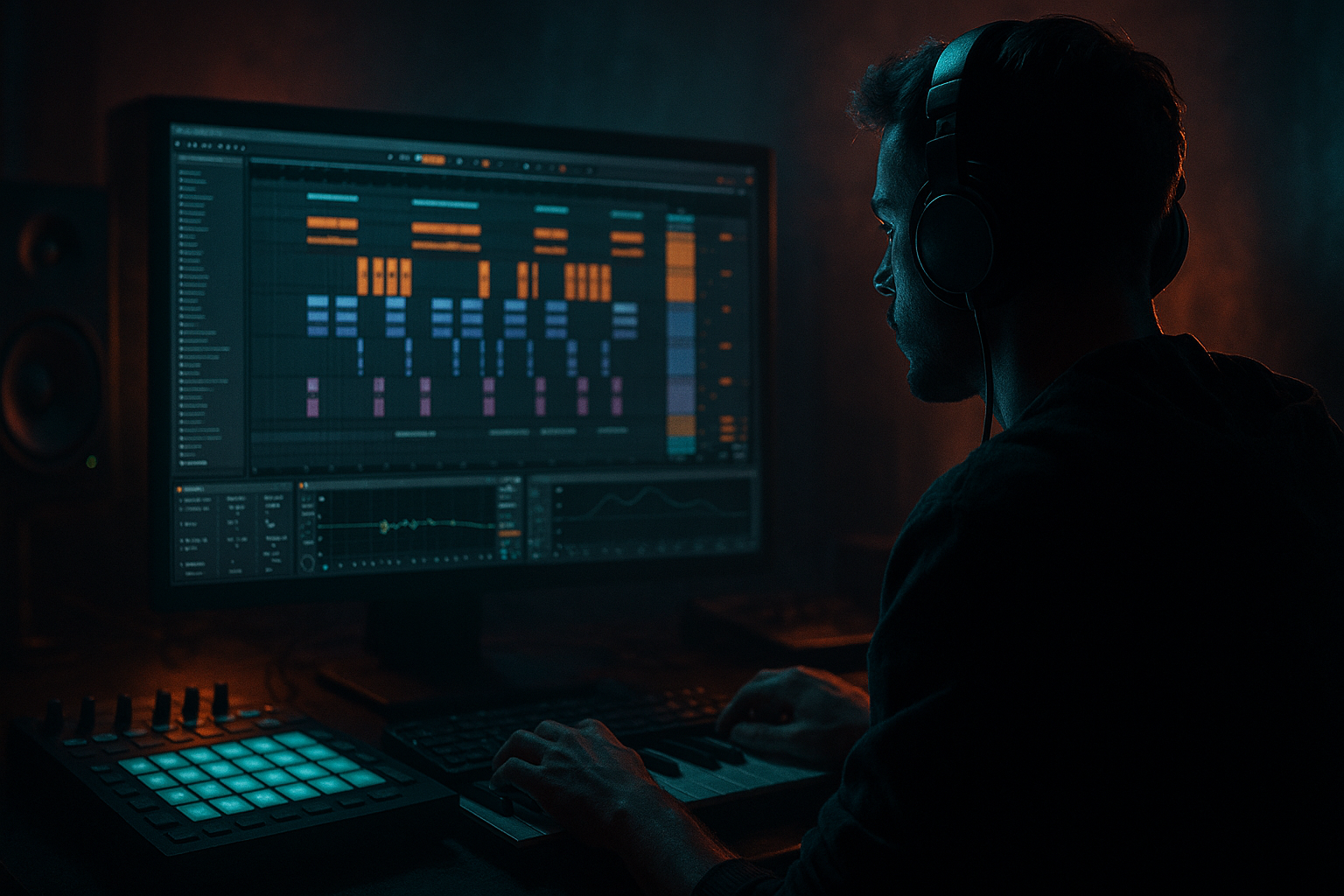
In this lesson you’ll learn how to build, resample, and reshape an Amen-style mid bass in Ableton Live 12 using a practical resampling workflow. This is a classic drum and bass technique: you design a bass idea, bounce it to audio, then chop, process, and re-record it until it becomes more aggressive, more musical, and more “finished.” 🔥
Why resample?
- It gives your bass a more organic, edited, and intentional feel
- It lets you commit to sound design decisions
- It makes it easier to create movement, grit, and variation
- It’s perfect for jungle, rolling DnB, neuro-lite, and dark halftime bass design
- A MIDI bass idea with a simple rhythmic pattern
- A sound design chain using stock Ableton devices
- A resampled audio version of the bass
- A chopped and processed mid bass loop
- A variation workflow for drops, fills, and transitions
- Wavetable or Operator
- Saturator
- Auto Filter
- Redux
- Echo or Delay
- Drum Buss
- Utility
- Resampling
- Optional: Compressor / Glue Compressor
- 174 BPM for classic drum and bass
- 170–174 BPM if you want a rolling jungle feel
- 172 BPM is a great middle ground
- 1 MIDI track for your bass synth
- 1 audio track set to Resampling
- 1 drum rack or drum group if you want to sketch with drums too
- Short notes on offbeats
- A longer note at the start of bar 2
- A small pickup note before the snare
- Leave gaps so the groove can breathe
- Beat 1: short bass stab
- “&” of 1: another hit
- Beat 2: rest
- “&” of 2: hit
- Beat 3: longer note
- Beat 4: short note into the next bar
- Keep note lengths short at first: 1/16 to 1/8
- Use notes around F1–C2 for mid-bass territory
- Avoid going too low for this lesson — we want audible harmonic character, not sub-only weight
- Oscillator 1: saw or square-based waveform
- Oscillator 2: optional detuned layer for thickness
- Turn on Unison lightly if needed
- Filter: low-pass or band-pass, depending on how aggressive you want it
- Osc 1 level: 80%
- Osc 2 level: 30–50%
- Filter cutoff: around 200–800 Hz to begin
- Resonance: 10–25%
- Envelope amount: moderate
- Use a sine or triangle as the core
- Add light saturation later
- Use FM or feedback sparingly for bite
- Drive: +3 to +8 dB
- Soft Clip: On
- Output: compensate so the level doesn’t jump too hard
- Filter type: Band-pass or Low-pass
- Cutoff: automate or map to a Macro
- Resonance: 10–35%
- LFO: very subtle for movement if desired
- Downsample: light, around 1.5x to 3x
- Bit Reduction: subtle, not extreme
- Keep it musical — you want texture, not total destruction
- Delay time: 1/8 or dotted 1/8
- Feedback: 10–25%
- Filter inside Echo: cut low end
- Use Ping Pong lightly if you want stereo width
- Drive: 5–15%
- Crunch: small amount
- Boom: usually off or very low for mid bass
- Transients: slightly positive if you want more attack
- Damp: adjust to taste
- Set Bass Mono if needed
- Or simply use Width to narrow low-end stereo
- For mid bass, some width is fine, but avoid wide low mids
- Add a new Audio Track
- Set Audio From to Resampling
- Arm the track for recording
- You now have audio, not just MIDI
- Audio can be cut, reversed, warped, and re-pitched
- You can process individual slices more aggressively
- 4 bars of the main bass loop
- 2 bars of variation
- 1 bar with a fill or extra note hits
- Split at transients or rhythmic hits
- Keep the strongest bass stabs
- Delete weak or muddy bits
- Rearrange slices to create new syncopation
- Right-click the audio clip
- Choose Slice to New MIDI Track
- Choose a slicing preset like:
- High-pass around 80–120 Hz if this is strictly a mid bass layer
- Cut harsh resonances around 2–5 kHz if needed
- Add a small boost in the presence area if the bass is too dull
- Answer phrases
- Build-ups
- Fill-ins before the snare
- Drop transitions
- Ratio: 2:1 to 4:1
- Attack: 10–30 ms
- Release: Auto or around 50–100 ms
- Aim for gentle control, not flattening
- Short bass stab
- Pause
- Another stab
- Filter open slightly
- More active chopped rhythm
- One longer note as a “lead” phrase
- Small delay tail at the end
- Same pattern, but with a different slice order
- Reverse one slice for variation
- Cut one note early for tension
- Fill bar
- Higher note variation
- Filter sweep or short stop
- Echo
- Drum Buss
- Redux
- EQ Eight
- Square
- Saw with low-pass filtering
- Wavetable positions with more harmonic midrange
- Saturator
- Roar if available in your Live version
- Drum Buss
- Overdrive
- fully closed filter
- filter half open
- filter sweeping upward
- Sub: clean sine or filtered low bass
- Mid bass: resampled gritty layer
- This keeps the mix heavy and controlled
- filter cutoff
- send level to delay
- clip gain
- warp markers for micro-stutter effects
- darker
- more aggressive
- more spacious
- Build a bass patch with stock devices
- Shape it with saturation, filtering, and distortion
- Record it through resampling
- Chop and rearrange the audio
- Process it again for a darker, heavier DnB result
- a Live 12 rack recipe
- a 2-bar MIDI example
- or a dark neuro-style version of the same workflow
In this tutorial, you’ll create a mid bass inspired by the Amen break energy: rhythmic, chopped, and call-and-response, with the bass acting like a second percussion layer.
---
2. What you will build
By the end, you’ll have:
We’ll use:
---
3. Step-by-step walkthrough
Step 1: Set up a DnB project
Start with a project at:
Create:
If you already have an Amen break playing, great. If not, even a simple kick/snare loop is enough while you build the bass.
---
Step 2: Program a simple Amen-style mid bass rhythm
The Amen break is famous for its chopped, syncopated feel. Your bass should interlock with the drums, not just sit underneath them.
Create a MIDI clip of 1 or 2 bars and try a pattern like this:
Example concept:
Think of it like bass answering the drum break.
#### MIDI tips
---
Step 3: Build the starting bass sound
Let’s make a bass patch that resamples well.
#### Option A: Wavetable
Insert Wavetable and start simple:
Suggested starting values:
#### Option B: Operator
Great for cleaner but punchy bass resampling.
For a beginner, Wavetable is easier to shape quickly.
---
Step 4: Add movement with an FX chain
Now add a chain that gives the bass character before resampling.
#### Suggested device chain:
1. Wavetable
2. Saturator
3. Auto Filter
4. Redux (lightly)
5. Echo or Delay
6. Drum Buss
7. Utility
#### 1) Saturator
Use this to add harmonics and make the bass more audible on small speakers.
Suggested starting settings:
Try Analog Clip or Soft Sine depending on the tone.
#### 2) Auto Filter
Use an LFO or envelope-like movement to create rhythm.
Settings:
A band-pass filter can be especially good for that chopped, vocal-like DnB mid bass tone.
#### 3) Redux
This gives digital crunch and upper-mid bite.
Settings:
#### 4) Echo or Delay
Add motion and space, but keep it tight.
Suggested:
For bass, be careful: too much delay can blur the groove.
#### 5) Drum Buss
Excellent for gritty DnB bass.
Settings:
#### 6) Utility
Use Utility to keep the bass controlled.
---
Step 5: Record the bass using resampling
Now comes the key workflow.
#### Create a resampling track
#### Record your bass phrase
Play the MIDI bass line and record a few bars of the processed output.
Why this matters:
Record at least:
---
Step 6: Chop the resampled audio into usable slices
Drag the recorded audio into a new audio track or keep it in place and edit it directly.
#### Two practical ways:
##### Method A: Manual chopping
##### Method B: Convert to Simpler
If you want more control:
- Transients
- 1/16
- Warp Marker if the source is clean
This is great for making a bass “breakbeat” from your own resampled audio.
---
Step 7: Process the resampled audio for more aggression
Now that it’s audio, you can treat it like an FX source.
#### Suggested post-resample chain:
1. EQ Eight
2. Saturator
3. Auto Filter
4. Redux
5. Compressor
6. Reverb or Hybrid Reverb very subtly
7. Utility
#### EQ Eight
Clean up the low end:
#### Saturator again
Yes, again. Resampled audio often loves another hit of saturation.
#### Auto Filter automation
Automate the cutoff so the bass opens and closes across the phrase.
Use this to create:
#### Compressor
If the resampled chops vary in level, use compression to tighten them.
Suggested:
---
Step 8: Create a call-and-response drop pattern
This is where the Amen-style energy really comes alive.
Try arranging your bass like this:
#### Bar 1
#### Bar 2
#### Bar 3
#### Bar 4
This keeps the bass feeling like part of the breakbeat, not a static synth loop.
---
Step 9: Add final polish with resampling passes
This is the pro workflow: resample more than once.
You can do:
1. First pass: synth bass with FX
2. Second pass: chopped audio loop
3. Third pass: reprocess that loop with more effects
Each pass makes the sound more committed and often more unique.
Try a second pass with:
Then resample again if the result sounds promising.
This is how a lot of heavy DnB bass design evolves: not by one perfect patch, but by layered decisions.
---
4. Common mistakes
1) Making the bass too low
If the patch sits only in sub territory, you lose the Amen-style character.
Keep this lesson focused on mid bass, and let the sub do separate work.
2) Too much reverb or delay
A little space is cool, but too much smears the groove and kills the punch.
3) Resampling without gain staging
If your synth chain is too hot, the resampled file may clip badly and become unusable.
Watch levels before and after saturation.
4) Leaving the bass too static
A resampled bass should feel edited and alive.
Chop it, mute notes, reverse slices, and vary the filter.
5) Forgetting the drums
DnB bass works best when it locks to the break.
If the Amen groove is busy, make room in the bass arrangement.
6) Making every slice sound identical
Variation is the point of resampling.
Use different note lengths, filter settings, and effect sends across sections.
---
5. Pro tips for darker/heavier DnB
Use darker source waves
Try:
Add controlled distortion
Good stock devices for this:
Keep the bass aggressive but not unusable.
Band-pass is your friend
A band-pass filter can make the bass sound more like a chopped vocal or reese fragment, which works brilliantly in dark jungle and techy DnB.
Resample at different filter states
Record one pass:
Record another:
Record another:
Now you have multiple textures to build the drop.
Layer with a clean sub
Keep the mid bass resampled layer separate from the sub:
Use automation on the resampled audio
Automate:
That gives you the “edited jungle machine” feel.
---
6. Mini practice exercise
Try this 20-minute exercise:
Goal
Make a 2-bar resampled Amen-style mid bass loop.
Steps
1. Set project tempo to 174 BPM
2. Program a 2-bar MIDI bass phrase
3. Build a patch in Wavetable
4. Add:
- Saturator
- Auto Filter
- Drum Buss
5. Resample 2 bars to audio
6. Chop the audio into 6–10 slices
7. Rearrange the slices into a new groove
8. Add one automation pass for filter cutoff
9. Export or bounce the result
Challenge variation
Make a second version that sounds:
This will train your ear for how resampling changes the personality of the same idea.
---
7. Recap
Resampling an Amen-style mid bass in Ableton Live 12 is all about turning a simple synth idea into a rhythmic, editable audio performance.
You learned how to:
The big takeaway: in drum and bass, especially jungle-influenced music, bass isn’t just a note — it’s a rhythmic event. Resampling lets you sculpt that event until it fits the break perfectly. 🥁⚡
If you want, I can also turn this into:

