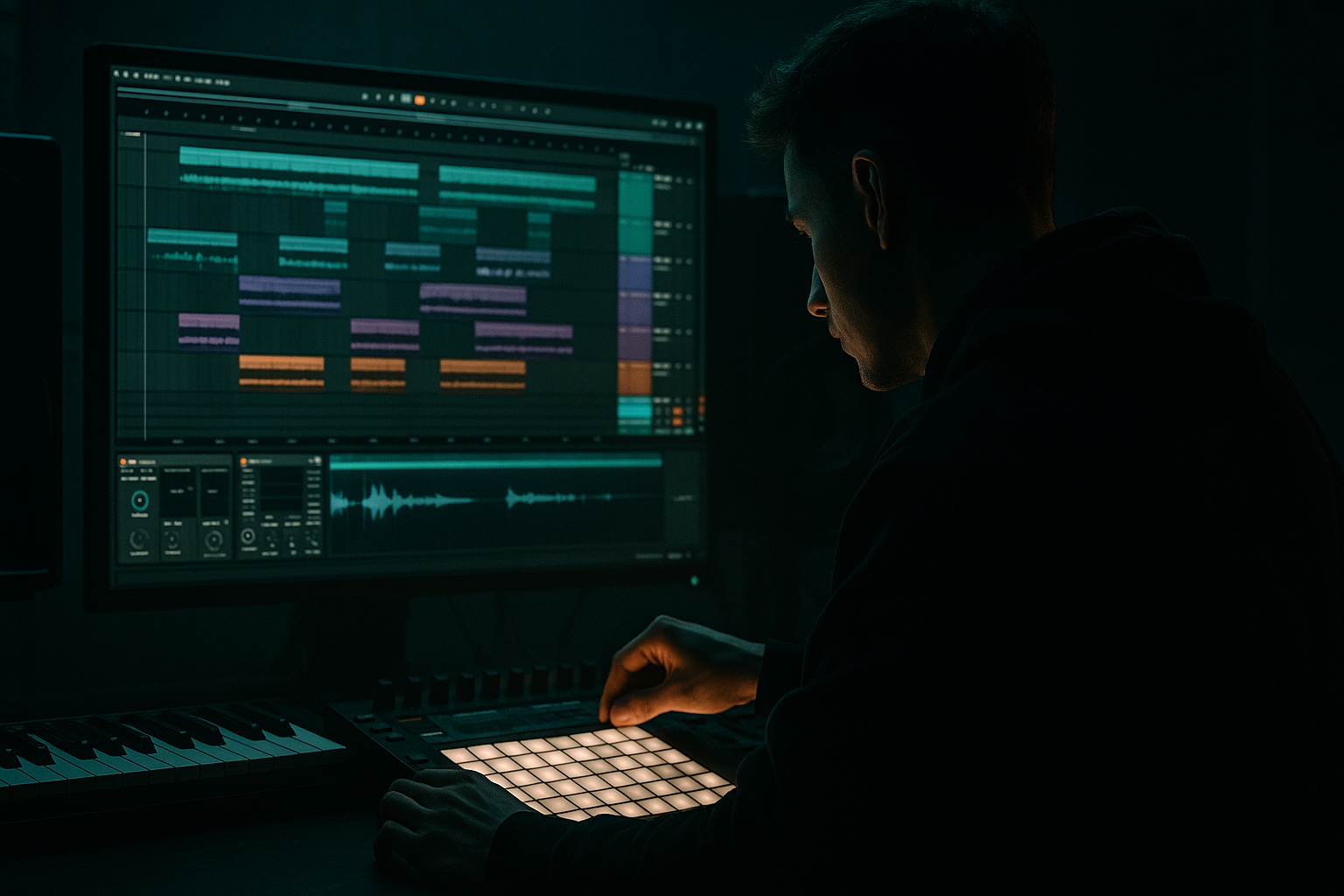
Main tutorial
Resample Oldskool DnB Fill for 90s-Inspired Darkness in Ableton Live 12
1. Lesson overview
In this lesson, you’re going to build a dark, oldskool drum and bass fill by resampling your own drum loop inside Ableton Live 12. This is a classic jungle / DnB technique: instead of drawing every drum hit manually, you mangle a loop, capture the best bits, then chop and reprocess it into a gritty, energetic fill that sounds like it belongs in a 90s warehouse set. 🔥
This approach is perfect for:
- Breaking up an 8- or 16-bar drum loop
- Adding tension before a drop
- Creating fake edits that sound sampled and raw
- Making your drums feel more human, dark, and aggressive
- A short resampled drum fill made from your own drum programming
- A slice-and-chop workflow using Ableton’s built-in tools
- A gritty 90s-style texture using stock effects
- A fill that works before a drop or between phrases in DnB / jungle arrangements
- Drum Rack
- Simpler
- Audio tracks
- Warp modes
- Beat Repeat
- Redux
- Drum Buss
- EQ Eight
- Compressor
- Reverb
- Optional: Auto Filter, Saturator, Vinyl Distortion
- Set your project tempo to 170–174 BPM
- Create a MIDI track
- Load Drum Rack
- Add the following sounds:
- Kick on 1
- Snare on 2 and 4
- Add a few offbeat hats
- Add ghost notes leading into snare hits
- Snare flams
- Hat bursts
- Ghost note clusters
- Small drum runs before the main snare
- Tiny transient-heavy moments that can be looped or chopped
- Stutters
- Triplet bursts
- Snare rushes
- Short reversed hits
- Tiny chopped fragments of breakbeat energy
- Warp On
- Beats mode for rhythmic material
- Preserve transient positions if needed
- Transient loop mode for punchy breaks
- 1/16 or 1/8 grid for slice-like edits
- Try Groove Pool if you want swing
- Set the clip to a short loop
- Duplicate a small section
- Nudge segments for a more “sample edit” feel
- Start sparse
- Add more hits every half beat
- End with a snare burst or crash into the drop
- Vinyl Distortion
- Saturator
- Gate
- Increase volume slightly over the fill
- Open the filter cutoff gradually
- Add more distortion as it approaches the drop
- Cut the kick out briefly before the final snare hit for impact
- First half: sparse chopped drums
- Second half: denser stutters and snare bursts
- Final hit: crash, sub drop, or reverse impact into the downbeat
- A reversed break hit
- A rimshot or snare ghost
- A vinyl crackle burst
- A sub drop or low tom
- Duplicate it
- Try a version with more distortion
- Try a version with less reverb
- Try a version with a different last hit
- Redux
- Saturator
- Drum Buss
- Dry
- Distorted
- Filtered
- Reversed tail
- Longer reverb version
- Dark
- Energetic
- Slightly gritty
- Clearly connected to oldskool jungle / DnB rhythm
- Build a drum loop
- Add grime and movement
- Resample it to audio
- Chop it into a fill
- Reprocess it with stock Ableton effects
- Automate it into a dark transition
- Resampling creates character
- Chopping creates tension
- Distortion and filtering create darkness
- Arrangement makes the fill useful in a track
- a beginner Ableton template
- a MIDI clip example
- or a follow-up lesson on making the bassline match the fill
We’ll use stock Ableton devices only, so you can do this with a standard Live 12 setup.
---
2. What you will build
By the end, you’ll have:
You’ll be working with:
---
3. Step-by-step walkthrough
Step 1: Build a basic oldskool drum loop
Start with a simple loop at a DnB tempo.
- Kick: punchy, short, slightly dirty
- Snare: tight and cracky with a strong transient
- Closed hat: short and bright
- Open hat or ride: optional for movement
- Ghost snare / rim / perc: for fill flavor
#### Simple starting pattern
Use a 2-step-ish DnB groove:
A classic oldskool DnB fill often comes from a loop that already has movement, so don’t make it too clean or too modern.
---
Step 2: Make the loop feel “resample-worthy”
Before resampling, add a little grime to the drum loop so it has character.
On the drum bus or group track, try this chain:
1. EQ Eight
- High-pass around 30–40 Hz
- Slight dip around 250–400 Hz if it feels boxy
- Small boost around 3–6 kHz if the snare needs crack
2. Drum Buss
- Drive: 5–20%
- Crunch: low to medium
- Boom: use carefully, around 10–20%
- Damp the low end if it gets muddy
3. Saturator
- Soft Clip: On
- Drive: 2–6 dB
4. Reverb on a send or return
- Short decay: 0.4–0.9 s
- Low cut: 300 Hz or higher
- Dry/Wet low, just enough to give space
This gives your loop the dusty, compressed energy that works well in jungle and oldskool DnB. 💥
---
Step 3: Resample the loop to audio
Now we’ll print the drum loop into audio so we can chop it up.
#### Option A: Quick resampling
1. Create a new Audio Track
2. Set its input to Resampling
3. Arm the track
4. Play your drum loop for 4 or 8 bars
5. Record the performance
This captures the exact sound of your drums plus any effects on the track.
#### Option B: Cleaner workflow
1. Right-click your drum group or MIDI clip
2. Choose Freeze and Flatten if you want to commit the sound
3. Or use Consolidate to create a single audio clip from the loop
For learning purposes, Resampling is best because it feels very “sound design” and encourages experimentation.
---
Step 4: Find the best fill moments
Open the recorded audio clip and listen for:
In oldskool DnB, fills often feel like:
Use the clip’s waveform to identify exciting sections. You’re looking for something with motion, not just a flat groove.
---
Step 5: Warp and reshape the resampled audio
Double-click the audio clip and check the Warp settings.
For drum fills, use:
#### Good starter settings:
If your audio is from a loop and you want to chop it musically, you can:
---
Step 6: Chop the fill into an arrangement-style phrase
Now make the fill into a proper musical moment.
#### Method 1: Duplicate and edit
1. Duplicate the resampled audio clip onto a new lane or section
2. Cut it into 1/4, 1/8, or 1/16 chunks
3. Rearrange the pieces so the fill rises in intensity
A common structure:
#### Method 2: Use Simpler in Slice mode
If you want a more playable workflow:
1. Drag the resampled audio into a Simpler
2. Switch to Slice mode
3. Slice by transients
4. Play the slices from MIDI notes
This is especially good if you want to trigger your fill as a performance element.
---
Step 7: Add the 90s darkness with stock effects
Now comes the fun part: making it sound older, dirtier, and more menacing. 😈
Try this chain on the resampled fill:
#### Suggested fill chain
1. EQ Eight
- High-pass at 25–35 Hz
- Slight cut around 200–300 Hz if muddy
- Boost 2–5 kHz for bite if needed
2. Redux
- Bit depth: reduce slightly, not full destruction
- Downsample: subtle to moderate
- Use this to create crunchy digital edge
3. Drum Buss
- Drive: 5–15%
- Transients: a little up if needed
- Boom: use sparingly on fills
4. Auto Filter
- Low-pass sweep or band-pass movement
- Automate cutoff to build tension into the drop
5. Compressor
- Light glue
- Ratio around 2:1 to 4:1
- Fast attack, medium release
6. Reverb or Echo
- Short, dark ambience
- Use only on the tail of the fill
#### Optional “nasty” insert
- For crackle and tone
- For harmonic density
- For chopping reverb tails or creating abrupt rhythmic motion
---
Step 8: Shape the fill with volume and mute automation
The secret to a great DnB fill is not just the sound — it’s the energy curve.
Use automation to:
#### Practical arrangement idea
Place the fill in the last half bar or last bar before the drop:
This is a very effective oldskool technique for transitions.
---
Step 9: Add a jungle-style transition layer
To push the 90s vibe further, layer one of these behind the fill:
You can make a reverse hit by:
1. Dragging a drum hit into audio
2. Reversing the clip
3. Adding a short fade-in
4. Placing it right before the fill lands
That little detail can make the fill feel much more authentic.
---
Step 10: Commit and compare
After you’ve built your fill:
Compare them in context with the full bassline and drums. In DnB, the fill should support the groove, not overpower it.
---
4. Common mistakes
1. Making the fill too clean
Oldskool DnB thrives on dirt, compression, and imperfect timing. If it sounds too polished, add subtle saturation and loosen the timing a bit.
2. Overusing reverb
Too much reverb will smear the transient attack and kill the impact. Keep the reverb short and dark.
3. Too much low end in the fill
A fill should usually stay out of the way of the sub bass. High-pass the fill if necessary so the low end remains controlled.
4. Chopping without musical intent
Random cuts can sound messy instead of exciting. Make sure the fill has a clear energy rise toward the drop.
5. Forgetting the bassline
In DnB, drums and bass are inseparable. Always test the fill against the bass so it doesn’t clash with the sub or midbass rhythm.
---
5. Pro tips for darker/heavier DnB
Use ghost notes
Tiny snare taps, rimshots, and hat flicks make fills feel more human and more “sampled.”
Layer a crushed parallel version
Duplicate the fill and process the copy with:
Then blend it quietly underneath the original for extra weight.
Automate filter movement
A slow low-pass opening or band-pass sweep can make a fill feel like it’s sucking the listener toward the drop.
Use clip gain for transient control
Sometimes the best fix is not more processing — it’s adjusting individual slice volumes so the fill hits evenly.
Keep the last hit strong
The final snare or crash before the drop should feel like a sentence ending. Make it decisive.
Bounce variations
Export several versions:
This gives you options when arranging the track.
---
6. Mini practice exercise
Try this now in Ableton Live 12:
Exercise: build a 1-bar resampled fill
1. Program a basic 4-bar DnB drum loop at 172 BPM
2. Add a few ghost notes and hats
3. Resample 4 bars onto an audio track
4. Find a 1-bar section with good movement
5. Chop it into 8 slices
6. Rearrange the slices to make the last half-bar denser
7. Add this chain:
- EQ Eight
- Drum Buss
- Redux
- Auto Filter
8. Automate the filter cutoff to open during the fill
9. Place the fill before the drop in your arrangement
Goal
Your fill should sound:
If it sounds too neat, add more crunch. If it sounds too messy, simplify the slice pattern.
---
7. Recap
You’ve just learned a classic DnB sound design workflow:
This is a powerful technique because it turns a simple loop into something that sounds sample-based, broken, and alive — exactly the vibe you want for 90s-inspired darkness in drum and bass. 🥁
Key takeaways
If you want, I can also turn this into:

