Main tutorial
```markdown
Resampled Rave Shots for Fills (DnB in Ableton Live) 🔥
1. Lesson overview
Rave shots—those classic stabby chords, hoover hits, and crunchy orchestral one-shots—are perfect for drum & bass fills because they cut through dense drums and give transitions instant attitude.
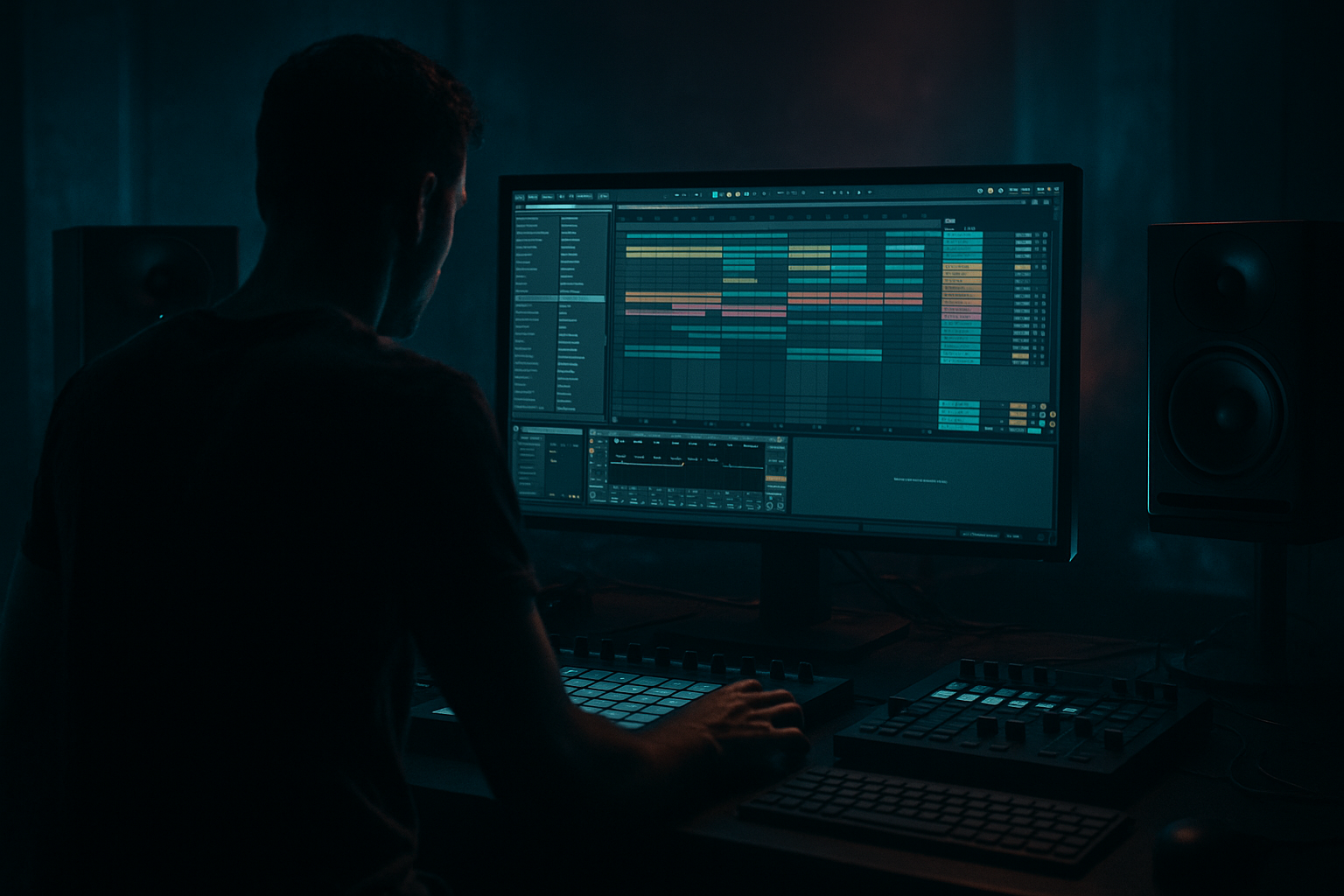
In this lesson, you’ll build a resampling workflow in Ableton Live to turn a simple rave stab into tight, punchy, tempo-locked fill moments that feel at home in rolling DnB/jungle.
You’ll learn:
- How to design a rave shot, then resample it into new variations 🎛️
- How to shape it into fills using envelopes, gating, and rhythm editing
- How to make it hit hard without stepping on drums/bass (EQ, transient control, sidechain)
- A Rave Shot Rack (one or more shots with macro control)
- A Resampled Fill Clip (audio) you can drop into transitions
- 3 fill types you can reuse:
- Use a short note (e.g., 1/8 long).
- Try notes around F–A range (mid) so it doesn’t fight sub.
- Filter Type: Band-Pass
- Frequency: 400 Hz – 2.5 kHz (sweep to taste)
- Resonance: 0.7–1.2
- Drive: 2–6 dB
- Width: 80–120% (don’t go crazy)
- Bass Mono: (if using Live 11/12 Utility) set 120 Hz as mono point
- Mode: Ring
- Frequency: 10–40 Hz (tiny metallic motion)
- Fine: adjust until it feels “alive”
- Mix: 10–25%
- Algorithm: Plate or Room
- Decay: 0.6–1.2 s
- Pre-delay: 10–25 ms
- HP Filter in the reverb: 250–500 Hz
- Wet: 8–18%
- Pass 1: clean-ish
- Pass 2: heavy distortion + tighter decay
- Pass 3: more reverb + filter sweep for “whoosh into drop”
- Pick the punchiest transient.
- Add Drum Buss:
- Add EQ Eight:
- Sidechain: Kick + Snare bus (or just snare if you want it to punch through the kick)
- Ratio: 3:1 – 6:1
- Attack: 5–15 ms (keep stab transient)
- Release: 60–140 ms (tempo-feel dependent)
- Aim for: 2–6 dB gain reduction during hits
- Put Utility after EQ:
- High-pass the fill more than you think. In DnB, sub belongs to bass.
- Bar 8 / 16 / 24: 1-beat stab + micro silence right before the phrase resets
- Last 1/2 bar before drop: 16th gated burst (Auto Pan square) + snare build
- Between A and B sections: pitch-dive stab with reverb throw → hard cut → drop impact
- Jungle vibe: put the fill between Amen edits—let it answer the break, not fight it.
- Too much low-end in the shot: it will mud your kick + sub instantly. High-pass aggressively.
- Over-reverb in the fill: huge tails smear drum transients. Use short verbs or automate throws.
- No transient control: if it’s all mid sustain, it won’t read as a fill. Use Gate/Drum Buss.
- Too wide / phasey: extreme width can disappear in mono (clubs). Check mono with Utility.
- Rhythm not locked: warp mode wrong or sloppy cuts. Use Beats warp + 1/16 preserve for tightness.
- Midrange violence, controlled top:
- Resample through a limiter for density:
- Add “metal air” with Frequency Shifter (Ring):
- Layer with noise for impact:
- Call-and-response with the bass:
- Design a rave shot quickly (Wavetable + Chord + Saturator).
- Add movement (Auto Filter, Frequency Shifter, short Hybrid Reverb).
- Resample multiple passes to commit vibe and create unique audio.
- Edit into fills using Gate, Auto Pan (square), warp in Beats mode, and tight slicing.
- Mix it like DnB: high-pass, sidechain, control width, protect drums and sub.
---
2. What you will build
By the end, you’ll have:
1) One-hit punctuation (end-of-phrase impact)
2) 16th-note gated burst (classic “rave machine-gun” fill)
3) Pitch-dive riser stab (mini “yeet” into the next section)
All designed specifically for 170–175 BPM drum and bass.
---
3. Step-by-step walkthrough
Step 0 — Session setup (so everything stays DnB-tight)
1. Set tempo to 174 BPM (or your project tempo).
2. Create these tracks:
- MIDI Track: `Rave Shot Source`
- Audio Track: `Resample Print`
- Audio Track: `Fill Edit`
3. Set Global Quantization to 1 Bar (you can change to 1/4 later for performance resampling).
---
Step 1 — Create the rave shot source (fast but flexible) ⚡
You can start from a sample, but building it in MIDI makes resampling more powerful.
#### Option A: Quick classic rave stab using stock devices
On `Rave Shot Source` (MIDI):
1. Load Wavetable (or Analog if you like it raw).
2. Wavetable settings (starter):
- Osc 1: Saw, Unison 2–4, Amount 20–35%
- Osc 2: Square (lower volume, adds bite)
- Filter: LP24, Drive 2–5 dB
- Amp Env: Attack 0 ms / Decay 250–450 ms / Sustain -inf / Release 80–150 ms
(You want a shot, not a pad.)
3. Add a Chord MIDI effect before Wavetable:
- Set Shift 1: +7 st, Shift 2: +12 st
(instant rave triad vibe)
4. Add Saturator after Wavetable:
- Mode: Analog Clip
- Drive: 3–8 dB
- Soft Clip: On
5. Add Redux (optional, for old-school grit):
- Downsample: 2–6
- Bit Reduction: 10–14 (use lightly—DnB needs punch)
#### MIDI note
---
Step 2 — Shape it like a “shot” (so it works as a fill)
Add Auto Filter after distortion:
Why: fills need midrange presence and less low-end clutter.
Then add Utility:
---
Step 3 — Create movement for resampling (macro automation mindset)
Before resampling, we want the shot to do something.
Add Frequency Shifter (subtle = gold):
Add Hybrid Reverb (short rave space):
---
Step 4 — Resample like a pro (print variations quickly) 🎚️
Now we commit audio so we can chop and mangle.
1. On `Resample Print` (Audio Track), set Input to:
- Resampling (top of the input list)
2. Arm `Resample Print`.
3. In Arrangement View:
- Loop 4 bars where your transition/fill will happen.
- Play your stab pattern on the MIDI track (or record in).
4. Record a few takes with different automation moves:
- Auto Filter frequency sweeps
- Saturator drive bumps
- Pitch bends (Wavetable: transpose automation or MIDI pitch bend)
Workflow suggestion:
Do 3 passes:
---
Step 5 — Turn the resample into a fill (editing + rhythm)
Drag the best printed audio onto `Fill Edit`.
#### A) Make a “gated 16th burst” fill (classic DnB tension)
1. Add Gate (stock) on `Fill Edit`:
- Threshold: adjust so it cuts tails
- Return: 0–2 dB
- Attack: 0.1–1 ms
- Hold: 10–25 ms
- Release: 30–80 ms
2. Add Auto Pan after Gate:
- Shape: Square
- Rate: 1/16
- Amount: 60–100%
- Phase: 0° (hard chop; 180° if you want stereo alternation)
3. Consolidate a 1-bar region and warp it:
- Warp Mode: Beats
- Preserve: 1/16
- Transients: 100
4. Chop the last half-bar before a drop:
- Use 1/8 and 1/16 cuts
- Repeat the tightest slice 3–6 times
- Leave a tiny gap (5–20 ms) before the downbeat for extra impact
#### B) Make a “pitch-dive stab” (micro-riser into the next phrase)
1. Add Pitch (Clip View) or use Complex Pro + Transpose automation:
- Start at +7 st, dive to 0 or -5 st over 1/2 bar
2. Add Reverb throw automation:
- Automate Hybrid Reverb Wet from 10% → 35% on the last hit
- Then hard cut reverb right before the drop (classic “suck-in” feel)
#### C) Make a single hit punctuation (end-of-4/8-bar stamp)
- Drive: 5–15
- Crunch: 0–20%
- Boom: Off (usually, to avoid sub conflict)
- Transients: +10 to +30
- High-pass: 150–300 Hz (steeper if needed)
- Small dip: 2–4 kHz if it’s too harsh
- Optional boost: 700 Hz – 1.5 kHz for “rave bark”
---
Step 6 — Make it sit in a rolling DnB mix (critical!)
Fills are cool until they ruin your drum clarity.
#### Sidechain it to the drums 🥁
On `Fill Edit`, add Compressor:
#### Keep low-end clean
- Width: 90–110%
- Mono below: 120 Hz (if available)
---
Step 7 — Arrangement ideas (where these fills actually work)
Try these placements:
---
4. Common mistakes ❌
---
5. Pro tips for darker/heavier DnB 🕶️
Use Saturator/Drum Buss for bite, then tame fizz with EQ Eight low-pass around 10–14 kHz if needed.
Put Limiter on the source chain during resampling (not necessarily final mix).
Ceiling: -0.8 dB, drive into it lightly for that “printed” aggression.
Tiny values (15–30 Hz) give industrial edge without sounding like a phaser.
Duplicate the fill audio, high-pass at 2–4 kHz, add Saturator, keep it low. Adds urgency.
Put fills in spaces where the bass holds or simplifies—don’t compete with your most complex bass phrase.
---
6. Mini practice exercise 🎯
In a 16-bar rolling DnB loop:
1. Make a simple drum loop (kick/snare + hats), and a rolling bass phrase.
2. Create one rave shot and resample 3 takes:
- Clean
- Distorted
- Reverb-heavy
3. Build two fills:
- A) 1/2-bar gated 16th burst before bar 9
- B) single hit + reverb throw at the end of bar 16
4. Mix rules:
- High-pass both fills at 200 Hz
- Sidechain both to snare for ~3–5 dB GR
5. Bounce a quick export and listen on headphones + speakers: does the snare still lead?
---
7. Recap ✅
If you want, tell me your subgenre (jump-up, neuro, jungle, dark rollers) and I’ll suggest a specific rave-shot chain and two fill patterns that fit it.
```

