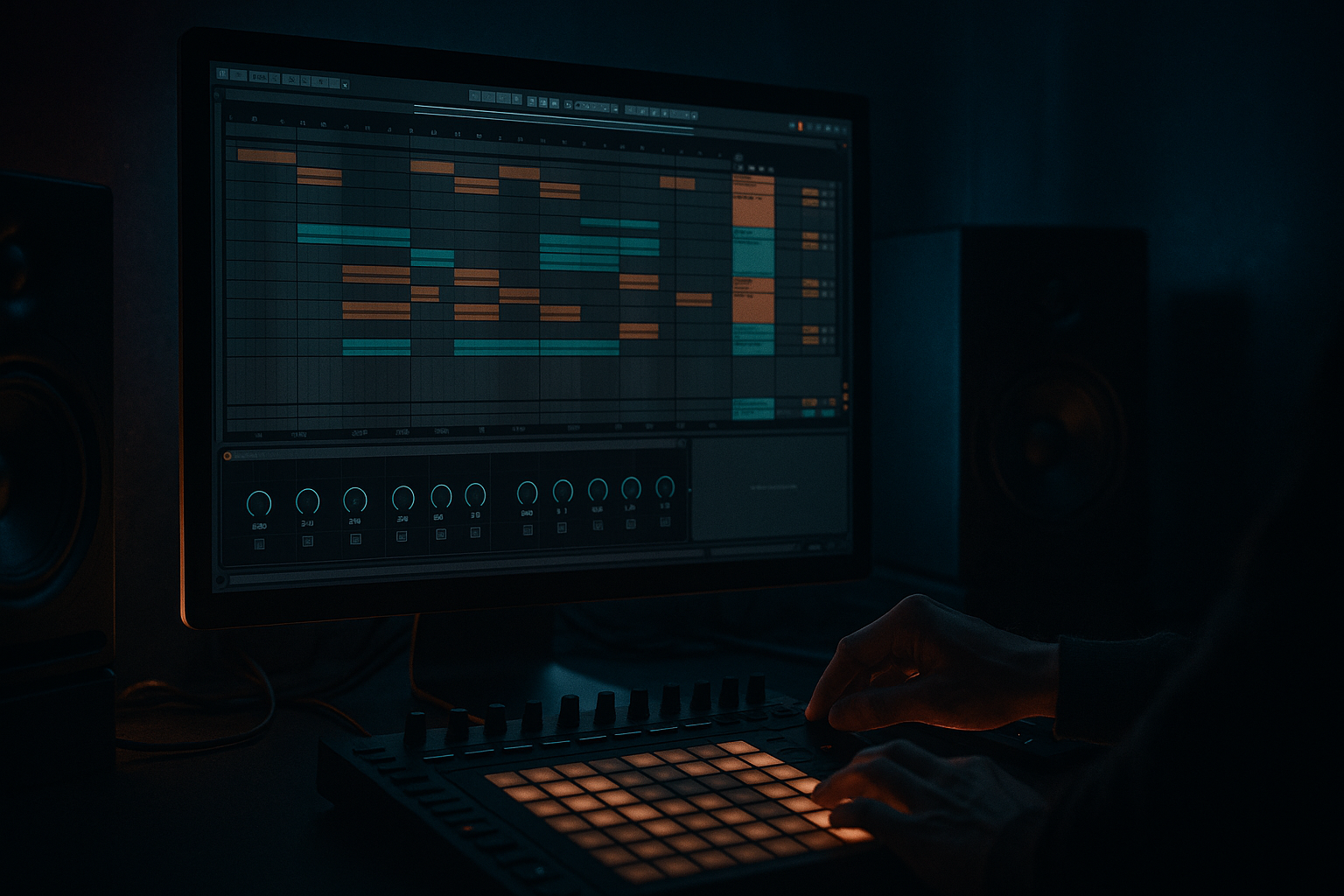
Main tutorial
Resampling Chord Stabs for Grit (DnB in Ableton Live) 🎛️🔥
1. Lesson overview
Resampling is one of the fastest ways to turn clean chord stabs into gnarly, textured, mix-ready DnB weaponry. Instead of endlessly tweaking a synth patch, you’ll print audio, then abuse it with saturation, filtering, pitching, warping, and transient shaping—then resample again.
This lesson focuses on rolling drum & bass / jungle-style stabs: short, aggressive, characterful, and able to sit above drums + bass without sounding polite.
---
2. What you will build
By the end you’ll have:
- A classic DnB chord stab (think Moving Shadow / early techstep vibe)
- A resampling chain that adds grit, weight, and movement
- A rack workflow for quick variations (different “prints”)
- Arrangement-ready audio clips: main stab, low-passed stab, downpitched reese-stab layer, and impact hits
- Tempo: 172–176 BPM (try 174 BPM)
- Drums: load a break (e.g., Amen-style) and/or your own DnB drum rack
- Leave space: stabs work best when you arrange around the groove (offbeats, call/response with snares)
- Use Algorithm 1 (all carriers)
- Put 2–3 oscillators on Saw (or sine + saturation later)
- Short amp envelope like above
- Fm9: F–Ab–C–Eb–G
- Dm7: D–F–A–C
- Keep as your “hero”
- Mild saturation + glue
- Pitch down -5 to -12 semitones
- Warp mode: Texture
- LP filter around 300–800 Hz
- Add Saturator to bring back harmonics
- High-pass at 2–4 kHz
- Add Redux lightly + short room reverb (see below)
- Keep this layer quiet (it’s for “presence”)
- EQ Eight (final shape)
- Glue Compressor (tiny glue)
- Limiter (only catching peaks)
- Hybrid Reverb
- EQ Eight after reverb
- Offbeat stab: 1/8 after kick, like a skank
- Call/response: Stab answers the snare on bar 2 or 4
- Phrase punctuation: A more distorted resample on bar 8 and 16
- Drop reinforcement: Layer the stab with a noise hit on the first downbeat only
- Filter cutoff opening slightly across 8 bars
- Redux/Drive increased just for the last 2 beats of a phrase
- Pitch dips (clip transpose -2) for “danger” moments
- Not committing to audio: endless synth tweaking kills momentum—print earlier.
- Overdoing bit reduction: too much Redux makes it small and papery.
- Leaving low-end in stabs: you’ll fight the sub + kick; high-pass is your friend.
- Too wide too low: wide low-mids can smear with bass—mono below ~200 Hz.
- No transient control: if the stab isn’t “hit-like,” it won’t cut through drums.
- Resample through a limiter (lightly) before heavy distortion. It creates a consistent “brick” that distorts more evenly.
- Use Roar/Saturator in parallel:
- Texture warp + downpitch = instant techstep grime:
- Mid/Side EQ:
- Gate your reverb send:
- Build a simple chord stab source, then commit to audio.
- Use resampling to create fast variations: distort → filter → warp → reprint.
- Shape stabs like drums: tight tails, controlled transients, and filtered low end.
- In DnB, the best stabs come from multiple printed versions arranged with intention—phrase endings, fills, and call/response with drums.
---
3. Step-by-step walkthrough
Step 0 — Session setup (DnB context) 🥁
---
Step 1 — Make a clean “source” chord stab (keep it simple)
You can start from any synth, but here are two solid stock options:
#### Option A: Wavetable (clean + modern)
1. Create a MIDI track → Wavetable
2. Osc 1: Saw
3. Osc 2: Saw, detune slightly (5–15 cents)
4. Voices: 6–8, Unison Amount: 40–70%
5. Filter: Low-pass (24dB)
- Cutoff ~ 3–7 kHz (you’ll re-shape later)
- Drive: 2–6 dB
6. Amp Env:
- Attack: 0–5 ms
- Decay: 200–500 ms
- Sustain: -inf / very low
- Release: 50–150 ms
#### Option B: Operator (classic + punchy)
#### Chords to try (DnB-friendly)
Use minor 7 or minor 9 shapes (instant mood):
Play them as short stabs (1/8 or 1/16) on the offbeats.
Groove tip: Place a stab just after the snare (late 1/16) for that rolling push.
---
Step 2 — Add a “pre-resample” grit chain (light first)
Before printing, add a controlled chain that’s easy to commit.
Device chain (stock):
1. Saturator
- Type: Analog Clip
- Drive: 3–8 dB
- Soft Clip: On
2. Auto Filter
- LP24
- Envelope: small movement (Amount 5–15%) for “pluck”
3. Chorus-Ensemble (optional for width)
- Amount: 10–25%, Rate slow
Keep it tasteful. The heavy abuse comes after printing.
---
Step 3 — Resample to audio (the core workflow) 🎚️
You’ve got two clean ways:
#### Method A: “Resampling” input (fast)
1. Create a new Audio track
2. Set Audio From: Resampling
3. Arm the track and record a few bars while triggering your stabs
#### Method B: Freeze + Flatten (clean + CPU-friendly)
1. Right-click the MIDI track → Freeze Track
2. Right-click again → Flatten
Now your stab is audio.
DnB workflow suggestion: Print multiple hits (different chords/velocities) in one pass. You’ll slice later.
---
Step 4 — Slice and tighten the stab like a drum hit ✂️
1. Double-click the audio clip
2. Turn Warp ON
3. Try Warp modes:
- Beats (great for tight stabs): Preserve Transient, 1/16 or 1/8
- Texture (grimey): Grain Size 10–30 ms
- Complex Pro (smoother, but can smear)
4. Use Fade In (very short, 1–5 ms) to kill clicks
5. Trim to a tight tail (often 120–300 ms works well in rolling DnB)
Pro move: Consolidate each stab to its own clip (`Cmd/Ctrl + J`) so you can process consistently.
---
Step 5 — The “grit resample chain” (audio destruction, controlled) 😈
On the audio stab track, build this chain:
#### Device chain (stock) — “DnB Stab Grit”
1. EQ Eight
- HP at 120–250 Hz (stabs don’t need sub; leave that for bass)
- Small cut if harsh: 2.5–4.5 kHz (Q ~2, -2 to -5 dB)
2. Roar (if you have Live 12 Suite) or Saturator
- Roar: start with “Tube” / “Dirt” style
- Drive until it speaks, then back off
- Add tone shaping: reduce fizz above 10 kHz
- If no Roar: Saturator Drive 6–12 dB, Soft Clip ON
3. Redux (for jungle crunch)
- Downsample: 2.0–6.0
- Bit Depth: 8–12
- Use subtly—too much kills punch
4. Overdrive
- Freq: 800 Hz – 2 kHz
- Drive: 10–40%
- Dry/Wet: 20–60%
5. Auto Filter (movement)
- LP12 or LP24
- Map cutoff to a macro later
- Add a tiny LFO feel using automation (or clip envelopes)
6. Glue Compressor
- Attack: 3–10 ms
- Release: Auto
- Ratio: 2:1
- Aim for 1–3 dB of GR to “sit” it
7. Utility
- Width: 80–120%
- Bass Mono: On, set around 150–250 Hz
Now resample again.
Print a few versions at different filter cutoffs and distortion amounts. This is how you get a “stab palette” fast.
---
Step 6 — Turn one stab into a whole stab family (layering)
Duplicate the resampled audio into 3 lanes:
#### Layer 1: Main mid stab
#### Layer 2: Dark low-mid body (reese-stab-ish)
#### Layer 3: Air/fizz tick
Group the layers (`Cmd/Ctrl + G`) and add on the group:
---
Step 7 — Space and vibe (DnB-style, not washy)
Instead of huge reverbs, go short and controlled:
Return Track A — “Short Room”
- Algorithm: Room
- Decay: 0.4–0.9 s
- Pre-delay: 10–25 ms
- High Cut: 6–9 kHz
- HP 250–500 Hz (keep low end clean)
Send stabs lightly (often -18 to -10 dB send is plenty).
DnB trick: Automate the send up at phrase ends (bar 8/16) for a “sucked into space” moment.
---
Step 8 — Arrangement ideas (rolling DnB / jungle)
Try these placements:
Automation that hits in DnB:
---
4. Common mistakes
---
5. Pro tips for darker/heavier DnB 🖤
- Limiter: Ceiling -1 dB, gain until you see 1–3 dB reduction.
- Audio Effect Rack → Dry chain + Distorted chain
- Blend 20–40% wet for aggression without killing transients.
- Texture mode, Grain 15–25 ms, pitch -7 semitones, then saturate.
- EQ Eight in M/S mode: cut harshness in the Sides around 3–6 kHz so the center stays punchy.
- Put a Gate after Hybrid Reverb on the return to keep it tight and “stepper.”
---
6. Mini practice exercise (15 minutes) ⏱️
1. Create one clean minor7 stab in Wavetable.
2. Resample it to audio.
3. Make three resampled versions:
- A: Saturator heavy (Drive 10 dB), no Redux
- B: Light Saturator + Redux downsample 4.0
- C: Pitch -7 semitones + Texture warp + LP filter 600 Hz
4. Arrange a 16-bar loop:
- Bars 1–8: Version A on offbeats
- Bars 9–12: introduce Version B as fills
- Bars 13–16: switch to Version C and automate reverb send up on the last bar
5. Bounce the loop and listen on low volume—does the stab still read?
---
7. Recap ✅
If you want, tell me what subgenre you’re aiming for (liquid, jump-up, neuro, jungle/140-ish halftime) and I’ll suggest a specific stab processing rack + 16-bar arrangement template tailored to it.

