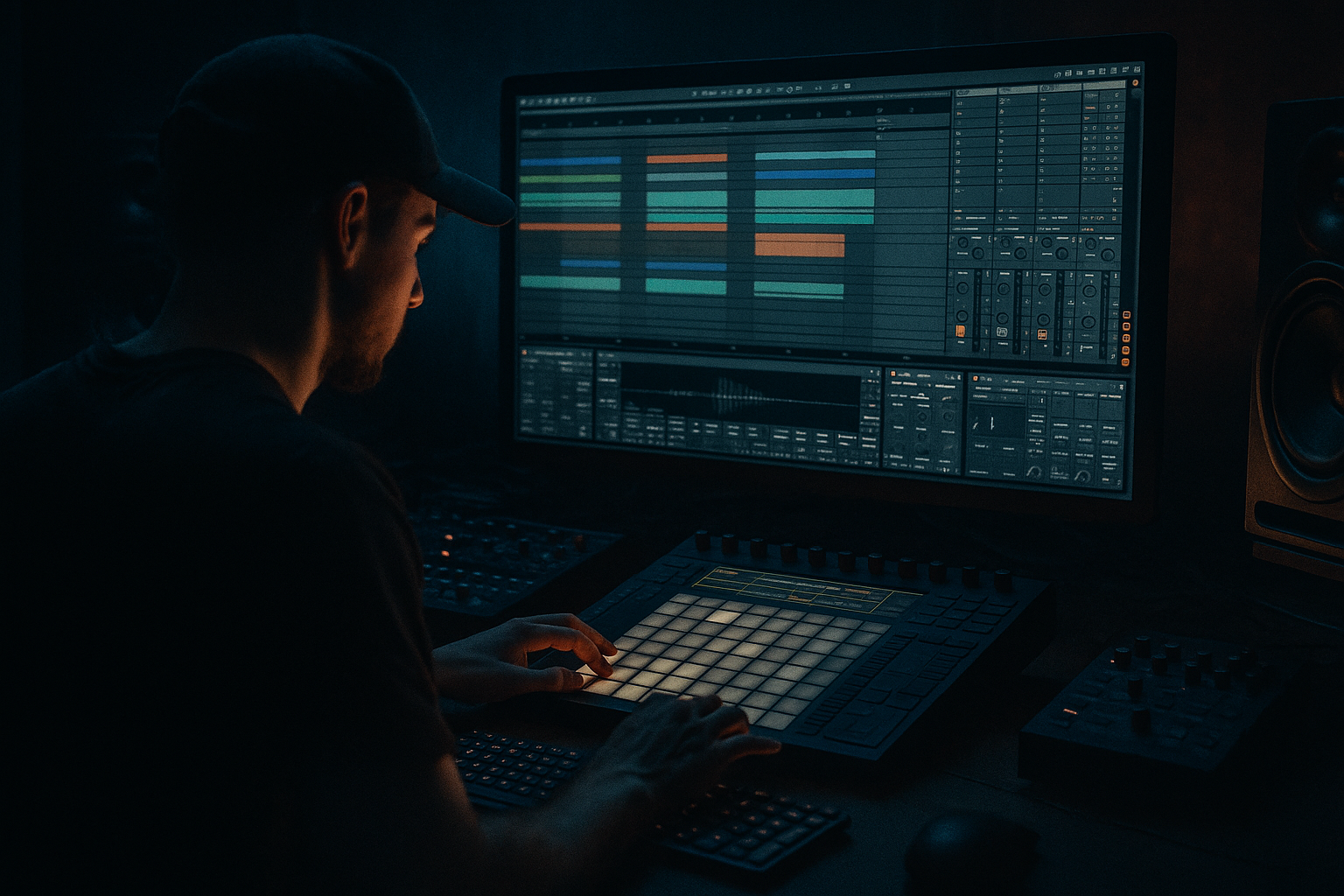
Main tutorial
```markdown
Resampling Your Own Fills Masterclass (Stock Ableton Only) 🔁🥁
Skill level: Intermediate
Genre focus: Drum & Bass / Jungle / Rolling bass music
Goal: Turn your own drum fills into a reusable “fill library” and signature edits using only Ableton stock devices.
---
1. Lesson overview
Resampling is one of the fastest ways to get personal, pro-sounding fills that feel like they belong in your tune—because they’re literally built from your own drums, processing, and groove. In DnB, fills aren’t just decoration: they’re energy management (switches, ramps, fake-outs, tension, and release).
In this lesson you’ll:
- Build a fill-printing workflow in Ableton Live
- Resample fills into audio, then slice, rearrange, and reprocess them
- Create rolls, stutters, reverses, pitch dives, and jungle-style edits
- Use stock tools like Drum Rack, Simpler/Sampler, Beat Repeat, Frequency Shifter, Saturator, Redux, Auto Filter, Echo, Reverb, Glue Compressor, Limiter
- A 16-bar DnB drum loop with a signature fill every 8 or 16 bars
- A Resample track and routing template to print fills quickly
- A small pack of your own:
- Audio From: `Resampling` (top of the list)
- Monitor: `Off` (to avoid feedback)
- Arm: on when printing
- Snare: on 2 and 4 (classic DnB backbeat)
- Kick: vary around the snare (common: pre-snare kick and post-snare kick)
- Hats: 1/8 or 1/16 with slight swing (subtle!)
- Last bar: add 1/16 snare notes that accelerate:
- Add a single kick drop-out right before the snare to create impact.
- Use a break slice (or hat layer) and create:
- Add a quick 1/12 (triplet) roll on a rim/hit for 1 beat.
- `Fill_174bpm_Roll_01`
- `Fill_174bpm_JungleEdit_02`
- Slice By: Transient
- Sensitivity: adjust until it catches the main hits cleanly
- Playback: Trigger (good for finger-drumming edits)
- Reverb: Decay 1.2–2.5s, Size 30–60%
- High Cut around 6–10 kHz so it’s not fizzy
- HP12, cutoff 200 → 40 Hz sweep downward into the hit (automate)
- Interval: 1 Bar (so it triggers on fill)
- Grid: 1/16
- Variation: 10–20%
- Chance: 30–60%
- Gate: 60–90%
- Pitch: 0 (or experiment with +1/+2 for weirdness)
- Filter: ON, set to tame highs
- Bar 7: start a subtle LP filter closing slightly
- Bar 8: fill hits + stutter
- Bar 9 (drop): remove 1 element for contrast (e.g., hats) then bring back on bar 11
- Resampling the entire master accidentally (and printing bass + vocals)
- No headroom on resampled clips
- Over-editing timing so the groove collapses
- Too much low-end in fills
- Beat Repeat always on
- Parallel distortion for fills only:
- Frequency Shifter for metallic edge:
- Gate your reverb for that tight jungle space:
- Print multiple versions:
- Use Corpus subtly on a snare-roll layer:
- Build fills from your existing groove for cohesion.
- Print them with a RESAMPLE track and consistent naming.
- Turn resampled audio into playable slices with Simpler (Slice mode).
- Make DnB-ready edits: stutters, reverses, pitch envelopes, Beat Repeat chaos.
- Re-layer into the arrangement with EQ control + dynamics so fills hit hard without ruining the drop.
---
2. What you will build
By the end you’ll have:
- 1–2 bar “main fills”
- micro-edits (1/16–1/4 bar)
- reverse hits and impacts
- “over-processed” dark variants for switches 😈
---
3. Step-by-step walkthrough
Step 0 — Set up the session (DnB-ready)
1. Tempo: set to 174 BPM (or your track tempo: 170–176 is typical).
2. Create tracks:
- Drums (Group): your kick/snare/hats/break layers
- Drum BUS (Return or Audio track): optional bus processing
- RESAMPLE (Audio track): where we print fills
RESAMPLE track settings:
> If you prefer cleaner control: route your drum group to a dedicated bus and resample that.
Alternative: Set RESAMPLE “Audio From” to your Drum Group or Drum BUS instead of full Resampling.
---
Step 1 — Build a solid 2-bar drum phrase as your “source”
Use whatever you’ve got, but here’s a very DnB-safe starting point.
Core pattern (2 bars):
Stock device suggestion:
Put your one-shots into a Drum Rack so your fills are MIDI-editable and fast to iterate.
---
Step 2 — Create a “Fill Design Rack” (stock effects chain)
On your Drum Group (or a dedicated Fill FX return), create a chain you can automate for fills.
Suggested chain (in this order):
1. Auto Filter
- Mode: LP24
- Drive: 2–6 dB
- Map cutoff to a macro for ramps (e.g., 200 Hz → 18 kHz)
2. Saturator
- Mode: Soft Clip ON
- Drive: 2–8 dB (more for heavier)
3. Drum Buss
- Drive: 5–20 (use your ears)
- Boom: 0–20% (careful—DnB low-end can get messy fast)
- Transients: +5 to +20 for snappy fills
4. Redux (for grit on fills)
- Downsample: 2–8
- Bit Reduction: 8–12 (use subtly, automate in)
5. Glue Compressor
- Attack: 3 ms
- Release: Auto
- Ratio: 2:1
- Soft Clip: ON
- Aim: just 1–3 dB of GR during fill peaks
Workflow tip: Group these into an Audio Effect Rack and map key parameters to 8 macros:
Cutoff, Filter Env, Saturation Drive, Drum Buss Drive, Transients, Redux Amount, Reverb Send, Echo Send.
---
Step 3 — Program 2–4 fill variations in MIDI (fast + musical)
In DnB, fills often work best as variations of your existing groove, not totally new drums.
Create a 16-bar section of drums, then add fills at bar 8 and 16.
Fill idea A (classic rolling 1-bar snare build):
- First half: 1/8
- Second half: 1/16
Fill idea B (jungle edit):
- a 1/8 stutter
- then a reverse hit into the downbeat (we’ll resample and reverse in a moment)
Fill idea C (triplet tease):
Ableton tip: set grid to 1/12 and keep it short—too much triplet gets messy in rolling DnB.
---
Step 4 — Print/resample your fill like a pro
1. Loop the section that contains your fill (e.g., bar 15–17 so you capture the lead-in and the downbeat after).
2. Arm RESAMPLE track.
3. Hit record and capture 2 bars (or 4 if you’ve got longer automation).
Naming discipline:
Immediately rename clips like:
Consolidate: Select the recorded region → Cmd/Ctrl + J
This makes editing/slicing far easier.
---
Step 5 — Slice your resampled fill into a playable instrument (Simpler)
Drag the recorded fill audio into Simpler (create a MIDI track, drop the audio onto it).
In Simpler → Slice mode:
Now you can play your fill like a kit and create new variations quickly.
DnB trick:
Turn on Warp inside the clip before slicing if the audio is drifting—tight timing is everything at 174.
---
Step 6 — Create 3 signature resample edits (fast recipes)
#### Edit 1: “Stutter + Pitch Dive” (classic switch energy) 🎚️
1. Duplicate the audio clip on the RESAMPLE track.
2. Choose a tiny region (1/8 or 1/16 right before the drop).
3. Cmd/Ctrl + D to repeat it rapidly (stutter).
4. Add Pitch Envelope using clip envelopes:
- Clip View → Envelopes → `Clip` → `Transposition`
- Draw a quick dive: 0 → -12 → -24 semitones over 1/2 bar
Optional: Add Reverb tail after the stutter (freeze vibe):
---
#### Edit 2: “Reverse Snare Suck-In” (jungle tension) 🔄
1. Duplicate your resampled fill clip.
2. Isolate the last snare hit (or a crash).
3. Reverse it (right-click → Reverse).
4. Fade it in (clip fade handle) and place it just before the downbeat.
Add Auto Filter:
Result: that signature whoosh into smack.
---
#### Edit 3: “Beat Repeat Fill Melt” (controlled chaos) ⚙️
On a duplicated fill clip (or a dedicated Fill FX bus), add Beat Repeat.
Beat Repeat settings (good starting point):
Key move: Automate Chance up only during the last 1/2 bar of your fill.
You want “designed randomness,” not roulette.
---
Step 7 — Re-layer and commit: glue your new fill back into the arrangement
Now that you have your printed + edited fill:
1. Place it into your drum arrangement at bar 8/16.
2. High-pass the fill slightly so it doesn’t fight your kick/sub:
- EQ Eight: HP at 70–120 Hz (depends on your track)
3. Tighten dynamics:
- Glue Compressor (light): 1–2 dB GR
4. Final safety:
- Limiter on drum bus if your edits get spicy
Arrangement idea (very DnB):
Contrast = perceived impact.
---
4. Common mistakes
→ Route from Drum Group/Bus if you want drums only.
→ Aim your resampled peak around -6 dBFS; you can always push later.
→ Keep fills locked to the grid, then add micro-swing via hats/ghosts—not random nudges everywhere.
→ High-pass your fills or they’ll fight the kick/sub and smear the drop.
→ Automate it only in the last 1/4–1 bar.
---
5. Pro tips for darker/heavier DnB 😈
Create a Return track “FILL DIRT” with:
- Saturator (Drive 8–15, Soft Clip ON)
- Redux (light)
- EQ Eight (band-pass mids, e.g., 200 Hz–6 kHz)
Send only fill hits to it for aggressive mid growl without wrecking your main drums.
On fill layers, try Frequency Shifter:
- Fine: +10 to +40 Hz
- Mix: 10–30%
Adds movement and a cold “techy” edge.
Reverb → Gate (or use Compressor sidechain) so the tail doesn’t wash the next bar.
Clean, medium, savage. Put them on adjacent lanes and choose based on arrangement energy.
Tiny Resonance adds that “metal shell” feel when kept low in the mix.
---
6. Mini practice exercise (15 minutes) ⏱️
1. Make a 16-bar drum loop at 174 BPM.
2. Write two 1-bar fills:
- One roll-based
- One jungle-edit-based
3. Resample both into audio.
4. Create three variants of one fill:
- Reverse suck-in
- Stutter + pitch dive
- Beat Repeat melt
5. Place fills at bar 8 and 16 and export a quick bounce.
Success metric: When you mute the bass, your drums still feel like a full, evolving DnB record.
---
7. Recap ✅
If you want, tell me your drum sources (breaks vs one-shots, liquid vs neuro vs jungle), and I’ll suggest a tailored stock-device fill rack with macro mappings.
```

