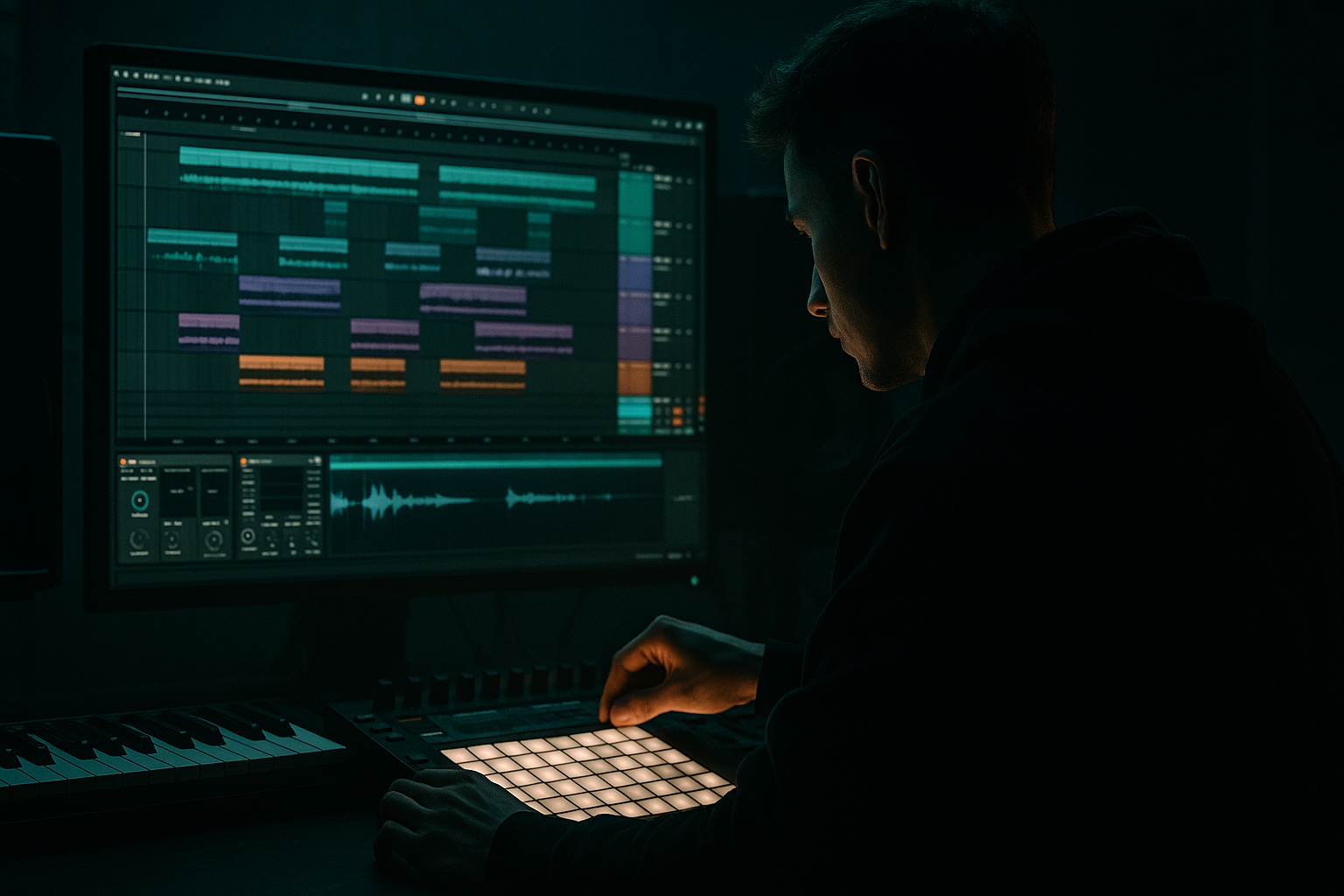
Main tutorial
Lesson Overview
This lesson is about building a retro rave ride groove in Ableton Live 12 using an automation-first workflow so your track feels like classic jungle / oldskool DnB, but still lands with modern clarity. The “ride groove” here is not just a cymbal pattern — it’s the moving high-frequency engine that drives energy through the drop, lifts vocals into the grid, and makes the whole arrangement feel like it’s constantly leaning forward.
In DnB, especially in jungle, rollers, and darker bass music, the ride is often doing more than keeping time. It can:
- reinforce the break edit,
- create excitement in 8- or 16-bar phrases,
- support vocal chops or lead phrases,
- and signal switch-ups without needing a massive fill.
- uses a clean or slightly dirty ride sample,
- evolves through filter, saturation, reverb send, and volume automation,
- locks to a jungle/oldskool-style break pattern,
- leaves space for a vocal hook or chopped phrase,
- and can be dropped into an intro, first drop, or switch-up section.
- a bright, urgent ride pulse on top of a break,
- with subtle ghosted motion that widens the groove,
- a lift into the vocal line during the last 2 bars of a phrase,
- and a darker, tighter version for the main drop that avoids harshness.
- Tempo: 170–174 BPM for jungle/oldskool DnB energy.
- Start with a drum break, a sub layer, and a vocal idea even if it’s just a placeholder chop.
- Put your break on one audio track and use Warp only if needed; for more natural oldskool feel, keep edits minimal and preserve transient shape.
- Add a simple sub on a MIDI track, using Operator or Wavetable with a sine or very soft triangle.
- Drop a placeholder vocal slice on a separate audio track so you can hear how the ride interacts with phrasing.
- a clean ride with a medium bell,
- a slightly dusty break-era cymbal,
- or a sampled ride from your own drum resample folder.
- In Simpler, use Classic mode for a one-shot ride sample.
- Set Start so you’re not clipping the transient.
- If the ride is too long, shorten Decay or use a small fade in the sample editor.
- Add Auto Filter after Simpler and set a gentle High-Pass around 180–300 Hz to keep the ride out of the low-mid fight zone.
- Classic lift pattern: ride on beat 1 and the “&” of 2 and 4.
- Driving drop pattern: ride on every beat, but lower velocity on beat 2 and 4.
- Oldskool shuffle pattern: ride hits placed around the break tail, with offbeat accents to create a rolling feel.
- Use velocity variation aggressively. Try a range of 70–110 for main hits, and 40–65 for ghosted accents.
- Nudge a few hits slightly early or late if the break needs more human pressure, but keep the main pulse locked.
- For more retro rave attitude, duplicate the ride part across 2 bars and create a small variation in the second bar: remove one hit, add a lighter pickup, or drop a bell hit.
- Auto Filter
- Saturator
- Utility
- optional Echo or Reverb on sends, not inserted heavily on the track
- Auto Filter: high-pass at 220 Hz, resonance low, cutoff automated between 3 kHz and 12 kHz depending on section.
- Saturator: Drive around 2–5 dB for subtle edge, or 6–8 dB if you want a more aggressive rave-metallic tone.
- Utility: use Width sparingly, keeping the ride mostly centered if it’s helping the groove; widen only in intros or breakdowns.
- Filter cutoff rises during transition bars.
- Saturator drive increases slightly into the drop or vocal reprise.
- Track volume dips 1–2 dB in busy phrases and rises 1 dB in sparse phrases.
- If using Echo on a send, automate send amount only on the final ride hit before a fill or vocal pickup.
- Solo the break and ride together.
- Identify where the break already has strong cymbal or shaker energy.
- If the ride masks the break’s snare snap, thin the ride with EQ or filter automation around 6–10 kHz.
- Use Transient shaping indirectly via clip gain or Drum Buss very subtly if the ride is too spiky. On Drum Buss, keep Drive low and Crunch restrained; you’re shaping attitude, not destroying the cymbal.
- Put the ride on its own return-like parallel chain using Audio Effect Rack.
- Chain 1: dry ride.
- Chain 2: filtered, saturated ride with a high-pass around 500 Hz, light Saturator, and maybe a touch of Redux at very low depth.
- Blend the parallel chain only during the last 4 bars of a phrase.
- Place your vocal hook or phrase in the Arrangement View.
- Mark the strongest words, breaths, and gaps.
- Automate the ride so it opens up in the gaps and backs off under sustained vocal notes.
- If the vocal has a long held note, automate the ride’s high-pass lower for a moment or reduce brightness slightly so the note owns the front of the mix.
- Bars 1–4: vocal chop enters, ride is tight and filtered.
- Bars 5–8: vocal phrase expands, ride gets brighter but quieter.
- Bars 9–12: no vocal; ride opens fully for impact.
- Bars 13–16: vocal repeat returns, ride ducks slightly and adds a few pickup hits before the next section.
- Return A: short room with Reverb
- Return B: rhythmic echo with Echo
- transition hits,
- the last ride before a drop,
- and the final bar before a vocal switch.
- 8-bar intro: filtered ride, break tease, vocal chop tease.
- 16-bar first drop: ride enters gradually, then locks in fully only after the first 4 bars.
- 8-bar switch-up: remove the ride for 1 bar, then bring it back with a different velocity pattern or brighter automation.
- DJ-friendly outro: strip the ride back to a filtered version so the mixdown feels usable in a set.
- first 4 bars = tension,
- next 4 bars = groove,
- last 8 bars = full statement with vocal and bassline interplay.
- Over-brightening the ride too early
- Letting the ride mask the vocal consonants
- Using one static ride loop for the whole tune
- Overusing reverb on the ride
- Ignoring the break’s cymbal content
- Making the ride too loud to create energy
- Put Saturator before Auto Filter if you want the filter sweeps to react to harmonics in a more aggressive way.
- Use Drum Buss very lightly on the ride parallel chain for a thicker oldskool smear, but keep Boom off unless you want deliberate low-end nonsense.
- In darker rollers, automate the ride to get brighter only on the last hit of a phrase, then slam it back to a duller tone.
- Layer a very low-level noise texture or vinyl-style atmosphere under the ride in breakdowns to evoke retro rave character without cluttering the mix.
- Use Utility to mono-check the ride and parallel chain. The center must stay stable if the vocal and sub are strong.
- If you want a more neuro-adjacent edge, resample a processed ride phrase, then chop the tail and re-trigger it with tiny variations. The result feels more synthetic and less “sample pack.”
- For extra tension before a drop, automate a high-pass rise on the ride up to 6–8 kHz, then suddenly drop back to the normal cutoff at the first downbeat.
- In DnB, the ride is a groove engine, not just a cymbal.
- Build it with automation-first thinking: filter, drive, level, and send movement.
- Let the ride support the break and vocal phrasing, not compete with them.
- Use Ableton stock devices like Simpler, Auto Filter, Saturator, Utility, Reverb, Echo, Drum Buss, and EQ Eight to shape movement and tone.
- Keep the main drop focused and controlled; use brightness and width as arrangement tools.
- The best retro rave / jungle ride grooves feel energetic because they breathe with the track 🎛️
For an advanced producer, the real skill is not placing a ride on every beat. It’s shaping the ride through automation, filtering, transient control, tone changes, and arrangement decisions so it feels like part of the record, not an afterthought. That’s especially important in retro rave-influenced DnB, where the ride can sit between classic warehouse energy and modern sub/bass discipline.
The focus here is a workflow that starts with automation lanes and resampling logic, then uses Ableton stock devices to turn a simple ride into a living groove element. We’ll also connect it to vocals, because in modern DnB the vocal hook often needs a rhythmic high-end bed underneath it to keep the chorus feeling huge without overcrowding the low mids.
What You Will Build
By the end of this lesson, you’ll have a 16-bar retro rave DnB ride groove that:
Musically, the result should feel like:
You’re not just making a cymbal loop. You’re building an arrangement tool that helps the tune breathe like a proper DnB record.
Step-by-Step Walkthrough
1. Set up the groove context first, not the ride
Open a fresh Live 12 set and build the core DnB frame before touching the ride:
Why this matters: in DnB, the ride is usually judged in context. A bright ride that sounds exciting solo can completely wreck the vocal or mask the attack of the break. Build the groove around the vocal pocket from the start.
2. Choose a ride source that already has character
Use a ride sample with a clear bow tone and a stable wash. You’re aiming for a sound that can survive heavy automation without turning brittle. Good sources include:
Load it into a Drum Rack pad or Simpler. Then:
Advanced note: if the sample is too clean for retro rave energy, don’t go straight to extreme distortion. First, layer tone through automation and bus processing. The ride should feel like it belongs in a 1994-inspired mix, not like it was just crushed into noise.
3. Program a sparse but propulsive ride rhythm
For jungle and oldskool DnB, avoid the beginner move of putting the ride on every quarter note without movement. Instead, use the ride as a phrase-based energy layer.
Start with one of these patterns:
In Ableton’s MIDI clip editor:
If the ride is clashing with the vocal syllables, remove the ride hit that lands directly under the strongest consonant or vowel. In DnB vocal arrangement, the ride often needs to “dance around” the lyric, not fight it.
4. Build an automation-first chain on the ride track
This is the core of the lesson. Don’t think “processing first.” Think movement first.
On the ride track, add:
Suggested starting points:
Now automate these parameters over 8 or 16 bars:
A strong automation move: open the filter gradually over the last 2 bars before a drop, then snap it back to a darker position on the first bar of the drop. That contrast is classic DnB arrangement language.
5. Make the ride interact with the break, not sit on top of it
Oldskool jungle energy comes from interlocking layers. Your ride should complement the break’s transient map.
Do this:
Try this advanced move:
Why this works in DnB: the break keeps the body and syncopation, while the ride adds the top-end propulsion. If both are fighting in the same frequency pocket, the groove loses depth and sounds smaller, not bigger.
6. Use vocal phrasing to decide where the ride opens up
Because this is in the Vocals category, the ride should be arranged around the lyric. In modern DnB, vocals often define the emotional peak of the drop or pre-drop. The ride can help that happen by lifting around the line ends.
Practical workflow:
Arrangement example:
Advanced tip: use Clip Envelopes for ride volume if you want the automation attached to the MIDI clip itself, but use Arrangement Automation when you need section-wide movement across the tune. In DnB, section automation often gives a more composed, record-like result.
7. Add controlled space and width with sends, not clutter
If the ride feels too dry, don’t immediately drown it in reverb. Use return tracks so you can preserve clarity.
Create two returns:
- Decay: around 0.4–0.9 s
- Pre-delay: 10–25 ms
- High-pass the return to keep low junk out
- Delay synced to 1/8 or 1/8 dotted
- Feedback kept low, around 10–25%
- Filter the return so the repeats are dark and don’t compete with the vocal
Automate the send amount only on:
For darker DnB, width is better used as a contrast tool. Keep the ride relatively focused in the main drop and open it wider in the intro or breakdown. If you widen too much during the drop, the center image can weaken and the bassline loses authority.
8. Finish with arrangement decisions that make it feel like a record
A ride groove becomes powerful when it’s tied to arrangement language, not just loop design.
Use these structure ideas:
For an oldskool-inspired DnB tune, the ride can act like a “section marker.” For example:
A good test: if you mute the vocal and the ride still clearly tells the arrangement story, you’ve probably overdone it. If you mute the ride and the song loses too much lift, you’ve likely underwritten its role.
Common Mistakes
Fix: automate brightness only in transition bars, and keep the drop slightly darker than you think.
Fix: reduce ride hits under dense lyric phrases or dip 6–10 kHz slightly with EQ Eight.
Fix: create at least two versions: a dry/tight drop version and a wider/brighter transition version.
Fix: use short returns and automate sends only where needed.
Fix: check the ride against the break and carve space instead of layering blindly.
Fix: energy should come from motion, automation, and arrangement contrast, not sheer level.
Pro Tips for Darker / Heavier DnB
Mini Practice Exercise
Spend 10–20 minutes building a two-part ride system:
1. Create a 4-bar drum loop at 172 BPM with a break, sub, and a vocal chop.
2. Add one ride sample in Simpler and program a sparse rhythm.
3. Build two automation passes:
- Pass 1: filtered, low-drive ride for bars 1–2
- Pass 2: brighter, slightly more saturated ride for bars 3–4
4. Add one return reverb and one return echo.
5. Automate the ride so it opens up only in the last 2 bars.
6. Duplicate the loop and make a second version where the ride ducks under the vocal but grows during empty gaps.
7. Bounce the ride phrase to audio and resample one bar with a tiny cut or reverse tail to create a switch-up.
Goal: after 20 minutes, you should have a ride groove that clearly changes energy across the phrase without needing any extra synths.

