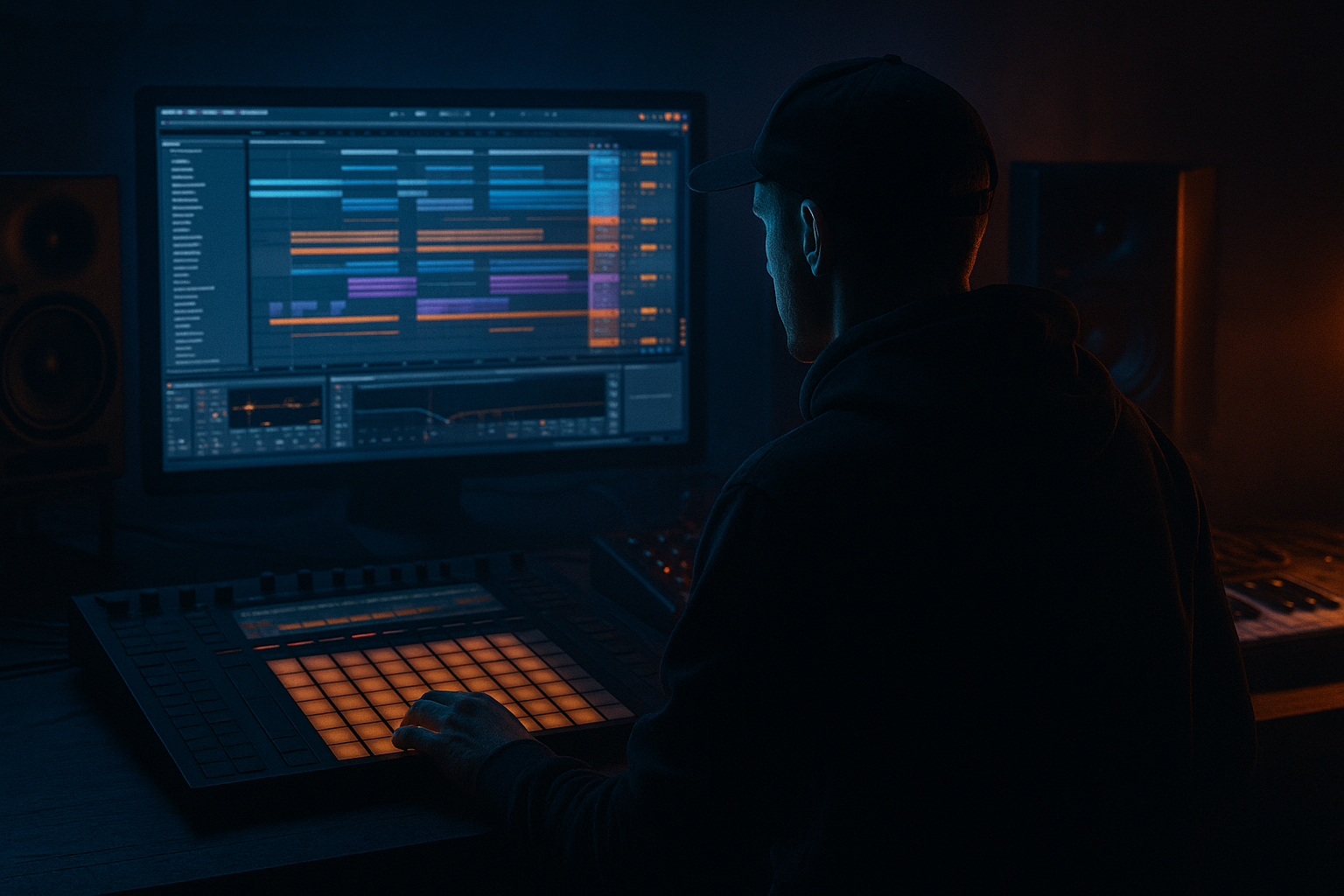
Main tutorial
Retro Rave: Dub Siren Warp for Oldskool Rave Pressure in Ableton Live 12
1. Lesson overview
In this lesson, you’ll learn how to create a retro rave dub siren that feels right at home in drum and bass, jungle, and heavier rolling bass music. The goal is not just “add a siren,” but to make it warp, pitch-bend, smear, and slam in a way that gives your drop or breakdown that classic oldskool rave pressure 😈
We’ll build a siren from a sample or simple synth source, then shape it using Ableton Live 12 stock devices to create:
- authentic rave-style pitch movement
- sample warping for tempo-synced energy
- dub delay throws and space
- controlled filter sweeps for tension
- distortion and modulation that sit in a DnB mix
- intro tension
- pre-drop builds
- turnaround fills
- jungle breakdowns
- call-and-response moments in rollers and amen tracks
- a single-hit rave stab
- a loopable warping siren phrase
- a resampled, mangled transition effect
- a performance-ready MIDI instrument for live tweaking
- classic warehouse rave energy
- slightly unstable pitch movement
- crunchy, tape-ish top end
- wide but controlled stereo
- dubby echoes throwing into the void
- dark enough to work over breakbeats without sounding cheesy
- 1–4 seconds long
- one clean pitch sweep or wobble
- not too much built-in reverb
- dry or lightly processed
- Operator: simple sine/saw blend works great
- Wavetable: use a bright wavetable and automate pitch
- Analog also works if you want a rawer edge
- Set mode to Classic if you want normal playback
- Set mode to Slice if you have multiple siren hits or phrases
- Turn Warp on in Clip View if it’s an audio clip
- Classic mode
- One-Shot playback if you want it to fire fully each note
- Start: trim to the cleanest attack
- Gain: balance the level before processing
- Transpose: set to taste, usually -12 to +12 semitones depending on the track key
- Complex Pro: best for preserving tonal movement
- Complex: good for smooth, musical warping
- Beats: good if you want chopped rhythmic texture
- Repitch: best if you want oldschool pitch-up/pitch-down vibe
- a slow pitch rise over 1 bar
- a quick downward dip before the snare
- repeated pitch wobble synced to 1/8 or 1/16 notes
- Clip Transpose
- Automated Warp Markers
- Frequency Shifter for more extreme sci-fi bending
- Shifter if you want more modern modulation textures
- automate Transpose from 0 to +7 semitones over 2 bars
- add a quick drop back down at the end
- duplicate the clip and offset the second one by a fifth or octave
- Auto Filter
- EQ Eight
- Roar if you want heavier aggression
- Filter Delay for extra movement and echoes
- Filter type: Low-pass or Band-pass
- Resonance: around 20–45%
- Drive: small amount if needed
- Map the cutoff to automation
- Saturator
- Drum Buss
- Roar
- Overdrive
- Drive: 2–8 dB
- Soft Clip: On
- Output: trim to avoid clipping
- moderate drive
- tube-style or warm distortion character
- parallel mix if the device feels too destructive
- drive lightly
- transient shaping carefully
- keep boom low unless you want a trashy effect
- Time: 1/4, 3/16, or dotted 1/8
- Feedback: 25–55%
- Filter: roll off low end and some top
- Modulation: subtle
- Dry/Wet: automate throws or use a send
- Put Echo on a send track
- Keep siren track relatively dry
- Automate send amount at the end of phrases
- Let the delay trail into the snare gap or into the next bar
- narrow low mids if needed
- widen only the top layer
- check mono compatibility
- keep the main siren fairly centered
- widen only the delay/reverb return
- use Utility > Width on a parallel effect chain
- Intro: filtered siren comes in over vinyl noise and atmospheres
- 8 bars before drop: automate pitch rise and delay feedback
- Half-time breakdown: call-and-response with a vocal chop
- Break fill: one-shot siren stab between snare rolls
- Second drop: mangled, distorted version for variation
- Bars 1–16: intro with siren tail and filtered delay
- Bars 17–32: breakbeat enters, siren phrases answer every 4 bars
- Bars 33–40: build with rising cutoff and pitch automation
- Bars 41–48: drop, siren becomes shorter and more staccato
- Bars 49–64: variation with more distortion or a lower octave layer
- siren hit on bar 1
- snare fill answers on bar 2
- siren pitch rise on bar 3
- silence before drop on bar 4
- commits the movement
- lets you chop it like an audio sample
- creates more character if you re-warp it again
- makes the result feel more “performed”
- chopped amen fills
- noise risers
- tape-stop effects
- vocal chops
- reverb-drenched rimshots
- LFO in Max for Live if available
- Auto Filter automation
- Shifter for eerie movement
- slight frequency shifting for unstable, haunted tones
- EQ Eight
- Auto Filter
- Saturator
- Echo
- Utility
- filter cutoff rises steadily
- pitch rises by 5–7 semitones
- delay feedback increases in bars 3–4
- reverb send increases only at the end of bar 4
- mute the siren abruptly, or
- reverse-resample the tail, or
- cut it and leave only the delay throw
- an amen break
- a rolling Reese bass
- a halftime snare build
- Start with a simple siren source
- Use warp mode and pitch automation for movement
- Shape tone with Auto Filter, Saturator, Roar, and EQ Eight
- Add Echo for dub atmosphere
- Keep the low end clean for the kick and bass
- Resample and chop for more jungle-flavored control
This is especially useful for:
---
2. What you will build
By the end, you’ll have a custom dub siren chain that can act as:
Final sound character
Think:
---
3. Step-by-step walkthrough
Step 1: Source the siren
You can start with either:
Option A: Sample a dub siren
Use a short siren sample, ideally:
Option B: Build one from a synth
If you want full control, use Operator or Wavetable:
For a classic dub siren vibe, a sine or saw with vibrato is usually enough. The movement comes from modulation and warping, not complexity.
---
Step 2: Put the sound on a Simpler or sampler track
Drag your siren sample into a new MIDI track and let Ableton create a Simpler instrument automatically.
In Simpler:
For a single siren hit, use:
Suggested settings:
If your siren is audio rather than MIDI-controlled, open the clip and enable Warp so you can stretch it rhythmically with the track.
---
Step 3: Choose the right warp mode
This is where the “retro rave warp” really happens.
Best Warp modes for dub siren movement:
For a DnB rave siren, try this workflow:
1. Set the clip to Complex Pro
2. Adjust Formants slightly if needed
3. Move warp markers to sync the siren phrase to the groove
4. Then duplicate and try Repitch for a more raw, authentic oldskool feel
Practical tip
If the siren needs to feel aggressive in a drop, Repitch can sound more alive because changing playback speed changes pitch naturally. That’s very useful for jungle-era energy.
---
Step 4: Shape the pitch movement
The classic dub siren character often comes from manual pitch movement.
If using MIDI + Simpler:
Add an MIDI Pitch Bend automation lane or use a MIDI clip envelope to create movement.
Try:
If using audio:
Use:
#### Easy oldskool approach:
This gives you that “warning signal” rave tension that works perfectly before a drop.
---
Step 5: Add a filter chain for movement
A dub siren almost always benefits from filtering. In Ableton Live 12, use one of these:
Recommended starting chain:
1. Auto Filter
2. Saturator
3. Echo
4. Reverb
5. Utility
Auto Filter settings:
#### Movement idea:
Automate the cutoff to open during the buildup, then snap back slightly before the drop. That contrast makes the siren feel much bigger over busy drums.
---
Step 6: Add character with saturation and distortion
A clean siren often sounds too polite for DnB. You want edge.
Best stock devices:
#### Option 1: Saturator
Great for controlled harmonics.
Suggested settings:
#### Option 2: Roar
Excellent for heavier, modern bass music aggression.
Try:
#### Option 3: Drum Buss
Surprisingly useful for sirens if you want grit and smack.
Try:
Pro move
Duplicate the siren track and process one copy very clean, one copy heavily distorted, then blend them. This gives you a wide “body + edge” layer without losing clarity.
---
Step 7: Add dub delay throws
This is where the dub pressure really lands.
Use Echo or Delay from Ableton.
Echo settings to try:
DnB-friendly delay workflow:
#### Great trick:
Set Echo to Ping Pong and filter the return so it doesn’t fight the break. This gives the siren a spacious, moving tail while preserving punch.
---
Step 8: Control stereo width and sub safety
Dub sirens can easily clutter the mix.
Use Utility:
Suggested approach:
Important
Do not let the siren dominate the sub region. In DnB, the kick/bass relationship is sacred. High-pass the siren if necessary, usually somewhere between 120–250 Hz, depending on the sound.
---
Step 9: Build a proper device chain
Here’s a solid starting chain for an oldskool rave dub siren in Ableton Live 12:
Main track chain
1. EQ Eight
- high-pass around 150 Hz
- tame harshness around 2.5–5 kHz if needed
2. Auto Filter
- automate cutoff
3. Saturator
- light-to-moderate drive
4. Echo
- synced delay
5. Reverb
- short to medium decay
6. Utility
- width control / gain staging
Parallel send chain
1. Roar or Overdrive
2. Delay/Echo
3. Reverb
4. Compressor sidechained lightly to the drum bus if needed
This keeps the siren exciting without crushing the mix.
---
Step 10: Place it in a DnB arrangement
A dub siren works best when it has a job in the arrangement.
Good placements:
Arrangement idea for a 174 BPM track:
Oldskool rave touch
Use call-and-response phrasing:
That contrast is what makes the vibe feel intentional rather than spammy.
---
Step 11: Resample for extra grit
Once your siren processing sounds good, resample it.
Why resample?
Because it:
How:
1. Route the processed siren to a new audio track
2. Record 8–16 bars of automation
3. Drag the recorded audio into a new track
4. Warp it again if needed
5. Slice it into hits for arrangement use
This is especially powerful in jungle, where resampled textures often become part of the hook.
---
4. Common mistakes
1. Too much low end
Dub sirens can muddy the kick and bass. High-pass them properly.
2. Overdoing reverb
Huge reverb sounds cool alone, but it can destroy DnB transients. Use sends and filter the return.
3. Leaving the siren static
A siren without pitch, filter, or delay movement quickly feels repetitive. Automate something.
4. Too bright, too harsh
Some sirens get painful around 3–6 kHz. Use EQ Eight to tame that region if needed.
5. Not syncing to the groove
If the siren ignores the breakbeat, it will feel pasted on. Make sure the timing complements the snare pattern and phrase length.
6. Overprocessing
If every device is working hard, the sound becomes noisy and loses impact. Keep the chain focused.
---
5. Pro tips for darker/heavier DnB
Tip 1: Layer a subharmonic response
Add a very low, sine-like layer an octave down, but keep it subtle. Use it only for moments where the siren hits hard, not constantly.
Tip 2: Use automation to “duck” the siren into the drums
Sidechain the siren slightly to the kick/snare or use volume automation so it doesn’t sit on top of every transient.
Tip 3: Combine with jungle textures
Try pairing the siren with:
This makes it feel part of the scene rather than just a novelty effect.
Tip 4: Make it scary with modulation
Use:
Tip 5: Darken with filtering after delay
A classic trick is to let the siren delay be bright at first, then filter the repeats darker as the phrase continues. That gives depth without clutter.
Tip 6: Use short, rude stabs in drops
For heavier DnB, don’t leave the siren ringing constantly. Cut it into short bursts so it acts like a rhythmic weapon rather than a pad.
---
6. Mini practice exercise
Exercise: Make a 4-bar dub siren build for a 174 BPM drop
#### Step 1
Create a siren sound using Operator or import a sample into Simpler.
#### Step 2
Add this chain:
#### Step 3
Automate over 4 bars:
#### Step 4
At the last beat before the drop:
#### Step 5
Bounce it and drop it over:
Listen for whether it enhances the drop without masking the drums.
---
7. Recap
You now have a practical method for creating a retro rave dub siren warp in Ableton Live 12 for drum and bass production.
Key takeaways:
The best sirens in DnB are not just effects — they’re arrangement tools. Used well, they create tension, nostalgia, and impact all at once 🔥
If you want, I can also turn this into:
1. a device-by-device Ableton rack recipe, or
2. a mini project template for 174 BPM DnB.

