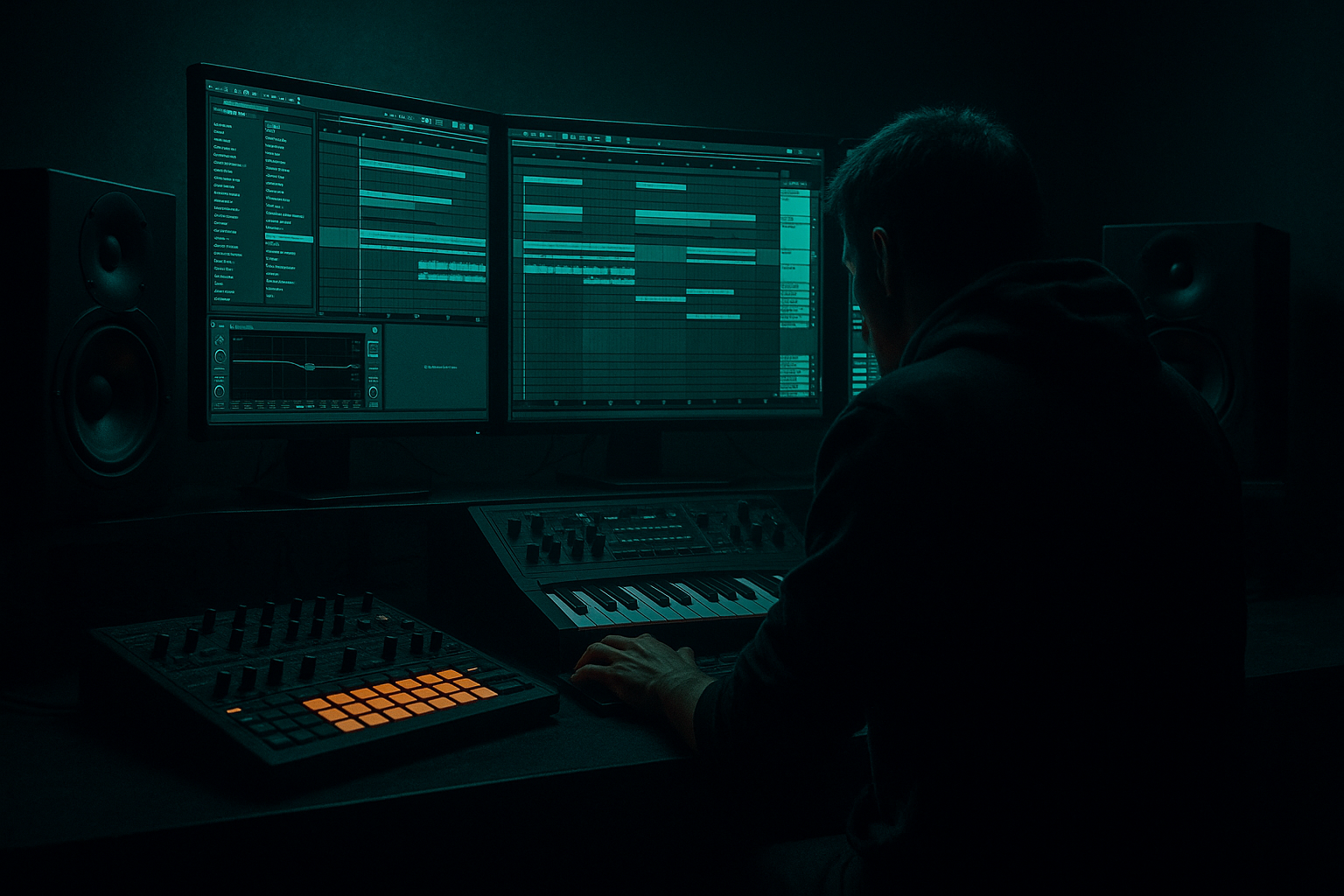
Main tutorial
Lesson Overview
This lesson is about building a retro rave edit: a jungle fill that flips into a new bass movement from scratch in Ableton Live 12, then placing it so it actually earns its keep in a Drum & Bass arrangement. The goal is not just “make a cool fill,” but to create a DJ-friendly, bar-aware, tension-building bass edit that sounds like it belongs in a proper jungle-to-rave crossover track, a darker roller, or a high-energy neuro/jungle hybrid.
This technique lives in the transition zones of a DnB track: the last half of a 16-bar phrase, the end of an 8-bar drum cycle, the last two bars before a drop, or the turnaround before a second-drop switch-up. Musically, it’s the moment where the track stops being a loop and starts feeling like a record. Technically, it matters because a jungle fill can do three jobs at once: carry momentum, reset the ear, and reveal a new bass identity without blowing up the low end or losing the groove.
This best suits:
- retro rave / jungle-influenced DnB
- dark rollers with old-school references
- break-led neuro or techstep with a throwback edit
- intros, drop turnarounds, or second-drop variation
- a chopped break or drum fill
- a short bass response phrase
- a filtered or distorted rave accent
- a final bar that “opens” into the next section
- retro rave character without sounding like a random sample pile
- a syncopated, forward-leaning rhythmic feel
- a clear role as a transition or switch-up
- enough polish to sit in a rough arrangement and still feel intentional
- solid mono-compatible low end, with the sub kept simple and readable
- Use a two-layer bass strategy: keep the sub plain and stable, then let the upper bass carry the retro rave tone. This preserves weight while giving the fill attitude.
- Print the fill and edit the audio: once the interaction between break and bass feels good, resample it. Tiny audio cuts often sound more dangerous than MIDI reshaping.
- Let one snare hit remain “too loud” on purpose: that slightly aggressive accent can make the whole fill feel like a real jungle edit instead of a polished loop.
- Use controlled resonance on the final bar: a brief filter bump around the last accent can create that rave-era bite, but keep it short or it becomes whining instead of menacing.
- Pair the fill with an arrangement drop in density: if the fill is busy, make the next bar simpler; if the fill is sparse but brutal, let the next section answer with more rhythm.
- Keep low-end motion narrower than the midrange motion: movement belongs in the harmonic layer; the sub should feel like a locked rail, not a wobble.
- Use call-and-response with the drum break: one phrase can be purely percussive, the next purely bass-driven. That contrast is what makes the flip feel intentional and underground.
- Check the edit at club-level playback volume: what sounds clever quietly can become muddy loud. The best darker DnB fills stay punchy when the system starts pressurising the room.
- Use only stock Ableton devices.
- Keep the bass flip to no more than 4 notes.
- Use one break or drum loop source only.
- Make the sub layer mono and simple.
- Add just one automation move that changes the energy at the end of the fill.
- A 4-bar loop with a clear fill in the final 2 bars
- A bass response that lands cleanly into the next section
- One printed/resampled version of the fill if it improves the result
- Does the fill still work when you mute the main bass for the first 2 bars?
- Does it stay punchy in mono?
- Does the last bar feel like a true setup for the next section, not a random flourish?
By the end, you should be able to hear a fill that feels like a controlled burst of break energy and bass stabs, with enough movement to excite the dancefloor but enough low-end discipline to keep the kick and sub intact. A successful result should sound like a recognisable old-school-inspired jungle moment that lands with modern weight — exciting, rhythmic, and mix-ready rather than messy.
What You Will Build
You will build a four-bar jungle fill flip made from:
The finished sound should have:
Success sounds like this: the ear recognises the jungle lineage immediately, but the bassline still hits like a modern DnB record. The fill should create a short spike of excitement, then resolve cleanly into the next groove, with the low end never becoming vague or flabby.
Step-by-Step Walkthrough
1. Set up the phrase first, not the sound
In Ableton Live, start with an 8-bar loop around the section where the fill will live. Put your drums, main bass, and any atmosphere in place so the fill is judged in context from the start. For a retro rave edit, the best placement is usually the last 2 bars of a 16-bar phrase or the last 1 bar before a drop change.
Create a new MIDI track for the fill bass and another for the break edit if they’re separate. If you’re working from an existing drum loop, duplicate the relevant drum track and turn that duplicate into your fill lane so you can edit without breaking the main groove.
Why this matters: jungle fills are phrasing devices, not isolated sound-design flexes. If the fill doesn’t answer the drums and the bass together, it will feel pasted on.
What to listen for: the moment the fill starts, the energy should rise without making the kick/bass relationship collapse. If the groove suddenly feels like “everything at once,” you’ve probably overloaded the phrase.
2. Choose your source material: break-first or bass-first
Here’s the first real decision point:
A) Break-first approach if you want a more authentic jungle edit with rhythmic identity leading the idea.
B) Bass-first approach if you want the fill to feel like a bassline mutation that happens to use break language.
A: Break-first
- Start with a chopped Amen-style break, classic two-step fill, or a tight old-school drum loop.
- Use Slice to New MIDI Track on the break if it helps you get quick control.
- Trim slices so that snare ghosts, kick pickups, and tiny hat details survive.
- Keep only the slices that contribute to momentum.
B: Bass-first
- Write a short MIDI phrase in the fill lane using a stabby bass patch or resampled bass one-shot.
- Then carve a small rhythmic pocket around it with break hits and fills.
- This is better if your track leans more modern, and you want the jungle reference to function as a flavour rather than the whole identity.
Practical call: if the track already has strong break language, go break-first. If the bass is the main hook, go bass-first. Both work, but they create different emotional weights.
3. Build the rhythmic skeleton with 1-bar and 2-bar logic
Make the fill legible in bars before adding detail. A reliable retro rave edit often uses:
- Bar 1: establish the original groove
- Bar 2: add chopped break tension
- Bar 3: introduce the bass flip or stab response
- Bar 4: release into the next section
Keep the first pass very structural. In MIDI, place a few accented hits and leave space. If you’re using audio slices, duplicate a break chop and move only one or two slices at a time. Resist the urge to fill every subdivision.
For timing, nudge certain ghost hits a few milliseconds ahead if you want urgency, or slightly behind if you want a looser jungle swing. In Ableton’s Arrangement View, zoom in and make micro-edits rather than forcing the whole clip onto a rigid grid.
What to listen for: the fill should still “breathe” against the kick. If the kick disappears emotionally, your fill is too dense. If the fill doesn’t pull the ear forward, it’s too empty.
4. Shape the drum edit inside Simpler or Drum Rack
If your break is chopped, load it into Simpler in Slice mode or into a Drum Rack after slicing. Use short, purposeful edits:
- tighten slice start times
- shorten tails where they blur the groove
- let one or two ghost notes ring longer for character
- use velocity to create the illusion of an old sampled break being played rather than programmed
A strong jungle fill usually needs a balance of hard hits and human-feeling micro accents. Don’t quantize everything to death. Keep the main snare anchors firm, then let the ghost notes be slightly imperfect.
Good starting points:
- break slices: trim decay so the low mids don’t smear
- ghost hit velocities: moderate to low, not full strength
- snare accents: clearly louder than the surrounding chatter
- hat fragments: narrow and controlled, not splashy
If the break sounds too clean, it will lose the retro rave edge. If it sounds too messy, it will eat the bassline. The sweet spot is dirty but legible.
5. Add a bass response phrase that answers the break
Now program the bassline or bass stab that flips the fill. This is where the lesson becomes a bassline lesson, not just a drum edit.
A strong approach is to use a short bass phrase with 2 to 4 notes maximum in the fill area, with one note acting as the “answer” to the break. For example:
- first two beats: keep the original bass minimal or drop it out
- third beat: introduce a punchy bass accent
- fourth beat: push a pickup note into the next section
If you’re using a reese-derived patch, keep the note lengths short enough that the low end stays controlled. A good starting zone:
- note lengths around 1/8 to 1/4
- short rests between hits
- one or two notes slightly higher in octave for movement
This is where octave control matters. A bass flip that lives entirely in the sub will sound heavy but flat. One that jumps too high will lose its DnB authority. The trick is to let the sub stay disciplined while the mid-bass does the character work.
6. Design the bass tone with stock Ableton devices
A solid stock chain for the bass flip is:
Operator → Saturator → EQ Eight → Auto Filter
Or, if you want a more aggressive printed character:
Wavetable → Overdrive → EQ Eight → Compressor
For Operator, use a simple sine/triangle-based core with a harmonically richer layer if needed. Keep the movement controlled rather than huge. In Saturator, a modest drive amount can bring the bass forward; think in the zone of a few dB of drive, not extreme clipping. Use EQ Eight to remove unnecessary low-mid cloud and tame harsh bands. With Auto Filter, automate a low-pass or band-pass sweep for the rave flip moment.
Good starting ranges:
- low-pass opening: around 200 Hz to 2 kHz, depending on how exposed the bass should feel
- saturation drive: low to moderate, enough to thicken the harmonics
- EQ cut around 200–400 Hz if the fill is boxy
- gentle control around 2.5–5 kHz if the bite gets sharp
If the bass is meant to feel like an old rave stab rather than a sub note, layer a short, filtered mid-bass with a cleaner low end underneath. The important thing is that the low end remains monophonic and stable.
7. Commit movement with resampling if the edit starts sounding too polite
This is the point where advanced workflow pays off. If the fill sounds technically correct but emotionally flat, resample it. Record the bass-and-break interaction to a new audio track and treat it like raw material.
Why this works in DnB: resampling captures the interaction between transient, saturation, and timing in a way that MIDI alone often doesn’t. Jungle edits often feel alive because the sound is slightly “printed” by its own distortion and envelope decisions.
Once bounced, you can:
- reverse a tiny tail into the next bar
- cut a transient earlier for a sharper pickup
- duplicate a stab and slightly detune or offset it
- fade a section into a breath before the drop lands
Stop here if the resampled version already grooves and the low end is stable. Don’t keep processing just because you can. Overworking a strong fill usually makes it smaller.
8. Automate the transition, not just the sound
A retro rave edit needs a clear entry and exit. Use automation on the bass and drum bus elements so the ear understands the transition.
Practical automation moves:
- close the bass low-pass slightly in the first half of the fill, then open it on the last hit
- reduce send to reverb or delay early, then allow a brief tail at the end
- add a short rise in filter resonance right before the final stab
- increase Saturator drive slightly only on the last accent if you want a “lift”
In Ableton, automation should feel like arrangement, not decoration. A tiny change to filter cutoff or dry/wet can create a strong payoff if timed against the bar structure.
What to listen for: the fill should feel like it “arrives” on the last hit. If the climax happens too early, the final bar loses purpose.
9. Check the edit against the drums and the next section
Put the fill into the full context: kick, snare, hats, bass, and the first bar of the next section. This is where you judge whether the edit is musically useful.
Two key checks:
- Does the final fill bar hand off cleanly into the next groove?
- Does the kick still punch, or has the bass fill stepped on it?
If the transition is into a heavier drop, let the fill end with a short gap or a stripped pickup so the next section can hit harder. If it’s into a breakdown or atmospheric reset, the fill can trail a little more and leave a tighter tail.
Arrangement example: use this over bars 13–16 of a phrase, with the fill intensifying in bars 15–16 and the new section landing on bar 17. That gives the listener just enough setup to recognise the shift without feeling interrupted.
10. Finish the mix discipline: mono, sub, and headroom
A jungle fill can easily ruin low-end clarity if the edit gets too wide or too harmonically busy. Keep the sub in mono and avoid spreading anything below roughly 120 Hz with stereo effects. If you’ve layered a rave stab or widened texture, keep that in the mid/high layer only.
Use Utility to check mono compatibility. If the fill loses too much impact when summed to mono, the width is probably sitting in the wrong part of the spectrum. Use EQ Eight to carve space rather than boosting more level. If needed, reduce the bass clip gain slightly and let the drums breathe.
In a real DnB session, the fill should feel exciting but not louder just because it has more information. The best versions create the illusion of a bigger hit by editing density and harmonic change, not brute-force level.
Common Mistakes
1. Making the fill too busy
- Why it hurts: the groove stops reading, and the listener hears clutter instead of momentum.
- Fix: mute half the ghost notes, keep one clear snare anchor, and simplify the bass response to 2–4 notes.
2. Letting the sub ring through every edit
- Why it hurts: the low end smears, and the kick loses authority.
- Fix: shorten bass note lengths, use a high-pass or low-end cleanup on the fill layer, and keep the real sub line minimal during the fill.
3. Over-widening the rave layer
- Why it hurts: it sounds big in headphones but weak or unstable in mono.
- Fix: use width only on the mid/high component, and check the whole fill in mono with Utility before committing.
4. Quantizing the break so hard it loses jungle feel
- Why it hurts: the fill becomes stiff and generic instead of rolling and alive.
- Fix: nudge a few ghost hits slightly early or late, and preserve the natural swing of the break slices.
5. Using too much distortion on the entire bass
- Why it hurts: the low end loses focus and the fill turns harsh.
- Fix: distort the mid layer more than the sub, or split the bass roles so the sub stays clean while the character layer gets the grit.
6. Forgetting the landing
- Why it hurts: the fill sounds interesting, but the next section doesn’t hit harder because the transition has no contrast.
- Fix: leave a final gap, strip the bass for a beat, or automate the filter so the next bar feels like a clean release.
7. Building the fill outside the arrangement
- Why it hurts: a cool loop may not function as a transition in the real track.
- Fix: test the edit against the actual drums and the first bar after the drop or switch-up before you approve it.
Pro Tips for Darker / Heavier DnB
Mini Practice Exercise
Goal: build a 4-bar retro rave jungle fill flip that works in context with your drop.
Time box: 15 minutes.
Constraints:
Deliverable:
Quick self-check:
Recap
A strong retro rave jungle fill in Ableton is built from phrase first, sound second. Keep the break edit rhythmic and readable, make the bass response short and disciplined, and use automation or resampling to create a real transition instead of a decorative loop. The winning version should feel heavy, nostalgic, and purposeful — a proper DnB movement that hits in the room and leads cleanly into what comes next.

