Main tutorial
```markdown
Retro Rave Switch‑Up Polish (Session → Arrangement) in Ableton Live 12
Advanced Composition for Jungle / Oldskool DnB vibes ⚡️🥁
---
1. Lesson overview
This lesson is about turning Session View energy into an Arrangement that hits like a proper rave record—with switch‑ups, drop discipline, and oldskool jungle pacing.
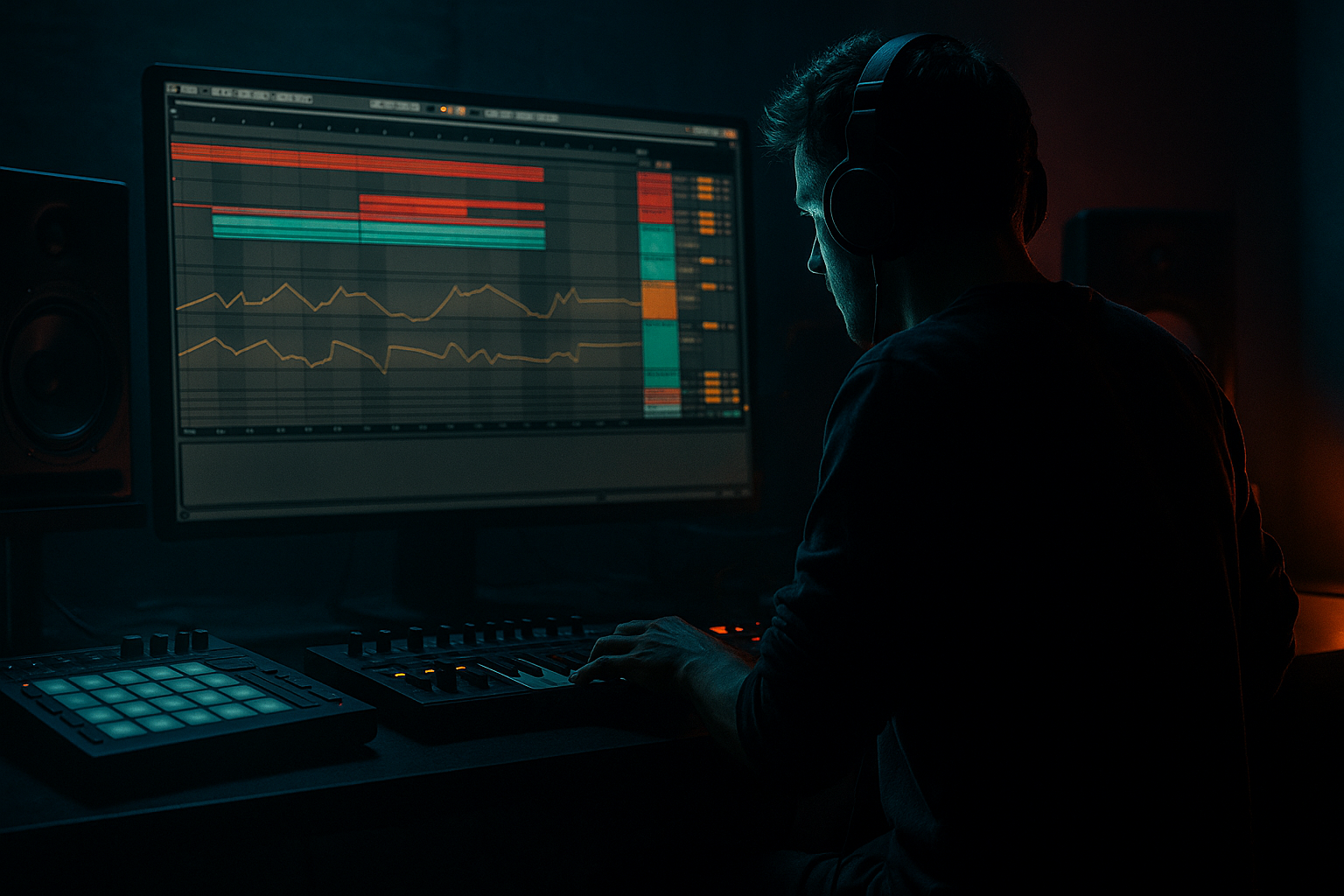
You’ll build a performance‑friendly Session View (clips + scenes + follow actions), record a live arrangement pass, then polish the switch‑ups using Arrangement View editing, automation, and Ableton stock devices.
Core idea: jam first, then commit—and make switch‑ups feel intentional, not accidental.
---
2. What you will build
A 3–4 minute jungle / oldskool DnB track skeleton with:
- Intro (DJ friendly) → Drop 1 → Switch‑Up / Variation → Break / Fake → Drop 2 (heavier) → Outro
- 2–3 drum “states” (tight, loose/amen, halftime tease)
- Bass “A/B” (rolling reese vs. sub+stab)
- Rave elements: stabs, hoovers, risers, rewinds, tape stops
- A clean Session workflow that records smoothly into Arrangement 🎛️
- DRUMS 1 (Tight / Modern): Kick + snare + hats (clean)
- DRUMS 2 (Breaks / Amen): sliced break(s) + ghost hits
- BASS (Sub/Reese): main bass MIDI
- STABS (Rave chords): stabs/hoover shots
- FX / RISERS
- VOCAL / SHOUTS (optional)
- PAD / ATMOS (optional)
- Drum clips: 8 bars (enough for evolution)
- Bass clips: 8 or 16 bars
- Stab/FX clips: 4 or 8 bars
- Make A / B / C variations for each core part.
- `D1_A Tight` / `D1_B AddRide` / `D1_C Fill`
- `BRK_A AmenClean` / `BRK_B AmenHyped` / `BRK_C Edits`
- `BASS_A ReeseRoll` / `BASS_B SubStab` / `BASS_C HalfTime`
- Use Drum Rack with clean one‑shots:
- Device chain idea:
- Drop an Amen / Think break audio into a track.
- In clip view:
- Add Slice to New MIDI Track (if you want edited fills)
- Instrument: Wavetable (or Operator if you prefer)
- Wavetable quick start:
- Chain:
- Instrument: Operator
- Add a short “stab” MIDI rhythm (syncopated, 1/8 + rests)
- Chain:
- On bass: Compressor → Sidechain ON → Audio From: Kick track
- Settings: Ratio 4:1, Attack 1–3ms, Release 60–120ms, aim 2–6 dB GR
- Use Simpler or Sampler with a classic stab sample
- Or build one with Analog / Wavetable and resample
- Rewind moment: automate a short reverse + stop (or fake it with delay throws)
- Tape stop: use Shifter (Pitch mode) automating down quickly, or resample and pitch drop
- Noise riser: Operator noise + Auto Filter sweep + reverb send
- Clip length: 8 bars
- Follow Action: after 8 bars → Next (probability 30–60%)
- Or: Any with a small probability for “surprise edits”
- Set locators at:
- Jungle likes 16‑bar phrases but loves surprises at bar 8.
- Cut everything for 1/4, 1/2, or 1 bar
- Leave a single FX tail (Echo/Verb)
- Add a snare fill or reverse cymbal
- Consolidate a 2–4 bar “pre‑drop” region
- Add Auto Filter automation on the break (HP sweep up)
- Automate Return send throws on the last snare
- Add fills every 8 or 16 bars:
- Use Warp markers to fix any rushed hits
- Use Fade handles on audio cuts to avoid clicks
- Use Gate (sidechained from snare) to shape noisy breaks if needed
- Keep the same break, change bass rhythm
- Keep bass, switch break to a more edited Amen
- Keep drums, change chords/stabs + filter world
- Bars 1–4: filter the break up (HP rising), remove sub
- Bars 5–6: half‑time tease (kick sparse, snare loud)
- Bars 7–8: FX swell + 1‑beat silence
- Drop: slam full break + bass A
- Bass filter cutoff (movement + transitions)
- Reverb send on stabs/snare for throws
- Echo feedback for 1‑shot “spin out”
- Utility gain for quick mute dips (cleaner than volume sometimes)
- Switch‑ups that change everything at once → feels like two unfinished tracks stitched together. Keep one anchor.
- Over-warped breaks → transients smear, groove dies. Use Warp carefully; consider consolidating and re-slicing.
- Too much reverb in the drop → jungle needs space, but the drums must stay forward. High‑pass your returns.
- Bass not sidechained or not arranged → constant bass = no drop impact. Use dropouts and rhythm changes.
- No phrase awareness → random changes every 4 bars can feel nervous. Use 8/16 bar logic and earn the chaos.
- Make Drop 2 heavier by arrangement, not just distortion:
- Parallel filth: Send breaks to a Crunch Parallel return and automate send up only in switch sections.
- Sub discipline:
- Weaponize silence: a 1/2 bar mute before a drop is often “heavier” than adding another FX layer.
- Pitch the break up/down for energy shifts:
- Use Drum Rack macros for performance: map:
- Build clip states in Session View that are designed for contrast (A/B/C), not randomness.
- Use scenes + follow actions to generate controlled jungle variation.
- Record a performance pass into Arrangement, then edit like a producer:
- Your switch‑ups become professional when they have anchor + payoff: tease → tension → slam.
---
3. Step-by-step walkthrough
Step 0 — Project setup (tempo, swing, routing)
1. Tempo:
- Jungle/oldskool sweet spot: 160–168 BPM (try 165 BPM).
2. Global Groove (optional but very genre):
- Add a groove like MPC 16 Swing 55–60 or a shuffled break groove.
- Apply subtly: Timing 10–25%, Velocity 0–15%.
3. Return tracks (set up early):
Create these Returns so your switches feel “rave” without clutter:
- A: Dub Echo → Echo (1/8 or 1/4, Feedback 35–55%, Filter on) + Auto Filter (HP around 200Hz)
- B: Plate Verb → Hybrid Reverb (Plate, Decay 1.2–2.2s, HP 250Hz, LP 8–12k)
- C: Crunch Parallel → Saturator (Soft Clip on, Drive 3–8 dB) + Drum Buss (Drive 5–15, Crunch 10–30) + EQ Eight (HP 120Hz)
4. Master safety:
- Put Limiter on Master (Ceiling -0.8 dB, Lookahead default).
- Don’t chase loudness yet—just prevent accidental overs.
---
Step 1 — Build “clip states” in Session View (the secret to switch‑ups)
Create tracks like this (typical oldskool layout):
#### Clip length strategy (keeps jungle flowing)
Naming discipline (it matters when performing):
---
Step 2 — Oldskool drum system: tight layer + break layer
#### DRUMS 1 (tight)
- Kick: short punch (tuned to track key)
- Snare: 200Hz body + 2–5k crack
- Closed hat: 1/8 driving
1. EQ Eight (HP 25–35Hz; notch any boxy ~250–400Hz if needed)
2. Drum Buss (Drive 5–10, Boom 0–10, Transients +5–15)
3. Saturator (Soft Clip On, Drive 2–6 dB)
#### DRUMS 2 (breaks)
- Warp: Beats
- Preserve: 1/16
- Transients: adjust so the groove stays crisp
- Use Transient slicing
- Put slices into a Drum Rack for quick jungle edits
Break chain (classic “rave grit”):
1. EQ Eight
- HP 70–120Hz (let your tight kick/sub own the low end)
- Add 3–6k presence if dull
2. Redux (subtle)
- Downsample small amount (try 2–8) for texture
3. Drum Buss
- Crunch 10–25, Drive 5–12
4. Glue Compressor
- Attack 3–10ms, Release Auto, Ratio 2:1, aim 1–3 dB GR
---
Step 3 — Bass A/B clips designed for switch‑ups (not just “different notes”)
Oldskool DnB switch‑ups often come from rhythm + tone change, not a whole new melody.
#### Bass A: Reese roll (movement)
- Osc 1: Saw, Unison 2–4, slight detune
- Filter: LP24, Drive a bit
1. Saturator (Drive 3–8, Soft Clip)
2. Auto Filter (envelope subtle for bite)
3. Chorus-Ensemble (very subtle width above 200Hz—keep sub mono)
4. Utility (Bass Mono ON, Width 80–120% for upper band if using split racks)
#### Bass B: Sub + stab bass (switch energy)
- Osc A Sine for sub
- Add a second osc lightly for harmonics
1. EQ Eight (keep sub clean)
2. Saturator (gentle)
3. Sidechain Compressor keyed from the kick (more below)
Sidechain setup (classic roll):
---
Step 4 — Rave stabs and switch FX (your “retro rave glue”) 🔊
STABS track
Device chain (stabs):
1. EQ Eight (HP 150–250Hz)
2. Saturator (Drive 2–6)
3. Auto Filter (map cutoff to Macro for buildup)
4. Send to Dub Echo + Plate Verb
Switch FX that scream oldskool:
---
Step 5 — Scene design: build an arrangement in advance (then perform it)
Create Scenes (rows) like a DJ set:
1. `01 Intro (Pads + Hats)`
2. `02 Intro (Add Stabs Tease)`
3. `03 Build (Break filtered)`
4. `04 DROP 1 (Tight + Break A + Bass A)`
5. `05 DROP 1 Var (Break B edits + Stabs)`
6. `06 Switch‑Up (Half-time tease / Bass B)`
7. `07 Break (FX only)`
8. `08 DROP 2 (Heavier: Break C + Bass A/B)`
9. `09 Outro (DJ friendly drums)`
#### Follow Actions (advanced, super useful)
For your break clips, set Follow Action to create controlled variation:
This makes your Session performance feel alive without chaos.
---
Step 6 — Record Session into Arrangement (the “commit” moment) 🎥
1. Turn on Arrangement Record (top transport) while in Session View.
2. Trigger scenes like you’re DJing:
- Keep scenes changing every 8 or 16 bars.
- Use mute/solo for drama: mute tight drums briefly to expose break edits.
3. Record 2 passes:
- Pass 1: structure (don’t over‑tweak)
- Pass 2: performance automation (stabs sends, filter sweeps, drops)
Key workflow:
When you’re done, hit Tab → Arrangement View.
Use Back to Arrangement (top) to ensure you’re hearing arrangement data, not still‑playing clips.
---
Step 7 — Switch‑up polish in Arrangement View (make it sound intentional)
Now you clean the “live jam” into a record.
#### A) Anchor points: markers + phrase lines
- Intro start
- Drop 1
- Switch
- Break
- Drop 2
- Outro
#### B) Edit the “drop gap” (classic rave drop technique)
At the moment before Drop 1 / Drop 2:
Practical:
#### C) Tighten drums: micro‑edits and fills
- Amen slice flam
- Snare rush (1/16 → 1/32)
- Kick dropouts (remove kick for 1 bar to make bass feel bigger)
Ableton tools:
#### D) Make switch‑ups “contrast + continuity”
A great switch keeps one identity constant:
OR
OR
Concrete switch recipe (8 bars):
#### E) Automation lanes that matter most
Focus on these first:
---
Step 8 — Bus processing for glue (don’t crush it yet)
Drum Bus group (all drums):
1. EQ Eight (HP 25–30Hz, tiny dip if harsh 4–7k)
2. Glue Compressor (2:1, Attack 10ms, Release Auto, 1–2 dB GR)
3. Drum Buss (very light, just a touch of Drive)
Music Bus group (bass + stabs + pads):
1. EQ Eight (trim low mids if muddy)
2. Saturator (gentle)
3. Utility (mono below 120Hz if needed)
---
4. Common mistakes
---
5. Pro tips for darker/heavier DnB 🖤
- Add a second break layer quietly (10–20% volume) for density
- Add ride loop or shuffled hat only in Drop 2
- Keep sub mostly sine/triangle, mono, minimal distortion.
- Distort/move the midbass separately (use an Audio Effect Rack with split bands).
- Duplicate break, change Clip Transpose ±1–3 semitones (watch artifacts).
- Break HP filter
- Break crush amount (Redux mix)
- Snare verb send
- Bass cutoff
- Master “DJ filter” (Auto Filter on a pre-master bus)
---
6. Mini practice exercise (20 minutes) 🎯
1. In Session View, create 3 scenes only:
- Scene A: Drop (Bass A + Tight + Break A)
- Scene B: Switch (Bass B rhythm + Break filtered + Stab throws)
- Scene C: Drop (Bass A + Break B edits + extra hat)
2. Record a 90‑second arrangement by launching A → B → C.
3. In Arrangement View, polish:
- Add 1 bar silence before Scene C drop
- Add Echo throw on the last snare before the silence
- Add one Amen fill every 8 bars (copy/paste a sliced fill)
Deliverable: one clean 90s section that feels like a real rave transition.
---
7. Recap
- phrase markers, drop gaps, fills, automation, and bus glue
If you want, tell me your current drum sources (Amen/Think/909-style), BPM, and whether you’re going more 96–98 jungle or techstep-ish—and I’ll suggest a scene map + device rack macros tailored to your sound.
```

