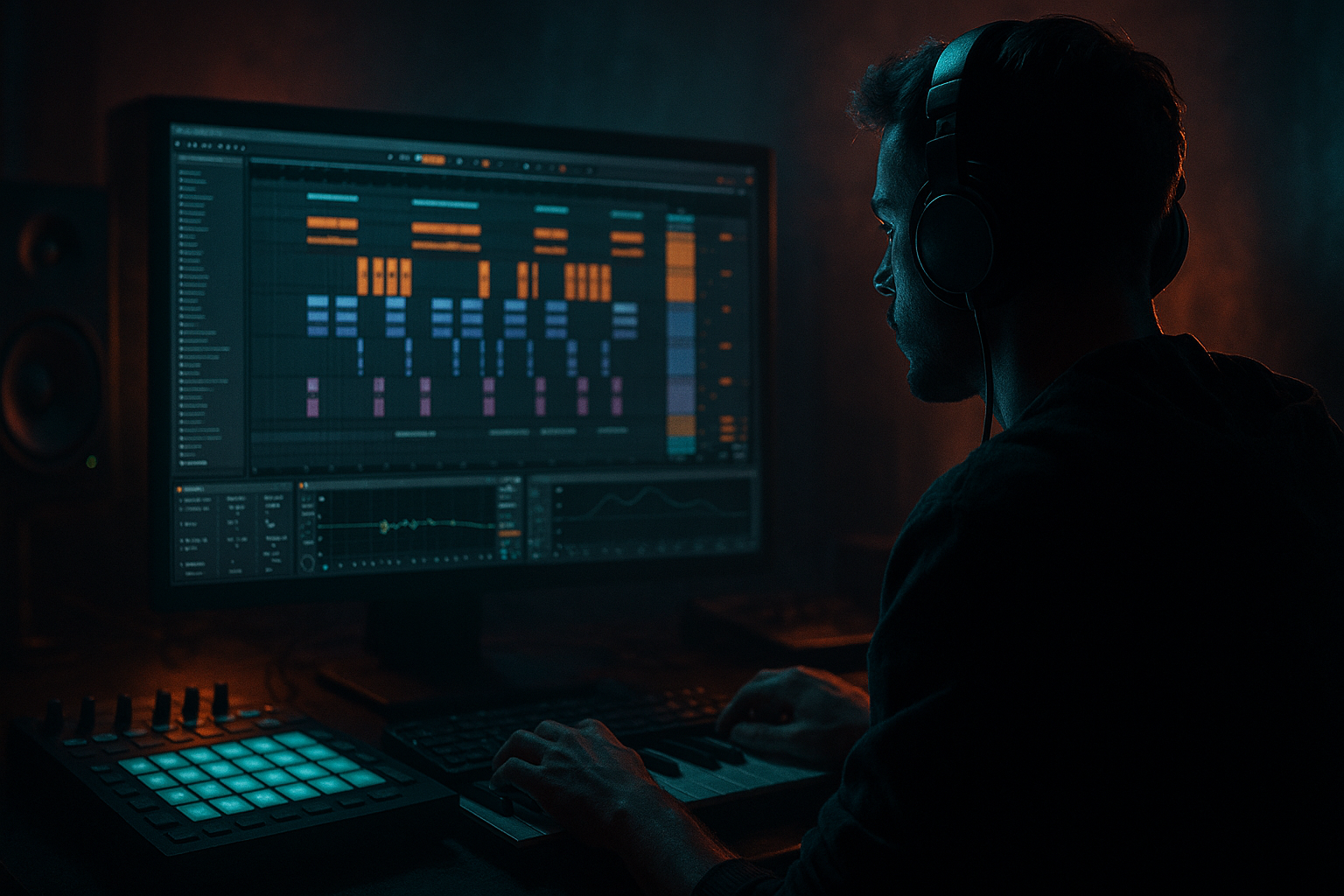
Main tutorial
```markdown
Retro Rave Transition Carve (Resampling Workflow) — Ableton Live 12 (Jungle / Oldskool DnB) 🚨
1. Lesson overview
This lesson is about building that classic rave “carve + lift + slam” transition you hear in jungle/oldskool DnB: the mix thins out, tension rises, then the drop hits harder because the spectrum and dynamics were deliberately “carved” beforehand.
We’ll do it using resampling in Ableton Live 12 so you can:
- print your transition as audio (stable, repeatable, CPU-light),
- abuse warping/reverses/filters like it’s 1994,
- create a DJ-tool style transition clip you can reuse across tracks.
- A “Carve Bus” that gradually removes sub/low-mids and exaggerates air/noise
- A Resampled Riser Print (audio) you can warp, reverse, gate, and stutter
- A Drop Impact Layer (sub hit + break hit + reese bite) to reintroduce weight
- Optional: oldskool rave artifacts (noise bursts, time-stretched tails, gated verb)
- Route DRUMS, BASS, MUSIC/FX to it during the transition (or automate sends).
- Device chain:
- Echo
- Drop Analog (Noise oscillator) or a noise sample
- Process with Auto Filter (bandpass sweep) + Saturator
- Keep it quiet; it’s glue, not the lead.
- 1/8 bar mute of PRE-DROP SUM right before the downbeat, with a reverb tail continuing.
- Or volume automation dip on PRE-DROP SUM:
- Let Return A (RAVE VERB) and Return B (DUB DELAY) continue (don’t mute returns).
- High-pass the returns if they bloom too much.
- Resample IMPACT to audio, then nudge it sample-accurate.
- This locks timing and stops CPU spikes.
- Full groove, subtle sends to dub delay
- Begin gentle HP carve (35 → 70 Hz)
- Push carve harder (HP up to ~120–160 Hz)
- Increase reverb send on stabs/snare fills
- Start band-pass sweep on resampled print quietly underneath
- Add Redux grit + widen
- Add a tiny break edit fill (1/16 chops)
- Optional: 1/8 silence right before drop
- Hard reset all filters (instant weight return)
- Impact layers hit
- Returns pulled back to avoid washing the first downbeat
- Carving only with volume: you lose excitement. Carve spectrum + dynamics instead.
- Not resetting automation at the drop: leaving HP filters up is the #1 “why is my drop weak?” issue.
- Resampling the master with limiters engaged: you print the limiter pumping into the riser. Bypass master limiting while printing transition tools.
- Too much width in the low end: if you widen the print, high-pass the widened content or keep sub mono.
- Clashing reverb tails with the drop kick/snare: EQ the returns (HP 250–400) and reduce send right at drop.
- Make the carve feel “predatory”: automate a narrow EQ dip sweeping slowly (EQ Eight bell, Q 6–10, -2 to -4 dB) across 1–3 kHz for that uneasy phasey feel.
- Parallel distortion on the print: duplicate the resample track, distort hard (Saturator + Overdrive), then high-pass at 500–800 Hz and blend low. Keeps grit without mud.
- Sub ghosting: while you carve the main bus, sneak in a very low-level sub note (Operator sine) in the last bar so the crowd “feels” the drop coming.
- Use Roar (Live 12) tastefully:
- Clip gain discipline: keep the resample clip peaking around -6 dBFS before adding transition FX. Let the impact hit loud, not the riser.
- You built a retro rave transition carve by processing a pre-drop sum, then resampling it into a flexible audio tool.
- The magic is contrast: remove sub/low-mids + add air/grit + tension FX, then hard reset for the drop.
- Resampling gives you commitment, consistency, and creative abuse (warp/reverse/stutter) that feels authentically jungle/oldskool.
Advanced focus: audio-first workflow, resample buses, parallel processing, spectral carving, and arrangement mechanics.
---
2. What you will build
A 4–8 bar transition tool designed for jungle/DnB:
End result: a transition that feels like a rave-era mix move but with modern control.
---
3. Step-by-step walkthrough
Step 0 — Session prep (so resampling is painless)
1. Tempo: 165–172 BPM (example: 170 BPM).
2. In Preferences → Record/Warp/Launch:
- Warp: Auto-Warp Long Samples = Off (keeps resamples clean)
- Create Fades on Clip Edges = On (prevents clicks)
3. Create these tracks:
- DRUMS (Group) (your break + tops)
- BASS (Group) (reese/sub)
- MUSIC/FX (stabs, pads, atmos)
- CARVE BUS (Audio) (this will record resamples)
- IMPACT (Audio) (for printed hits)
4. Create Return tracks:
- A: RAVE VERB
- B: DUB DELAY
- C: NOISE / AIR (optional for texture)
Routing philosophy: We’re going to print “the moment” as audio, then destroy it.
---
Step 1 — Build the Carve chain (on a dedicated bus)
You want to thin the mix before the drop without just “turning stuff down.”
Option A (recommended): use an Audio track as a resampling recorder
1. Set CARVE BUS input to:
- `Audio From: Master` (or from a dedicated “PRE-DROP SUM” bus if you prefer)
2. Set Monitor = Off (so it doesn’t double-monitor).
3. Arm it when printing.
Carve processing should be on the source, not the recorder, so you have a real mix move.
Create a group called PRE-DROP SUM:
On PRE-DROP SUM, add this chain (stock devices):
1. EQ Eight (carving & pre-drop “radio” effect)
- Enable HP filter (48 dB/oct if you want it dramatic)
- Start cutoff around 35–45 Hz, automate up to 140–200 Hz over 4–8 bars
- Add a wide bell dip: -2 to -5 dB at 250–450 Hz (removes box/weight)
- Optional: small high shelf +1 to +3 dB at 8–12 kHz near the peak
2. Auto Filter (movement + classic sweep)
- Mode: HP12 or HP24
- Drive: 3–6 dB (adds bite)
- Envelope: low (0–10%)
- Automate Frequency alongside EQ but slightly offset (gives “two-stage” lift)
3. Saturator (rave grit)
- Mode: Analog Clip
- Drive: 2–5 dB
- Soft Clip: On
- Output: trim so you’re not smashing the master
4. Compressor (glue while carving)
- Ratio: 2:1
- Attack: 10–30 ms
- Release: Auto or 80–150 ms
- Aim for 1–3 dB GR as the sweep rises
✅ Automation tip: Put all “carve” automation on the PRE-DROP SUM group track so it’s one lane per macro-move.
---
Step 2 — Add classic jungle tension layers (quick + effective)
In oldskool jungle, transitions often use noise, time-stretch tails, and echoes.
Return A: RAVE VERB
1. Hybrid Reverb
- Algorithm: Hall or Plate
- Decay: 2.5–5.5 s
- Pre-delay: 10–25 ms
- Lo Cut: 200–400 Hz
- Hi Cut: 7–10 kHz
2. EQ Eight
- HP at 250–400 Hz
- Notch harshness if needed (2–4 kHz)
3. Gate (gated-rave vibe)
- Threshold: set so tail clamps rhythmically
- Return channel Gate can be triggered by the return’s own signal (good enough), or sidechain it from drums for tighter chop.
Return B: DUB DELAY
- Time: 1/8 dotted or 1/4
- Feedback: 25–45%
- Filter: HP around 250 Hz, LP around 6–9 kHz
- Mod: subtle (2–5%) for wobble
Optional Return C: NOISE / AIR
---
Step 3 — Print (resample) the transition moment 🎛️➡️🎚️
Now we “commit” the carve and tension into an audio clip.
1. Set loop over your transition: 4 or 8 bars before the drop.
2. Arm CARVE BUS.
3. Record while playing the section with your automation moving (filters rising, verbs sending, etc).
4. Stop recording; consolidate the best take (`Cmd/Ctrl + J`) into a clean clip.
Naming: `CarvePrint_170BPM_8bars.wav`
This becomes a reusable DJ tool.
---
Step 4 — Turn the print into a retro-rave riser (audio abuse)
This is where resampling shines.
On the printed audio clip:
1. Warp = On
2. Try Warp Modes:
- Complex Pro for full mix prints (keeps it coherent)
- Formants: 0–30 (don’t overdo)
- Envelope: 80–128 (smoother)
3. Create movement edits:
- Duplicate the clip.
- Reverse the first half (`R`), keep second half forward.
- Add a short fade at the splice to avoid clicks.
Add devices on CARVE BUS (post-clip) for the “rave lift”:
1. Auto Filter (Band-Pass)
- BP12
- Automate Frequency rising (e.g., 400 Hz → 4 kHz)
- Resonance: 0.70–1.20 (tasteful squeal)
2. Redux (lo-fi edge, very 90s)
- Downsample: 2.0 → 6.0 (automate slightly up near the end)
- Bit Depth: 10–12 (don’t kill it)
3. Utility (stereo trick)
- Automate Width 100% → 140% in last 1–2 bars
- Then hard reset to 100% at drop (contrast!)
---
Step 5 — Create the “Carve Stop” (the moment of silence) ✂️
Classic rave/DJ tension move: a tiny gap or choke right before the drop.
Options:
- Fade down to -inf over last 1/16–1/8, then snap back at drop.
To keep energy while muting weight:
---
Step 6 — Build the drop impact (printed + layered) 💥
Oldskool jungle drops often hit because transient + sub + mid bite all arrive together.
Create IMPACT layers:
1. Break Hit / Drum Slam
- Grab a single clean break transient (Amen/Think-style)
- Put it on the drop downbeat
- Process:
- Drum Buss: Drive 5–15, Crunch 0–20, Boom 0–10 (short)
- EQ Eight: small lift at 3–5 kHz for crack, control 200–400 if muddy
2. Sub Punch
- Use Operator (sine) or a one-shot sub
- Pitch to root (often F/G for darker)
- Envelope: fast attack, short decay (or match your bass note)
- Add Saturator (Soft Clip on) for audibility
3. Mid “Bite”
- A short reese stab or distorted bass click
- Even a resampled bass transient works great
Print the impact too (optional but pro):
---
Step 7 — Arrangement blueprint (8-bar example)
Here’s a reliable oldskool DnB transition shape:
Bars -8 to -5:
Bars -4 to -3:
Bars -2 to -1:
Drop bar 1:
---
4. Common mistakes
---
5. Pro tips for darker/heavier DnB 🕶️
- Put Roar on the resampled print, pick a darker preset, then filter before Roar. Automate Mix from 0 → 15–25% near the end.
---
6. Mini practice exercise (15–20 minutes)
1. Take an 8-bar loop of your current jungle groove (break + bass + stabs).
2. Create PRE-DROP SUM and automate:
- EQ Eight HP: 40 → 180 Hz
- Auto Filter HP: 80 → 300 Hz
- Utility Width: 100 → 135%
3. Add sends:
- Snare to RAVE VERB: ramp 0 → -8 dB send in last 2 bars
- A tiny Echo send on stabs
4. Resample to CARVE BUS (8 bars).
5. Warp the print in Complex Pro, reverse the first 2 bars, add Redux lightly.
6. Create a 1/8 stop before drop.
7. Add IMPACT: break hit + sub punch.
8. Bounce/export just the transition + first 2 bars of drop and A/B:
- With carve + resample tool
- Without it
Listen for contrast and drop weight.
---
7. Recap
If you want, tell me your tempo + whether your drums are Amen/Think-style or modern breaks, and I’ll suggest a transition curve (bar-by-bar automation values) tailored to your groove.
```

