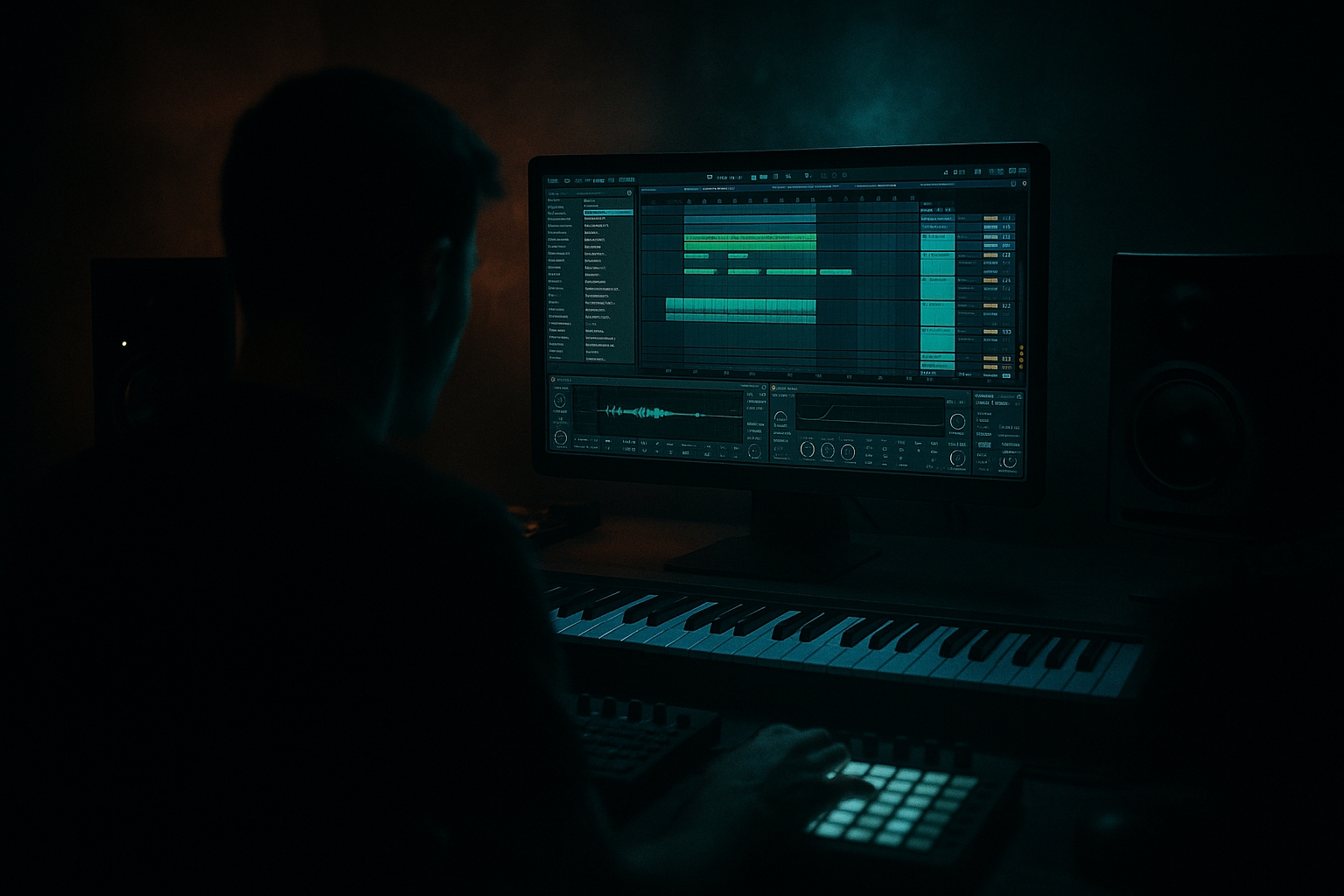
Main tutorial
```markdown
Rhythmic Composition with One-Note Bass (Advanced DnB in Ableton Live) 🔥
1. Lesson overview
Writing a bassline that never changes pitch sounds limiting… until you treat it like a rhythmic instrument. In drum & bass—especially rollers, jungle, and dark steppers—one-note bass can feel more aggressive and hypnotic than melodic lines, because the interest comes from gaps, syncopation, note length, accents, modulation, and call-and-response with the drums.
In this lesson you’ll build a one-note bass part that:
- grooves hard against a DnB drum pattern
- evolves across an arrangement without changing note
- stays clean in the low-end while still sounding nasty 💀
- rhythmic motifs (A/B variations)
- velocity + note length as “accent design”
- filter/FM/wavetable movement without pitch changes
- sidechain + gating that locks to your kick/snare
- arrangement automation to create sections (intro → drop → mid → 2nd drop)
- Wavetable (most flexible for modern DnB)
- Operator (great for clean sub + aggressive mid via FM)
- Anchor notes: just after the snare hits feel great.
- Try placing notes on: 1.1.1, 1.1.3, 1.2.2, 1.3.1, 1.3.3, 1.4.2
- Some notes: 1/16 short “taps” (percussive)
- Some notes: 3/16–1/8 (glue phrases together)
- Avoid everything being the same duration—this is what makes one-note bass feel like a loop.
- In the MIDI editor, toggle to Note Length view and deliberately create short/long patterns as if it’s a drum.
- filter amount (map velocity → filter)
- saturation intensity (via Macro → mod)
- amp volume (default)
- Go to Mod Matrix → add Velocity → Filter Freq (small amount, like +5 to +15)
- Add Velocity → Amp Level (subtle)
- Accents (velocity 100–127) on notes that answer the snare
- Ghost notes (velocity 30–60) to create shuffle
- Sidechain: From Kick (or a dedicated ghost kick)
- Ratio: 4:1
- Attack: 1–5 ms
- Release: 60–120 ms (tune to tempo)
- Aim for 2–6 dB reduction depending on style
- Use Sidechain input from a ghost hi-hat pattern or a muted percussion track
- This creates a tight “chatter” without writing more MIDI notes
- Threshold: adjust until it opens on intended hits
- Return: 50–150 ms
- Floor: -inf for hard gating, or -12 dB for subtle
- You can distort and modulate the mid without wrecking the sub’s clarity.
- Macro 1: Filter cutoff (MID chain Auto Filter or Wavetable filter)
- Macro 2: Drive (Saturator/Overdrive amount)
- Macro 3: Noise/Texture (Wavetable noise level or erosion)
- Macro 4: Gate intensity (Gate threshold or floor)
- Intro (16 bars): less drive, more filtering, simpler rhythm (Motif A)
- Drop 1 (32 bars): open filter, more drive, add Motif B every 4 bars
- Mid (16 bars): strip sub briefly, keep mid chatter (tension)
- Drop 2: bring sub back hard, slightly different rhythm density
- Open cutoff on bar 15→17 (pre-drop lift)
- Increase drive only on bars 1–2 of each 8-bar phrase
- Momentary “mute gaps” (Utility gain dip) right before snares for impact
- Bars 1–2: Motif A
- Bar 3: Motif A with a couple missing notes (space!)
- Bar 4: Motif B “fill” (more 16ths + shorter notes)
- Use silence as a fill. A 1/8-note gap before the snare can hit harder than any extra note.
- Keep the sub mostly on-grid.
- Push/pull mid-bass rhythm slightly:
- Consolidate your MIDI clip, duplicate it, and make a “late” version.
- Or use Track Delay on the MID chain (if you split).
- Erosion (on MID chain):
- Corpus for metallic “reese-adjacent” character (still one note):
- Multiband Dynamics as controlled aggression:
- Auto Filter + Envelope for “pluck” motion:
- Resample to audio and slice:
- Make the snare the boss:
- One-note bass becomes composition when rhythm is treated like melody.
- Use note length + velocity + space as your main writing tools.
- Lock it to drums with sidechain + (optional) gate.
- Go heavy safely by splitting sub and mid.
- Keep interest via automation, A/B motifs, and arrangement-level density changes—not pitch changes.
Ableton focus: MIDI rhythm programming, device chains, modulation, resampling/automation, and arrangement workflow.
---
2. What you will build
A rolling one-note bass (e.g., F1 / G1 / A#1—pick your key) that evolves through:
End result: a bassline that feels written and intentional, not like a loop.
---
3. Step-by-step walkthrough
Step 0 — Session setup (so the bass has context)
1. Tempo: 172–176 BPM (we’ll assume 174 BPM).
2. Create a basic drum loop (or use your own):
- Kick on 1 and 11 (classic DnB spacing)
- Snare on 5 and 13
- Hats/shuffles: 16ths with swing or ghost hits
3. Set Groove Pool:
- Try Swing 16-65 lightly (Amount ~10–25%) for hats, not the sub.
> Advanced mindset: you’re composing the bass against the snare and hats, not “in isolation”.
---
Step 1 — Choose the “one note” and lock it in
1. Create a MIDI track: BASS – One Note.
2. Add Tuner (temporary) at the end of the chain.
3. Decide your root note (example: F1 for weight).
- In DnB, a lot of subs sit around E1–G1 depending on key and system translation.
Rule: no pitch changes. One MIDI note only (octave stays fixed too).
---
Step 2 — Build a bass instrument that responds to rhythm (stock-first)
Pick one:
#### Option A: Wavetable (recommended)
Device chain:
1. Wavetable
- Osc 1: Basic Shapes → Sine (or slightly toward triangle for a touch of harmonic)
- Osc 2: Off (for now)
- Filter: LP24
- Drive: 5–15% (subtle; you can do heavier later)
- Amp Env:
- Attack 0–5 ms
- Decay ~200 ms
- Sustain 0
- Release ~60–120 ms
(This makes short notes punchy and long notes sustained—perfect for rhythmic writing.)
2. Saturator
- Mode: Soft Sine or Analog Clip
- Drive: 2–6 dB (keep it controlled)
- Soft Clip: On
3. EQ Eight
- HP at 25–30 Hz (gentle)
- Small dip around 200–350 Hz if it clouds
4. Compressor (optional, gentle)
- Ratio 2:1, Attack 10–30ms, Release Auto
> Keep the instrument expressive: changes in note length and velocity should clearly change the sound.
---
Step 3 — Write the “rhythm bassline” (the real composition)
Set your MIDI clip length to 4 bars. You’ll create Motif A and Motif B.
#### 3.1 Start with a “call to the snare”
In a 1-bar grid (16th notes), place F1 notes like this:
(You’re implying “push-pull” around the backbeat.)
Now do the advanced part:
#### 3.2 Use note length as groove
In MIDI, vary note lengths aggressively:
Workflow tip:
#### 3.3 Velocity = accents (even if your bass is “flat”)
Even on a single pitch, velocity can drive:
In Wavetable:
Then set:
This makes it feel like a drummer’s ghosting, but in bass.
---
Step 4 — Make it roll: sidechain + rhythmic gating
You’ll glue bass rhythm to the drums without changing pitch.
#### 4.1 Sidechain (classic DnB pump)
Add Compressor after EQ:
#### 4.2 Rhythmic gate (for extra “talk”)
Add Gate after the sidechain compressor:
Gate settings starter:
> This is huge for one-note bass: you can “add rhythm” without changing pitch or MIDI density.
---
Step 5 — Split sub and mid (so you can go heavy safely) ⚙️
Create an Audio Effect Rack after your instrument (or build two layers).
Rack Chains:
1. SUB chain
- EQ Eight: LP at 90–120 Hz
- Saturator: very mild (or none)
- Utility: Mono below 120 (or just keep chain mono)
2. MID chain
- EQ Eight: HP at 90–120 Hz
- Overdrive / Saturator (heavier)
- Auto Filter (movement)
- Chorus-Ensemble (tiny amount, optional)
- Utility: Width 120–160% (careful—keep low mids centered)
Why this matters:
---
Step 6 — Movement without pitch: automation + modulation
Now you “compose” section changes.
#### 6.1 Macro-map the right stuff
In the Rack, map to Macros:
#### 6.2 Automate per section (arrangement)
In Arrangement View:
Automation ideas (that feel DnB):
---
Step 7 — Variation system: A/B motifs and fills (still one note)
Create a 4-bar clip:
DnB tip:
---
Step 8 — Glue it to the drums (micro-timing & swing)
Advanced groove comes from micro placement:
- Nudge selected notes +3 to +10 ms late for laid-back roll
- Or -3 to -10 ms early for aggression
Ableton workflow:
---
4. Common mistakes 🚫
1. Same note length everywhere
→ Makes it feel like a MIDI drone. Fix: design a “short/long” pattern like drum ghosting.
2. Too much distortion on the sub
→ Low-end smears and loses headroom. Fix: split SUB/MID and keep sub clean.
3. Sidechain release not tuned
→ Either flappy pumping or no groove. Fix: adjust release while listening to kick + bass only.
4. Over-filling every gap
→ Rollers need breathing room. Fix: remove 10–20% of notes and let hats carry motion.
5. No arrangement evolution
→ One-note is unforgiving; you must automate movement and density changes.
---
5. Pro tips for darker/heavier DnB 😈
- Mode: Noise / Sine
- Amount: 0.2–1.5
Great for gritty edge that reads on small speakers.
- Put on MID chain, mix low, automate decay or tune slightly (do not change MIDI pitch).
- Use gently, or try upward movement in mids only. Don’t smash the sub band.
- Envelope Amount small, short decay—lets note length create articulation.
- Freeze/Flatten the MID chain, then cut audio rhythmically for surgical fills and stops.
- Carve a small dip around snare fundamentals (often ~180–220 Hz body + 1–2 kHz crack depending on sample), so the bass doesn’t fight it.
---
6. Mini practice exercise 🧠
Goal: 16 bars of one-note bass that stays interesting without pitch change.
1. Write a 2-bar Motif A (medium density).
2. Duplicate it to make Motif B:
- Remove 2–4 notes
- Shorten 3 notes to 1/16
- Add 2 ghost notes (low velocity)
3. Arrange 16 bars:
- Bars 1–4: A
- Bars 5–8: A, then B on bar 8
- Bars 9–12: B (with more drive)
- Bars 13–16: A (but automate a filter opening into bar 17)
4. Print (resample) the MID chain and add one audio stop-fill (1/4 bar silence) before a snare.
Deliverable: bounce a quick draft and check if the groove still works with drums muted to just kick+snare.
---
7. Recap ✅
If you want, tell me your target sub note (and whether you’re going jungle/roller/darkstep), and I’ll give you a specific 8-bar MIDI rhythm blueprint and a matching Ableton Rack macro map.
```

