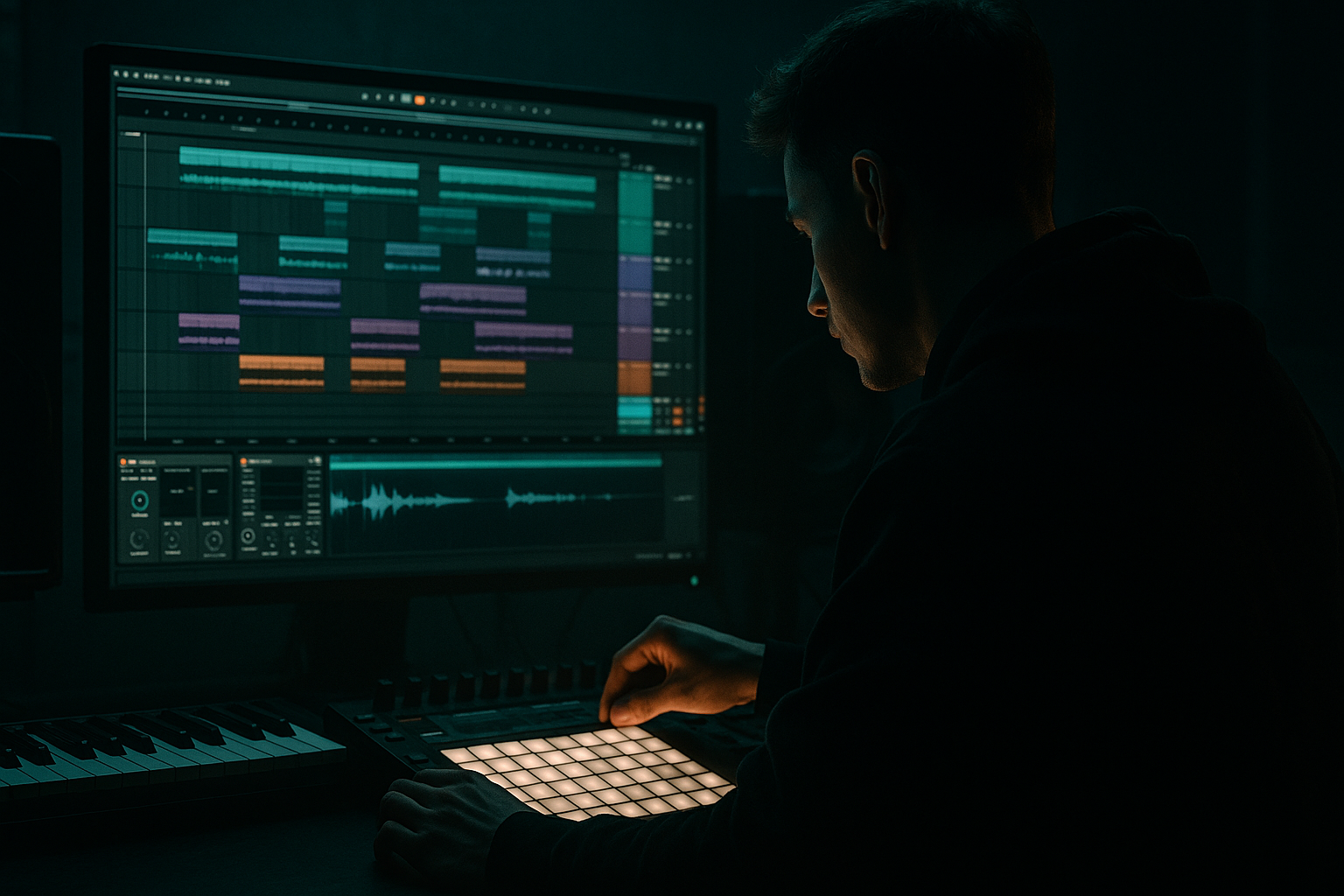
Main tutorial
```markdown
Ride Groove Warp Blueprint for Floor‑Shaking Low End (Ableton Live 12)
Intermediate • Ragga Elements • Oldskool Jungle / DnB vibes 🔥
1) Lesson overview
In jungle and oldskool DnB, rides and shuffles aren’t just “top end”—they’re a timing engine. The right ride groove creates a rolling push/pull that makes your sub and kick feel bigger without even touching a limiter.
In this lesson you’ll build a ride-driven groove template using Groove Pool + Warp timing tricks, then lock your bass and drums to it for that classic ragga/amen bounce.
You’ll use only stock Ableton Live 12 tools: Groove Pool, Warp modes, Drum Rack, Saturator, EQ Eight, Glue Compressor, Compressor, Utility, Auto Filter, and (optionally) Roar.
---
2) What you will build
A reusable “Ride Groove Blueprint” project scaffold with:
- A ride loop / one‑shot pattern that defines the swing
- A Groove Pool template (timing + velocity) extracted from the ride
- A drum bus and sub/bass bus that follow the ride without smearing the low end
- A sidechain + micro‑timing strategy so the sub hits after the ride push (classic rolling feel)
- Arrangement moves for oldskool jungle energy (ride drop-ins, fills, mute tricks)
- A sampled 909/808 ride
- A break ride (top end from a break)
- A reggae/roots ride one-shot
- Nudge hits around 1.2.3 / 1.2.4 / 1.4.2 / 1.4.4 (the in-between ticks) to create roll.
- Keep downbeats stable (1.1.1, 1.2.1, 1.3.1, 1.4.1) so your kick/sub doesn’t drift.
- Timing: 40–70% (try 55%)
- Velocity: 10–25% (try 15%)
- Random: 2–8% (try 4%) 🎲
- Base: 1/16 (important for jungle hats/rides)
- Sidechain: From Kick (or a dedicated “SC KICK” track)
- Ratio: 4:1
- Attack: 2–10 ms (try 5 ms)
- Release: 60–120 ms (try 90 ms)
- Threshold: set for 3–6 dB gain reduction
- Intro (16 bars): filtered break + occasional ride shots (not full pattern)
- Drop (bar 17): bring full ride groove in with bass
- Every 8 bars: mute the ride for 1 bar, let the break breathe, then slam it back ✅
- Fills: automate ride velocity down for 2 beats before a snare fill, then back up
- Switch-ups: duplicate ride clip and increase groove Timing to 70% for a more frantic section
- Grooving the sub too hard → late/draggy low end. Keep sub groove subtle (10–25%).
- Warping every transient on the ride → jittery, unnatural shuffle. Use fewer markers, move them with intent.
- Applying groove to already-swingy breaks at high amounts → flammy snares.
- Over-widening rides → phasey top end. Keep rides mostly mono/center; widen only reverb sends.
- Too much Drum Buss “Boom” → mud + weak kick/sub separation.
- Split bass duties: keep SUB pure (Operator sine), put aggression in BASS MID (Wavetable/Reese) and high-pass it at 120–200 Hz.
- Roar (optional) on rides: tiny drive + tone shaping can add nasty texture without EQ boosting. Keep mix low.
- Ghost ride layers: layer a second ride pitched down -1 to -3 semitones very quietly for thickness (HP it aggressively).
- Negative track delay: if your groove makes everything feel late, try Track Delay:
- Mono-check your low end: Utility on BASS BUS → Width 0% below ~120 Hz (use EQ Eight M/S or just keep sub mono).
- The ride defines the shuffle, and shuffle defines the weight of the whole tune.
- Use Warp markers to craft a purposeful push/pull, then Extract Groove and spread it across the kit.
- Keep sub groove subtle, reinforce with clean sidechain, and let the ride create motion up top.
- Use stock tools (EQ Eight, Saturator, Glue, Compressor, Utility) to make it hit hard while staying oldskool.
---
3) Step-by-step walkthrough
Step 0 — Set your project for jungle timing
1. Tempo: set 168–174 BPM (try 172 BPM).
2. Global quantization: 1/16 (top bar).
3. Create these tracks:
- RIDE (Audio) or RIDE (MIDI in Drum Rack)
- BREAK (Audio) (Amen / classic break)
- KICK+SNARE (MIDI Drum Rack) (optional reinforcement)
- SUB (Instrument) (Operator or Wavetable)
- BASS MID (Instrument) (optional layered reese)
- DRUM BUS (Return or Group)
- BASS BUS (Group)
Workflow tip: Group all drum tracks into DRUMS, all bass into BASS. Keep your low end organized from bar 1. ✅
---
Step 1 — Source a ride with the right “ragga” attitude
You want a ride that has a sharp stick transient and slightly dirty tone (90s vibe). Options:
#### Option A (Audio ride loop)
1. Drag a ride loop into RIDE (Audio).
2. Double-click the clip → enable Warp.
3. Set Warp Mode:
- Beats for tight percussive control
- Transient Loop Mode: Forward
- Preserve: 1/16 (or 1/8 if it gets too chattery)
#### Option B (MIDI ride pattern)
1. Load Drum Rack on RIDE (MIDI).
2. Put your ride sample on a pad.
3. Program 1 bar of 16ths, then remove a few hits for human bounce:
- Keep most 16ths
- Drop a hit right before beat 3 occasionally (oldskool “air”)
4. Vary velocities: 70–110 range, with accents on offbeats.
Goal: A ride that feels like it’s leaning forward—not robotic.
---
Step 2 — Build the “Ride Groove Warp” (micro-timing)
This is the core: we shape timing inside the ride clip and turn it into a groove you can apply everywhere.
#### A) Warp markers for swing without changing tempo
1. In the ride clip view, zoom in.
2. Find the 16th hits. Add Warp markers on key transients (not every hit—start minimal).
3. Create a subtle “push-pull”:
- Push (slightly early) some offbeat 16ths by -5 to -12 ms
- Pull (slightly late) some ghost 16ths by +5 to +15 ms
DnB timing reference (per 1 bar):
✅ You’re aiming for “shuffling propulsion,” not drunken timing.
#### B) Commit the ride’s groove as a template
1. Right‑click the ride clip → Extract Groove.
2. Open Groove Pool (left browser).
3. Find the extracted groove (named after the clip).
Start with these Groove Pool settings:
Click Commit only when you’re sure (committing makes it permanent).
---
Step 3 — Apply the ride groove to breaks without wrecking transients
Your break (Amen etc.) is sacred—don’t mush it.
1. Put an Amen (or similar) on BREAK (Audio).
2. Warp it cleanly first:
- Warp Mode: Beats
- Preserve: 1/16 or 1/8
3. Apply your extracted groove to the break clip:
- In clip box → Groove dropdown → select your ride groove
4. Set Groove Amount:
- Start at 20–35%
- Go higher only if the break still punches
Key check: If your snare loses crack, reduce groove amount or change Preserve to 1/8 to protect bigger transients.
---
Step 4 — Lock the low end to the groove (but keep it solid)
This is the “floor-shaking” part: we’ll make the sub feel like it’s rolling, while the fundamental stays stable.
#### A) Build a sub that follows the groove
1. On SUB, load Operator:
- Osc A: Sine
- Envelope: short attack (0–5 ms), medium decay, sustain ~ -inf if you want plucks, or sustain up for held notes
2. Write a classic jungle pattern (1–2 notes, lots of rhythm):
- Example: Root note on 1.1.1, then short repeats around 1.2.3, 1.3.1, 1.4.3
- Use 1/16 note lengths for skanky movement
3. Apply your ride groove to the SUB MIDI clip:
- Groove Amount: 10–25% (sub is sensitive)
- Timing: keep low to avoid “late sub” that feels weak
#### B) Sidechain that respects the ride
Add Compressor on SUB:
Why this works: the ride groove creates the perceived roll; sidechain keeps the sub clean so the roll feels loud, not messy.
---
Step 5 — Ride presence without harshness (Ragga-friendly top end)
On the RIDE track, use this stock chain:
1. EQ Eight
- High-pass at 200–400 Hz (12 or 24 dB/oct)
- Dip harshness around 6–9 kHz if needed (-2 to -4 dB, medium Q)
2. Saturator
- Mode: Soft Sine or Analog Clip
- Drive: 1–4 dB
- Output: trim to match level
3. Auto Filter (optional movement)
- HP or BP with slight resonance
- Map filter cutoff to an 8‑bar automation for “live” energy 🎛️
Oldskool vibe trick: Slight distortion on rides makes them sit like tape-era jungle without boosting 10 kHz into pain.
---
Step 6 — Glue the drums to the ride (without killing punch)
Group your drum tracks → DRUMS Group.
On DRUMS group, add:
1. Glue Compressor
- Attack: 3 ms
- Release: Auto
- Ratio: 2:1
- Threshold: aim for 1–3 dB GR
2. Drum Buss (subtle!)
- Drive: 2–6
- Crunch: 0–10
- Boom: 0–10 (careful: only if it enhances, not mud)
3. Utility
- Width: 80–100% (keep drums mostly centered for weight)
Important: If your break is already processed, go lighter on Glue/Drum Buss.
---
Step 7 — Arrangement: classic jungle ride-drop energy
Here are proven oldskool moves:
---
4) Common mistakes
---
5) Pro tips for darker/heavier DnB
- Nudge SUB earlier by -5 to -15 ms
- Or nudge RIDE later by +5 ms if it’s too pushy
---
6) Mini practice exercise (15 minutes) 🧠
1. Create a 4‑bar loop at 172 BPM with:
- Amen break
- Ride pattern (audio or MIDI)
- Kick + snare reinforcement
- Simple sub line (2 notes)
2. Warp and extract groove from the ride.
3. Apply groove to:
- Break at 25%
- Sub at 15%
- Kick/snare at 10% (just a touch)
4. A/B test:
- Groove Off vs On
- Then increase groove Timing by +10% and listen to what happens to the perceived bass weight.
Deliverable: bounce two versions—Groove OFF and Groove ON—and compare on headphones + monitors.
---
7) Recap
If you want, tell me what ride source you’re using (909? break ride? sample pack?), and I’ll suggest a groove map (which 16ths to push/pull) tailored to your pattern.
```

