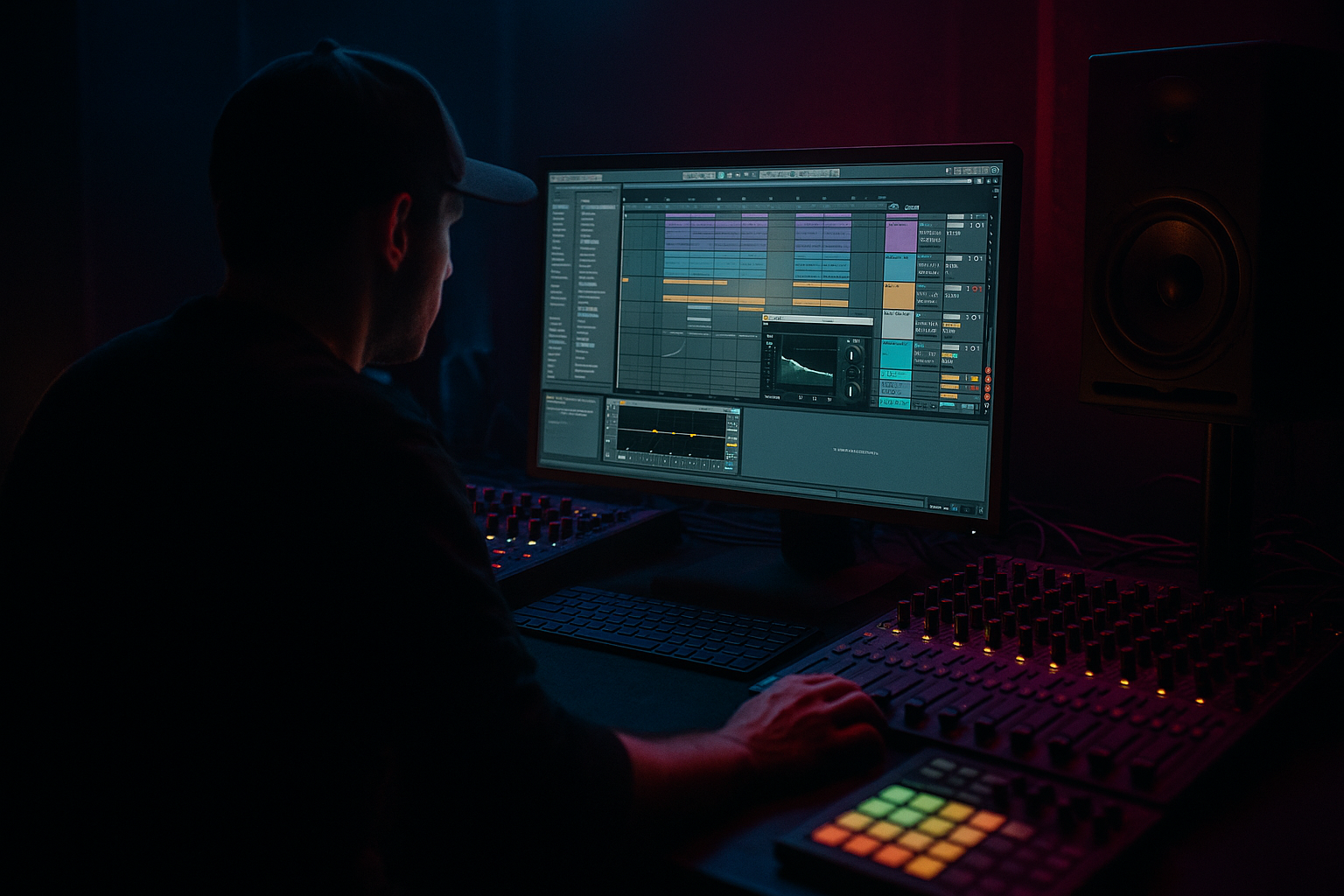
Main tutorial
Rise & Fall Automation for Crowd Noise (DnB in Ableton Live) 🔊🎚️
1. Lesson overview
Crowd noise is one of the fastest ways to make your drum & bass drops feel bigger than the speakers. Used right, it creates anticipation, scale, and “room” without muddying your drums or bass.
In this lesson you’ll build a controlled rise-and-fall crowd bed that:
- swells into a drop (hype + tension)
- ducks under the drop (impact stays clean)
- returns in gaps (movement + live energy)
- stays tight in a rolling/jungle arrangement (not cheesy, not washing out the mix)
- A Crowd Audio track (sample/loop)
- A Crowd FX chain (EQ → width → reverb → glue → limiter)
- A Return track “CrowdVerb” for controlled size
- Automation for:
- Pick a crowd ambience, festival chant, or club-room “bed” that’s steady, not overly peaky.
- In DnB, you usually want something that feels like a large room, not a sitcom audience.
- Layer:
- Group them and treat as one “Crowd” bus.
- Warp mode: Complex (or Complex Pro if it’s very tonal).
- Clip gain: pull down early—crowd should be felt, not starring.
- High-pass to keep the sub clean:
- Optional: small dip where snares bite if needed:
- Set initial width to 120–160% (crowds feel wide)
- Keep Bass Mono ON (if available) or just ensure lows are cut via EQ
- Attack: 10 ms
- Release: Auto
- Ratio: 2:1
- Threshold: aim for 1–3 dB gain reduction on peaks
- Ceiling: -1.0 dB
- Just catch rare spikes.
- Add Hybrid Reverb (or Reverb if you prefer)
- Add EQ Eight after the reverb
- On the Crowd track, automate Track Volume:
- For rolling tracks: do a subtler rise over 8 bars
- For big festival/anthem vibes: more obvious over 16 bars
- Add Auto Filter (before reverb/width usually works well)
- Automate Frequency:
- Automate the Send to CrowdVerb:
- Add an automation breakpoint right at the drop:
- Then gradually bring it back up in the gaps (next step).
- Sidechain: ON
- Input: your Drum Bus (or Kick+Snare group)
- Ratio: 4:1
- Attack: 1–5 ms
- Release: 80–160 ms (set to groove with your 174 BPM bounce)
- Threshold: adjust for 3–7 dB reduction when drums hit
- Pre-drop: 150–170%
- On drop: reduce to 110–130%
- Breakdown: crowd low, roomy, wide (sets space)
- Build: volume + filter + send rise (hype)
- Drop first 8 bars: ducked/sidechained (impact)
- After 8 bars: crowd returns slightly in the background (energy sustain)
- Keep crowd quiet during dense drum passages
- Bring it up in 1–2 bar gaps, snare fills, or stop-start moments
- Automate quick send bursts at the end of phrases (like “room reacts”)
- On drop 2, allow slightly more crowd:
- snare snap (2–5 kHz)
- hats/air (8–12 kHz)
- reese midrange (200–800 Hz)
- EQ Eight dynamic-ish workaround: automate a small dip on the crowd during the drop around 3 kHz if your snare loses bite.
- Keep crowd high-passed enough to not blur your sub.
- If it feels “hissy,” low-pass around 10–12 kHz.
- Make the crowd more “industrial”:
- Band-pass for menace:
- Gate the crowd rhythmically (dark techy bounce):
- Parallel “distant” crowd:
- Drop impact trick:
- Crowd noise in DnB works best as automated energy, not constant loud ambience.
- Build the effect with volume + filter + reverb send rising into the drop.
- Protect the drop with ducking (automation or sidechain) and smart EQ.
- Use Ableton stock tools: EQ Eight, Auto Filter, Utility, Hybrid Reverb, Glue Compressor, Compressor, Limiter.
- Arrange it like a real room reacting: loudest before the drop, controlled during the drop, returning in gaps and phrases.
Skill level: intermediate—assumes you can automate parameters and route tracks in Ableton Live.
---
2. What you will build
A reusable crowd-noise system with:
- Volume (rise + drop duck)
- Auto Filter cutoff (hype sweep)
- Reverb send amount (size increase)
- Optional: Utility width + sidechain ducking
Result: that classic “rave pressure” around your drop, common in rolling DnB, jungle revivals, and heavier neuro/techy styles.
---
3. Step-by-step walkthrough
Step 1 — Choose the right crowd source 🧱
Option A: Use a clean crowd loop
Option B: Create your own quick crowd layer
- a “room tone / ambience” sample
- a “cheer” one-shot (very low in level)
Ableton tips
---
Step 2 — Set up the Crowd track chain (stock devices) 🧰
On the Crowd track, add:
1) EQ Eight
- HP at 120–200 Hz, 24 dB/oct
- Dip 2–4 kHz by 1–3 dB if it fights your snare crack
2) Utility
3) Glue Compressor (light control)
This keeps sudden cheers from jumping out.
4) Limiter (safety)
---
Step 3 — Add “size” via a dedicated reverb Return 🏟️
Create a Return Track named CrowdVerb:
- Start with a Hall or large space
- Decay: 2.5–5.5 s (bigger for breakdowns, shorter for drops)
- Pre-delay: 15–30 ms (keeps transients from smearing)
- HP at 250–400 Hz
- LP at 8–12 kHz (prevents hissy wash)
Send your Crowd track to CrowdVerb at around -18 to -10 dB as a starting point.
Why Return? You can automate the send for huge swells without permanently drowning the mix.
---
Step 4 — Create the “Rise” automation (classic pre-drop swell) 📈
You’ll automate 3 things together over the final 4–16 bars before the drop, depending on your arrangement.
#### A) Volume rise (main hype)
- Start low (e.g., -24 to -18 dB)
- Rise to (e.g.) -12 to -8 dB right before the drop
DnB timing suggestion
#### B) Filter opening (adds “approaching” energy)
- Mode: High-Pass or Band-Pass (Band-pass is more “radio/hype”)
- Resonance: 10–25% (don’t over-whistle)
- Start around 300–800 Hz
- Rise toward 8–12 kHz approaching the drop
This makes the crowd “come alive” without loading the low end.
#### C) Reverb send rise (size expansion)
- Increase gradually into the last 2 bars
- Typical move: from -18 dB → -8 dB (or more if subtle crowd)
Pro move: In the final 1/2 bar pre-drop, let the send spike slightly (a mini “whoosh”), then cut it at the drop (next step).
---
Step 5 — Create the “Fall” automation at the drop (keep impact clean) 💥
At the moment the drop hits, you want the crowd to get out of the way.
Do one of these reliable approaches (or combine them):
#### Approach 1: Hard duck (fast and effective)
- Crowd track volume dips quickly by 6–12 dB for the first 1–2 bars
This makes your kick/snare and bass feel louder without actually turning them up.
#### Approach 2: Sidechain ducking from the drums (clean + dynamic)
On the Crowd track, add Compressor:
This gives that classic “crowd breathes with the beat” movement.
#### Approach 3: Width reduction on drop (focus center)
Automate Utility Width:
This makes the drop feel more punchy and centered.
---
Step 6 — Arrange the crowd like a DnB record (where it actually works) 🧠
Here are reliable placement patterns:
A) Breakdown → Build → Drop
B) Jungle-style call-and-response
C) Second drop “bigger room”
- +1 to +2 dB vs drop 1
- slightly higher reverb send in the 2 bars before it hits
---
Step 7 — Control harshness and masking (critical in DnB) 🎛️
Crowd noise loves to fight:
Quick fixes:
---
4. Common mistakes ❌
1) Crowd too loud in the drop
If you notice it consciously, it’s probably too high. Duck more, filter more, or sidechain.
2) Too much low end / low-mid wash
Not high-passing enough. Crowds can destroy clean rolling subs.
3) Reverb tail smearing the first kick/snare
Use pre-delay (15–30 ms), reduce decay, and/or cut send at the drop.
4) Automation ramps that feel linear and boring
Use curved automation shapes: slow rise → faster rise in last 2 bars.
5) Crowd feels “pasted on”
Try a touch of Saturator (very subtle) or match ambience by sending a tiny bit to the same room return as your drums.
---
5. Pro tips for darker/heavier DnB 🖤
Add Redux very lightly (or Saturator) to rough it up—keep it subtle so it stays background.
Auto Filter in Band-Pass mode, automate frequency to hover around 1–3 kHz pre-drop for a tense, claustrophobic crowd.
Use Gate or Auto Pan (set to 0° phase for amplitude tremolo) synced to 1/8 or 1/16 at low depth. This can make the crowd “pump” in a controlled way.
Duplicate the crowd track:
- Track A: dry-ish, wide, quieter
- Track B: heavy reverb + low-pass, very quiet
Automate Track B mainly in breakdowns for cinematic depth.
At the exact drop, do a micro-mute (10–50 ms) on the crowd track. That tiny silence can make the first snare feel like it hits harder.
---
6. Mini practice exercise 🧪
At 174 BPM, create a 16-bar build into a 32-bar drop.
1) Add a crowd loop and build the chain: EQ Eight → Utility → Glue → Limiter.
2) Create Return “CrowdVerb” with Hybrid Reverb + EQ.
3) Automate over 16 bars:
- Volume: -22 dB → -10 dB
- Auto Filter HP cutoff: 500 Hz → 10 kHz
- CrowdVerb send: -18 dB → -8 dB (last 2 bars ramp faster)
4) At the drop:
- Volume dip: -10 dB → -18 dB for 2 bars, then rise to -14 dB by bar 9
- Add sidechain compressor from Drum Bus, aiming for 4 dB GR
5) Listen: can you still clearly hear kick transient, snare crack, and sub weight? If not, adjust HP filter and ducking.
---
7. Recap ✅
If you tell me your substyle (roller / jungle / neuro / jump-up) and whether your drop is 16 or 32 bars, I can suggest exact automation curves and bar-by-bar crowd placements tailored to your arrangement.

