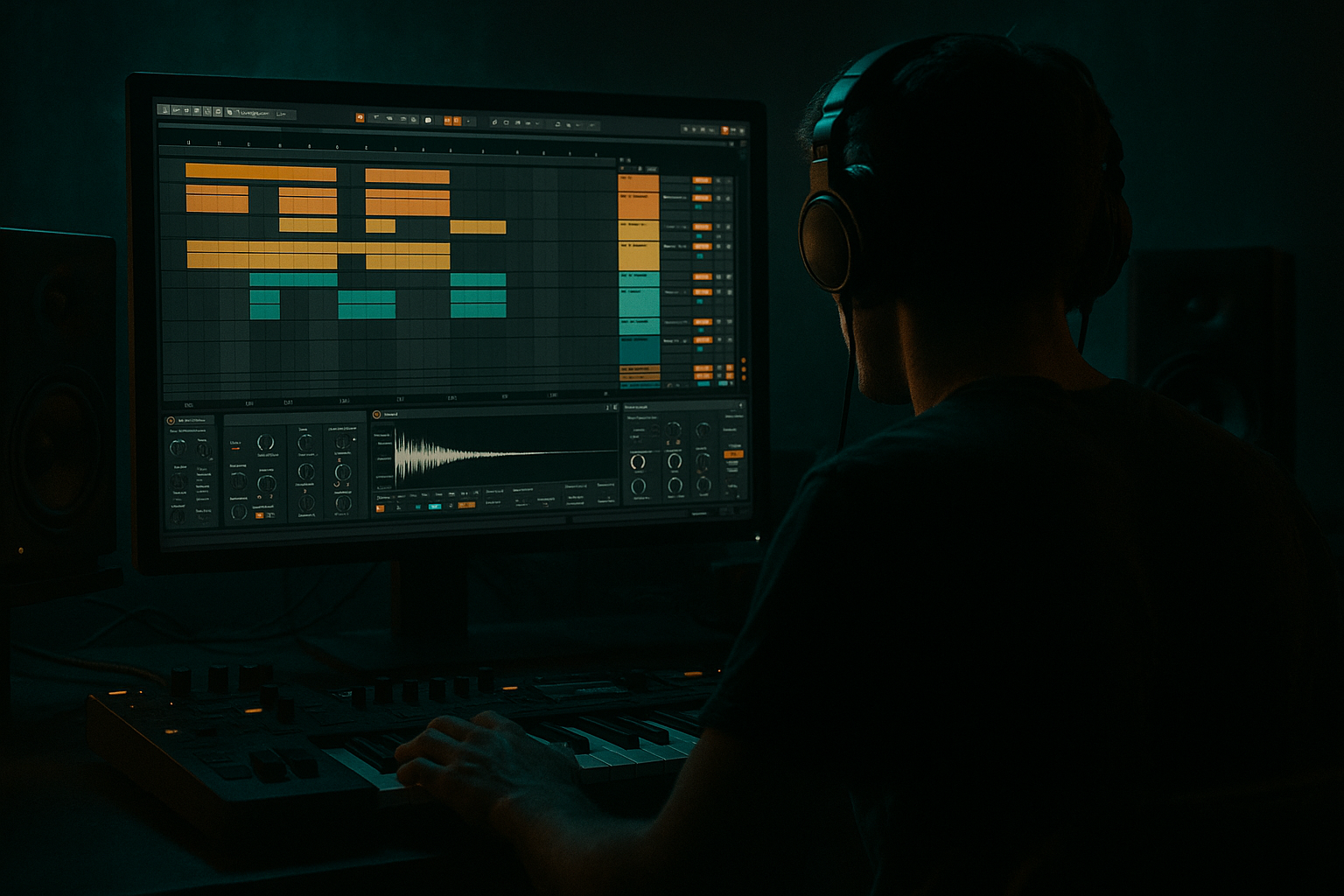
Main tutorial
```markdown
Riser Intensity Shaping from Scratch (Arrangement View) — Advanced DnB Automation 🔥
1) Lesson overview
In drum & bass, a “riser” isn’t just a white-noise sweep—it’s a controlled increase in tension, density, brightness, and perceived loudness that makes the drop hit harder. In this lesson you’ll build a modern, rolling DnB-ready riser entirely in Arrangement View, and shape its intensity with layered automation (filter, pitch, distortion, reverb size, stereo width, transient control, and mix buss management).
You’ll walk away with a repeatable workflow: design → layer → automate → clip/arrange → mix for impact. ✅
---
2) What you will build
A 16-bar pre-drop riser (customizable to 8 bars) with:
- 3 layers: Noise/Sweep, Tonal Pitch Riser, “Air + Texture” Top layer
- 1 group bus with macro-like automation lanes for intensity shaping
- DnB arrangement logic: minimal early energy → escalating mid → aggressive final 2 bars → micro-silence before drop
- A drop transition moment: pre-drop vacuum + impact tail control
- Operator / Wavetable
- Auto Filter
- Saturator / Dynamic Tube / Overdrive
- Echo
- Reverb
- Utility
- Compressor / Glue Compressor
- Limiter
- Shaper (if you have Live Suite; otherwise we’ll do alternatives)
- Reverb:
- EQ Eight after Reverb:
- Echo:
- Saturator after Echo:
- Auto Filter:
- Saturator:
- Utility:
- EQ Eight:
- One long MIDI note spanning 16 bars (e.g., C3).
- Wavetable:
- Auto Filter:
- Overdrive:
- EQ Eight:
- Use a sustained note (e.g., G2 or A2) for 16 bars.
- If you want more menace, stack octaves lightly (but keep low end filtered).
- Redux:
- Echo:
- Reverb:
- EQ Eight:
- Auto Filter Frequency (main rise)
- Auto Filter Resonance (tension)
- Distortion/Drive (aggression)
- Send to `LongVerb` (space/tension)
- Send to `DubEcho` (movement)
- Utility Gain (perceived loudness ramp)
- Utility Width (stereo expansion)
- Group EQ (brightness ramp)
- Optional: Group Compressor Threshold (density ramp)
- Noise filter opens slowly from dark.
- Tone is subtle; don’t reveal full harmonic content.
- Reverb send low.
- `Riser Noise` Auto Filter Freq: ~200 Hz → 2 kHz
- `Riser Tone` Auto Filter Freq: ~300 Hz → 1.5 kHz
- `LongVerb` send: start -inf → -18 dB
- Group Utility Width: 70% → 90%
- Increase resonance slightly.
- Add more echo movement.
- Introduce texture layer gradually.
- Noise Resonance: 15% → 30%
- Tone Drive: increase gently (Overdrive/Tube)
- `DubEcho` send: -inf → -20 dB
- Group EQ: gentle high shelf +0 → +2 dB at 8–10 kHz
- More distortion, more top end, a bit more width.
- Increase rate-like motion via Echo feedback or filter movement.
- Group Utility Gain: +0 dB → +1.5 dB (careful—headroom!)
- Texture Redux downsample: 1.2 → 2.0
- `LongVerb` send: -18 → -12 dB (but keep low-cut active)
- Noise Filter Freq: 2 kHz → 12–16 kHz (open hard)
- Resonance: spike slightly near the end (but avoid whistling)
- Tone pitch ramp (see next step)
- Group Width: 100% → 130–160% (only if mono compatibility is ok)
- Group high shelf: +2 → +4 dB (short window only)
- At last 1/8 or 1/4 note before bar 17, automate:
- Automate Transpose from 0 → +12 (one octave) over 16 bars.
- For heavier tension, do 0 → +7 for first 12 bars, then +7 → +12 in last 4.
- Enable pitch bend range in the instrument (if needed).
- Draw pitch bend ramp; add a tiny wobble in last bar.
- Linear early (boring but stable)
- Exponential late (panic)
- For filter frequency: keep modest until bar 13, then steep rise bars 13–16.
- For drive: ramp gently then add a late jump in last bar.
- HP at 120–200 Hz (24/48 dB if needed)
- Optional: dynamic-ish manual move—automate a dip at 3–5 kHz if harsh
- Attack: 3–10 ms
- Release: Auto
- Ratio: 2:1
- Threshold: automate for more “density” late (but keep GR moderate: 1–3 dB)
- Gain and Width automation lives here.
- Ceiling: -0.8 dB
- Watch you’re not slamming it the whole time
- Automate `LongVerb` return return track Utility Gain down quickly right before bar 17
- On the riser group, automate a fast volume cut right before the drop, but leave a tiny tail (like 20–80 ms) if you want glue.
- Only automating filter cutoff: it rises, but doesn’t intensify—add drive, width, sends, and density ramps.
- Too much low-end in the riser: it steals energy from the drop’s sub + kick. High-pass aggressively.
- Over-widening early: if it’s wide from bar 1, there’s nowhere to go. Start narrower.
- Reverb washing into the drop: automate return gain or send down right before the hit.
- Harsh resonance whistle: resonance spikes can create painful peaks around 2–6 kHz. Use EQ or tame resonance.
- Limiter doing heavy lifting: if you’re pushing the riser too loud, the drop won’t feel like it arrives.
- Add a “metallic edge” layer: very quiet FM tone (Operator) automated into audibility only in last 2 bars.
- Automate distortion tone, not just drive:
- Use mid/side discipline:
- Rhythmic gating for roll energy:
- Pre-drop silence + sub teaser:
- No Redux
- Controlled resonance
- More pitch automation
- Less reverb, more filter/drive movement
- Add texture layer with Redux
- More echo send (dub feel)
- Slight rhythmic tremolo (Auto Pan Phase 0°)
- Add a short tape-stop style pitch dip in the last 1/8 note (quick transpose down) before muting
- Which one makes the drop feel bigger at the same master level?
- Which one masks drums/bass less?
- Build risers as layered systems: noise + tone + texture.
- Shape intensity with multiple automation lanes: filter, resonance, pitch, drive, sends, width, and bus density.
- Use DnB arrangement timing: save the real chaos for the last 2 bars, and do a micro-vacuum before the drop.
- Keep headroom: high-pass risers, control reverb tails, and avoid slamming the limiter.
You’ll use mostly Ableton stock devices:
---
3) Step-by-step walkthrough
Step 0 — Arrangement context (DnB-specific)
1. Set tempo: 172–176 BPM.
2. Create a typical DnB structure:
- Bars 1–16: Build / pre-drop
- Bar 17: Drop
3. Aim for 16 bars riser. (If your tune uses 8-bar builds, halve durations but keep the “last 2 bars” intensity logic.)
> DnB tip: Rolling tunes often keep the groove alive—your riser shouldn’t just be a cinematic sweep. It should interlock with drums and bass by leaving space and controlling subs.
---
Step 1 — Create the riser group and routing
1. Create 3 MIDI tracks:
- `Riser Noise`
- `Riser Tone`
- `Riser Air/Texture`
2. Select them and Group (Cmd/Ctrl+G) → name group: `RISER (Build 16)`.
3. Add Return tracks if not already:
- Return A: `LongVerb`
- Return B: `DubEcho`
Return A – LongVerb (stock chain)
- Quality: High
- Decay Time: 6–10 s
- Pre-Delay: 20–40 ms
- High Cut: 6–10 kHz
- Low Cut: 250–500 Hz
- Dry/Wet: 100% (because it’s a send)
- High-pass at 250–400 Hz (steeper if needed)
- Small dip around 2–4 kHz if harsh
Return B – DubEcho
- Time: 1/4 or 3/16 (DnB bounce)
- Feedback: 35–55%
- Filter: HP around 250 Hz, LP around 7–10 kHz
- Modulation: subtle (Amount 5–15%)
- Dry/Wet: 100%
- Drive: 2–6 dB
- Soft Clip: On
---
Step 2 — Layer 1: Noise sweep (the “energy ramp”) 🌪️
On `Riser Noise`:
1. Load Operator.
2. Set it to make noise:
- Operator → Oscillator A: choose White Noise (or “Noise” mode depending on version)
3. Add devices (in this order):
1) Auto Filter
2) Saturator
3) Utility
4) EQ Eight
Suggested starting settings
- Type: Lowpass 24 dB
- Resonance: 15–30%
- Drive (if available): a touch
- Drive: 3–8 dB
- Soft Clip: On
- Width: start 80–100% (we’ll automate)
- HP at 200–400 Hz (keep low-end clean)
- Optional: gentle shelf up top if you want more “air”
Program the MIDI
Noise ignores pitch mostly, but note length gates the sound.
---
Step 3 — Layer 2: Tonal riser (the “pitch threat”) ⚙️
On `Riser Tone`:
1. Load Wavetable (or Operator if you prefer).
2. Choose a waveform that reads well in DnB:
- Wavetable: basic Sine → Saw blend, or a slightly gritty table.
3. Add devices:
1) Auto Filter
2) Overdrive (or Dynamic Tube)
3) Compressor (gentle control)
4) Utility
5) EQ Eight
Starting settings
- Unison: 2–4 voices, Amount low
- If it gets too wide early, keep it mono-ish (we’ll automate width later)
- Type: Bandpass or Lowpass 12/24
- Resonance: 10–25%
- Frequency: 1–2 kHz
- Drive: 10–30%
- Tone: taste
- HP at 120–200 Hz (avoid fighting sub)
- Watch harshness 2–5 kHz
MIDI note
---
Step 4 — Layer 3: Air + texture (the “final sparkle + chaos”) ✨
This is where you add “shrapnel” that sells the last 4 bars.
On `Riser Air/Texture`:
1. Load a simpler source:
- Option A: Operator noise again
- Option B: Wavetable with a bright wavetable and short envelope
2. Add devices:
1) Redux (subtle!)
2) Auto Filter
3) Echo
4) Reverb (shorter than return)
5) EQ Eight
Starting settings
- Downsample: 1.2–2.5 (keep subtle)
- Bit reduction: minimal or off (DnB can get brittle fast)
- Time: 1/8 dotted or 3/16
- Feedback: 20–35%
- Keep it filtered
- Decay: 1–2.5 s
- Low Cut: 400–800 Hz
- HP at 500–1k
- Gentle shelf up 8–12k if needed
---
Intensity shaping in Arrangement View (the core lesson)
Step 5 — Create automation lanes like a pro (fast workflow)
1. Hit A to show automation.
2. In Arrangement View, add automation for these “intensity pillars”:
On each riser layer
On the RISER group
> Big idea: Don’t automate only one knob. Real intensity comes from multiple small ramps across layers.
---
Step 6 — Shape the 16-bar arc (DnB arrangement logic)
Think in four zones:
#### Bars 1–8: “Tease” (controlled, minimal)
Automation suggestions
#### Bars 9–12: “Pressure” (audible ramp)
Automation
#### Bars 13–14: “Warning lights” (aggressive)
Automation
#### Bars 15–16: “Panic” (maximum tension + controlled chaos)
This is where DnB needs urgency without wrecking the mix.
Automation
Crucial DnB move: add a micro-dropout before the drop.
- Group Utility Gain → -inf (quick dip), or
- Mute just the riser group briefly
That tiny vacuum makes the drop feel violent.
---
Step 7 — Pitch automation for the tonal layer (the “lift”)
For `Riser Tone`, create pitch rise without messing your MIDI notes:
Method A: Automate Wavetable Transpose
Method B: Use Pitch Bend
DnB feel: Keep it mostly steady until the final 2 bars, then accelerate the curve upward (use curved automation).
---
Step 8 — “Acceleration” curves (advanced automation shaping)
Right-click automation points and shape curves (or add extra breakpoints). The goal:
Practical approach:
---
Step 9 — Group bus control (make it hit without clipping)
On `RISER (Build 16)` group, add:
1) EQ Eight
2) Glue Compressor
3) Utility
4) Limiter (safety, not loudness)
> DnB rule: your riser should not steal headroom from the drop. Keep the limiter doing minimal work.
---
Step 10 — Drop transition: reverb tail management + impact space
Two classic DnB transition moves:
1) Reverb “suck-out” right before drop
This prevents a huge reverb tail washing into the drop.
2) Hard gate feel
---
4) Common mistakes
---
5) Pro tips for darker/heavier DnB 🖤
- Operator: FM from B to A, Ratio ~2.00, small amount, then distort lightly.
- Overdrive frequency sweeping upward adds aggression without just “more volume.”
- Keep the tonal riser more mid-focused.
- Put “air noise” in the sides late (Utility width or chorus-like movement).
- Add Auto Pan set to Phase 0° (acts like tremolo).
- Rate: 1/8 or 1/16, Amount automate from 0 → 30–60% in final 4 bars.
- In last 1/2 bar, drop most layers, leave a tiny filtered noise tick—then let the drop sub own the space.
---
6) Mini practice exercise 🎯
Create two versions of the same 16-bar riser:
Version A: “Clean Neuro Tension”
Version B: “Rugged Jungle Pressure”
Goal: Bounce both and compare:
---
7) Recap
If you want, tell me your track vibe (liquid / rollers / jungle / neuro / jump-up) and your build length (8 or 16 bars), and I’ll suggest a specific automation map and device settings tailored to that substyle. 🥁
```

