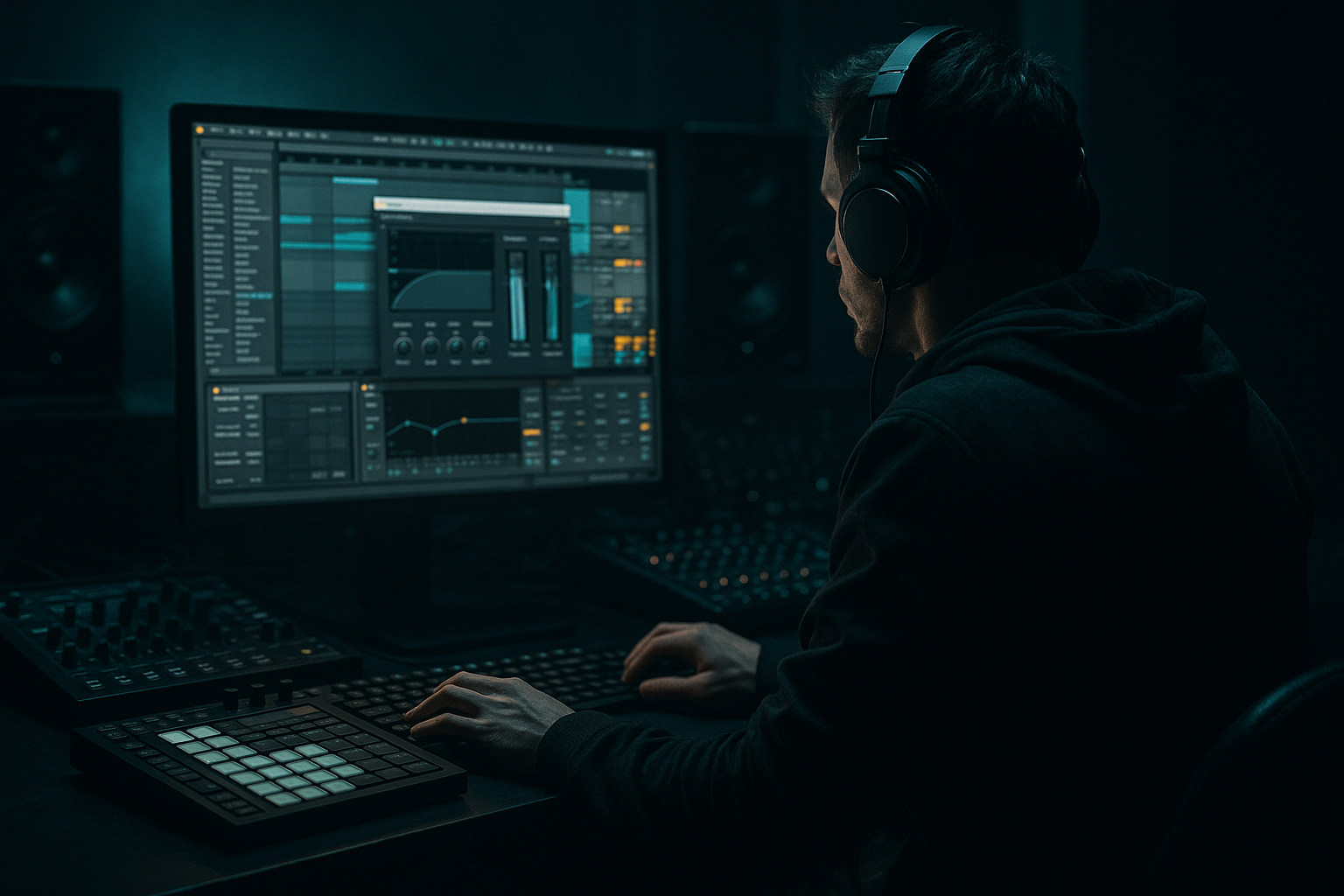
Main tutorial
Riser timing for jungle drops (resampling only) — Ableton Live (Advanced FX) 🔥
1) Lesson overview
In jungle/DnB, a riser isn’t just “noise going up.” It’s timing, tension, and misdirection that makes the drop hit harder. This lesson is specifically about building risers using resampling only in Ableton Live—meaning you’ll generate audio from your own session, print it, and shape it into tight pre-drop movement that locks to jungle phrasing (2/4/8/16-bar language) and classic “lift-then-slam” energy. 🎛️
You’ll learn how to:
- Choose the right bar lengths for jungle drops
- Use micro-timing (last 1/2 bar, last 2 beats, last 1 beat) to snap the listener into the drop
- Create risers from breaks, bass, stabs, and ambience by resampling and processing
- Use Ableton stock devices and arrangement tricks to create impact without new synths
- Long riser (8 bars): subtle tension and stereo motion
- Mid riser (2 bars): filtering + density ramp
- Micro riser (last 1 bar): urgency, “pull forward”
- Pre-drop suck (last 1/4–1/2 bar): vacuum/negative space that makes the kick + snare explode
- 16-bar sections (common for full changes)
- 8-bar pre-drop build
- 2-bar intensifier
- Last 1 bar: the “oh no” moment
- Drop at bar 33 (start of a new 16)
- You’ll build from bar 25 → 33 (8-bar riser)
- Add locators: `8 to drop`, `2 to drop`, `1 to drop`, `Suck`, `DROP`.
- a main break (Amen-style, chopped loop, etc.)
- bass reese / sub layer
- a dub stab / pad / atmosphere
- Turn Warp ON
- Use Complex or Complex Pro
- Create a duplicate clip named `Riser 8bar`.
- Automate Clip Transpose gradually upward:
- Filter type: Lowpass 24 dB
- Drive: 2–6 dB
- Resonance: 0.20–0.45
- Automate cutoff:
- Automate Width
- If the drop is heavy mono, this contrast makes the drop hit harder.
- Warp ON
- Mode: Beats
- Downsample: 8–14
- Bits: 8–12
- Mode: Analog Clip
- Drive: 2–8 dB
- Soft Clip: On
- HP filter at 120–250 Hz, 24 dB slope
- Tiny notch if something rings (often 2–4 kHz)
- Auto Filter cutoff: slow rise for 3 beats, then steep climb in last beat.
- Utility Gain: slight gain ramp (like -6 dB → -2 dB) so it feels like it’s approaching, not just getting louder.
- Mode: Ring Mod (or Frequency Shift for subtler)
- Fine: automate 0 Hz → +80/150 Hz over the bar
- Auto Filter: HP from 200 → 30 Hz (yes, opening downwards)
- Utility: Width 140%, but fade it to 100% right at the drop.
- Bars -8 to -4: long riser stays subtle (mostly high-pass + width)
- Bars -4 to -2: add 2-bar intensifier (distortion/density)
- Bars -2 to -1: reduce low end + increase motion (pitch + filter)
- Last 1 bar: micro-riser + small mute pockets
- Last 1/2 bar: suck + tiny pause
- Drop: everything snaps back to mono + full transient integrity
- Pull your risers down to around -6 to -10 dB peak.
- Use Utility to automate Width down to 100% at drop.
- Use Auto Filter to remove sub energy from risers (HP at 150–300 Hz).
- Keep the last 1/4 bar slightly emptier than you think.
- Let kick + snare transient through (avoid limiter crush while designing).
- Reintroduce sub clean and centered.
- Riser too loud: If it’s competing with the drop, the drop won’t feel like a payoff.
- Ignoring bar math: A 7.5-bar riser into a 16-bar phrase can feel amateurish in jungle.
- Linear sweeps only: Jungle likes accelerating energy near the end.
- Too much low end in risers: Sub energy before the drop weakens impact and can trigger limiting.
- Over-widening into the drop: Wide riser + wide drop = no contrast. Collapse at drop for punch.
- No reprint/commit: If you don’t resample your processing, you’ll avoid doing the precise edits that make it pro.
- Make risers mid-focused, not bright-focused: A lot of dark DnB builds live in 400 Hz–4 kHz grit, not just airy noise.
- Use Saturator + Auto Filter Drive for “pressure,” not just volume.
- Add subtle chorus to the riser only (then print it):
- Resample reese movement: Print 8 bars of bass automation, then high-pass it and pitch it up. It becomes a mean, tonal riser that matches your track key.
- Create a “pre-drop choke”: last 1/8 note, cut almost everything except the suck. That tiny silence is ruthless in a club.
- Great jungle risers are timing + contrast, not just sound design.
- Use resampling to turn your own breaks/bass/music into cohesive tension that matches the track.
- Build in layers: 8-bar mood → 2-bar intensity → 1-bar urgency → pre-drop suck.
- Commit (print), then do tight edits—micro-timing and negative space are what make drops slam. 💥
---
2) What you will build
A full pre-drop riser system for a typical rolling/jungle arrangement:
All created via resampling your own drums/bass/music, then warping + processing + reprinting.
---
3) Step-by-step walkthrough
A) Set up resampling workflow (clean + fast) ✅
1. Create an Audio Track called `RESAMPLE PRINT`.
2. Set Audio From to `Resampling`.
3. Set Monitor to `Off` (to avoid feedback loops).
4. Arm the track when printing.
Workflow tip:
Group all your music tracks into a group called `MUSIC BUS` and keep your master chain light while designing risers. Heavy mastering can smear transients and make your risers harder to control.
---
B) Identify jungle phrasing + drop target (timing first) ⏱️
Most jungle/DnB drops feel “right” when your transitions respect:
Pick a drop point (example):
Arrangement markers (do this now):
---
C) Print raw source material to shape (breaks + bass = gold) 🎚️
You’ll create risers from your own elements:
Print pass 1: Break-based tension
1. Solo your break bus (or break group).
2. Play from bar 25 to 33.
3. Record into `RESAMPLE PRINT`.
4. Rename clip: `Break Riser Raw`.
Print pass 2: Bass-based tension
1. Solo bass group.
2. Record same 8 bars.
3. Rename clip: `Bass Riser Raw`.
Print pass 3: Full-mix texture
1. Solo everything except kick/sub (optional).
2. Print 8 bars.
3. Rename: `Music Riser Raw`.
Why multiple prints? Because jungle builds feel thick when different riser “layers” hit different time scales.
---
D) Build the 8-bar riser (slow burn) from your resample 🌫️
Take `Music Riser Raw` (audio clip) and do this:
#### 1) Warp + mode
- Complex Pro: Formants at 0, Envelope 90–120 (adjust by ear)
#### 2) Create rising motion using clip transposition + automation
- Start: 0 st
- End (bar 33): +7 to +12 st
In jungle, +12 st can sound manic—great if you want that “tape cranked” vibe. For darker rollers, +7 st is often enough.
#### 3) Add “closing walls” with Auto Filter
Drop Auto Filter on the riser track:
- Bar 25: 300–600 Hz
- Bar 33: 10–16 kHz (open right before drop)
Optional: automate Env Amount slightly negative near the end to make it “grab” transients.
#### 4) Make it wider over time
Add Utility:
- Start: 70–90%
- End: 120–150%
#### 5) Print it again (commit)
Resample this processed riser to a new audio clip: `Riser 8bar PRINT`.
Committing matters: you’ll now do destructive edits for micro-timing without CPU chaos.
---
E) Build the 2-bar intensifier (density + urgency) ⚡
Use `Break Riser Raw` (or `Riser 8bar PRINT`) and create a 2-bar version:
#### 1) Warp style for punch
- Preserve: 1/16
- Transients: 100
This keeps break grit while you manipulate timing.
#### 2) Increase density (without adding new synths)
Add Redux (subtle, not videogame):
Automate it to increase toward the drop.
Add Saturator:
Automate drive up slightly.
#### 3) High-pass to make room for the incoming sub
Add EQ Eight:
#### 4) Reprint
Resample to `Riser 2bar PRINT`.
---
F) Build the last-1-bar micro-riser (the “pull”) 🧲
This is where timing gets serious.
#### 1) Create a 1-bar clip from your resample
Take a noisy, transient-rich moment (break fill, stab tail, reese scrape). Consolidate to exactly 1 bar.
#### 2) Do a ramp that accelerates
Instead of a linear sweep, use automation curves:
#### 3) Add a “fake pitch rise” without synths
Add Frequency Shifter (stock, underrated):
This adds metallic urgency that reads as “riser” even on rough material.
Reprint to `Riser 1bar PRINT`.
---
G) The pre-drop “suck” (last 1/4–1/2 bar) 🕳️
This is the moment that makes the drop hit like a truck. The suck is negative space + a downward motion.
#### Option 1: Reverse reverb suck (resampling-only version)
1. Take a snare hit, vocal stab, or crash already in your project.
2. Put it on an audio track and add Reverb:
- Decay: 3–8 s
- Size: 80–120%
- Predelay: 0–10 ms
- High Cut: 6–10 kHz
- Wet: 100%
3. Resample that reverb tail.
4. Reverse the printed audio (clip reverse).
5. Trim so it ends exactly on the drop.
Now shape it:
#### Option 2: Break “tape stop inhale”
1. Resample a 1/2 bar of break.
2. Warp Mode: Tones (grain size ~ 8–20) for smooth pulling.
3. Automate Clip Transpose down: 0 → -12 st in last half-bar.
4. Fade out the last ~30–60 ms to avoid clicks.
---
H) Lock the riser timing to jungle drop psychology 🧠
Here’s a proven timing map (works for rollers and jungle):
Important jungle trick:
Mute something rhythmic right before the drop (like 1/8–1/4 beat of hats or break). The groove “trips,” then the drop resolves it.
---
I) Make the drop feel louder without making it louder (contrast tricks) 🎯
Just before drop:
Then on the drop:
---
4) Common mistakes
---
5) Pro tips for darker/heavier DnB 🖤
- Chorus-Ensemble (stock): low amount, slow rate → gives moving haze.
---
6) Mini practice exercise 🧪
Goal: Build a 4-layer pre-drop using only resampling.
1. Choose a drop at bar 49.
2. Print 8 bars (41–49) of:
- breaks only
- bass only
- music (no kick/sub)
3. Make:
- `Riser 8bar`: filter + width + mild pitch rise
- `Riser 2bar`: beats warp + redux + saturator ramp
- `Riser 1bar`: frequency shifter rise + steep cutoff curve
- `Suck`: reversed reverb tail that ends exactly at 49.1.1
4. Arrange:
- 8bar starts at 41
- 2bar starts at 47
- 1bar starts at 48
- suck starts at 48.3 (or last 1/2 bar)
5. Print your whole pre-drop (41–49) to one clip and listen:
- Does it accelerate into the drop?
- Does the drop feel louder without changing your master?
---
7) Recap
If you want, tell me your typical drop structure (16/32 intro, vocal or not, halftime fakeout or straight roll) and I’ll suggest an exact locator map + riser recipe tailored to your style.

