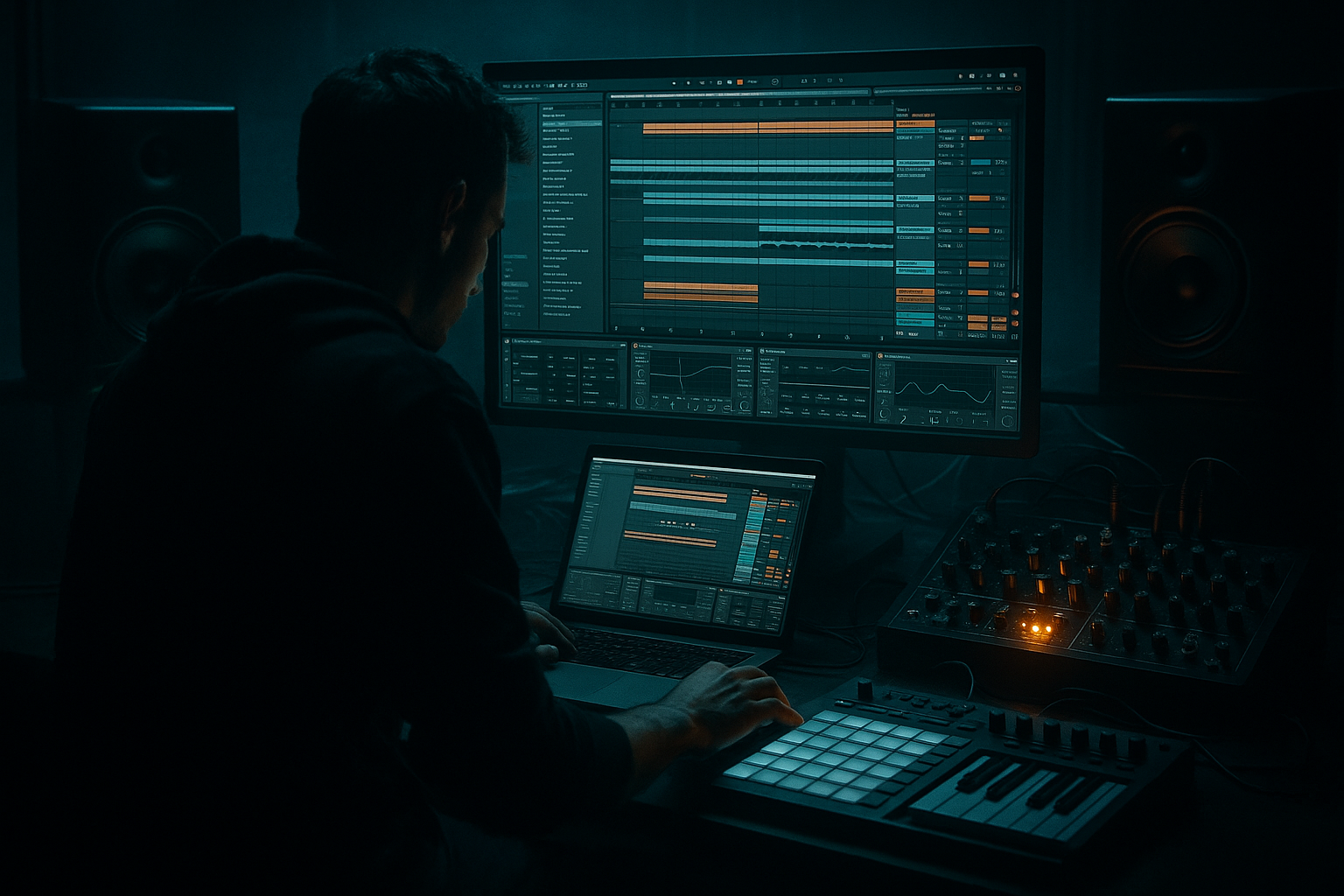
Main tutorial
Roller Jungle Amen Variation: Carve & Arrange in Ableton Live 12 (Automation)
1. Lesson overview
This lesson is about taking a classic Amen break and turning it into a modern roller jungle variation using automation-driven carving in Ableton Live 12. You’ll learn how to:
- Slice and re-map Amen hits for fast edits
- Create rolling ghost notes + movement without losing groove
- Use automation (filter, pitch, transient shaping, sends, reverb throws) to create arrangement energy 🚀
- Keep it tight and punchy while still sounding wild and junglist 🥁
- Bars 1–4: clean roller groove (foundation)
- Bars 5–8: variation via micro-edits + filter automation
- Bars 9–12: tension (HP automation + reverb throws + pitch flicks)
- Bars 13–16: release into a heavier, fuller Amen with fills and stutters
- A Drum Rack built from Amen slices
- A processing chain that hits hard but stays controllable
- Automation lanes that perform the groove over time 🎛️
- A Drum Rack filled with Amen hits
- A MIDI clip you can write like a drummer
- Put your main kick slices on 1.1 and 1.3 (or 1.1 and 1.2.3 for a jungle push)
- Put your main snare slices on 1.2 and 1.4
- Add ghost snares (low velocity) just before the main snares:
- Add little hat/shuffle slices in the gaps (8ths/16ths)
- Velocity guide:
- EQ Eight
- HP at 300–600 Hz
- Small dip at 7–10 kHz if harsh
- Low shelf / small boost at 50–80 Hz if needed
- Dip 200–350 Hz if boxy
- Drum Buss
- Glue Compressor
- Saturator
- Filter type: OSR 24 (or 12 for gentler)
- Base cutoff: ~8–12 kHz
- Resonance: 5–15%
- Drive: small (0–3)
- Bars 1–4: mostly open (cutoff ~10–12k)
- Bars 5–8: slowly dip to ~7–9k to darken a touch
- Bars 9–12: dip more aggressively to ~4–6k for tension
- Bars 13–16: open back up quickly into the drop/impact
- Verses: +5 to +10
- Build / pre-drop: reduce to 0 or even -5 (smear slightly = tension)
- Drop / release: push +15 to +25 for “front-of-speaker” snap
- Return A: Hybrid Reverb
- Put Echo after reverb (optional):
- Add a send spike on the last snare of bar 8 and bar 12
- Keep it subtle: -18 to -8 dB send peaks usually works
- In Simpler (snare slice), automate Transpose:
- Duplicate a snare slice hit into two 1/16 notes (or 1/32 if you’re brave)
- Lower velocity of the first, higher on the second
- Remove one kick hit (or replace with a quieter ghost kick)
- Let the hats carry the motion
- Warping wrong: if transients aren’t aligned, every edit feels sloppy. Fix warp first.
- Too much transient boost: breaks get clicky and tiring. Use Drum Buss Transients with intention.
- Reverb washing the groove: always HP/LP your reverb return.
- Over-quantizing: jungle needs human push/pull. Try Groove Pool lightly (see Pro Tips).
- Everything loud velocity: ghost notes must be quieter or the roll turns into a mess.
- Parallel distortion return:
- Multiband dynamics (careful):
- Tune the snare body:
- Groove Pool for swing:
- Make space for sub:
- You sliced the Amen to Drum Rack and treated slices like a real kit.
- You carved clarity with per-slice Simpler edits + EQ Eight.
- You built a proper break bus with Drum Buss / Glue / Saturator.
- You used automation to create a roller narrative: filter movement, transient energy, reverb throws, and pitch flicks.
- You finished with optional resampling for final control and extra jungle attitude 🔥
Skill level: Intermediate (you know Warp, Simpler/Drum Rack basics, and arranging).
---
2. What you will build
A 16-bar Amen roller loop that evolves like a real track section:
You’ll end up with:
---
3. Step-by-step walkthrough
Step 0 — Session setup (fast, DnB-friendly)
1. Set tempo to 170–174 BPM (try 172 BPM).
2. Create a 1-bar and 16-bar loop brace on the timeline.
3. Grab a clean Amen sample (or any classic jungle break). Prefer 44.1k/24-bit if possible.
---
Step 1 — Warp the Amen properly (don’t skip this)
1. Drag Amen audio into an Audio Track.
2. In Clip View:
- Enable Warp
- Set Warp mode to Beats
- Preserve: Transients
- Transient Loop Mode: Forward
- Envelope: ~35–55 (higher = tighter, more “chopped”)
3. Right-click the clip → Warp From Here (Straight) at the first downbeat.
4. Confirm the loop lands cleanly on 1.1.1 to 2.1.1 (one bar).
Goal: tight timing while preserving break character.
---
Step 2 — Slice to Drum Rack (your playground)
1. Right-click the warped Amen clip → Slice to New MIDI Track.
2. Settings:
- Slice by: Transient
- Create one slice per: Transient
- Slicing preset: Built-in > Drum Rack (no extra processing yet)
Now you have:
---
Step 3 — Build a roller pattern (foundation groove)
Create a 1-bar MIDI clip on the Drum Rack and program this as a starting point:
Core hits (typical Amen logic):
Add roller movement:
- e.g. 1.1.4 (before 1.2)
- 1.3.4 (before 1.4)
- Main snare: 110–127
- Ghost notes: 30–70
- Hats: 40–90 depending on brightness
✅ DnB roller rule: the groove should feel like it “falls forward” but still lands heavy on 2 and 4.
---
Step 4 — Carve the Amen inside Drum Rack (clean separation)
Open Drum Rack and treat slices like a mini kit.
#### 4A) Tighten each slice quickly
For key slices (kick, snare, hat):
1. Click the pad → open Simpler
2. In Simpler:
- Mode: One-Shot
- Turn on Snap
- Adjust Start to remove pre-transient fluff
- Shorten Decay slightly on hats to reduce wash
#### 4B) Add per-slice EQ (huge for clarity)
On the snare slice chain, add:
- HP at 120–180 Hz (remove low mud)
- Gentle boost around 180–240 Hz if snare feels thin
- Small boost around 3–6 kHz for crack (don’t overdo)
On hat slices, add:
On kick slices, add:
---
Step 5 — Make it roll: macro controls + automation
This is where the “carve and arrange” happens 🎚️
#### 5A) Create a “Break Bus” inside Drum Rack
1. In Drum Rack, create a Return Chain (right-click in chain list area).
2. Name it: Break Bus (or use the main Rack output as your bus).
Add on the Rack output (or Group):
- Drive: 5–15
- Boom: 0–15 (tune to ~55 Hz if you use it)
- Transients: +5 to +20 (for snap)
- Attack: 3–10 ms
- Release: Auto
- Ratio: 2:1
- Aim for 1–3 dB gain reduction
- Mode: Soft Sine or Analog Clip
- Drive: 1–6 dB
- Turn on Soft Clip (often yes for breaks)
#### 5B) Add a “Movement Filter” you will automate
Add Auto Filter after saturation:
Map to a Macro (Rack Macro) called: AIR / LPF
Now you can automate this macro over 16 bars.
---
Step 6 — Automation: the roller jungle “story” over 16 bars
Switch to Arrangement View. Duplicate your 1-bar MIDI groove across 16 bars. Now automate like a producer, not like a robot.
#### Automation lane 1: Filter “Air / LPF”
This creates a DJ-mix style evolution without changing the core groove.
#### Automation lane 2: Drum Buss Transients (energy control)
Automate Transients:
#### Automation lane 3: Reverb throws (classic jungle trick) 🌫️
Create a Return Track (global return):
- Algorithmic Hall / Plate
- Decay: 1.2–2.5s
- Pre-delay: 15–30 ms
- HP: 250–500 Hz
- LP: 6–9 kHz
- 1/8 or 1/16
- Low feedback (10–25%)
- Filtered
Now automate send level from your snare slice (or entire break bus):
This gives that “space opens for a second” vibe.
#### Automation lane 4: Pitch flicks (micro variation)
On selected snare fills or last 1/16 before a bar change:
- tiny moves like -2 to -5 semitones for a dark “tuck”
- or +1 to +3 semitones for a sharp lift
Do this sparingly—it’s a spice.
---
Step 7 — Amen edit moves that scream “roller”
Now we actually “carve” variations into the pattern.
#### Move A: The 1/16 stutter into snare
At the end of bar 4 or 8:
#### Move B: Kick removal for swing illusion
In bar 9 or 10:
This makes the return hit feel heavier.
#### Move C: Reverse a tiny hat slice (tasteful)
1. Duplicate a hat slice to a new pad (or resample)
2. Reverse it (if you resampled to audio: Reverse)
3. Place it right before a snare for a mini suction effect
---
Step 8 — Resample to audio for final “amen control” (optional but pro)
Once your 16-bar section feels good:
1. Create a new Audio Track
2. Set input to Resampling
3. Record your 16 bars
4. Now you can:
- Add fade-ins on edits
- Apply clip gain to tame random spikes
- Do one or two audio-only chops for extra attitude
---
4. Common mistakes
---
5. Pro tips for darker/heavier DnB 🖤
Return B: Saturator (Analog Clip, Drive 6–12 dB) → EQ Eight (HP 150 Hz, tame 4–6k)
Send just snares/ghosts for grit without destroying the break.
On break bus, Multiband Dynamics with gentle control:
- Slightly compress mid band to keep snare consistent
- Don’t crush highs unless you want a late-90s radio vibe
If the break snare fights your bass key, use Transpose -1 to -3 on snare slice.
Try a subtle MPC-ish groove at 10–20%, then manually fix any hits that drag too far.
On the break bus, roll off lows with EQ Eight HP ~30–60 Hz so your sub owns that zone.
---
6. Mini practice exercise (15–25 minutes)
1. Build a 1-bar Amen roller using Drum Rack slices.
2. Duplicate it to 16 bars.
3. Create three automation lanes:
- Auto Filter cutoff (tension curve)
- Drum Buss Transients (energy curve)
- Reverb send throws on bar 8 and 16
4. Add two fills:
- 1/16 snare stutter
- one kick drop-out bar
5. Resample the 16 bars and do one micro audio chop.
Deliverable: export a 16-bar loop that clearly evolves without changing the core groove.
---
7. Recap
If you want, tell me your target sub style (liquid roller, techy steppers, or heavy jungle) and I’ll suggest a matching Amen automation curve + break bus settings.

