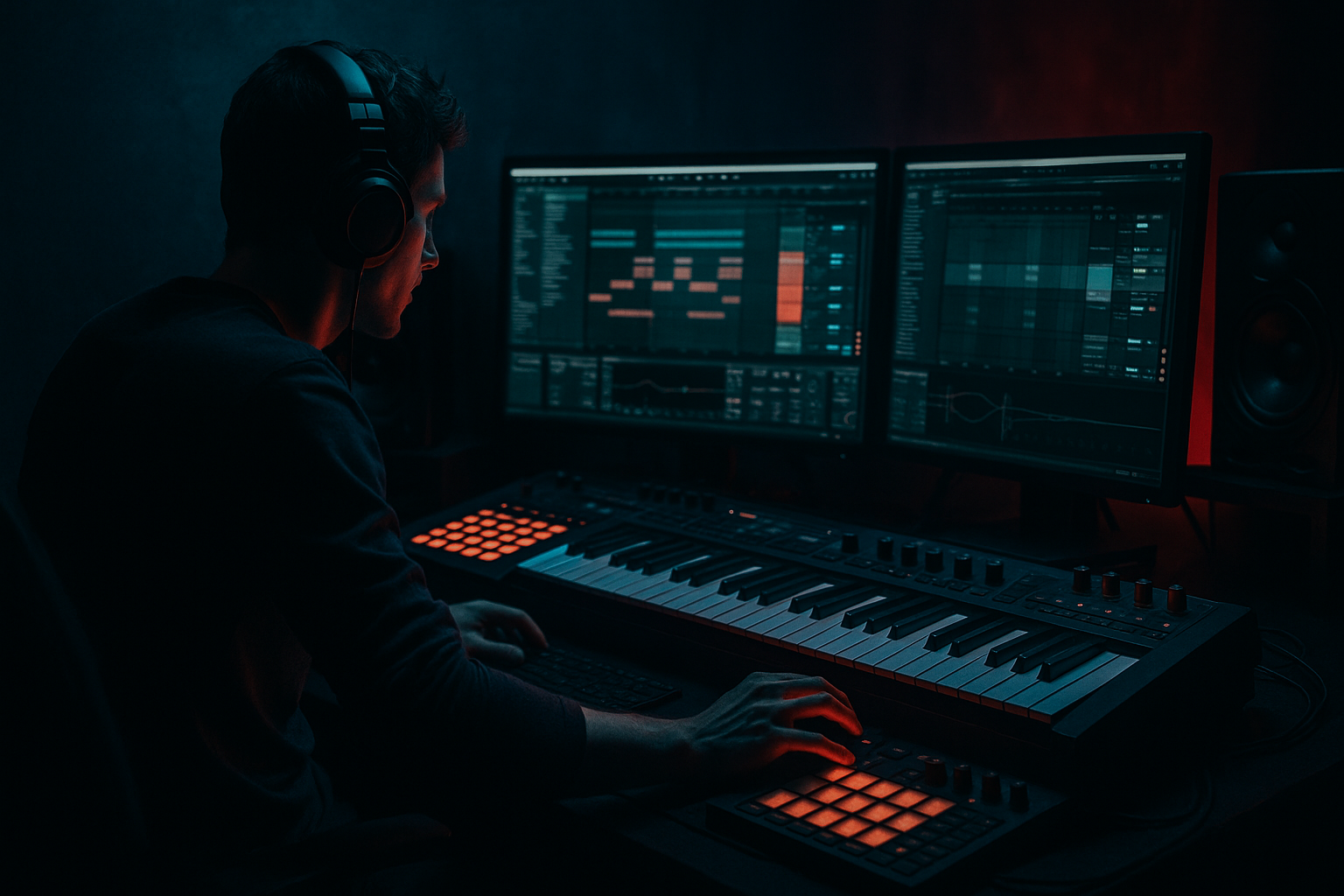
Main tutorial
Roller Jungle Ghost Note: Offset and Arrange in Ableton Live 12
1. Lesson overview
In drum and bass, a ghost note roller is one of the most effective ways to make a drum loop feel alive, shuffled, and dangerous without overcrowding the mix. The idea is simple:
- keep the main backbeat and snare impact solid
- add very low-velocity ghost hits
- offset them slightly ahead or behind the grid
- arrange them so they function like groove glue, not extra clutter
- MIDI ghost-note programming
- Groove Pool timing
- note nudging / micro-offsets
- Audio or MIDI clip arrangement
- stock devices for filtering, transient shaping, saturation, and glue
- a subtle loop enhancer
- a breakbeat support layer
- a transition tool for arrangement
- a way to make your drums feel more “human” and more “pressure-loaded” 🥁
- a solid kick/snare foundation
- ghost snare taps around the main snare
- tiny off-grid hat or rim accents
- a parallel texture layer for movement
- a simple arrangement that evolves over 8–16 bars
- hits hard on the main snare
- has subtle in-between motion
- feels like a classic jungle roller
- can sit under bass without fighting it
- a clean breakbeat loop sliced to MIDI
- single drum one-shots from your library
- stock samples from Ableton’s Core Library:
- Kick
- Main Snare
- Ghost Snare
- Closed Hat
- Rim / Tap
- Ride or shaker accent
- EQ Eight for cleanup
- Drum Buss for density
- Saturator for bite
- Optional Transient shaping via Drum Buss or external plugin if you use one
- Kick: centered, punchy, short
- Main snare: loudest transient besides kick
- Ghost snare: much quieter, thinner, more midrange-focused
- Hats/rims: tucked in, mostly for motion
- volume
- timing
- filter tone
- reverb send
- arrangement automation
- Kick on 1
- Snare on 2 and 4
- Secondary kick or kick pickup before bar 2
- Light hat on off-beats or eighths
- strong anchors on the 2 and 4
- movement between those anchors
- small surprises leading into the snare
- just before the main snare
- just after the main snare
- between kick and snare
- around late off-beats
- a tiny tap 1/32 before beat 2
- another very soft hit right after beat 2
- a second cluster around 3.4 to 4
- Velocity 10–35 for very faint support
- Velocity 35–55 if you want a more audible shuffle
- main snare = 110–127
- ghost snare = 15–40
- accent ghost = 45–60
- stick noise
- room tick
- snare chatter
- rhythmic smoke
- drag ghost notes slightly ahead for urgency
- drag them slightly behind for laid-back weight
- Ahead of grid: more tension, nervous energy
- Behind grid: heavier, more swagger, more “rolling”
- Mixed placement: the most human and jungle-like
- move one ghost note 5–15 ms early
- move another 5–20 ms late
- an extracted break
- swing preset
- custom groove from a jungle loop
- apply it lightly to the ghost-note clip
- reduce Timing Amount to keep it subtle
- keep Velocity moderate so the groove doesn’t feel exaggerated
- main groove = almost straight
- ghost layer = more swung or displaced
- Ghost snare taps: very short, almost click-like
- Rimshots: slightly longer if they need body
- Hats: short and controlled
- sub bass
- reese movement
- break transient detail
- reverb tails
- Reverb device
- Decay: short, around 0.3–0.8 s
- Pre-delay: tiny, around 0–10 ms
- Low cut: high enough to avoid mud
- Wet: very low, maybe 5–12%
- very quiet rim click
- filtered shaker
- chopped break percussion
- high-passed snare tail
- light foley tick
- EQ Eight high-pass aggressively
- Auto Filter with subtle movement
- Echo very low mix if you want rhythmic smear
- Drum Buss lightly for glue
- reinforce time
- add top-end motion
- make the ghost notes feel like part of a living break
- basic groove
- minimal ghost notes
- establish the pocket
- add one extra ghost note before the snare
- slightly increase velocity on one tap
- introduce subtle filter movement on hats
- add a second ghost hit around the end of bar 5
- automate reverb send slightly higher
- bring in a rim click layer
- slightly denser ghost cluster
- short fill at the end of bar 8
- remove one kick or hat to make room for the transition
- before a drop
- before a bass switch
- before a snare fill
- before a breakdown hit
- ghost-track filter cutoff
- send level into Reverb or Echo
- Utility gain
- Drum Buss drive
- transient emphasis in the drum bus chain
- open the ghost-note filter slightly in bars leading to a drop
- increase reverb send for a single fill hit
- pull the ghost layer down during bass-heavy sections
- brighten the top percussion only in the last 2 bars of the phrase
- sub
- reese
- mid-bass
- noise layer
- ghost snares masking bass attack
- hats fighting the 4–8 kHz zone
- too much transient clutter around the main snare
- reduce ghost velocity
- move ghost notes a few milliseconds
- high-pass harder
- shorten note lengths
- reduce reverb
- carve 2–5 kHz in the bass if needed
- tense and snappy
- or late and lazy
- ghost snares
- rims
- hats
- break chops
- shakers
- FX hits
- an anxious breath
- a snare scrape
- a tiny machine glitch
- more high-mid bite
- less body
- a touch of saturation
- low cutoff in the intro
- slightly brighter in the build
- darker again under the drop so the bass owns the high mids
- mute some hits
- replace others with ghost taps
- offset selected slices off-grid
- fewer ghost notes in one section
- more ghost notes in the next
- kick on 1 and a pickup
- snare on 2 and 4
- closed hats on offbeats
- one just before beat 2
- one just after beat 2
- one before beat 4
- one at the end of bar 2 leading into bar 1
- 18
- 24
- 30
- 22
- EQ Eight high-pass at around 220 Hz
- Drum Buss low drive
- Saturator soft clip
- short Reverb send
- do the ghost notes make the groove feel tighter?
- do they interfere with the snare impact?
- do they help transition into the next bar?
- Version 1: sparse ghost layer
- Version 2: denser ghost layer with one extra rim accent
- subtle low-velocity hits
- careful micro-timing offsets
- clean layering
- high-pass processing
- arrangement that evolves over phrases
- make the beat breathe
- push the rhythm forward
- add jungle-style swing
- create tension under bass and breaks
- a MIDI clip example for this pattern
- a rack chain preset recipe
- or a full 8-bar DnB drum arrangement map in Ableton Live 12 🎚️
In Ableton Live 12, this becomes especially powerful because you can combine:
This lesson focuses on creating a rolling jungle-style ghost note layer that supports the groove in a DJ-friendly DnB loop. We’ll build it so it works as:
---
2. What you will build
You’ll create a 2-bar roller drum pattern in Ableton Live 12 with:
Final result
A loop that:
Suggested palette
Use one of these starting points:
- kicks
- sharp snares
- rimshots
- hats
- shakers
- break perc hits
---
3. Step-by-step walkthrough
Step 1: Set up the core drum rack
Create a MIDI Track and load Drum Rack.
Suggested chain inside Drum Rack
Use separate pads for:
Device chain per pad
For each drum pad, keep processing lean:
Starting mix targets
Keep the ghost note layer separate from the main snare if possible. This gives you control over:
---
Step 2: Program the main roller grid
Set your clip length to 2 bars and start with a basic DnB backbone:
Example 2-bar pattern
Keep this initial pass clean. The ghost notes will be added after the main pulse is working.
Think in DnB phrasing
A good roller usually has:
---
Step 3: Add ghost notes as separate MIDI notes
Now create a separate lane or separate pad for ghost snares.
Best placement zones
Try ghost notes:
A classic jungle-feeling placement is:
Velocity range
Keep ghost notes subtle:
A practical method:
Important
Ghost notes should not sound like extra snares. They should feel like:
---
Step 4: Offset the ghost notes in time
This is the key move. The “ghost note” part is not just velocity—it’s also timing offset.
In Ableton Live 12, try these approaches:
#### Option A: Manual micro-shift
In the MIDI editor:
Timing behavior guide
A useful starting rule:
Option B: Use Groove Pool
Add a groove from:
Then:
A common DnB move is:
That contrast creates movement without breaking the pocket.
---
Step 5: Use note length and clip behavior intelligently
Ghost notes should usually be short.
Suggested note lengths
Why?
Because short notes leave room for:
If the ghost layer is too long, it will smear into the main snare and flatten the groove.
---
Step 6: Shape the ghost layer with stock Ableton devices
Here’s a practical stock chain for a ghost-note track:
Ghost layer chain
1. EQ Eight
- High-pass around 180–300 Hz
- Slight cut if boxy around 400–700 Hz
- Small boost if needed around 2–5 kHz for stick presence
2. Drum Buss
- Drive: light, around 5–15%
- Transients: modest positive amount if you want more snap
- Boom: usually off or very low for ghosts
3. Saturator
- Soft Clip on
- Drive: low, around 1–4 dB
- Use to make tiny hits audible without making them loud
4. Optional Utility
- Reduce gain if the layer feels too forward
- Narrow width if it’s stereo clutter
Optional ambience
Send ghost notes to a short room reverb:
This can make ghost notes feel like they’re bouncing in the same room as the break, which is very jungle.
---
Step 7: Add a parallel texture layer
To make the roller feel fuller without cluttering the main groove, create a second percussion track.
Good parallel textures
Process it like this
Purpose
This layer should not dominate. It should:
---
Step 8: Use arrangement to turn the loop into a section
A good ghost-note roller should evolve over time, not repeat identically forever.
8-bar arrangement idea
#### Bars 1–2
#### Bars 3–4
#### Bars 5–6
#### Bars 7–8
Arrangement trick
Use ghost notes to lead into section changes:
That last 1/2 bar before a phrase change is prime jungle real estate.
---
Step 9: Use automation for motion and impact
In Live 12, automate:
Example automation moves
This keeps the drums feeling “performed,” not looped.
---
Step 10: Check the groove against the bass
This is essential in DnB. Ghost notes are often amazing solo, then messy against bass.
Test your loop with:
Listen for:
Fixes
---
4. Common mistakes
1. Making ghost notes too loud
If you can clearly hear every ghost note, they may no longer be ghost notes.
They should support the groove, not dominate it.
2. Putting ghost notes on the wrong side of the snare
A tiny offset can make the groove feel:
But too much offset makes it sound sloppy. Use intentional micro-timing, not random placement.
3. Over-layering with too many percussion sounds
If you stack:
…you can lose the roller. Keep only the layers that actually improve motion.
4. Leaving low end in ghost layers
Ghost percussion should usually be high-passed.
Low mids build up fast and kill sub clarity.
5. Ignoring phrase structure
A loop that never changes will sound like a practice idea, not a finished drum and bass section.
Use arrangement to introduce, build, and release tension.
6. Quantizing everything rigidly
Perfect grid placement can make jungle feel sterile.
Try slight offsets and groove variation, especially on the ghost layer.
---
5. Pro tips for darker/heavier DnB
Tip 1: Use ghost notes as tension, not decoration
For darker DnB, ghost notes should sound almost like:
Try very quiet hits with:
Tip 2: Distort the ghost layer before EQing it
A useful chain:
1. Saturator
2. Drum Buss
3. EQ Eight
This can add aggression, then you clean it up afterward.
Tip 3: Filter the ghost layer dynamically
Map Auto Filter cutoff to automation or macro control.
Dark roller trick:
Tip 4: Use reverb as a rhythmic shadow
A short room reverb on ghost notes can create a “tunnel” feel.
Keep it very short and filtered so it feels like space, not wash.
Tip 5: Combine ghost notes with break slicing
Take a classic break, slice to MIDI, and then:
This gives you authentic jungle energy with modern control.
Tip 6: Automate density, not just volume
For heavier DnB, the most effective move is often:
Density automation feels more musical than simply turning the fader up.
---
6. Mini practice exercise
Exercise: Build a 2-bar roller ghost pattern
Do this in Ableton Live 12:
#### Step A
Create a 2-bar drum loop with:
#### Step B
Add 4 ghost snares:
#### Step C
Set ghost velocities to:
#### Step D
Offset two notes slightly early and two slightly late.
#### Step E
Process the ghost track with:
#### Step F
Loop it with a sub and bassline, then ask:
Bonus challenge
Duplicate the clip and make a second version:
Then arrange them as a call-and-response over 8 bars.
---
7. Recap
A strong roller jungle ghost note pattern in Ableton Live 12 is about:
Core takeaway
Ghost notes in DnB are not just tiny drums. They are groove architecture.
When placed well, they:
Remember the workflow
1. Build the main snare/kick spine
2. Add a separate ghost layer
3. Offset notes slightly
4. Shape with EQ, Drum Buss, Saturator
5. Arrange density over 8–16 bars
6. Test against bass and simplify if needed
If you want, I can also give you:

