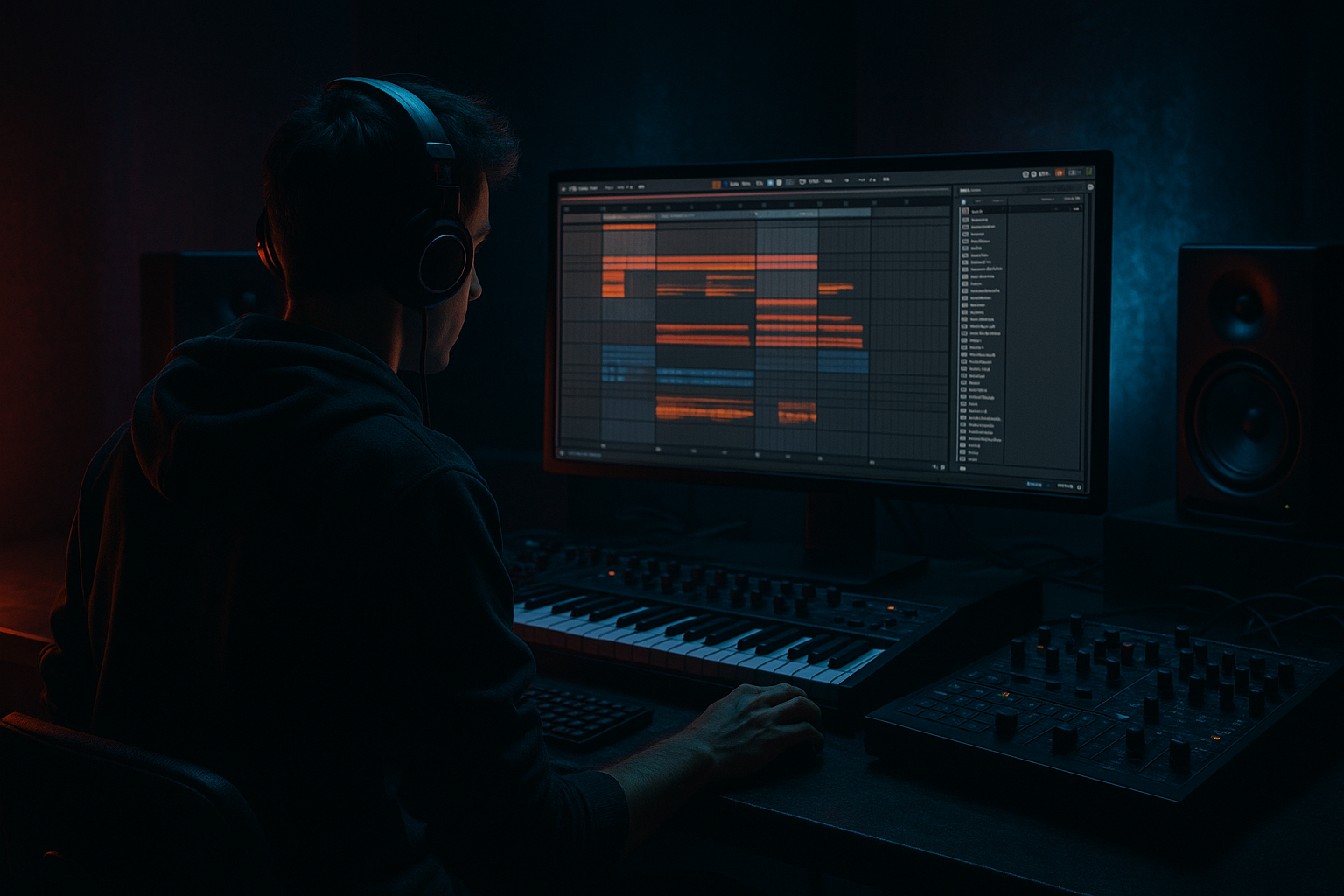
Main tutorial
Roller: Ragga Cut Swing with DJ-Friendly Structure in Ableton Live 12
1. Lesson overview
In this lesson, you’ll build a rolling drum and bass track with a ragga-flavoured swing, cut-up vocal energy, and a DJ-friendly arrangement that works on a mixdown or dancefloor.
The goal is to create a tune that feels:
- relentless and smooth like a proper roller
- syncopated and human with ragga-style chops
- easy to mix by DJs with clear intro, breakdown, drop, and outro sections
- program a rolling breakbeat foundation
- create swing without losing drive
- chop ragga vocals into rhythmic hooks
- build a bassline that locks with the drums
- arrange the track for DJ mixing and energy control 🎛️
- 16-bar DJ intro
- main drop section
- ragga vocal cut hook
- b-assline + drums working together
- 8-bar breakdown
- DJ-friendly outro
- Drums: tight kick, snappy snare, ghost notes, rolling hats, shuffled percussion
- Bass: Reese or sub-led mid-bass with a steady rhythmic pattern
- Vocal chops: short ragga phrases, sliced and re-triggered like percussion
- Arrangement: clean intro/outro for mixing, with clear phrase changes every 8 or 16 bars
- 172–174 BPM for classic DnB roller territory
- Drums
- Bass
- Vocal Chop
- Atmosphere/FX
- Impact/Fill
- 4 bars = musical sentence
- 8 bars = section
- 16 bars = major change
- Snare on beat 2 and 4
- Kick patterns that support momentum without overcrowding the groove
- kick on 1
- snare on 2 and 4
- extra kick before the snare for push
- Kick: 1, 1a, 3, 3a
- Snare: 2, 4
- Drum Buss
- EQ Eight
- Saturator
- 1/8 notes as a base
- add offbeat hats
- then swing them slightly
- on the offbeats between snare hits
- with occasional 1/16 ghost hats for energy
- use Groove Pool
- drag in a swing groove, like a light MPC-style groove
- Swing amount: 55–58%
- Timing: subtle
- Random: low or off
- Velocity: a little movement
- quieter snare hits before or after the main snare
- low-velocity rim clicks
- short woodblocks or congas
- low in the mix
- panned slightly left/right
- tightly quantized or lightly swung
- your own voice
- royalty-free vocal samples
- a ragga-style phrase with attitude and rhythm
- “come again”
- “pull up”
- “massive”
- “soundsystem”
- “ready now”
- cut the vocal into short bits
- rearrange them rhythmically
- align them to the drum groove
- right-click the audio clip and Slice to New MIDI Track
- choose slicing by transients
- play the vocal slices like an instrument
- upbeat positions
- gaps between snares
- transitions into the drop
- the “and” of 2
- right before the snare
- the last half of bar 4 or 8 for fills
- Wavetable
- Operator
- or Analog
- two detuned saw waves
- low-pass filter gently opening and closing
- slight unison or detune
- subtle distortion
- sub bass for weight
- mid bass for grit and presence
- avoids stepping on the snare
- uses short notes
- leaves breathing room
- bass notes on offbeats
- occasional sustained note into a drum gap
- answer the vocal chop rhythm
- use Operator with a sine wave
- keep it mono
- avoid too much processing
- Wavetable or Analog
- distortion/saturation
- filter movement
- modulation for tension
- keep bass notes short and controlled
- use velocity to shape energy
- automate filter cutoff slightly over 8 bars
- don’t let bass overlap the snare too much unless it’s a deliberate sustain
- make hats, percussion, and vocal chops feel loose
- preserve the forward drive of the drums
- create a subtle dancehall/jungle lean without sounding off-grid
- apply swing groove to hats, percussion, and vocal chops
- leave kick and snare mostly straight for impact
- give the DJ a clean mix point
- establish groove and atmosphere
- filtered drums
- light percussion
- maybe a bass tease
- no full vocal hook yet
- bars 1–8: drums and ambience only
- bars 9–16: introduce bass hint or a vocal teaser
- deliver the full roller groove
- full drums
- full bassline
- vocal chop hook
- drop out a kick
- add a fill
- switch a vocal chop
- open the filter on the bass for 1 bar
- give space before the next section
- atmospheres
- vocal fragments
- reduced drum energy
- maybe a filtered bass swell
- bring back the main groove with variation
- new bass rhythm
- higher energy percussion
- extra vocal call-response
- stronger drums
- make it easy for a DJ to mix out
- gradually strip away bass
- leave drums and percussion
- remove the main vocal hook
- keep the intro-style groove available at the end
- bass filter cutoff
- reverb send on vocal chops
- delay throws
- drum group filter for breakdowns
- saturation amount on bass for drop impact
- open the bass filter slightly over 8 bars
- increase vocal echo on the last word of a phrase
- filter the drums down during 1-bar transitions
- add a reverse reverb or crash before the drop
- Glue Compressor
- gentle settings, like:
- EQ Eight
- Saturator
- Compressor only if needed
- keep processing minimal
- avoid crushing the dynamics too early
- kick = punch
- sub = sustained low end
- mid bass = character
- Redux very lightly for digital grit
- Saturator with soft clipping
- Roar if you want modern harmonic aggression
- EQ cutting some high end
- formant shifting if appropriate
- delay throws into reverb
- filtering for a ghostly feel
- pitching them down slightly
- chopping them tightly
- leaving space after each phrase
- low drones
- vinyl noise
- field recordings
- reversed hits
- filtered pads
- Drum Buss
- parallel compression on drum group
- transient emphasis on the snare using Saturator or careful EQ
- layered snare samples with different body and crack
- the vocal answers the bass
- the bass answers the snare
- the percussion answers the vocal
- 1 kick/snare pattern
- 1 swung hat loop
- 1 ragga vocal chop
- 1 bassline
- Tempo: 174 BPM
- Snare must land on 2 and 4
- Hats must use Groove Pool swing
- Vocal must be chopped into at least 4 pieces
- Bass must leave space for the snare
- filter the bass down
- add a vocal echo throw
- mute the kick for half a bar
- insert a short drum fill
- tight drums
- subtle swing
- rhythmic vocal chops
- controlled bass movement
- clean DJ-friendly arrangement
- Keep the main drums solid and let supporting parts swing
- Use vocal chops like percussion, not full melodies
- Build bass that leaves room for the snare
- Arrange in clear 8- and 16-bar phrases
- Make an intro and outro that DJs can mix easily
- a template project layout for Ableton Live 12
- a MIDI drum pattern example
- or a bars-by-bars arrangement map for this exact track style.
We’ll do this in Ableton Live 12 using stock devices and practical DnB workflow.
You’ll learn how to:
---
2. What you will build
By the end, you’ll have a basic roller arrangement with:
Core elements
---
3. Step-by-step walkthrough
Step 1: Set the project up
Tempo
Set the tempo to:
A good starting point is 174 BPM.
Project layout
In Arrangement View, create tracks for:
Color-code them if you like. That helps a lot when you’re building fast.
Turn on the metronome and count phrases
DnB is very phrase-based. Think in blocks of:
---
Step 2: Build the drum foundation
A roller lives or dies by the drums. Start with a strong groove before adding bass.
A. Kick and snare
Create a MIDI clip on a Drum Rack or use individual audio tracks if you prefer.
For a standard DnB backbone:
A simple starting point:
Try this feel:
Keep the snare punchy and short. Use:
Suggested snare chain
On your snare track:
1. EQ Eight
- high-pass around 120–150 Hz
- boost slightly around 180–220 Hz for body if needed
- add presence around 2–5 kHz
2. Drum Buss
- Drive: subtle, around 5–15%
- Crunch: small amount only
3. Saturator
- Soft Clip ON
- Drive: 1–4 dB if needed
B. Add hats for motion
Create a closed hat pattern that gives forward momentum.
Use:
Try placing hats:
Add swing
In Ableton Live 12:
Good starting point:
Important: don’t over-swing the whole kit.
DnB should still feel driven and precise. The swing should be felt, not obvious.
C. Add ghost notes
Ghost snares and tiny percussion hits help the roller feel alive.
Use:
Keep these:
This creates the “ragga-cut” human groove without sounding messy.
---
Step 3: Create the ragga cut vocal rhythm
This is where the character comes in.
A. Find or record a vocal phrase
Use:
Look for short words or phrases like:
B. Warp and slice
Drop the vocal into an audio track.
In Ableton Live 12:
1. turn Warp on
2. choose Complex Pro for full vocal phrases, or Beats for chopped rhythmic pieces
3. set the tempo correctly
Then either:
#### Option 1: Chop manually in Arrangement View
#### Option 2: Use Simpler / Drum Rack
This is the best method for ragga-style rhythmic cuts.
C. Make the vocal behave like percussion
Don’t treat the vocal as a long melody.
Treat it like a rhythmic instrument.
Use short chops on:
Good places for vocal hits:
D. Process the vocal
On the vocal chop chain, try:
1. EQ Eight
- high-pass around 150–250 Hz
- reduce muddy mids if needed around 300–600 Hz
2. Compressor
- light control to keep chops consistent
3. Echo
- short, dub-style throws on selected hits only
4. Reverb
- very small amount, or automate for transitions
5. Utility
- use to control width and mono compatibility
A nice trick: automate Echo dry/wet only on the last word of a phrase.
That gives you character without washing out the groove.
---
Step 4: Design the bassline
A roller bassline should sit in the pocket, not dominate the mix.
A. Choose a bass sound
For beginners, a good stock Ableton approach is:
#### Option 1: Reese-style bass
Use:
A simple Reese setup in Wavetable:
#### Option 2: Sub + mid layer
Layer:
This is often easier to control in DnB.
B. Make the bass rhythm lock with the drums
For a roller, bass movement should support the snare and kick.
Start with a bass pattern that:
Typical approach:
C. Keep the sub clean
On the sub track:
Suggested chain:
1. Utility → Width to 0%
2. EQ Eight → low-pass if needed to remove harmonics
3. Saturator → very subtle for audibility on smaller systems
4. optional Compressor with sidechain from kick if needed
D. Add character to the mid bass
On the mid-bass track:
Good stock chain:
1. Wavetable
2. Auto Filter
3. Saturator
4. Redux lightly if you want a rougher edge
5. Compressor sidechained from kick/snare if required
6. EQ Eight
Helpful settings
---
Step 5: Program the swing feel properly
This is the secret sauce for a ragga-cut roller.
What swing should do
Swing should:
How to do it in Ableton
Use Groove Pool:
Suggested workflow:
1. drag a groove onto a hat or vocal clip
2. adjust groove amount to 20–40% for subtlety
3. use Commit only if you love the feel and want to lock it in
4. keep the kick/snare more rigid
Do not swing everything
If the snare and kick are too swung, the track loses its DnB backbone.
Let the top loop swing, while the main impact stays straight.
---
Step 6: Build the DJ-friendly arrangement
This is crucial. A great tune that DJs can mix is more useful than a messy banger with no intro.
Suggested structure
1. Intro — 16 bars
Purpose:
Include:
Arrangement idea:
2. First drop — 16 or 32 bars
Purpose:
Include:
Add variation every 4 or 8 bars:
3. Breakdown — 8 bars
Purpose:
Include:
4. Second drop — 16 or 32 bars
Purpose:
Change something:
5. Outro — 16 bars
Purpose:
Include:
---
Step 7: Use automation to create movement
Rollers feel alive because something is always shifting subtly.
Automate:
Good automation ideas
In Ableton Live 12, use automation lanes in Arrangement View to draw these changes cleanly.
---
Step 8: Glue the mix lightly
You do not need a heavy mixdown at this stage. Just enough to hear the groove clearly.
On the Drum Bus
Use:
- Ratio: 2:1
- Attack: 10–30 ms
- Release: Auto or 0.3–0.6 s
- Gain reduction: only 1–2 dB
On the Bass Bus
Use:
On the Master
For writing/creating:
You want enough headroom to arrange and tweak later.
---
4. Common mistakes
1. Swinging the kick and snare too much
This kills the roll.
Keep the main drum hits solid and let the supporting elements swing.
2. Making the bass too long
Long bass notes can smother the snare and muddy the groove.
Use shorter notes and leave breathing room.
3. Overusing vocal chops
If every bar is full of vocals, the hook loses impact.
Use vocal cuts like seasoning, not wallpaper.
4. Weak intro/outro structure
If the track jumps straight into the full drop, DJs have a hard time mixing it.
Always build a clean intro and outro.
5. Too much low-end on multiple tracks
If the sub, kick, and bass all fight for the same space, the roller will lose weight.
Keep sub ownership clear:
6. Ignoring phrase changes
DnB arrangements need clear movement every 4, 8, or 16 bars.
If nothing changes, the track feels static.
---
5. Pro tips for darker/heavier DnB
If you want this roller to hit darker and harder, try these:
A. Use a more aggressive bass texture
Add:
Keep it controlled. Heavier does not mean louder everywhere.
B. Darken the vocal chops
Process vocals with:
You can make ragga cuts sound menacing by:
C. Use eerie atmospheres
Add:
Keep them very low in the mix so they support the groove instead of distracting from it.
D. Make the drums hit harder without overcrowding
Try:
E. Use call-and-response
A dark roller often works best when:
That conversational feel is classic jungle/DnB energy.
---
6. Mini practice exercise
Try this 30-minute exercise in Ableton Live 12:
Task
Build an 8-bar loop with:
Rules
Bonus challenge
In bars 7–8, do one of these:
The goal is not perfection.
The goal is to make the groove feel like a real DnB roller with movement and character.
---
7. Recap
A ragga cut swing roller is all about balance:
Key takeaways
If you follow this workflow in Ableton Live 12, you’ll start making rollers that feel rolling, rude, and mixable — exactly what you want in drum and bass and jungle-inspired production 🔥
If you want, I can also turn this into:

