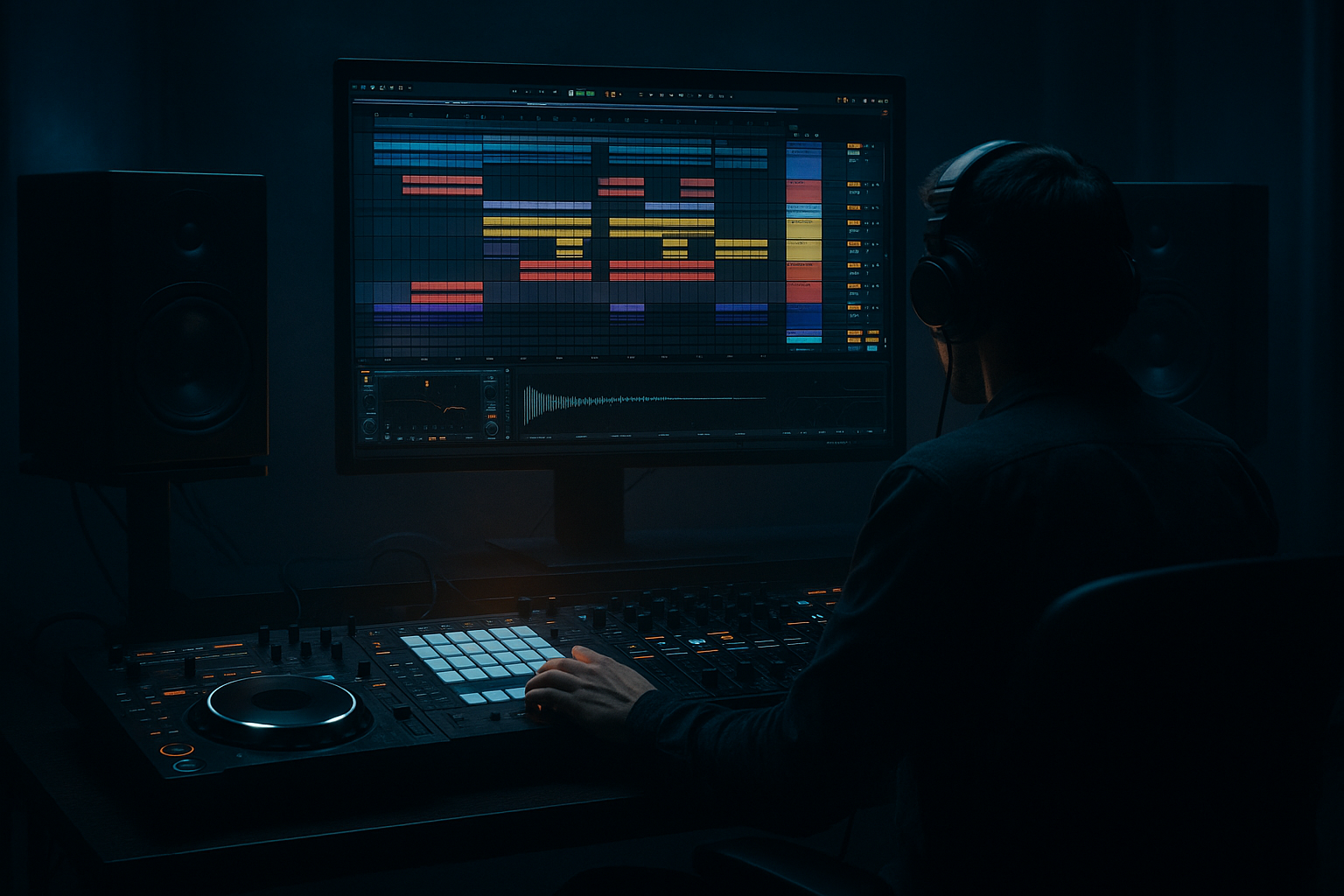
Main tutorial
Roller Sampler Rack Offset Tutorial (Resampling Workflow) — Ableton Live 12 (Jungle / Oldskool DnB) 🥁⚡
1. Lesson overview
In classic jungle/oldskool DnB, that “roller” feel comes from micro-timing offsets, layered breaks, and constant variation—without losing the forward drive. In this lesson you’ll build a Sampler-based Roller Rack where each hit is slightly offset, processed, and then resampled back into audio for that gritty, glued, “printed” vibe.
We’ll lean on Ableton Live 12 stock tools (Sampler, Drum Rack, Delay, Saturator, Glue Compressor, EQ Eight, Auto Filter, Redux, Roar if you have it) and a resampling-first workflow that makes your loops feel like they came off a battered sampler or DAT. 🎛️
---
2. What you will build
You’ll end up with:
- A Drum Rack “Roller Engine” that:
- A resampling workflow that prints:
- A jungle-ready 8–16 bar arrangement idea with fills, switch-ups, and movement
- In Sampler → Sample tab:
- Move Start until it becomes tighter (earlier) or slightly late/flammy relative to grid.
- Put pads into separate chains and use Chain Delay via an Audio Effect Rack after “External Routing” is messy.
- Use Groove Pool + note start variations, and reserve Sampler Start for the “texture” offset.
- Sampler Start for texture/feel
- Groove + note placement for timing
- ± 3 to 8 cents on hats/percs
- Macro 1: Offset Tightness → map to key Sampler Start parameters (hats + ghosts)
- Macro 2: Grit → map to Saturator Drive (post rack)
- Macro 3: HP Filter → map EQ Eight/Auto Filter cutoff (clean low-end)
- Macro 4: Air/Presence → map high shelf gain on EQ Eight
- Macro 5: Break Crunch → map Redux (Downsample a touch)
- Macro 6: Room/Space → map a small Reverb send amount (tiny!)
- Kick: 1, (optional extra on “and” of 2)
- Snare: 2 and 4
- Hats: constant 16ths but remove a few to breathe
- Ghost snares: 1e / 3e-ish positions (low velocity)
- Downbeats harder
- Offbeats softer
- Ghost notes very low (10–35 velocity)
- Bars 1–4: Clean roller only (no dirt layer)
- Bars 5–8: Add dirty layer quietly (-12 to -18 dB)
- Bar 8: Add a 1-beat stutter fill (slice repeat)
- Bars 9–12: Swap to alternate slice pattern (remove a kick, add ghost)
- Bars 13–16: Filter sweep + tiny pitch drop on a snare slice, then hard cut on 16
- Very short dub delay on a single snare hit (Delay: 1/8 or 3/16, low feedback)
- One reversed crash into bar 9
- Over-offsetting: If your hats feel late and the groove loses urgency, pull it back. Rollers are tight but alive.
- Too much swing + start offset: Groove Pool timing plus big sample start changes can fight each other.
- Printing too hot: Resampling with clipping everywhere kills punch. Keep peaks controlled, then distort intentionally.
- No low-end discipline: Breaks carry rumble—HP filter your breaks so your sub and kick stay clean.
- Over-layering: Jungle is dense, but if you stack 5 breaks with no EQ, you’ll get mush.
- Sub-anchoring: Keep your roller break HP’d around 80–140 Hz depending on your kick/sub plan, then let the sub do the heavy lifting.
- Midrange bite layer: Take the DIRTY print and bandpass 800 Hz–6 kHz, tuck it under the clean for aggression without mud.
- Transient control: Use Drum Buss lightly on the break print:
- Dark air: Add Auto Filter LP around 10–14 kHz and automate slightly down in heavier sections.
- Tension edits: In bar 16, mute the kick for half a bar and let the break “run,” then slam the drop back in.
- You built a roller-focused Sampler/Drum Rack where offsets and micro-variation create movement.
- You used Groove + Sampler Start to get that authentic pushed/pulled jungle feel.
- You resampled the performance to audio, then re-sliced it for classic oldskool edits.
- You now have a repeatable workflow to turn sterile MIDI breaks into printed, gritty, rolling DnB drums. 🥁⚡
- Uses Sampler per pad with offset start times (and optional micro pitch drift)
- Offers macro control for offset, grit, filtering, and stereo movement
- A clean roller loop (for editing)
- A “crushed/dirty” version (for edge)
- A re-layered version (for weight and variation)
---
3. Step-by-step walkthrough
Step 0 — Project setup (fast but important)
1. Set tempo to 165–172 BPM (try 170 BPM for that classic drive).
2. Create 3 audio tracks:
- A-Resample CLEAN
- A-Resample DIRTY
- A-Break Print
3. Create 1 MIDI track:
- M-Roller Rack
Why: You’re building a loop as a playable instrument first, then committing it to audio to get that “finished” bite.
---
Step 1 — Choose a break + prep slices
1. Drop a classic-style break (Amen, Think, Funky Drummer, or any jungle break) onto an audio track.
2. Warp it:
- Warp Mode: Beats
- Preserve: 1/16
- Transients: On
3. Right-click the clip → Slice to New MIDI Track
- Slicing preset: Built-in → Slicing
- This creates a Drum Rack with slices.
Now you’ve got break slices mapped to pads—perfect for rollers.
---
Step 2 — Convert key slices into “offset-friendly” Samplers
Drum Rack slices often use Simpler. We want Sampler because it’s deeper for offsets, modulation, and consistent control.
1. Pick 4–8 core slices to build your roller:
- Kick-ish hit
- Snare-ish hit
- Hat/shuffle bits
- Ghost snare / ride / percussion
2. For each chosen pad:
- Replace device with Sampler (drag Sampler onto pad, then drop the slice sample into Sampler).
- Keep each pad one slice (short hits are ideal).
Tip: Start with 6 pads: Kick, Snare, Ghost Snare, Hat 1, Hat 2, Perc.
---
Step 3 — Create the “Offset” behavior (the roller magic)
This is the heart: intentional micro-late / micro-early hits to mimic that pushed/pulled break feel.
For each Sampler pad:
#### A) Offset using Sampler Start (micro)
- Adjust Start slightly (we’ll macro-map later)
- Start offset range suggestion:
- Hats/percs: 0.10–2.00 ms equivalent feel (you’ll do by ear via sample start)
- Ghost snares: tiny start nudges to change the “drag”
Because Ableton shows Start in samples/time depending on view, do it by ear:
#### B) Offset using Track/Chain Delay (macro timing)
This is more “musical timing” than sample start.
Option 1: Per-pad Track Delay isn’t available inside Drum Rack directly per pad, but you can:
Better option inside Drum Rack:
So we’ll do both:
---
Step 4 — Add “human roller” variation with modulation (subtle!)
Inside each Sampler:
1. Go to Modulation section:
- Add a tiny LFO (Sampler’s built-in mod) to Sample Start or Pitch
- Rate: 0.10–0.40 Hz
- Amount: very small (you want “alive,” not drunk)
2. Add Velocity control:
- Map Vel → Volume (obvious)
- Optional: Vel → Filter Freq so harder hits are brighter
Oldskool vibe trick: Add Random to Pitch:
---
Step 5 — Build the Rack macros (fast performance control)
1. Put your Drum Rack inside an Instrument Rack (Group it).
2. Create macros like:
Stock chain suggestion (post Drum Rack):
1. EQ Eight
- HP at 25–35 Hz
- Gentle dip around 250–400 Hz if boxy
2. Saturator
- Mode: Analog Clip
- Drive: 2–6 dB
- Soft Clip: On
3. Glue Compressor
- Attack: 10 ms
- Release: Auto
- Ratio: 2:1
- Gain reduction: 1–3 dB
4. Optional Redux
- Downsample: 1.2–2.5
- Bit reduction: very light (or none)
Keep it subtle—you’re going for movement and glue, not obliteration (yet). 😈
---
Step 6 — Program a proper roller pattern (MIDI)
In M-Roller Rack, program a 1–2 bar loop:
Classic roller skeleton (1 bar, 16ths grid):
Key detail: Use velocity shaping:
Then add Groove:
1. Open Groove Pool
2. Try MPC 16 Swing 55–60 or any shuffle groove
3. Apply at 20–40% timing, 5–15% velocity
This gives you the “rolling” pull without destroying tightness.
---
Step 7 — Resampling workflow (print, then re-chop)
Now we commit the magic.
#### A) Resample CLEAN
1. Set A-Resample CLEAN input to:
- Resampling (top of input list)
2. Arm A-Resample CLEAN
3. Record 8 bars while you tweak macros slightly:
- Tiny Offset changes
- Slight Grit automation
- Filter movements
Rename the recorded clip: `ROLLER_CLEAN_170_8B`.
#### B) Resample DIRTY (parallel destruction)
1. Duplicate your Drum Rack channel or create an Audio Effect Rack with two chains:
- Chain 1: Clean (light processing)
- Chain 2: Dirty (heavy)
2. Dirty chain devices (stock):
- Roar (if available): mild “Tape”/“Warm” → then push 🔥
- Or Overdrive: Drive 20–50%, Tone to taste
- Redux: Downsample 2–5, bit reduction 6–10 (careful)
- Auto Filter: bandpass around 1–6 kHz for nasty grit
3. Record to A-Resample DIRTY for 8 bars.
Now you have two prints you can layer.
#### C) “Break Print” bounce for arrangement control
Take your CLEAN print and:
1. Right-click → Slice to New MIDI Track
2. Choose slicing by 1/16 or transients
3. Now you can do classic jungle edits:
- Stutters
- Reverse snare hits (reverse individual slices)
- Quick fills at bar 8/16
This is how you get that proper oldskool “reconstructed break” energy.
---
Step 8 — Arrangement ideas (8–16 bars that feel like DnB)
Try this 16-bar loop structure:
Add ear candy:
---
4. Common mistakes
---
5. Pro tips for darker/heavier DnB 😈
- Drive: 2–6
- Boom: Off (usually for breaks)
- Transients: small boosts if it got too soft
---
6. Mini practice exercise (15–25 minutes) 🧠
1. Build a 6-pad Sampler roller rack from one break.
2. Create 3 macros:
- Offset Tightness (Sampler Start)
- Grit (Saturator drive)
- HP Filter (Auto Filter cutoff)
3. Program 2 bars of roller MIDI.
4. Record 8 bars resample clean while moving only Macro 1 (tiny changes).
5. Slice the resample by 1/16 and create:
- One stutter fill
- One reverse hit
- One “dropout” (mute 1/2 bar)
Export a 16-bar idea.
---
7. Recap
If you tell me what break you’re using (Amen/Think/other) and your target vibe (more 94 jungle vs. techstep vs. modern rollers), I can suggest exact slice choices and a macro map that fits that sound.

