Main tutorial
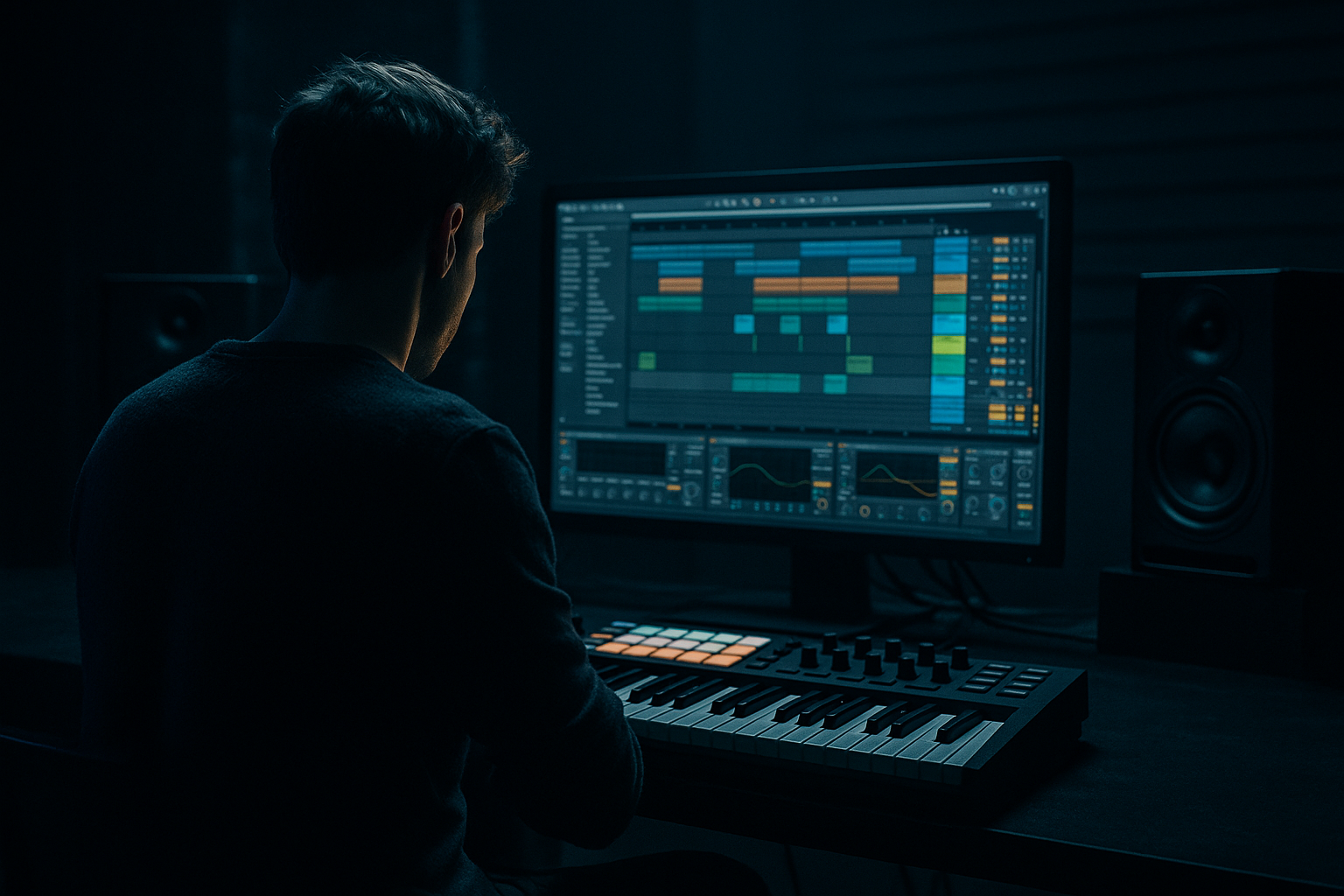
Roller: Sub Swing for VHS-Rave Color in Ableton Live 12
Beginner-friendly arrangement tutorial for jungle / oldskool DnB vibes
1. Lesson overview
In this lesson, you’ll learn how to create a rolling drum and bass arrangement with “sub swing” — a subtle, elastic movement in the low end that gives your track that worn-tape, VHS-rave, oldskool jungle feel without making the bassline messy.
This is not about huge modern neuro bass sound design.
It’s about:
- tight drums
- moving sub
- syncopated low-end rhythm
- nostalgic, dusty energy
- arrangement that evolves without losing the roller feel
- a rolling 174 BPM drum & bass groove
- a sub bass that swings against the kick/snare pattern
- arrangement sections that feel like a classic rave tape or jungle dubplate
- Intro: filtered drums + atmosphere
- Drop: rolling breakbeat + swung sub
- Variation: bass phrase changes every 8 bars
- Breakdown: VHS-style space, tape wobble, and tension
- Second drop: fuller drums and heavier bass energy
- sub notes landing slightly behind or ahead of the grid
- a “bouncy” low-end call-and-response
- jungle-style movement, but controlled
- that hazy, haunted oldskool rave vibe
- roll, not wobble
- swing, not sloppiness
- weight, not distortion overload
- Amen-style break
- Think / Apache-style pattern
- Any dusty 4-bar break you like
- kick on the main downbeats
- snare on the backbeats
- ghost notes and hats to fill the gaps
- Snare: beats 2 and 4
- Kick: syncopated placements around the snare
- Closed hats: offbeats and 16th-note motion
- Ghost snare / rim: very low in velocity
- ghost notes
- hats
- percussion
- sub placements
- Mono: On
- Legato: On
- Glide/Portamento: very small, around 20–60 ms if you want a slight slide
- Volume envelope: short and controlled
- Filter: optional, very subtle
- Saturator after Operator
- Simple Delay very lightly on a parallel return
- EQ Eight to roll off unnecessary high frequencies
- note on the 1
- another on the “and” after 2
- another slightly after the snare
- a short answer note before the next bar
- Bar 1, beat 1: long sub note
- Bar 1, beat 2.3 or 2.4: short sub hit
- Bar 1, beat 3: longer sustain
- Bar 1, beat 4.2: short pickup into the next bar
- nudge certain sub notes slightly later
- keep others right on the grid
- avoid making everything perfectly quantized
- long notes = tension and weight
- short notes = rhythm and movement
- use very small pitch envelope movement
- or do manual MIDI note overlaps for a slight glide
- Saturator: Drive around 1–4 dB
- Redux: very lightly if you want grit, not destruction
- Echo: subtle fluttery ambience on a send
- Chorus-Ensemble: only on atmos, not the sub
- Bars 1–2: establish groove
- Bars 3–4: add small fill or extra break chop
- Bars 5–6: variation in kick placement or hat rhythm
- Bars 7–8: tension before loop resets
- Bar 1: basic groove
- Bar 2: add a ghost snare or break chop
- Bar 3: remove one kick to create space
- Bar 4: add a ride or open hat
- Bar 5: introduce bass variation
- Bar 6: repeat with altered last note
- Bar 7: fill
- Bar 8: tension riser or drum stop
- chopped rave stab
- filtered noise
- reversed cymbal
- low-key vinyl crackle
- distant ambient hit
- resampled amen texture
- Auto Filter for sweeps
- Reverb for space
- Echo for ghostly delay
- Hybrid Reverb for more character
- Utility to keep lows out of FX layers
- Intro – 16 bars
- Drop 1 – 32 bars
- Breakdown – 16 bars
- Drop 2 – 32 bars
- Outro – 16 bars
- Intro – 8 bars
- Drop – 16 bars
- Variation – 8 bars
- Breakdown – 8 bars
- Final Drop – 16 bars
- remove the kick for 1 bar before a drop
- filter the bass down in breakdowns
- add extra break slices in the last 4 bars
- automate reverb throw on a stab or snare
- mute sub for half a bar and bring it back hard
- Auto Filter cutoff
- Volume
- Reverb wet/dry
- Saturator drive
- Bass note velocity if your instrument responds dynamically
- low-pass unnecessary highs if needed
- remove muddiness around 150–300 Hz if it builds up
- don’t over-cut the fundamental area
- keep sub mono
- check stereo width on atmos only
- use Bass Mono if needed on a mix bus, but carefully
- note edits
- fills
- filter moves
- dropouts
- Operator with a saw or square
- low-passed heavily
- distorted lightly with Saturator
- mixed very low
- sub hit after the snare
- short answer note before the next kick
- silence, then a low hit on the next bar
- break fill on bar 4
- bass note change on bar 5
- snare roll before a bass drop
- filtered amen loop
- low rumble
- distant pad
- mono bass tease
- no full low end until the drop
- filter cutoff up/down
- bass volume dips
- reverb throws on selected hits
- send delay on one stab at the end of a phrase
- Keep the sub clean but rhythmic
- Use small timing offsets for swing and character
- Let the drums and bass answer each other
- Add texture with stock Ableton devices
- Change the arrangement every 4 or 8 bars
- Use space, not clutter, for weight and vibe
- a bar-by-bar arrangement template
- a MIDI note example for the sub swing pattern
- or an Ableton device chain for oldskool jungle bass
In Ableton Live 12, we’ll use stock devices and simple editing to build:
You’ll end up with a loop that already feels like a tune, not just a beat. 🔥
---
2. What you will build
By the end, you’ll have a short arrangement with:
Core sound idea
We’re aiming for a bass groove that feels like:
Think:
---
3. Step-by-step walkthrough
Step 1: Set the project up
1. Open Ableton Live 12
2. Set the tempo to 170–174 BPM
- A classic starting point is 174 BPM
3. Create these tracks:
- Drums (audio or MIDI)
- Sub Bass
- Atmos / FX
- Return tracks for reverb and delay if needed
Step 2: Build the drum foundation
For this style, the drums carry the roller feel.
#### Option A: Use a breakbeat
Drag in a classic break like:
Then:
1. Put the break on an Audio Track
2. Use Warp if needed
3. Slice the break to MIDI:
- Right-click clip → Slice to New MIDI Track
- Use Transient or Beat slicing
Now you can rearrange hits.
#### Option B: Program a simple roller drum pattern
If you want to build from scratch:
A basic DnB starting point:
Step 3: Add groove with Groove Pool
This is where the roller starts to breathe.
1. Open Groove Pool
2. Try a groove like:
- MPC 16 Swing
- MPC 16-55 or 16-57
3. Drag the groove onto:
- hats
- ghost percussion
- some bass notes, if you want a more human push/pull
#### Important:
Don’t swing the main snare too much.
Keep the backbone solid. Swing should live mostly in:
Step 4: Create the sub bass
Now the key ingredient: sub swing.
#### Use Operator for a clean sub
1. Create a MIDI track
2. Load Operator
3. Set:
- Oscillator A = Sine
- Turn off other oscillators
4. Add a low-pass feel if needed, but keep it clean
#### Suggested settings:
If you want a warmer tape-like feel, try:
Step 5: Write a sub swing pattern
This is the heart of the lesson.
Instead of playing the sub on every drum hit, create a syncopated pattern that leaves space and then answers the drums.
#### Basic approach:
Use 1-bar or 2-bar MIDI loops and place notes like this:
#### Practical example:
In 4/4 at 174 BPM, try:
This creates a push-pull roller effect.
Step 6: Make the sub swing feel “VHS-rave”
Oldskool rave color comes from imperfection + texture.
Try these subtle moves:
#### A. Offset some notes
In the MIDI editor:
#### B. Shorten some notes
Use note length to create bounce:
#### C. Add pitch modulation or slides
If you’re using Operator or Wavetable:
#### D. Add tape-style texture
Use stock Ableton devices:
For the bass itself, keep it mostly mono and clean.
Step 7: Add the “roller” with drum arrangement
A roller isn’t just bass — it’s drum phrasing.
#### Build your 8-bar loop:
#### Easy arrangement idea:
That “slight change every 2 bars” is what keeps the roller alive.
Step 8: Add VHS-rave atmosphere
To get the old tape energy, use small textural layers, not huge cinematic pads.
Good options:
#### Stock Ableton devices for atmosphere:
Step 9: Arrange the track like a proper DnB tune
A beginner arrangement can be simple and effective.
#### Example 1: Classic short arrangement
#### Example 2: Quick club version
Step 10: Use arrangement energy changes
To avoid a static loop:
#### Good automation targets:
Step 11: Keep the low end controlled
For DnB, the sub must stay clear.
Use EQ Eight on the bass track:
Use Utility:
Step 12: Render the bass feel with resampling
A great trick in Ableton:
1. Solo drums + bass
2. Resample to a new audio track
3. Slice the resampled loop
4. Rearrange tiny chunks for fills and transitions
This can make your arrangement feel more like a real jungle edit than a programmed loop.
---
4. Common mistakes
1. Making the sub too busy
If the sub is playing constantly, the groove loses weight.
Fix: leave space. Let silence do some of the dancing.
2. Quantizing everything perfectly
Too-clean timing kills the VHS-rave character.
Fix: keep the kick/snare solid, but allow small offsets on sub and ghost percussion.
3. Distorting the sub too much
Heavy distortion can make the low end disappear.
Fix: keep the sub clean and add grit to a duplicate layer or upper-mid bass, not the pure sine.
4. Overusing reverb on drums
This can make oldskool vibes turn into muddy soup.
Fix: use short rooms or sends lightly. Keep kick and sub dry.
5. Not varying the arrangement
A repeating 2-bar loop can feel flat fast.
Fix: add changes every 4 or 8 bars:
---
5. Pro tips for darker/heavier DnB
Tip 1: Layer a mid-bass ghost under the sub
Keep the sub sine clean, then layer a very quiet mid layer:
This adds presence on smaller speakers without losing the sub foundation.
Tip 2: Use call-and-response bass phrasing
Dark DnB often feels heavier when the bass answers the drums.
Example:
Tip 3: Chop breaks against the bass
Oldskool jungle energy comes alive when the break and bass don’t perfectly mirror each other.
Try:
Tip 4: Make the intro scary, not huge
For darker tunes:
Tip 5: Use Automation Lanes for tension
In Arrangement View, automate:
This is where the track starts sounding like a finished roller, not just a loop.
---
6. Mini practice exercise
Try this in a new 8-bar project:
Drum task
1. Load an amen or make a basic drum loop
2. Add Groove Pool swing to hats and ghost notes
3. Insert one small fill at the end of bar 4 or 8
Bass task
1. Create a sine sub in Operator
2. Write a 1-bar MIDI pattern with:
- 1 long note
- 1 short syncopated note
- 1 pickup note into the next bar
3. Copy it across 8 bars
4. Change only the last note in bars 4 and 8
Arrangement task
1. Bar 1–4: filtered intro
2. Bar 5–8: full drop
3. Automate Auto Filter on the bass or drums
4. Add one atmospheric FX sound before bar 5
Challenge
Resample the 8-bar loop and chop it into a new variation.
Use that version as your second section.
---
7. Recap
You now know how to build a roller with sub swing in Ableton Live 12 that brings VHS-rave color and jungle oldskool movement.
Key takeaways:
Most important mindset:
A great DnB roller is not about constant intensity.
It’s about controlled motion, low-end tension, and smart arrangement.
That’s what gives you the classic feeling of a dusty rave tape coming alive on the dancefloor 🎛️🥁
If you want, I can also turn this into:

