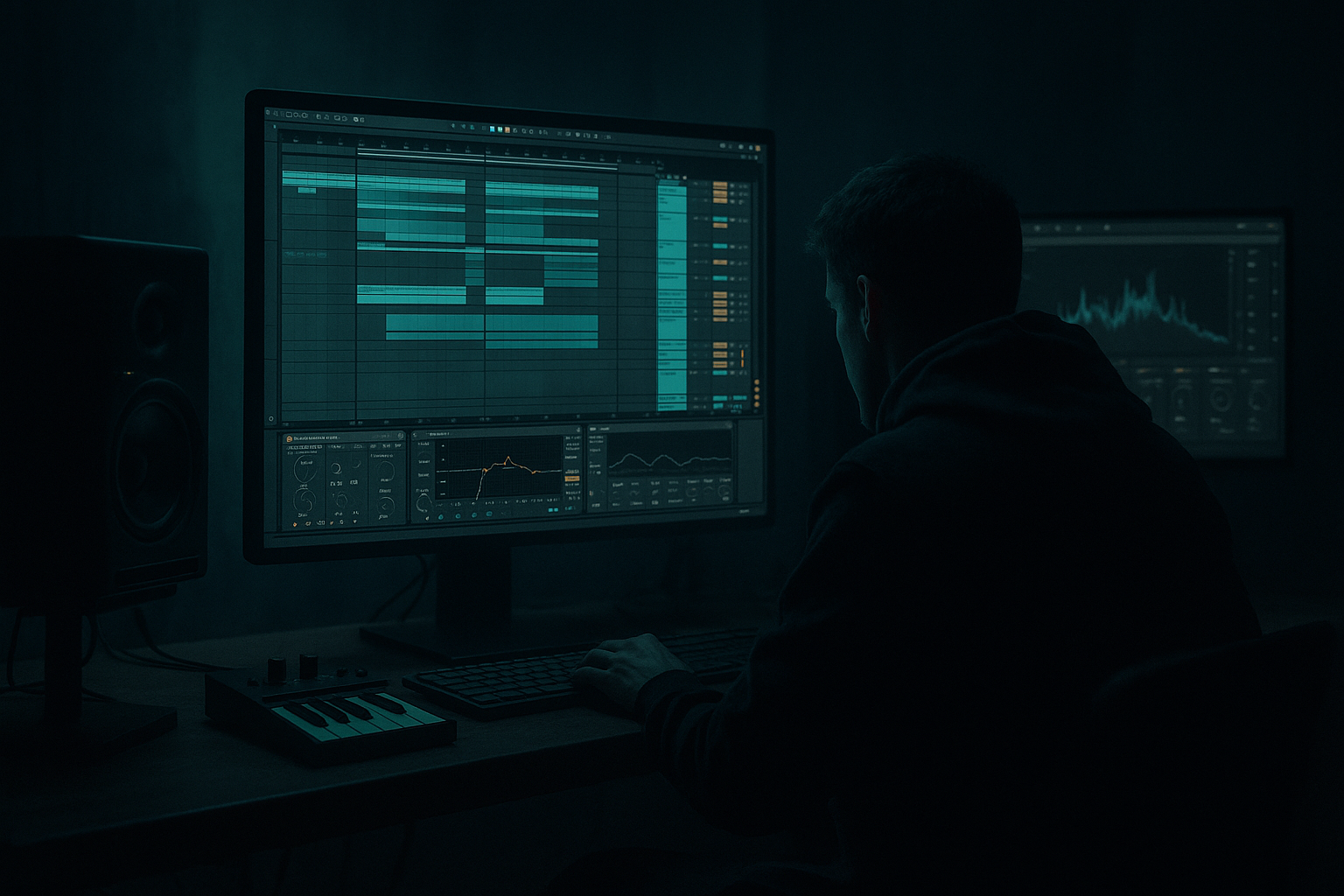
Main tutorial
```markdown
Roller Sub-Sine Arrange Workflow (Resampling) in Ableton Live 12
Oldskool jungle / DnB vibes — intermediate — Mastering-focused workflow 🎛️🔥
---
1) Lesson overview
This lesson is about building that rolling sub-sine “roller” bass foundation and then using resampling workflows in Ableton Live 12 to turn it into mix-ready, arrangement-ready audio that sits like classic jungle/DnB: tight, consistent, and punchy.
Key idea: Design in MIDI → Commit with resampling → Arrange and “master” the bass as audio (gain-staged, clipped/limited, and controlled).
We’ll use mostly stock devices (Operator, Saturator, Auto Filter, Glue Compressor, Limiter, EQ Eight) and a practical routing setup so you can print variations quickly.
---
2) What you will build
By the end you’ll have:
- A sub-sine roller bass (MIDI-based) with subtle movement
- A resampling rig that prints:
- An arrangement workflow for 16–64 bars with classic roller phrasing
- A mastering-minded bass bus (tight peaks, stable low-end, consistent loudness) ✅
- Algorithm: A only
- Osc A: Sine, Level 0 dB
- Envelope (Amp):
- Add subtle pitch envelope (optional but very “roller”):
- Write a 1-bar loop in A minor (or your tune key).
- Classic roller sub trick: syncopation + repetition.
- Important: leave space around snare hits (or duck later).
- Add Groove Pool swing like:
- Apply at 10–30% to avoid flamming against drums.
- Sidechain Input: Kick (and optionally Snare via a routed “SC” track)
- Ratio: 4:1
- Attack: 0.5–3 ms
- Release: 80–140 ms (time it so it breathes in rhythm)
- GR: typically 2–5 dB on sub, 1–3 dB on top
- EQ Eight
- Saturator (Soft Clip)
- Limiter
- Drums filtered / sparse breaks
- Tease TOP (no sub or very low)
- High-pass the full bass print to ~150 Hz until drop
- Full bass on
- Every 8 bars: a variation (chop, small fill, mute sub for a beat)
- Consider alternating:
- Remove sub entirely for 4–8 bars (huge impact)
- Keep tops or reese tails low
- Add jungle FX: tape stop, dub siren, vinyl noise (tastefully)
- Bring bass back with a new resample variation:
- Utility
- Spectrum
- Keep BASS GROUP peaking around -6 dBFS before premaster limiting.
- If the limiter is working too hard, fix it at the source (sub envelope, saturation output, bus compression).
- Sub level relative to kick
- Upper bass presence around 200–800 Hz
- How consistent bass feels bar-to-bar
- Parallel dirt for tops:
- Midrange “growl pocket” without reese chaos:
- Tight transient control using soft clipping (not just limiting):
- Key your sub to the track’s root note:
- Use short sub drops for menace:
- Build a clean sub-sine roller in MIDI (Operator) 🎚️
- Split Sub (mono, clean) vs Top (saturated, moving)
- Sidechain for the classic DnB pocket 🥁
- Resample early: print stems and a full bass print for fast arranging
- Treat prints with mastering-minded control: EQ → soft clip → light limiting
- Arrange in 8/16-bar phrases with small variations for oldskool jungle energy 🔥
- Clean sub
- Harmonic/top layer
- Full bass print
---
3) Step-by-step walkthrough
Step 0 — Session prep (DnB/jungle baseline) 🧱
1. Set tempo: 165–170 BPM (try 168).
2. Create groups:
- DRUMS
- BASS
- MUSIC/FX
- PREMASTER
3. Put your kick/snare loop down first (even a placeholder):
- Kick on 1 and 3 (or 1 and the “and” depending on style)
- Snare on 2 and 4
4. On PREMASTER, add:
- Utility (Gain 0.0 dB, Mono = ON below 120 Hz later)
- Limiter (Ceiling -0.8 dB, Lookahead 1 ms, Release Auto)
> We’re not “final mastering” yet—this is just to keep things safe while designing.
---
Step 1 — Build the sub-sine roller (MIDI) 🎸
Create a MIDI track: BASS – SUB (MIDI)
Load Operator (stock) with a clean sine:
Operator settings
- Attack: 0–3 ms
- Decay: ~300 ms
- Sustain: -inf (or very low)
- Release: 60–120 ms
- Pitch Env Amount: +3 to +8
- Pitch Env Decay: 60–120 ms
MIDI pattern (roller feel)
- Use mostly 1/8 notes, with occasional 1/16 pickups into snare gaps.
Groove
- MPC 16 Swing 55–58% (subtle)
---
Step 2 — Split the bass into “Sub” and “Top” (mastering mindset) 🧪
We want the sub to stay clean and the character to live above it.
#### On BASS – SUB (MIDI) chain:
1. EQ Eight
- HP at 20–25 Hz (12 or 24 dB/oct)
- Gentle dip if needed around 200–300 Hz (mud zone), -1 to -3 dB
2. Utility
- Mono ON
- Width 0% (for sub stability)
3. Glue Compressor (optional for control)
- Attack: 10 ms
- Release: Auto
- Ratio: 2:1
- Aim: 1–2 dB GR max
Now duplicate the track: BASS – TOP (MIDI) (or create an Audio Effect Rack)
#### On BASS – TOP (MIDI) chain:
1. EQ Eight
- HP at 90–120 Hz (24 dB/oct) — keeps tops from muddying sub
2. Saturator
- Mode: Soft Clip
- Drive: 2–8 dB
- Output: trim so level matches bypass
3. Auto Filter (movement)
- Type: LP24 or MS2
- Cutoff: 300–1.5k depending on tone
- Envelope: small amount or map cutoff to LFO
4. Chorus-Ensemble (very subtle width)
- Mix: 5–15%
- Keep it subtle to avoid phase weirdness
> The “top” is what makes the bass audible on small speakers—treat it like its own instrument.
---
Step 3 — Sidechain the bass to the kick/snare (classic DnB pocket) 🥁
On BASS – SUB and BASS – TOP, add Compressor (stock) with sidechain:
If you want that “pumping roller glide,” slightly longer release can feel great, but keep it controlled.
---
Step 4 — Resampling workflow (commit to audio fast) 🎚️✨
Now we print audio so arrangement becomes fast and mix/master-friendly.
#### Option A (simple): “Resampling” into new audio tracks
1. Create 3 audio tracks:
- PRINT – SUB
- PRINT – TOP
- PRINT – FULL BASS
2. Set each track’s Audio From:
- PRINT – SUB: BASS – SUB (Post FX)
- PRINT – TOP: BASS – TOP (Post FX)
- PRINT – FULL BASS: a BASS BUS group (see below)
3. Arm the print tracks and record your 8–16 bar loop.
#### Recommended routing (cleaner): Bass bus + prints
1. Group BASS – SUB and BASS – TOP into BASS GROUP.
2. On BASS GROUP, add:
- EQ Eight (gentle shaping)
- Glue Compressor
- Attack: 10 ms
- Release: Auto
- Ratio: 2:1
- GR: 1–2 dB
- Saturator (very subtle “glue”)
- Drive: 1–3 dB, Soft Clip ON
3. Send BASS GROUP to PRINT – FULL BASS via Audio From: BASS GROUP (Post FX).
> Why print? Because you’ll arrange faster, avoid endless tweaking, and you can treat bass like an audio stem during “mastering-style” finishing.
---
Step 5 — Audio-edit the roller like jungle records 🧬
Once printed, mute the MIDI bass tracks (keep them for revisions).
On the printed audio:
1. Consolidate your best 8–16 bars (Cmd/Ctrl + J).
2. Create variation:
- Chop 1/2 bar gaps before snares
- Reverse a tiny “pickup” (very oldskool if subtle)
- Add 1-bar call/response: bar 4 differs, bar 8 differs
3. Add micro-fills:
- End of 8-bar: drop bass for 1/8 or 1/4 before a crash/snare
#### Audio processing for control (on printed FULL bass)
- HP at 20–25 Hz
- If kick fights: small dip around 45–60 Hz (depends on key)
- If boxy: dip 180–300 Hz
- Drive: 1–5 dB
- Ceiling: -1.0 dB
- Aim: shave peaks 1–3 dB max
This is a mastering mindset: consistent bass level = easier loudness later.
---
Step 6 — Arrange workflow (16/32/64 bar roller blueprint) 🧱🎶
Here’s a practical, DnB-rooted structure:
Intro (0–16 bars)
Drop 1 (16–48 bars)
- Bars 1–8: full
- Bars 9–16: slightly less top / filter movement
Break (48–64 bars)
Drop 2 (64–96 bars)
- Different saturation amount
- Slightly different filter envelope
- Extra 1/16 pickup notes
---
Step 7 — “Mastering” touches specific to bass/roller control 🎛️✅
You’re in the mastering category, so let’s lock the low-end like a pro.
#### Check mono + low-end stability
On PREMASTER:
- Width 100%
- Bass Mono: enable Mono below 120 Hz
- Confirm the sub fundamental is stable (no weird spikes from modulation)
#### Gain staging (important!)
#### Reference quickly
Drop in a jungle roller reference (matched volume) and compare:
---
4) Common mistakes
1. Over-widening bass tops
Too much Chorus/width can cause phase issues and weak mono translation. Keep it subtle and check mono.
2. Sub too long / overlapping snares
If the sub sustain is too long, it smears the groove. Shorten release or sidechain more.
3. Printing too late
If you don’t resample early, you’ll keep “designing” instead of finishing. Commit, then arrange.
4. Clipping in the wrong place
If you slam the premaster limiter, you lose punch. Clip/limit on the bass print gently first, then keep premaster calmer.
5. No variation across 8/16 bars
Rollers need micro-changes. Even small mutes and filter shifts keep it alive.
---
5) Pro tips for darker/heavier DnB 🖤⚙️
Duplicate PRINT – TOP, distort harder (Saturator Drive 8–12 dB), then blend at -15 to -25 dB. Gives menace without ruining sub.
On TOP layer, use Auto Filter with slight resonance + envelope so every note “barks” a bit. Keep it controlled and repeatable.
Saturator (Soft Clip) before Limiter often sounds more “record-like” for jungle.
Dark rollers hit harder when the sub fundamental matches the tune (e.g., A=55 Hz, G=49 Hz, F=43.65 Hz). Use Spectrum to confirm.
Cut sub for 1/8 right before a snare fill—classic tension move.
---
6) Mini practice exercise (20–30 minutes) ⏱️🎯
1. Make a 1-bar roller sub pattern in Operator.
2. Create SUB and TOP splits (HP top at 100 Hz, mono sub).
3. Add sidechain to kick.
4. Resample 8 bars into:
- PRINT – SUB
- PRINT – TOP
- PRINT – FULL
5. Create two variations using audio chops:
- Variation A: remove bass for 1/4 before bar 8
- Variation B: add a 1/16 pickup into bar 5
6. Arrange 32 bars: intro 8, drop 16, mini-break 8.
Deliverable: a 32-bar loop that feels like a roller and plays consistently loud without the premaster limiter doing more than ~2–3 dB.
---
7) Recap
If you want, tell me your track key and your kick fundamental (rough Hz), and I’ll suggest exact sub note choices + EQ dip points for clean kick/sub coexistence.
```

