Main tutorial
Lesson Overview
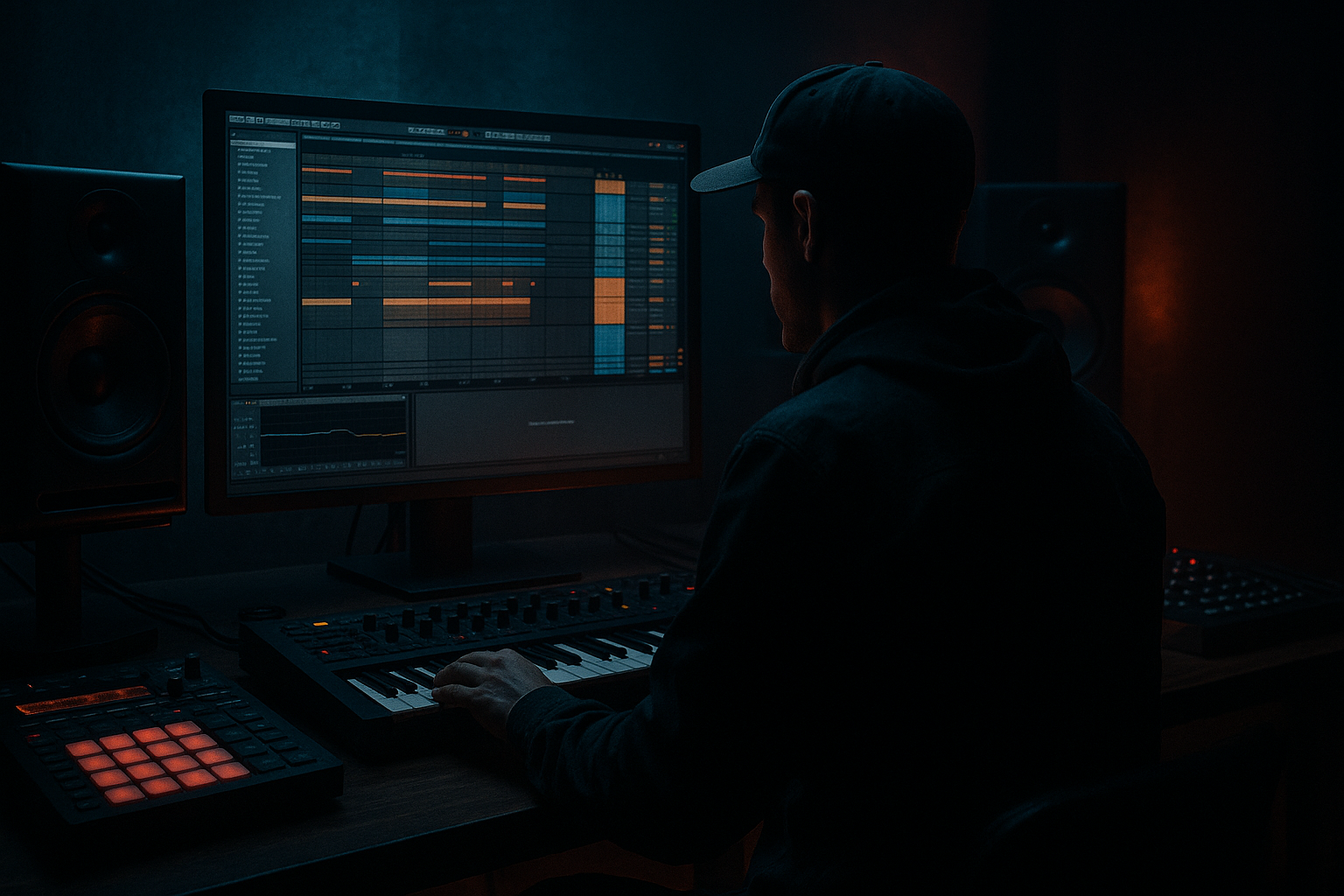
This lesson is about building a pirate-radio-style transition blueprint in Ableton Live 12 for jungle / oldskool DnB / rollers with a DJ-friendly structure. The goal is to make a section that feels like it could slide naturally from one tune into another on a set, while still sounding like an intentional production choice inside your own track.
In DnB, transitions are not just “effects moments.” They’re part of the arrangement language. A good roller tactic lets you move from a full-energy 2-step or break-driven section into a filtered, tension-heavy passage, then back into a drop without killing momentum. For darker bass music, this matters because the listener’s ear is always tracking three things: low-end continuity, drum identity, and tension release. If those are controlled, your track feels DJ-ready and properly engineered for movement.
We’re going to build a transition blueprint that uses:
- break edits for momentum and oldskool flavour
- sub/bass filtering and resampling for tension
- radio-style atmospheres and FX for pirate-radio character
- DJ-friendly phrase design so the transition can live inside a longer mix
- Ableton stock devices only, with a strong focus on practical routing and automation
- a half-bar to 2-bar break edit with chopped Amen-style energy
- a filtered bass pullback where the reese or sub is briefly narrowed, then rebuilt
- radio chatter / noise texture / vinyl-style room atmosphere sitting in the upper mids
- a drum fill and reverse hit that marks the phrase change
- a clean, DJ-friendly outro or intro window where a selector could blend tracks
- a drop re-entry with stronger low-end impact and clearer stereo discipline
- oldskool jungle urgency
- dark roller pressure
- pirate-radio grit
- modern Ableton precision
- Overusing reverb on the entire transition
- Letting the sub vanish completely too early
- Making the pirate-radio texture too wide and bright
- Adding too many fills at once
- Ignoring mono compatibility
- Using automation that ramps everything at the same time
- Resample your own transition
- Use subtle saturation before filtering
- Let the snare lead the ear
- Push the tension with negative space
- Use pitched noise risers instead of glossy uplifters
- Keep the sub lane clean
- build around drum flow, bass control, and phrase tension
- use Ableton stock devices like Auto Filter, Utility, Drum Buss, Echo, Reverb, Saturator, and EQ Eight
- automate multiple elements in stages, not all at once
- keep the transition DJ-friendly, mono-safe, and rhythmically clear
- let the pirate-radio character live in the mids and movement, not in the sub
This is an advanced workflow, so we’ll think like an arranger, a mix engineer, and a selector at the same time.
What You Will Build
By the end, you’ll have a compact transition section that works like a pirate-radio breakdown into a rolling re-entry.
Musically, it will sound like:
Think of it as the blueprint for a transition in a tune that could live somewhere between:
It’s not just an FX chain. It’s a mini-arrangement system.
Step-by-Step Walkthrough
1. Set up a 16-bar transition region with clear phrase landmarks
In Ableton Live 12, start by marking out a 16-bar section on your Arrangement View where the transition will live. For a DJ-friendly feel, structure it as:
- Bars 1–4: rolling groove established
- Bars 5–8: energy thins out, low-end tension begins
- Bars 9–12: pirate-radio breakdown / atmosphere / break edit
- Bars 13–16: re-entry build back into the main drop or next phrase
For oldskool DnB, that 16-bar span is useful because it gives enough time for a selector-style blend. If you want a more “mixable” intro/outro, duplicate the idea into an 8-bar version later.
Use Locators for:
- intro into transition
- tension pullback
- break reveal
- re-entry
Why this works in DnB: the genre relies heavily on phrase logic. A 16-bar arc gives dancers and DJs a readable energy curve, especially when the drums are busy and the bass is syncopated.
2. Build the drum backbone with a break edit and a clean anchor kick/snare
Start with your core drums: a main break loop, a snare anchor, and a few support hits. If you’re using a classic jungle break, slice it in Simpler using Slice to New MIDI Track. Keep the slices tight and create a 1- or 2-bar pattern that has enough swing to feel human, but not so much chaos that the transition loses focus.
Practical move:
- Put the break in a Drum Rack or Simpler
- Use Transient or Slice mode for edits
- Layer a clean kick and snare underneath if the break is too thin
Stock devices to use:
- Drum Rack
- Simpler
- EQ Eight
- Drum Buss
Suggested settings:
- On the break bus, use Drum Buss with:
- Drive: 5–15%
- Crunch: 5–20%
- Boom: keep low or off if your sub is already strong
- Use EQ Eight to cut low rumble below 25–30 Hz
- If the break is too sharp, dip around 3–6 kHz by 1–3 dB
Keep one strong snare or rimshot on the backbeat. That anchor helps the listener feel the phrase even when the break chops get wild.
3. Design the bass pullback with automation, not just muting
This is where the transition becomes musical instead of mechanical. Don’t simply drop the bass out. Instead, create a controlled bass withdrawal using automation on a bass group or return.
If you have a reese or mid-bass layer:
- automate an Auto Filter low-pass sweep from around 120–180 Hz cutoff down to 60–90 Hz over 4–8 bars
- narrow the stereo width during the pullback using Utility
- keep the sub either steady or reduced very slightly, depending on how much suspense you want
A strong approach:
- Put your bass stack into a group
- On the group, add Auto Filter, Utility, and Saturator
- Automate:
- Auto Filter cutoff: open to closed over the first 4–8 bars
- Resonance: modest, around 0.5–1.2, only if it adds a vocal-like bite
- Utility Width: from 100% down to 0–40% for the transition section
- Saturator Drive: automate up a few dB as the filter closes to keep the bass audible
If you want the sub to remain present without dominating, split it:
- keep a pure sine sub on a separate channel
- automate the mid-bass separately
- leave the sub mono and stable
This creates the classic DnB illusion of “less bass” without actually emptying the floor.
4. Create pirate-radio atmosphere with noise, voice fragments, and band-limited space
Now build the pirate-radio identity. This should feel like a late-night broadcast bleeding into the tune, not a random FX layer.
Create an audio track with:
- vinyl hiss or room noise
- short voice snippets / radio textures / sampled chatter
- perhaps a low-fi siren or tuner-like tone
Then process it with Ableton stock tools:
- EQ Eight: band-limit the sound
- Redux: lightly degrade for gritty texture
- Auto Filter: sweep movement
- Echo: short, dubby throws
- Reverb: small to medium space, not huge wash
Suggested settings:
- EQ Eight high-pass around 250–500 Hz
- low-pass around 6–9 kHz
- Redux: bit reduction lightly, enough to roughen the edges without crushing intelligibility
- Echo feedback: 10–25%
- Reverb decay: 1.2–2.8 s, with low cut engaged
Place these atmospheres in the gaps between break hits and bass phrases. Use short automation curves so they feel like bursts from a broadcast, not a constant pad. That keeps the arrangement moving.
5. Program a call-and-response phrase between break hits and bass stabs
For advanced DnB, the transition gets stronger when the drums and bass “talk” to each other. Create a call-and-response pattern across 2 bars:
- bar 1: break fill + bass stab
- bar 2: break drop + silence pocket + FX answer
Use a short reese stab or distorted mid bass hit on offbeats or after a snare. Keep the sub absent or very restrained on these stabs so they don’t blur the groove.
Sound design ideas:
- resample a bass note with Resonator, Saturator, or Wavetable
- bounce it to audio
- reverse one hit for a suction effect
- add Beat Repeat sparingly for an oldskool stutter texture
Useful settings:
- Beat Repeat Interval: 1/4 or 1/8
- Grid: 1/16 or 1/32
- Chance: 20–40%
- Variation: low to moderate, so it feels intentional
Keep this section sparse. In jungle and rollers, silence is a rhythm tool. A small gap before the next hit often feels heavier than another busy fill.
6. Shape the transition with return tracks for reverb throws and delay throws
Rather than putting giant effects directly on the source, send specific hits to Return tracks. This lets you keep the dry drums tight while still getting cinematic transition energy.
Set up two return tracks:
- Return A: short room / plate
- Return B: tempo-synced echo
On Return A:
- Reverb with decay around 0.8–1.8 s
- high cut around 5–8 kHz
- low cut around 200–400 Hz
On Return B:
- Echo synced to 1/8D or 1/4
- feedback around 15–35%
- filter on the return to keep it from muddying the low mids
Send:
- snare ghosts
- chopped vocal fragments
- reverse cymbals
- isolated break hits
Automate the send amounts on the final two bars before the re-entry. A snare hit with a delayed throw can imply a much larger space than a full wash of reverb. That’s the kind of detail that feels premium in a DnB arrangement.
7. Use automation lanes to create the re-entry lift
The re-entry should feel like pressure returning, not just volume returning. Build the lift with multiple parameters moving together:
- open the bass filter
- widen the bass slightly after the impact, but not during the sub-heavy part
- increase drum brightness with a gentle EQ or transient boost
- reduce the atmosphere send
- shorten the echo tail right before the drop
A strong automation recipe:
- Auto Filter cutoff opens from 80 Hz to 180–300 Hz over 2 bars
- Utility Width goes from 0–40% up to 80–100% on the mid layer only
- EQ Eight on the drum bus gets a subtle high shelf lift of 1–2 dB at 8–10 kHz
- Reverb send falls back to near zero in the final beat before the drop
If you want the transition to feel more aggressive, add a downlifter with a reverse crash or noise tail and cut it exactly on the drop. In DnB, the last 1/8 before impact is often more important than the whole build.
8. Glue the whole transition with bus processing and mono discipline
Group your drums, bass, and FX separately. Then use bus processing lightly so the transition sounds like one system rather than several layers.
Drum bus:
- Glue Compressor with slow-ish attack and medium release
- aim for only 1–2 dB of gain reduction
- Drum Buss for edge and body, but not overcooked
Bass bus:
- Saturator for harmonics
- Utility to force mono on low end if needed
- EQ Eight to clean muddy low mids around 200–400 Hz
FX bus:
- high-pass aggressively so the effects don’t fight the kick/sub
- keep the pirate-radio textures mostly above 300 Hz
Do a mono check on the transition. If the bass disappears or the drums lose punch in mono, the transition will feel impressive in headphones but weak in a club or on a radio stream. In DnB, mono compatibility is non-negotiable for the foundation.
Common Mistakes
- Fix: send only selected hits to returns; keep the dry break tight.
- Fix: keep a controlled low-end anchor or a reduced sub presence so the floor doesn’t collapse.
- Fix: band-limit it with EQ Eight and keep it mostly in the mids.
- Fix: choose one main break edit, one main FX gesture, and one bass move. Simplicity hits harder.
- Fix: check Utility width, collapse low layers, and audition the section in mono.
- Fix: stagger movements. Let the drums answer first, then bass, then atmosphere, then impact.
Pro Tips for Darker / Heavier DnB
- Bounce the whole 2-bar transition to audio, then chop it again. This often creates a more violent, coherent result than stacking more devices.
- A Saturator before Auto Filter can keep the bass audible as you close the filter. This is especially useful for reese layers.
- In darker rollers, the snare often defines the energy more than the kick. A snare with the right transient feels heavier than extra low-end.
- Remove one kick, mute one bass hit, or leave a half-beat blank before the drop. That “missing” information is what creates impact.
- A filtered noise tone or reversed break fragment feels more authentic than a shiny EDM-style riser.
- If the transition includes mid-bass chaos, let the sub stay simple. A stable mono sub makes the whole section feel more violent by contrast.
Mini Practice Exercise
Spend 15 minutes building a 4-bar pirate-radio transition inside an existing DnB loop.
1. Take a 4-bar drum loop and duplicate it.
2. In bars 3–4, slice one break hit and create a 2-step fill.
3. Add a bass group with Auto Filter and automate the cutoff down over the last 2 bars.
4. Put a short radio texture on a separate audio track and band-limit it with EQ Eight.
5. Send one snare hit and one vocal fragment to a delay return.
6. Add a reverse crash or reversed break tail into the final beat.
7. Collapse the bass width on the mid layer only, then reopen it on the drop.
8. Bounce the 4 bars to audio and listen back in mono.
Goal: make the transition feel like it could live between two jungle records in a mix, not just as a production exercise.
Recap
The key idea is to treat your DnB transition like a DJ-aware arrangement move: keep the phrase readable, protect the low end, and use FX as part of the groove rather than decoration.
Remember:
If the transition feels like it could come out of a late-night jungle broadcast and still slam in a modern roller context, you’ve got it right.

