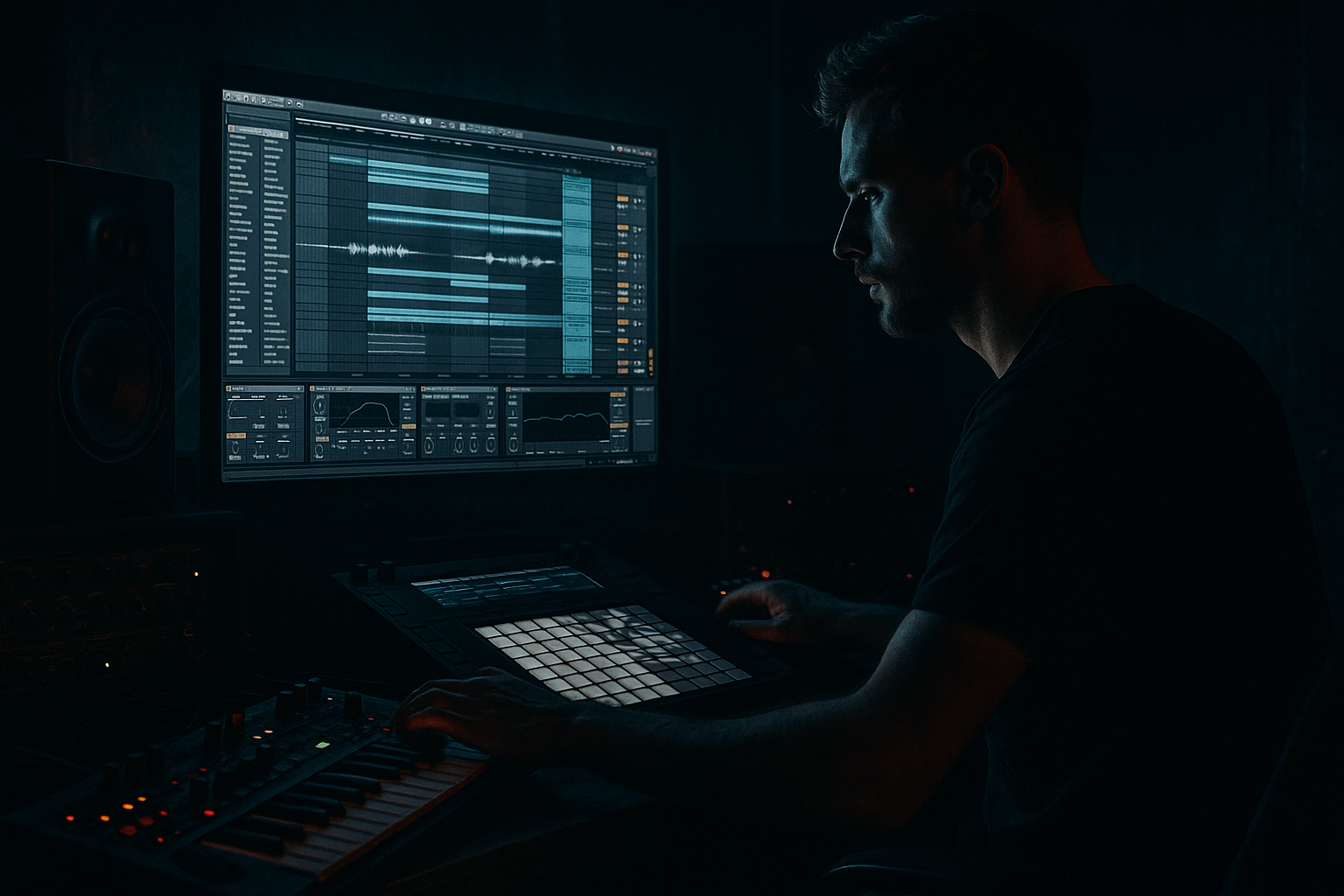
Main tutorial
Lesson Overview
In this lesson, you’ll build a roller-style bass wobble shape from scratch in Ableton Live 12 — not a huge festival growl, but a tight, musical, movement-heavy DnB bassline that sits inside a roller tactic edit and supports atmosphere, groove, and forward motion. This is the kind of bassline you hear in darker rollers, jungle-influenced edits, and stripped-back neuro-leaning DnB where the bass isn’t just “sound design” — it’s part of the arrangement and drum conversation.
The goal is to create a controlled wobble shape that can evolve across a 4, 8, or 16-bar section without losing low-end clarity. In a DnB track, this technique is especially useful when you want the bass to feel alive while the drums and atmospheres keep the energy rolling. Instead of using a single static patch, you’ll build a layered Ableton instrument chain, shape its modulation, then turn that into a performance-ready bass pattern that can be edited like a roller tactic: call-and-response phrasing, tension changes, and short swaps that keep the drop moving.
Why this matters: in DnB, the bassline often has to do three jobs at once — hold the groove, support the sub, and create tension. A wobble shape done right gives you movement without clutter, and in an atmospheric context it leaves space for pads, textures, break edits, and FX tails. That balance is what makes a roller feel deep instead of messy.
---
What You Will Build
You’ll create a mono-compatible roller bass patch in Ableton Live 12 with:
- a clean sub layer that stays solid below the drop
- a mid-bass wobble layer with LFO-driven movement
- controlled saturation and filtering for grit without harshness
- a resampled audio phrase you can chop into a proper roller edit
- a bassline that works in a darker DnB arrangement with breaks, atmospheres, and switch-ups
- intro atmosphere
- 8-bar build
- 16-bar drop
- 4-bar switch-up
- DJ-friendly outro
- break ghost notes
- hat shuffle
- rim accents
- atmospheric swells
- short risers and reverse hits
- Oscillator 1: Basic Shapes, saw or square-saw blend
- Oscillator 2: duplicate or slightly detune it for thickness
- Unison: 2 voices max to avoid low-end smear
- Voicing: mostly mono
- Glide/Portamento: light, around 20–60 ms if you want slides between notes
- filter type: Low Pass 24
- cutoff around 120–250 Hz at the start
- resonance: low to moderate, around 10–20%
- Drive: 2–6 dB
- Soft Clip: on
- Keep an eye on the low end; you want density, not fuzz overload
- Bass Mono: on if you want to keep the bottom stable
- Width: keep narrow on the main layer
- Use it for quick mono checking during the build
- Use Operator or Wavetable set to a simple sine
- Keep it mono
- No unison
- Low-pass if needed, but sine is usually enough
- Write long, stable notes matching the bass root notes
- Put the Wavetable patch here
- High-pass with Auto Filter around 80–120 Hz
- This prevents the wobble movement from fighting the sub
- SUB: everything below 80–90 Hz
- MID WOBBLE: movement and harmonics above that
- Glue Compressor with gentle gain reduction, around 1–2 dB
- Optional EQ Eight to clean up low-mid buildup around 200–400 Hz
- Wavetable filter cutoff
- Wavetable wavetable position
- Auto Filter cutoff
- Saturator drive very lightly, if you want extra motion
- Filter cutoff movement: about 20–40% depth
- Rate: start at 1/8, then test 1/16 for more frantic neuro-leaning movement
- For a roller feel, 1/8 dotted or 1/8 with swing can sound especially effective
- use a slow-open / fast-close curve
- automate cutoff in 2-bar phrases
- create a “question” bar and an “answer” bar
- one bar of lower cutoff
- one bar of higher cutoff
- a short burst at the end of the phrase for impact
- root notes
- octave jumps
- one or two passing tones
- small gaps for drum emphasis
- short note lengths
- rests on snare accents
- answer notes after kick/break hits
- occasional pickup notes into bar 2 or bar 4
- In a 16-bar drop, bars 1–4 introduce the bass motif
- Bars 5–8 add a higher octave response
- Bars 9–12 remove one note and open the filter more
- Bars 13–16 use a small fill or reverse-style note ending into the next section
- For tighter rollers: notes around 1/8 to 1/4 length
- For more legato wobble: allow some notes to overlap slightly if the glide is helping the phrase
- kick
- snare on 2 and 4, or break-derived backbeat
- ghost notes
- hats with swing or light shuffle
- occasional break edits
- Mute the bass and listen to the drum loop alone
- Identify empty pockets after snare hits or during kick gaps
- Place bass attacks where the groove needs propulsion
- Leave space where the break has character
- Bass hits just after the snare for a push-forward feel
- Bass rests before a break fill so the fill cuts through
- Use a short pickup note into bar 1 or bar 5
- Make one bar slightly different every 4 or 8 bars to avoid repetition fatigue
- filter movement
- note changes
- any automation curves
- a few transitions
- warp it if needed, but keep it minimal
- slice out strong moments
- reverse tiny fragments for fills
- create a call-and-response edit from the best bars
- cut bass before snare hits
- stutter one wobble cell
- duplicate a transient-heavy moment
- leave one bar “dry” and one bar “processed”
- filtered pads
- vinyl noise
- distant drones
- reversed cymbal textures
- rain-like high textures or field recording beds
- EQ Eight high-pass above 150–300 Hz
- Auto Pan for subtle movement
- Reverb with long decay but reduced low end
- Utility to control width and mono compatibility
- sidechaining atmospheres lightly to the kick or snare if needed
- cutting any atmospheric rumble below 120 Hz
- checking mono on the bass bus regularly
- Making the wobble too wide in the low end
- Using too much modulation on every parameter
- Letting the bass fight the kick and snare
- Over-saturating the patch until it gets fizzy
- Ignoring phrase changes across the drop
- Skipping mono checks
- Use subtle pitch glide between selected notes to make the bass feel alive without sounding too obvious.
- Automate filter cutoff in 4-bar arcs so the drop breathes instead of staying stuck at one intensity.
- Layer a quiet distorted mid copy of the bass and high-pass it aggressively for extra grit.
- Resample a version with more saturation and use it only for fills or switch-ups.
- Shape tension with silence: a one-beat gap before a return can hit harder than another bass note.
- Add tiny pitch automation drops at the end of phrases for a darker, more sinister feel.
- Use break edits to mask transitions between bass variations — a chopped break fill can make the bass switch feel intentional.
- Keep atmospheres filtered and distant so the bass remains the focal point, not the pad wash.
- Try call-and-response between sub and mid by letting the sub hold while the mid answers, or vice versa.
- Build roller bass in two parts: sub + moving mid layer
- Keep the sub mono, stable, and simple
- Use Wavetable, Auto Filter, Saturator, Utility, and Glue Compressor to create controlled movement
- Program the bass like a drum-aware phrase, not a synth loop
- Resample the good parts so you can edit the bass like a roller tactic
- In darker DnB, space, tension, and atmosphere are just as important as the wobble itself
Musically, the result should feel like a wobbling, slightly reese-like bass phrase that can sit under a broken beat or halftime-feeling edit, then open up for fills and transitions. Think: one-bar movement cells, alternating notes, short rests, and small automation changes that make the bass breathe against the drums.
---
Step-by-Step Walkthrough
1) Set up the drop lane and reference the role of the bass
Start with a blank MIDI track and rename it something useful like “Roller Bass - Wobble Shape.” Before loading any devices, decide the role of this bass in the arrangement.
For this lesson, place the bass in a context like:
In a roller tactic edit, the bass usually doesn’t dominate every beat with giant notes. It’s often short, purposeful, and groove-locked, leaving room for:
Set your project around a DnB tempo, around 172–176 BPM. If you’re building for darker rollers, 174 BPM is a safe sweet spot.
Why this works in DnB: the bassline needs to feel fast even when the notes are simple. At DnB tempo, small timing shifts and short note lengths create motion without overcrowding the drum grid.
2) Build the core synth with stock Ableton devices
Use Wavetable as the main source. It’s flexible, clean, and easy to modulate for roller-style movement.
Suggested starting setup:
Then add an Auto Filter after Wavetable:
Add Saturator next:
Add Utility at the end:
If you want more unstable character, add Roar after Auto Filter and before Utility. Use subtle drive and tone shaping; don’t overcook it. A little goes a long way in darker DnB.
3) Separate sub and mid-bass so the wobble stays clean
A proper roller wobble shape is almost always easier to control when the sub is separated from the moving mid layer.
Create two tracks:
1. SUB
2. MID WOBBLE
On the SUB track:
On the MID WOBBLE track:
A good starting split is:
Group both tracks into a Bass Bus. On the bus, add:
This separation is crucial in DnB because the kick and snare need space, and the sub must stay stable even when the wobble gets animated.
4) Create the wobble motion with LFO-style modulation
Now give the mid layer movement. There are several stock Ableton ways to do this, but the cleanest for this workflow is to use LFO from the Max for Live modulation devices if available in your Live setup. If not, use Envelope automation inside clips or a combination of Auto Filter and Shaper-style movement via clip automation. For Live 12 users with the stock modulation tools, use the built-in LFO where available.
Target these parameters:
Suggested modulation ranges:
Keep the wobble shape musical. Don’t randomize everything. Instead:
If using clip envelopes, draw:
The goal is not a huge talking bass. It’s a controlled pulse that feels like it’s reacting to the drums.
5) Program the MIDI phrase like a roller tactic edit
Now write the bass notes. Keep it simple but rhythmically smart.
Use a 1-bar or 2-bar loop with:
A strong DnB roller tactic pattern often has:
Example musical context:
Two practical note-length suggestions:
Don’t overcrowd the phrase. In darker DnB, space is part of the heaviness.
6) Make the rhythm interact with the break and drums
This is where the bass becomes a roller instead of just a synth loop. Put your drums in place:
Now align the bass phrase so it answers the drum groove.
Workflow moves:
Try this:
Why this works in DnB: the drums already carry a lot of motion. If the bass lands with them exactly every time, the groove can flatten. A roller bass works best when it locks in but doesn’t over-explain.
7) Resample the movement and chop it into a tactile edit
Once the wobble phrase feels good, resample it. Create a new audio track and set its input to Resampling or route the bass bus to it.
Record 4–8 bars of the full bass phrase, including:
Then take the audio clip and:
This step is very useful for a roller tactic edit because audio gives you a more hands-on arrangement feel. You can:
A great use of resampling is to print a version with more drive, then keep the MIDI version underneath. That gives you both control and character.
8) Shape space with atmosphere and low-end discipline
Because this lesson sits in the Atmospheres category, don’t treat the bass as an isolated element. Build the surrounding air so the wobble feels cinematic but still hard.
Add atmospheric layers such as:
Process atmospheres with:
Keep the bass clear by:
A useful arrangement trick: let the atmosphere swell up during a transition, then pull it back as the bass enters. That makes the drop feel wider without cluttering the bass.
---
Common Mistakes
Fix: keep the sub mono and high-pass the mid layer around 80–120 Hz.
Fix: modulate one or two key controls only, usually cutoff and wavetable position.
Fix: shorten note lengths, leave rests, and check the bass against the drum groove.
Fix: reduce drive, use soft clipping, and compare bypassed vs processed regularly.
Fix: add a small variation every 4 or 8 bars so the roller keeps evolving.
Fix: hit Utility on the bass bus and make sure the core low end stays stable.
---
Pro Tips for Darker / Heavier DnB
---
Mini Practice Exercise
Spend 10–20 minutes making a mini roller bass loop:
1. Set your project to 174 BPM.
2. Build a simple Wavetable bass with a separate sine sub.
3. Program a 2-bar MIDI pattern using only 3–4 notes.
4. Automate the filter so bar 1 is darker and bar 2 opens up slightly.
5. Add a drum loop with kick, snare, and a light break layer.
6. Resample 4 bars of the result.
7. Chop the audio into 3 versions:
- a tight opening phrase
- a mid-drop variation
- a fill leading back into bar 1
8. Add one atmosphere layer and make sure it sits behind the bass.
Finish by comparing the original MIDI version to the resampled edit. Ask yourself: which one feels more like a real roller tactic? Which one leaves more space for the drums?
---

