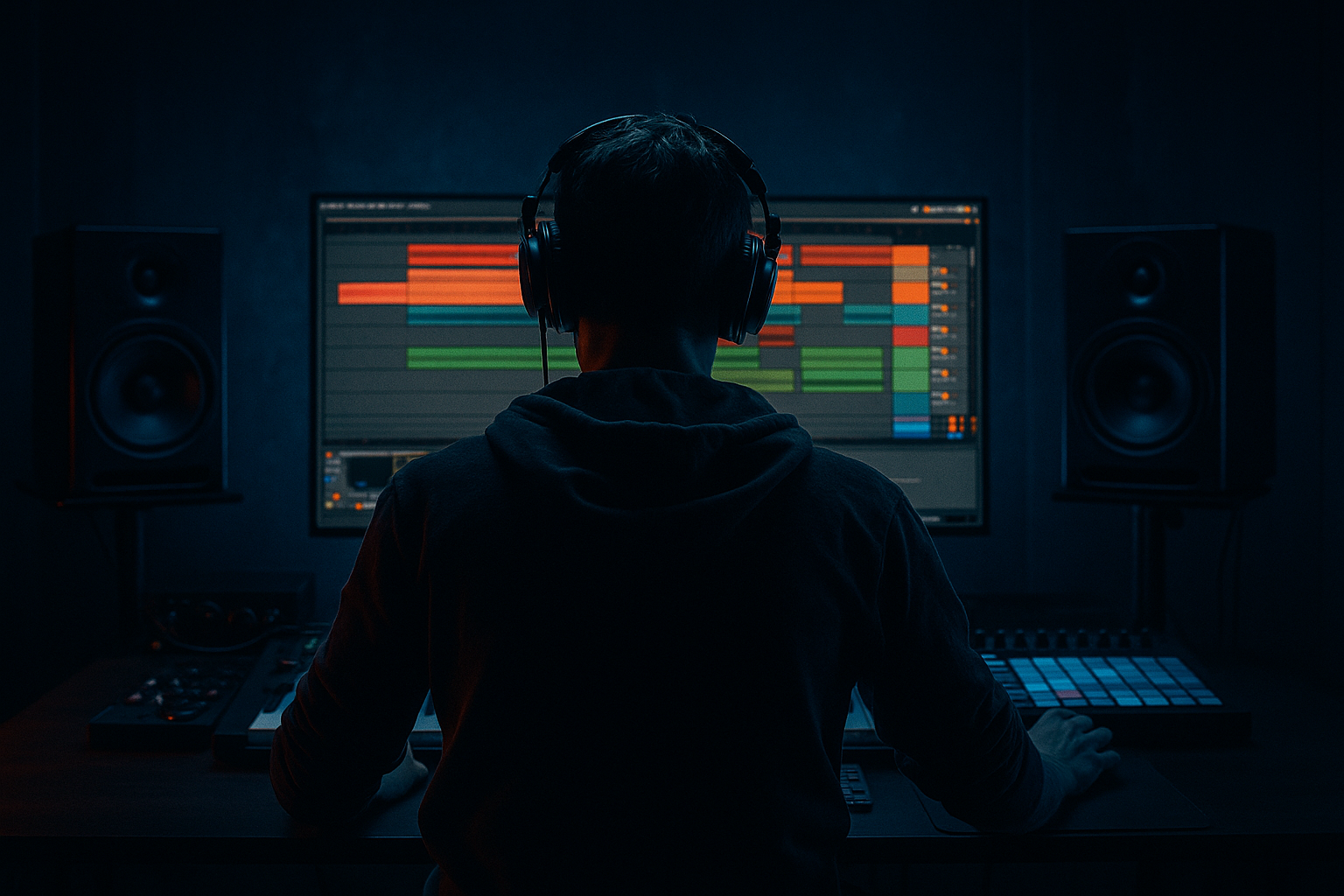
Main tutorial
Lesson Overview
This lesson is about building a roller tactics edit: a bassline turn and modulation move that feels like it was lifted from a real DnB arrangement, then sharpened inside Ableton Live 12 into a playable, DJ-friendly moment. The goal is not just to make a bass sound “move” — it’s to make the bassline change direction, energy, and attitude at the exact point the drums need a lift.
This technique lives in the mid-drop and phrase-turn zones of a DnB track: the last half of a 16-bar section, the end of an 8-bar loop, or the first bar after a snare fill where the bass has to pivot without losing the roller. In darker rollers, this kind of edit is often what stops the tune from feeling looped-out and gives the second phrase a proper bite.
Musically, it matters because DnB basslines have to do two jobs at once: they need to carry weight in the low end and create movement in the mids without smearing the groove. Technically, it matters because a “turn” edit can easily wreck mono compatibility, blur the kick/snare pocket, or introduce low-end chaos if the modulation is too broad or the resonance gets out of control.
By the end, you should be able to hear a bassline that switches direction with purpose: the sub stays anchored, the midrange morphs in a controlled way, and the edit feels like a musical hand-off into the next phrase rather than a random effect. This works especially well for rollers, dark halftime-leaning DnB, neuro-influenced rollers, and breakdown-to-drop transitions where precision matters more than spectacle.
What You Will Build
You will build a bassline turn modulate from scratch in Ableton Live 12: a short bass phrase that starts settled, then bends into a new motion using sampling, automation, and resampling decisions. The finished result should sound like a tight, gritty, evolving roller bass turn: low-end stays stable, the midlayer swells or pivots, and the edit lands with enough clarity to sit under drums without fighting the kick or snare.
The rhythmic feel should be syncopated but functional — something that locks to a DnB drum pocket rather than floating over it. The role in the track is usually a phrase transition or a bass turnaround, not a lead hook. Think of it as the bass equivalent of a drum fill that still respects the groove.
Polish-wise, it should be mix-ready enough to drop into a working arrangement: controlled dynamics, no ugly sub spikes, and a midrange that is intentionally rough rather than accidentally harsh. A successful result sounds like a bassline that has weight, intention, and motion, and when played against drums, it should feel like the tune is “turning a corner” without losing floor pressure.
Step-by-Step Walkthrough
1. Start with a dry, rhythm-first bass source
In Ableton, load a simple instrument that gives you a solid harmonic base. If you want a clean starting point, use Operator or Wavetable; if you already have a sampled bass hit, drag it onto a Simpler track. For this lesson, keep the source uncomplicated: one note or a short two-note motif in the mid-low register, with a strong fundamental and some upper harmonic content.
Keep the MIDI phrase short: 1 to 2 bars. Use notes that sit in a DnB-friendly range — often around F1 to A2 depending on the tune — but make sure the root note is not fighting your kick. If your sub is too high, the bass will feel thin; too low, and the modulation becomes muddy and unreadable.
Why this works in DnB: rollers depend on repeatable phrasing with small variations. The turn only feels powerful if the starting groove is clear first. You’re building contrast, not noise.
2. Shape the basic bass into a controlled roller lane
Before you modulate anything, set up the bass so the low end is stable. On the bass track, add EQ Eight first if needed to trim unnecessary rumble below roughly 25–30 Hz. Then add Saturator with a modest amount of drive — a realistic starting point is around 2 to 6 dB — to create harmonics that help the bass read on smaller systems.
If the source is too bright, use a low-pass filter in the instrument or an Auto Filter after it. For a roller, you usually want the bass to feel focused rather than wide-open. A good starting move is a low-pass around 120–400 Hz, depending on how much mid character you need. If it starts to sound like mush, back off the cutoff and use saturation to restore presence instead of just opening the filter wider.
Listen for two things:
- the sub staying even from note to note
- the midrange speaking clearly without harsh fizz
If the bass already feels unstable here, fix that before adding motion. The turn edit will only exaggerate problems.
3. Create the “turn” as a musical change, not just an FX sweep
The core trick is to design a phrase that changes identity at the turn point. Write a short MIDI clip with a repeating groove, then alter the last 1/4 bar or last bar so the bass behaves differently. That change can be:
- a longer note that lets the tone open up
- a shorter stutter that makes room for a snare fill
- a note jump up an octave for emphasis
- a pause that creates tension before the next bar
In DnB, this works because drum programming is already highly directional. If the snare lands on 2 and 4 and your bass turn happens just before the downbeat, the listener hears a phrase pivot, not just a sound effect.
A practical structure:
- Bars 1–3: stable roller pattern
- Bar 4: bass begins to open or mutate
- Last beat of bar 4: turn gesture
- Bar 5: return or answer phrase
Keep the turn short enough that the groove doesn’t disappear. A good successful result should feel like the bass is leaning into the next section, not falling off the rails.
4. Choose your modulation route: A or B
Here’s the decision point.
A — Filter-led turn
- Use Auto Filter or the instrument filter to automate cutoff and resonance
- Best if you want a cleaner, more DJ-friendly roller
- The bass feels like it is opening, bending, or “talking” without becoming too aggressive
B — Timbre-led turn
- Use Wavetable, Operator, or a sampled bass chain with macro movement, saturation, and resampling
- Best if you want a heavier, more neuro-leaning or darker mechanic turn
- The bass feels like it is mutating rather than merely opening
For most intermediate DnB roller edits, A is safer for a first pass. B gives more character but can get messy faster. If the tune is already dense, choose A and keep the turn more disciplined. If the tune is sparse and needs menace, choose B.
5. Program the modulation so it peaks on the phrase edge
If you choose the filter-led route, automate cutoff across the last 1/2 bar to 1 bar. A useful starting range is moving the cutoff from roughly 150–300 Hz up toward 600–1.5 kHz, depending on how bright the bass can tolerate. Add a small resonance boost, but keep it restrained — too much resonance will make the bass poke in a way that weakens the roller.
If you choose the timbre-led route, use Envelope changes or macro automation to move wave position, filter amount, or FM depth. Keep the change audible but not theatrical. In DnB, a strong turn often sounds better when the modulation is felt more than spotlighted.
What to listen for:
- Does the bass still sound like the same instrument?
- Does the change happen right before the snare or right after it?
If it blooms too early, it can flatten the impact. If it blooms too late, it feels disconnected from the drums.
6. Resample the turn so you can edit it like audio
This is where the edit becomes serious. In Ableton, route or resample the bass performance to a new audio track and record the phrase. Once printed, you can cut the turn more precisely, reverse tiny fragments, or tighten the transient edges.
Commit this to audio if the modulation is already doing the right musical job. That is the point where moving forward becomes faster than endlessly tweaking MIDI. A printed turn gives you micro-edit control, which is huge for DnB phrasing.
After recording:
- trim the clip tightly to the musical bar
- crossfade if needed to avoid clicks
- nudge the turn by a few milliseconds if it sits late against the drums
A tiny timing adjustment can make the edit feel locked. In roller music, a bass turn that lands even slightly late can lose momentum against the snare.
7. Add a second processing chain for attitude, but keep the low end disciplined
A practical stock-device chain here could be:
Chain 1: EQ Eight → Saturator → Auto Filter
- EQ Eight: remove mud below 25–30 Hz, tame any harsh area around 2–5 kHz if needed
- Saturator: light to medium drive, often 2–6 dB
- Auto Filter: automate cutoff during the turn
Chain 2: Utility → Compressor or Glue Compressor → EQ Eight
- Utility: keep the low end centred; if needed, reduce width on the bass layer or mute stereo spread below the turn
- Compressor / Glue Compressor: use only if the turn’s peaks are jumping out too hard
- EQ Eight: clean up any buildup after processing
If the bass has a stereo mid layer, keep the sub mono. A very useful move is to split the bass conceptually: low layer stable and mono, mid layer allowed to move. The club system will thank you later.
Watch the low end in relation to the kick. If the bass turn causes the kick to lose punch, reduce the bass’s low-frequency energy during the exact hit of the kick instead of boosting everything else. In DnB, space is often more effective than volume.
8. Check the edit in context with drums and a phrase change
This is mandatory. Loop the full drum section with the bass turn and listen to the turn in relation to the snare, kick, and any ghost notes or break shuffles. The edit should not only sound good soloed; it needs to create lift inside the groove.
Use a simple context check:
- drums alone
- bass alone
- both together
- full 8-bar phrase
Ask whether the turn strengthens the bar line. If the bass turn lands on the same spot as a kick and gets swallowed, move it earlier or reduce its low-end emphasis. If it crowds the snare fill, leave more space before the downbeat.
What to listen for:
- the snare staying sharp and present
- the bass turn adding tension without masking the groove
In DnB, a successful edit feels like the drums are “pulling” the bass through the phrase.
9. Use a small arrangement move to make the turn earn its place
Don’t leave the turn exposed on a dead 8-bar loop. Give it a job in the arrangement. One strong option is to place it at the end of an 8-bar block, then answer it with a stripped return of the bass on the next bar. Another is to use it as the lead-in to a second-drop variation, where the bass line comes back with a different modulation angle.
Example arrangement logic:
- Bars 1–8: original roller
- Bars 9–16: repeated groove with the turn edit at bar 16
- Bar 17: brief drum focus or halftime-feel answer
- Bar 18 onward: bass returns with a new variation
That contrast helps the turn feel intentional. In club arrangements, these edits are valuable because DJs can mix phrases cleanly, and the dancefloor gets a meaningful change rather than just more loop.
10. Refine the feel with one deliberate restraint move
If the turn is working but feels too busy, simplify it. Either shorten the automation curve or reduce the brightness during the peak. In a darker DnB context, less motion often hits harder because it leaves room for the drum pocket and makes the low-end information easier to read.
If the turn is too polite, do the opposite: lengthen the motion by a beat, or add a slightly more aggressive midrange push in the middle of the edit. A gritty turn often benefits from a touch of asymmetry — not perfectly even movement, but a bias toward one side of the phrase.
A good final check: mute the bass and then unmute it. The moment it returns, it should feel like the track has direction again.
Common Mistakes
1. Making the turn too wide in stereo
- Why it hurts: the low end loses centre focus and the bass turn becomes less reliable in clubs.
- Fix: keep the sub mono with Utility, and if you use width, apply it only to the mid layer above the low fundamental.
2. Automating too much low-frequency movement
- Why it hurts: the bass turns into a wobble of mud and clashes with the kick.
- Fix: keep the deepest part of the bass stable; automate mainly the mids or the filter point above the sub.
3. Letting resonance spike the wrong note
- Why it hurts: the turn starts screaming instead of grooving, especially on resonant filter sweeps.
- Fix: reduce resonance, or place the resonant peak earlier and let it decay before the downbeat.
4. Printing the bass too late without trimming
- Why it hurts: the phrase feels lazy and loses lock with the drums.
- Fix: resample, then tighten the clip edge and nudge by a few milliseconds if the turn sits behind the pocket.
5. Over-processing the bass before checking it with drums
- Why it hurts: the bass sounds exciting soloed but flattens the groove in context.
- Fix: always test the turn against the drum loop before adding more saturation or compression.
6. Ignoring the kick/snare relationship
- Why it hurts: the bass turn steals impact from the most important hits in the bar.
- Fix: duck or reduce the bass briefly around the kick/snare anchor points instead of pushing everything louder.
7. Making the turn too long
- Why it hurts: the phrase loses momentum and stops feeling like DnB.
- Fix: keep the main movement compact — often a 1/2-bar or 1-bar gesture is enough.
Pro Tips for Darker / Heavier DnB
- Split the bass into roles. Let the sub stay almost boring on purpose, then give the mid layer the movement. That contrast is what makes the turn feel heavy without collapsing the low end.
- Use saturation as harmonic insurance. In darker rollers, a small amount of saturation on the bass can make the turn audible on bad systems without needing extra volume. Try gentle drive first, then only increase if the bass disappears on quieter playback.
- Let one note “bend the scene.” A single held note with filter movement can often sound more menacing than a rapid-fire modulation pattern. Heavy DnB often feels stronger when the edit has confidence.
- Automate the turn against the snare, not over it. The best dark bass edits often reveal the snare rather than compete with it. Place the most obvious change just before the snare or just after it so the phrase feels like it opens into impact.
- Use subtle clipping or controlled gain staging, not random loudness. If the bass turn needs more aggression, push the front of the sound with saturation rather than boosting the fader into uncontrolled peaks.
- Keep the midrange motion slightly imperfect. In neuro-leaning rollers, a tiny amount of asymmetry in the modulation makes the bass feel alive. Perfectly symmetrical movement can sound synthetic in a flat way.
- Reference the second drop, not just the first. A heavier turn often becomes more useful when it evolves later. Save a variation with more bite for the second drop so the track feels like it’s progressing rather than looping.
- Use only Ableton stock devices
- Keep the sub mono
- Make the turn happen in the last 1 bar only
- Use either a filter-led turn or a timbre-led turn, not both
- Keep the bass phrase at 4 bars maximum
- One bounced or resampled audio clip of the bass turn
- One version with drums
- One version without drums
- Does the bass still feel anchored in the low end?
- Can you hear the phrase change clearly at bar 4?
- Does the turn improve the groove instead of distracting from it?
Mini Practice Exercise
Goal: Build one 4-bar bass turn that changes the phrase without breaking the roller groove.
Time box: 15 minutes
Constraints:
Deliverable:
Quick self-check:
Recap
A strong roller tactics edit is built from phrase clarity, controlled modulation, and disciplined low-end management. Start with a stable bass groove, shape a turn that lands on the phrase edge, print it to audio if needed, and always test it against the drums. Keep the sub centred, let the mids do the motion, and make sure the result feels like the track is turning forward, not just twisting for attention.

