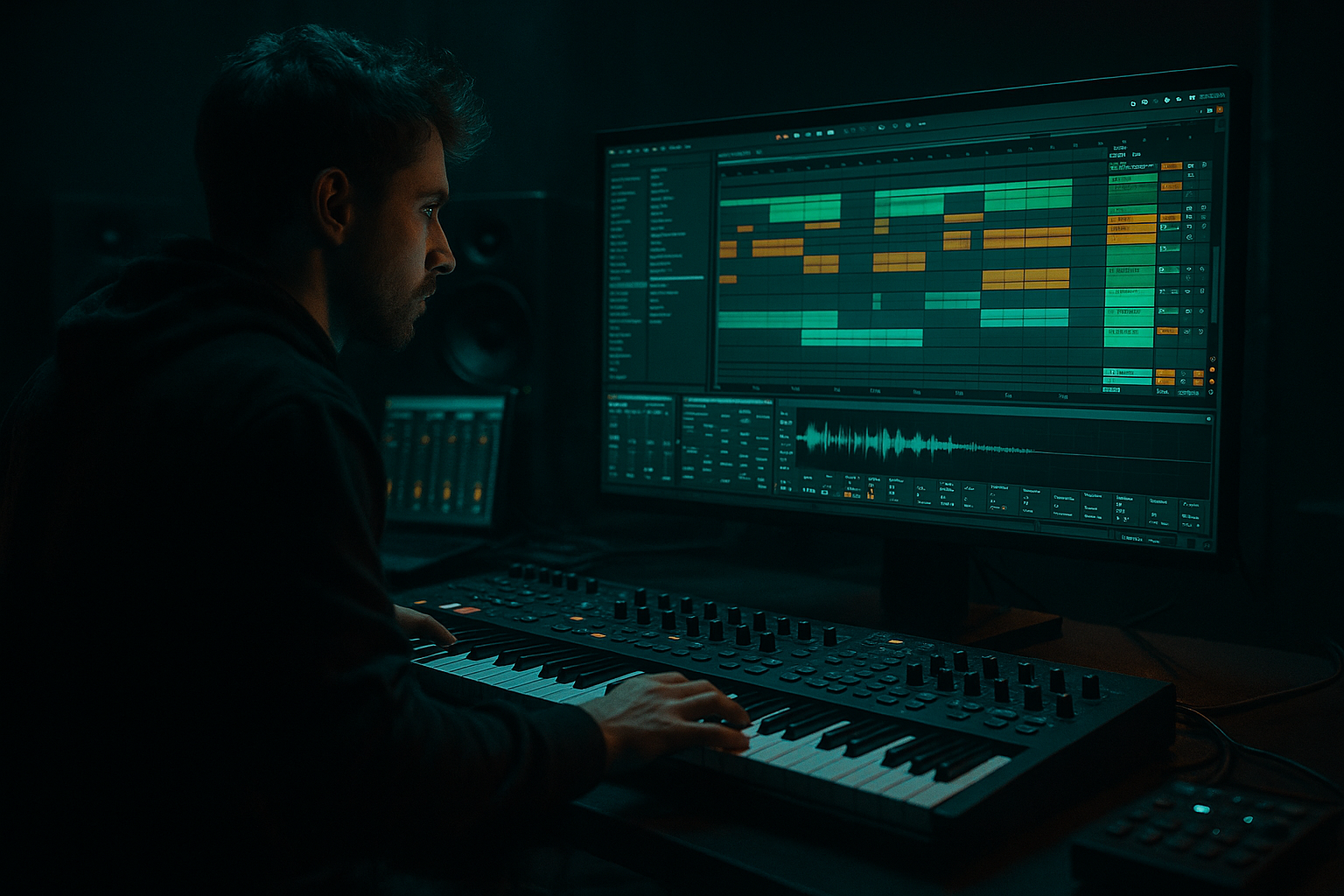
Main tutorial
Rolling Jungle Bassline in Ableton Live — Advanced Tutorial 🎛️🔥
Teacher tone: energetic, clear, professional. This is a hands-on advanced lesson aimed at building a gritty, rolling jungle / DnB bassline in Ableton Live that sits hard in the low end, moves dynamically across the beat, and has the harmonic grit to cut through Amen-style drums.
---
1. Lesson overview
What you’ll learn:
- Design a two-layer rolling bass (clean sub + distorted reese/growl) in Ableton.
- MIDI programming patterns and micro-groove techniques for a “rolling” jungle feel.
- Device chains, routing and processing with stock Ableton devices (Operator, Wavetable, Simpler/Sampler, EQ Eight, Saturator, Frequency Shifter, Utility, Glue Compressor, Auto Filter, Sidechain Compressor).
- Arrangement ideas and automation to turn a loop into a track-ready motif.
- Layer A: Stable mono sub (Operator) — tight, clean, sidechained to drums.
- Layer B: Stereo, detuned reese/growl (Wavetable or Sampler) — heavily processed (distortion, frequency shift, movement) and rhythmically gated/filtered to create the roll.
- MIDI pattern: push-and-pull 16th-note/Rolling triplet phrasing with pitch slides and velocity variation for groove.
- Routing into a Bass Group for cohesive processing and arrangement automation.
- Use a short looped sample of a detuned pad or reese sample. In Sampler use looping with filter + LFO modulating cutoff + mono/portamento for slides. Same post FX chain as above.
- EQ Eight: Gentle overall shaping.
- Multiband Dynamics (optional): Slight> compress mid band.
- Saturator (parallel): Put a copy of the group processing chain in parallel using an Audio Effect Rack with dry/wet macro so you can add distortion in bursts.
- Glue Compressor: Mix glue compression 1–2 dB gain reduction to bind layers.
- Intro (bars 1–16): Sub only → gradually open Auto Filter cutoff on Reese send → introduce reese fully into the drop.
- Build (bars 16–32): increase reese distortion + widen + add triplet fills; automate Glue compressor release for more slam.
- Drop: full reese + sub + main breakbeat; add pitch-bend slam into the first bar of the drop.
- Breakdowns: filter the reese heavily, bring sub only for a bar or two, then reintroduce reese with a reverse sample fill.
- Variation: resample a bar of the reese, chop and re-trigger rhythmic phrases (classic jungle sample manip).
- Too much reese in the sub region: results in mud and phase issues. Always HP the reese at ~120 Hz.
- Widening below 120 Hz: causes collapse when heard in mono and club systems.
- Over-saturating the sub: drives distortion into sub frequencies and causes tame low-end clarity. Saturate mids, not the pure sine.
- Not sidechaining the sub to drums: sub and kick fight for headroom — you must duck.
- Over-quantizing: jungle feels human — leave some swing/human microtiming.
- Excessive multiband compression on the bass bus that kills dynamics of the roll.
- Forgetting to check in mono and with club PA playback levels.
- Layer 3 bands: sub (mono sine), mid-reese (detuned pairs), top bite (transient grain/noise). Process each band separately.
- Heavy parallel distortion: Split a reese chain, send to a return with Saturator+Overdrive+EQ (HP at 1k) and mix in 15–30% for bite.
- Use small frequency modulation (Operator FM) to add metallic growl: in Operator have Osc B modulate A with small amount, tuned to harmonic partials.
- Frequency Shifter + Chorus + Micro Pitch detune: use Frequency Shifter to make left/right slightly different for aggressive stereo width without phasing.
- Automate resonance peaks: a quick boost of resonance in the bandpass region during fills adds “howl” without increasing low-end.
- Create “rollers” via clip automation: short bursts of heavy distortion + high-pass filtering to let the band stand out in breaks.
- Resample reese → granular chop in Simpler (Slice Mode) and play triplet micro-phrases for unpredictable jungle motion.
- Use slow-moving LFOs on Wavetable filters for evolving timbre over 16–32 bars — gives track morphing without extra layers.
- Saturation oversampling: when adding heavy distortion, toggle Oversampling (device or plugin) to reduce aliasing and retain low-end integrity.
- Sub should be solid and duck under the kick/snare.
- Reese must be audible above 120 Hz and create motion without adding muddy low-energy.
- Pattern should feel rolling — not robotic — adjust groove/swing.
- Split the bass into mono sub (Operator) and stereo reese (Wavetable/Sampler), each with targeted EQ.
- Program a rolling MIDI pattern using 16ths and triplet fills; humanize with groove and velocity variation.
- Use tempo-synced LFO/envelope gating and subtle pitch slides/portamento to create the “roll”.
- Process reese with saturation, frequency shifting, and stereo modulation; keep subs mono and sidechained to drums.
- Arrange with automation: open cutoffs, increase distortion at drops, and resample chops for variation.
Prereqs: Comfortable with Ableton Live instruments and effect routing, MIDI editing, and mixing basics. Live 10/11 recommended (Wavetable + Operator). Max for Live LFO optional but alternatives shown.
BPM suggestion: 170–176 (classic jungle/DnB range). I’ll use 174 as examples.
---
2. What you will build
A 2-bar rolling bass loop at 174 BPM consisting of:
Result: A dark, heavy, rolling jungle bass that punches through breakbeats while maintaining a solid low end.
---
3. Step-by-step walkthrough
Step 0 — Template/setup
1. Set tempo to 174 BPM.
2. Create a Drum Rack and load a chopped Amen break (or your chosen break) on Track 1. Flatten and warp if necessary. Put clean kick/snare hits on a simple two-bar loop — we'll use them for sidechain and groove reference.
3. Create 3 audio/instrument tracks: Bass-Sub, Bass-Reese, Bass-Group (Audio Effect Rack/GROOVE bus).
---
Step 1 — Build the Sub (Layer A) — Operator
1. Create MIDI Track → Load Operator.
2. Oscillator routing:
- Enable only Oscillator A; set Wave to Sine.
- Octave: -2 (or -1 depending on your keyboard/pitch); tune so the sine sits around 40–60 Hz for root notes.
- Level: 0 dB.
3. Filter & Envelope:
- Filter type: Lowpass 24 dB (LP24).
- Cutoff: around 120 Hz to start, Resonance low.
- Reduce Filter Envelope amount; keep the tone stable — sub should be very consistent.
4. Envelope:
- Amp Envelope: Attack 0 ms, Decay 300–400 ms, Sustain 100%, Release 40–60 ms (short but not clicky).
5. Output:
- Operator Global Oversampling: set to 2x or 4x if CPU allows (reduces aliasing when using saturation later).
6. Effects (on the same track, after Operator):
- EQ Eight: High-pass nothing; Low-shelf boost if needed around 60–80 Hz + gentle cut in 200–400 Hz to avoid mud (bell -2 to -4 dB).
- Saturator: Drive 1–2 dB, Type 'Analog Clip' or 'Warm' (very subtle).
- Glue Compressor: Metered soft compression (Threshold -10 to -16 dB, Ratio 2:1, Attack 10 ms, Release 200 ms).
- Utility: Width = 0% (mono below 100–120Hz).
7. Sidechain:
- Add Compressor (stock) with sidechain input: the drum track. Ratio 4:1, Attack 1–5 ms, Release 60–120 ms; Threshold so you get 3–6 dB pumps on kick/snare hits. This keeps the sub ducking under drums.
Why: Sine sub must be mono, clean, and duck under drums. Keep saturation minimal.
---
Step 2 — Build the Reese/Growl (Layer B) — Wavetable (or Sampler)
Option A: Wavetable (Live 10/11)
1. Create MIDI Track → Load Wavetable.
2. Oscillators:
- Oscillator 1: Select a “Saw-ish” wavetable (Basic Shapes > Saw), Unison 3–4 voices, Detune 0.06–0.12, Warp off.
- Oscillator 2: Another saw or pulse with slight coarse tune +7–12 cents or one octave up and detune slightly for harmonic richness. Set source 2 to do a subtle FM from osc 1 or use oscillator B to modulate A slightly for growl.
3. Filter:
- Filter: Lowpass 24 dB, Cutoff ~600–1200 Hz (start high), Drive 6–10 (adds grit).
- Assign LFO 1 to cutoff, Rate synced to 1/8 or 1/16, shape = saw or triangle, amount moderate.
4. Global:
- Voicing: Mono or Legato with portamento 10–30 ms for occasional slides (helps for rolling slides).
- Unison Detune wide enough to make it thick but not smear sub area.
5. Post FX (on the track):
- EQ Eight: High-pass at 120 Hz (to leave subs to Operator); cut 300–600 Hz if muddy.
- Saturator: Drive 4–8, Soft Clip ON; select ‘Analog Clip’ or ‘Tube’ for heavier growl.
- Frequency Shifter: Offset small (e.g., 0.2–1 Hz) with Dry/Wet 20–40% and L/R dial to introduce stereo width and unpredictable beating.
- Redux (optional) for bit grit: Rate ~8–12 kHz, Depth 10–20% — used sparingly.
- Auto Filter (Envelope/Frequency mode) or LFO device to rhythmically open/close cutoff for rolling effect (see MIDI modulation below).
- Utility: Width 110–140% for presence (do NOT widen below 120Hz).
Option B: Sampler / Simpler technique
Why: The reese is the harmonic, stereo material — you’ll intentionally remove the low content so the sub stays mono.
---
Step 3 — Frequency split & routing
1. Duplicate the Wavetable track if needed: keep one strictly highpass >120 Hz (Reese), the other lowpass <120 Hz (Sub alternative). Simpler approach: keep Operator for subs and Wavetable highpassed for mids.
2. Create a Group track “Bass Group” and route both Bass-Sub and Bass-Reese into it. This lets you process both as a single bass bus.
Bus chain (Bass Group):
---
Step 4 — MIDI pattern & rolling groove
1. Create a 2-bar MIDI clip for each bass layer. Grid: 1/16 or 1/32 depending on detail.
2. Sub pattern (Operator):
- Basic anchor notes on beats 1 and 3 (quarter notes) sustained (legato) for the low foundation.
- Add short 16th-note stabs on the off-beats (e.g., 1e & 2 & 3e & 4 & pattern) at lower velocity to add movement without cluttering low-end.
- Keep notes in low octave (D0–D1 range depending on root).
3. Reese pattern (Wavetable):
- Create a rolling 16th-note pattern with accents: play 1/16 notes across the bar but program velocity variation and occasional triplet fills (3 x 1/8 triplets) to give that jungle roll feel.
- Use a pattern such as: [1e&a 2 & a 3e&a 4&a] with tied notes and varying velocities (90–127 for accents).
- Insert occasional pitch shifts: play short notes up a fifth/octave or add a slide using portamento for passing tones (set voice mode to Mono + Portamento).
4. Use Groove Pool:
- Drop a groove template (swing > 8–15%) from the Groove Pool to humanize. Apply to the reese more than the sub.
- Or, manually nudge off-beat notes slightly forward/back to emulate breakbeat timing.
Pro tip: Velocity controls filter/envelope time if you map velocity to filter cutoff or amplitude for dynamic rolls.
---
Step 5 — Movement (LFOs, gating, and automation)
1. Rhythmic gating:
- On the Reese track, add Auto Filter: set filter type BP or LP, then map LFO to cutoff. Sync to 1/16 or 1/8, waveform = triangle or saw, amount tuned so the filter opens and closes musically.
- Alternative: Use an Envelope Follower (Max for Live) on your Amen break to drive filter cutoff — gives natural groove-linked movement.
2. Clip Automation:
- In the MIDI clip, open the Envelope box: automate ‘Track Volume’ or ‘Synth Parameter’ (if available). Create micro-ducks and accents that follow the drum hits.
3. Frequency Shifter LFO:
- Automate Frequency Shifter Dry/Wet or shift amount to introduce wobble during fills or drops.
4. Tune automation:
- Lightweight pitch automation can create slams. E.g., automate pitch bend on the reese for 1/16 slide down into the downbeat hit (use MIDI pitch bend lane + instrument set to respond).
---
Step 6 — Processing & mixing tips
1. Check mono compatibility: use Utility width 0% on the sub track and toggle mono to hear phase cancellation.
2. EQ separation: Highpass the reese at ~120 Hz, lowpass the sub at ~120–140 Hz. Use a steep slope if necessary.
3. Parallel distortion: Send Reese to a return track with heavy distortion & HP filter and blend back for aggression.
4. Mid-side:
- On Bass Group, use EQ Eight in mid/side mode: tighten the mids (mono) below 120 Hz, widen the sides > 300 Hz.
5. Automation for arrangement:
- Automate Reese drive and frequency-shifter amount across sections (low in intro, full-on in drop).
- Automate sidechain compression amount (via threshold) if you want more or less ducking.
---
Step 7 — Arrangement ideas
---
4. Common mistakes
---
5. Pro tips for darker/heavier DnB 🖤
---
6. Mini practice exercise (approx. 20–30 minutes) 🎯
Goal: Produce a 2-bar loop with sub + rolling reese that grooves with an Amen break.
1. Set tempo to 174 BPM. Drop in an Amen loop on Drum Rack and loop bars 1–2.
2. Operator Sub:
- Load Operator, set Osc A to Sine, Octave -2, Amp Envelope sustain full, release 50 ms.
- EQ Eight: low boost 60 Hz + cut 300–500 Hz.
- Utility width 0% and Compressor sidechained to Drum Rack.
3. Wavetable Reese:
- Load Wavetable, Osc1 = Saw (Unison 3), Osc2 = Saw detuned one octave, Filter LP24 cutoff 800 Hz.
- HP the output at 120 Hz with EQ Eight.
- Saturator Drive 5 + Frequency Shifter 30% dry/wet, small shift.
4. MIDI:
- Sub: create a 2-bar clip with long notes on 1 and 3; add 16th stabs on the offbeats.
- Reese: create 16th-note pattern with variable velocities; add a triplet fill at bar 2 beat 4.
5. Movement:
- Auto Filter on Reese: LFO synced to 1/16, knob to cutdown to ~40% for rhythmic gating.
6. Bus:
- Group both tracks and insert Glue Compressor (soft knee, 2:1).
7. Render loop and listen on different systems (headphones + mono button).
Checkpoints:
---
7. Recap
You now have a blueprint for building aggressive, rolling jungle basslines that sit clean in the mix and have the movement and character needed for modern dark DnB. Want a pre-built rack & MIDI pattern I can export as a .alc or presets for Live? I can assemble a downloadable starter pack with the exact chains and MIDI clips. 👇💥

