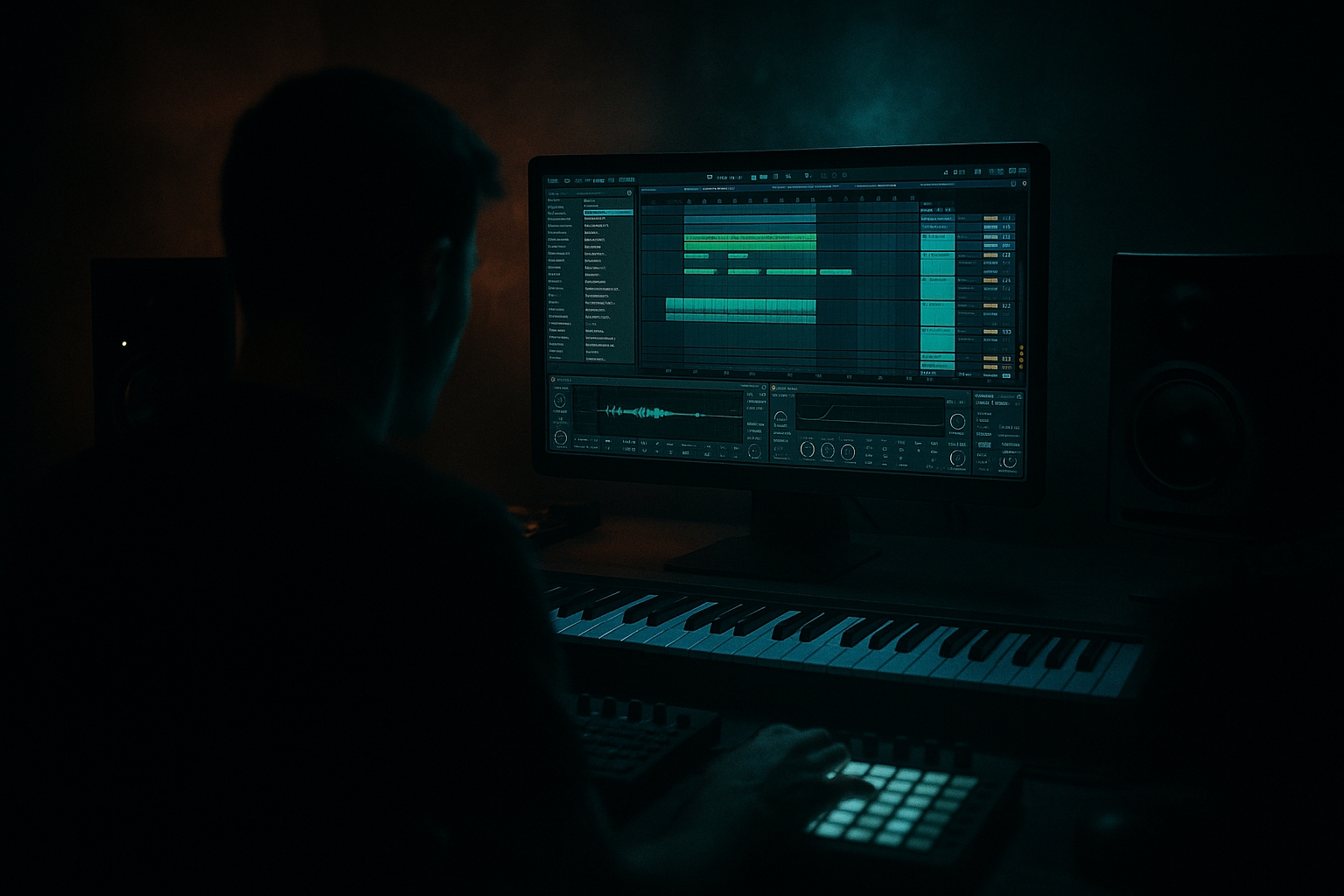
Main tutorial
```markdown
Round Sub Layering Without Mud (DnB in Ableton Live) 🔊🥁
1. Lesson overview
In drum & bass, the sub has to feel round, steady, and powerful—but it can’t fight the kick or smear the low-mids. In this lesson you’ll learn a simple, repeatable Ableton Live workflow to layer a clean sub with a character layer without creating mud, using mostly stock devices.
You’ll focus on:
- Clean sub fundamentals (30–80 Hz)
- Mid/character layer control (80–300+ Hz)
- Phase, filtering, sidechain, and mono management
- Arrangement moves for rolling/jungle-style basslines 🎚️
- Tempo: 172–175 BPM
- Drop a reference tune into an audio track (DnB roller with clean low end).
- Turn on Spectrum on your master (Ableton stock):
- F1 (43.65 Hz), G1 (49 Hz), A1 (55 Hz) are common.
- Keep most subs between 40–70 Hz for rollers.
- EQ Eight (cleanup)
- Glue Compressor
- Utility
- Put Utility on the `SUB` track:
- On the BASS Group, use Audio Effect Rack with 2 chains:
- Start with 1-bar pattern, then duplicate.
- For rolling bass, try:
- Shorten note lengths slightly so they don’t overlap:
- Bars 1–8 (Drop A): Sub + character steady, minimal variation
- Bars 9–16 (Drop A2): Add a call/response fill or pitch variation
- Every 4 bars: remove character layer for 1 beat (or 1/2 bar) for impact
- Before the snare (beat 2 & 4): keep sub stable, let mids do movement
- Automate CHAR filter cutoff slightly up in the last 2 bars of an 8-bar phrase.
- Automate Saturator Drive on CHAR (tiny moves, 0.5–1.5 dB) for intensity.
- Fix: HP the character layer at 90–130 Hz, steep slope.
- Fix: shorten MIDI notes, add 80–150 ms release, avoid legato overlaps.
- Fix: `SUB` Utility Width = 0%. Keep stereo above ~120 Hz.
- Fix: saturate lightly (1–3 dB), keep the harmonic action in the character layer.
- Fix: sidechain bass group to kick with 2–5 dB GR.
- Fix: use Spectrum, and A/B with reference at similar loudness.
- Sub as sine, weight as harmonics:
- Add controlled grit (but high-pass first):
- Reese-style movement without mud:
- Midrange punch with Multiband Dynamics (carefully):
- Kick tuning matters:
- SUB = clean, mono, stable (Operator sine/triangle + light saturation if needed)
- CHAR = high-passed + textured (Wavetable/Operator + movement, no sub info)
- Group processing: gentle EQ cleanup, light glue, controlled mono lows
- Sidechain the bass to the kick for clarity and punch
- Short note lengths + smart arrangement = rolling weight without low-end smear
---
2. What you will build
A two-layer DnB bass in Ableton:
1) SUB layer: pure, round sine/triangle with tight dynamics
2) CHARACTER layer: reese/warp/saturate texture that lives above the sub
Both layers glued in a Bass Group with clean routing, proper sidechain, and mono low-end.
End result: a bassline that feels fat on big systems and still clear on headphones.
---
3. Step-by-step walkthrough
Step 0 — Session prep (fast but important)
- Block Size: 8192
- Avg: Medium
- Range: -96 to 0 dB
This helps you see low-end buildup while you learn.
---
Step 1 — Create the SUB layer (clean + round)
1. Create a new MIDI Track → name it `SUB`.
2. Add Operator (stock).
3. Set Operator like this:
- Oscillator A: Sine
- Level: 0 dB
- Envelope (Amp):
- Attack: 0–5 ms
- Decay: 0 ms
- Sustain: -inf? (No—set Sustain to full / 0 dB in Ableton terms)
- Release: 80–150 ms (prevents clicks, keeps it smooth)
4. Optional for “rounder” feel (still clean):
- Change Osc A from Sine → Triangle OR
- Keep Sine and add Saturator after Operator:
- Drive: 1–3 dB
- Soft Clip: On
- Output: trim so level matches bypass
✅ Goal: Sub is consistent and stable, not “buzzy”.
Sub note range (typical DnB):
---
Step 2 — Create the CHARACTER layer (mid-bass that doesn’t muddy)
1. Duplicate the SUB MIDI clip to a new MIDI track → name it `CHAR`.
2. Add Wavetable (or Operator if you prefer).
3. Wavetable starting point (easy and effective):
- Osc 1: Saw (or Basic Shapes → Saw)
- Unison: 2–4 (don’t go huge)
- Detune: 5–15%
- Filter: LP24 or MS2 style
- Filter cutoff: start around 200–600 Hz depending on vibe
- Add a little Envelope to cutoff (subtle movement)
4. Now the most important anti-mud move: High-pass the CHARACTER layer
- Add EQ Eight at the start of the chain:
- Enable a HP filter
- Frequency: 90–130 Hz
- Slope: 24 or 48 dB/Oct
- Keep it steep—this layer should NOT carry sub weight.
✅ Goal: Character layer brings presence and movement without adding low-end energy.
---
Step 3 — Group them + set a clean bass bus
1. Select `SUB` and `CHAR` tracks → Cmd/Ctrl + G → name group `BASS`.
2. On the BASS Group, add:
1) EQ Eight
2) Glue Compressor
3) Utility
4) (Optional) Saturator very lightly
Suggested group settings:
- If it feels boxy/muddy: try a gentle dip around 180–300 Hz (1–3 dB, Q ~1.0)
- If it’s harsh: tiny dip around 2–4 kHz (depends on sound)
- Attack: 3 ms
- Release: Auto
- Ratio: 2:1
- Threshold: aim for 1–2 dB gain reduction on peaks
- Width: 0% below ~120 Hz (see next step for exact method)
- Gain: adjust for headroom (keep master peaking around -6 dB while building)
---
Step 4 — Keep the sub mono (and the mids wide, safely)
DnB low end should be mono-compatible. Stereo sub = weak on club systems.
Simple stock method:
- Width: 0%
This ensures the pure low is locked center.
Optional advanced (still stock):
If you want only the lows mono but allow stereo above:
- Chain 1: `LOW MONO`
- EQ Eight: Low-pass at 120 Hz (24–48 dB/Oct)
- Utility: Width 0%
- Chain 2: `MIDS/STEREO`
- EQ Eight: High-pass at 120 Hz
- Utility: Width 110–140% (careful—small moves)
✅ Result: sub stays solid, character can be wide without wrecking the low end.
---
Step 5 — Sidechain the bass to the kick (the “no mud” secret sauce)
Most “mud” in DnB drops is actually kick + bass overlapping, not just EQ.
1. On the BASS Group, add Compressor (not Glue) for sidechain.
2. Turn on Sidechain:
- Input: your Kick track (or a dedicated “Kick SC” track)
3. Settings (starting point):
- Ratio: 4:1
- Attack: 1–3 ms
- Release: 60–120 ms (set to groove with the kick)
- Threshold: aim for 2–5 dB gain reduction on kick hits
4. Fine-tune:
- If bass feels like it “ducks too long”: lower Release
- If kick and bass still clash: slightly increase GR or shorten Attack
🎯 DnB roller tip: the duck should feel like a tight bounce, not a big EDM pump.
---
Step 6 — Tighten note lengths so the sub doesn’t smear
In your MIDI clip:
- Main notes: 1/8 or 1/4
- Occasional 1/16 pickups into snare gaps
- In piano roll: make notes end a tiny bit early (a few ms)
This reduces low-end “blur” and keeps the groove punchy.
---
Step 7 — Arrangement ideas (roller/jungle-rooted)
Try this classic DnB drop approach:
Automation ideas:
---
4. Common mistakes (and quick fixes) ⚠️
1) Both layers contain sub
2) Sub is too long / overlapping
3) Stereo low end
4) Over-saturating the sub
5) No sidechain
6) EQ’ing blindly
---
5. Pro tips for darker/heavier DnB 😈
Keep the sub clean, then make it feel huge by adding harmonics above it (CHAR layer saturation/distortion).
- On CHAR: try Pedal (stock)
- Drive: low to medium
- Tone: adjust so it doesn’t fizz
- Always HP first so distortion doesn’t explode the lows.
- Wavetable Unison 2–4 + slight detune
- Then Auto Filter (LP) with slow LFO (rate: 1/4 or 1/2, small amount)
- HP at 100 Hz remains non-negotiable.
- On BASS group: Multiband Dynamics
- Only tame the Low-Mid band if it blooms (around 120–300 Hz).
- Don’t over-compress the sub band.
If your kick fundamental sits near your sub note, you’ll fight forever. Consider:
- choosing a kick with a different fundamental, or
- shifting bassline notes slightly in register.
---
6. Mini practice exercise (15 minutes) 🧪
1. Create an 8-bar drum loop:
- Kick on 1 & 3
- Snare on 2 & 4 (classic DnB)
2. Write a simple rolling bassline using notes around F1–A1.
3. Build SUB (Operator sine/triangle), build CHAR (Wavetable saw/reese).
4. Put EQ Eight HP @ 110 Hz on CHAR.
5. Sidechain BASS group to Kick aiming for 3 dB GR.
6. Bounce/export a short loop and check:
- In mono: does the low end stay strong?
- On small speakers: can you still “hear” the bass (from CHAR harmonics)?
If the bass disappears on small speakers → increase CHAR presence (not SUB level).
---
7. Recap ✅
If you tell me what style you’re aiming for (liquid roller, jump-up, techy neuro-ish, jungle), I can give you a ready-to-drop 8-bar MIDI pattern and a matching Operator/Wavetable preset chain.
```

