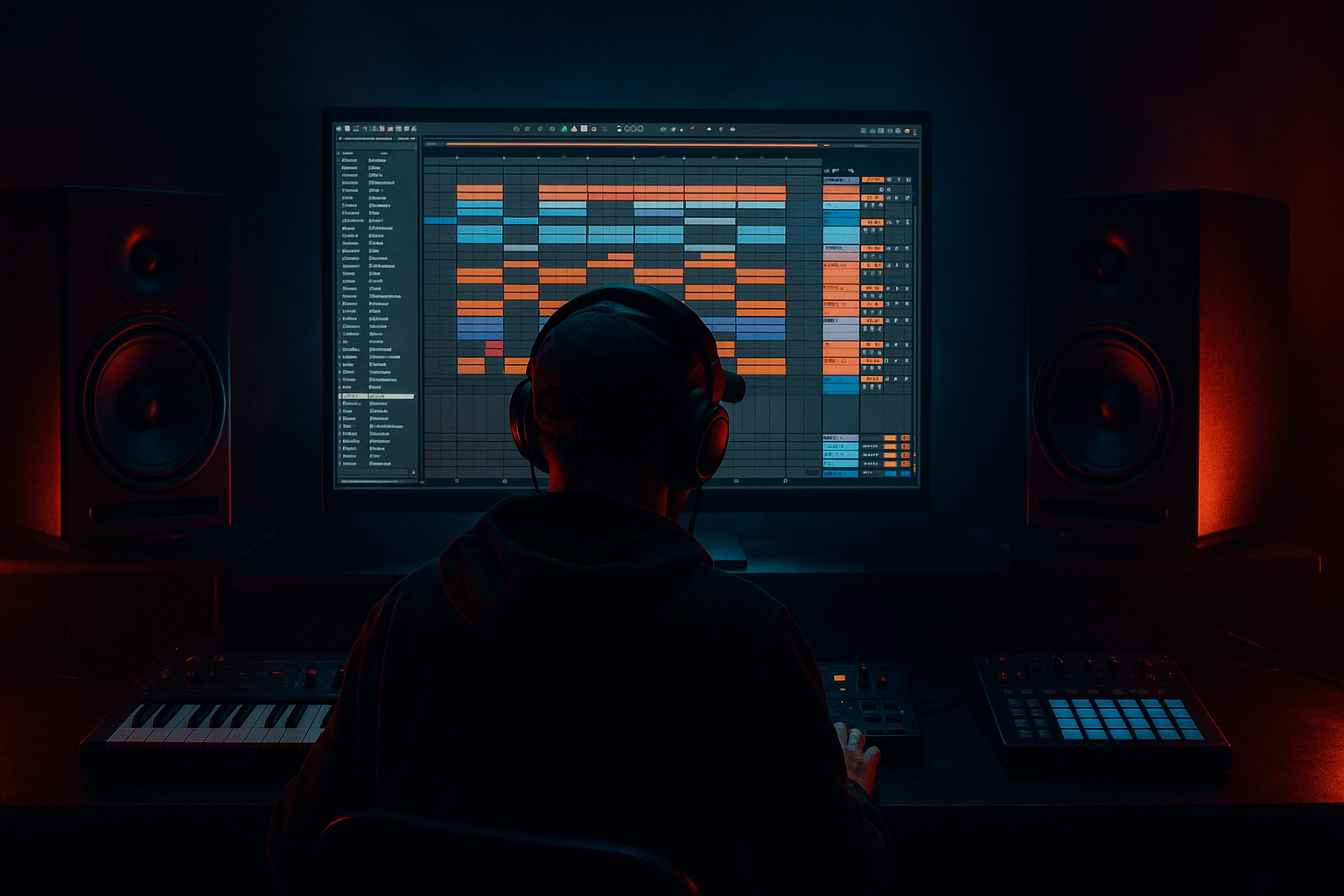
Main tutorial
Route an Amen-Style DJ Intro from Session View → Arrangement View (Ableton Live 12) 🥁⚡
Intermediate • Drums • Drum & Bass / Jungle workflow
---
1. Lesson overview
In DnB, the DJ intro is your “mix-in runway”: clean drums, tension, small variations, and clear phrasing (usually 16/32 bars). Session View is perfect for building and jamming these intro elements, but you’ll want the final result printed into Arrangement so it’s locked to song structure and easy to automate.
This lesson shows you how to perform an Amen-style intro in Session View (with tight scene launching and fills), then record that performance into Arrangement View with proper routing, reverb throws, and a clean “drop-ready” transition.
---
2. What you will build
You’ll create a DJ intro built around an Amen-inspired break that evolves across 32 bars, recorded from Session to Arrangement:
- Scene 1 (Bars 1–8): filtered tops + ghosted Amen texture
- Scene 2 (Bars 9–16): full Amen loop (still controlled), light bass poke
- Scene 3 (Bars 17–24): variation + fills (1-bar / 2-beat edits)
- Scene 4 (Bars 25–32): tension ramp + pre-drop snare build + “air”
- Then you’ll capture the whole jam into Arrangement as audio/MIDI, ready to edit.
- Drag an Amen break sample into an Audio track in Session View.
- In the Clip View:
- Create a MIDI Track → load Simpler (or use a Drum Rack pad with Simpler).
- Drop the Amen sample into Simpler:
- Now you can sequence classic Amen rearrangements with MIDI.
- Scene 1 – “Tops/Filtered Amen (8)”
- Scene 2 – “Full Amen (8)”
- Scene 3 – “Amen Variation/Fills (8)”
- Scene 4 – “Build to Drop (8)”
- Scene 1 clip:
- Scene 2 clip:
- Scene 3 clip:
- Scene 4 clip:
- Create an Audio Track called `AMEN FX`.
- Add Beat Repeat:
- Add Reverb after Beat Repeat:
- Route Amen track to it:
- Enable Automation Arm if you want to record knob moves (filter sweeps, send throws).
- Put Utility last on the intro drum bus and automate Width:
- Global Quantization set too small (e.g., 1/16): scene launches will flam and drift. Use 1 Bar for DJ intros.
- Warp not set correctly: Amen transients smear; your groove loses bite. Use Beats mode for looped breaks.
- Too much low-end in the intro: DJs can’t mix it cleanly over another track’s bass. High-pass your intro drums.
- Overusing Beat Repeat: turns your intro into chaos. Save it for Scene 3/4 moments.
- Recording without Automation Arm: you perform great filter moves but none are captured.
- Make the Amen darker without killing energy:
- Add controlled aggression:
- Ghost-layer a grit break:
- Atmosphere beds:
- Pre-drop “vacuum” moment:
- You built an Amen-style DJ intro in Session View using scenes for tight DnB phrasing.
- You used stock devices (EQ Eight, Auto Filter, Saturator, Glue) to shape a mixable intro.
- You routed/recorded the performance into Arrangement View either by recording scene launches (editable) or by printing audio (committed).
- You finalized it with clean transitions, tension automation, and a drop-ready handoff.
You’ll use stock devices like: Drum Rack, Simpler, EQ Eight, Auto Filter, Saturator, Compressor, Glue Compressor, Utility, Reverb, Delay, Limiter.
---
3. Step-by-step walkthrough
A) Project prep (DnB-friendly fundamentals)
1. Set tempo: `170–175 BPM` (try 174 BPM).
2. Global Quantization: top-middle of Live → set to 1 Bar.
- This ensures clean scene/clip launches like a DJ mix.
3. Turn on the metronome and set a 1-bar count-in if you like (helpful for recording your performance).
Workflow suggestion: DJ intros work best when you’re strict about phrasing. Think in 8/16/32.
---
B) Build the Amen core in Session View (clean + controllable)
#### 1) Create an Amen track (Audio or MIDI)
Option 1 (fastest): Audio track with an Amen loop
- Warp: ON
- Warp Mode: Beats
- Preserve: Transients
- Set Loop ON and make it loop cleanly at 1 bar or 2 bars.
Option 2 (more control): MIDI track with Simpler
- Mode: Slice (great for Amen edits)
- Slicing: Transient
- Playback: Trigger
> For a DJ intro, Option 1 is quick and solid. Option 2 is ideal if you want proper chopped fills.
#### 2) Add a “DJ Intro Processing” device chain (stock)
On your Amen track, add:
1. EQ Eight
- HP filter around 120–180 Hz (keep intro low-end clean for mixing)
- Optional small dip around 300–500 Hz if it’s boxy
2. Auto Filter (for evolving intro movement)
- Filter Type: Lowpass
- Frequency: start around 1.2–2.5 kHz for Scene 1
- Resonance: 10–20% (subtle)
3. Saturator
- Drive: 2–5 dB
- Soft Clip: ON (optional)
4. Glue Compressor (light glue)
- Attack: 3 ms
- Release: Auto
- Ratio: 2:1
- Aim for 1–2 dB gain reduction.
---
C) Create Session View scenes for a structured DJ intro 🧱
#### 1) Make 4 Scenes (32 bars total)
In Session View, rename scenes like:
Tip: You can put “(8)” in the name as a reminder. You’ll still perform the length, but it keeps you honest.
#### 2) Populate clips per scene
On the Amen track, duplicate your clip into 4 slots (one per scene), then change each clip:
- Use Clip EQ / or your track Auto Filter: keep it filtered/bright tops only
- Clip Gain lower (e.g., -3 dB) for headroom
- Open the filter (more full-range, but still high-passed)
- If using Audio clip: create variation with Beat Repeat (see below)
- If using Slices: add a MIDI clip with a small chop fill every 4 bars
- Add rising tension: automate filter opening + reverb throw moments
#### 3) Add “Fill Generator” track (quick jungle flavor)
Create a Return track trick or a dedicated FX track:
Dedicated FX track method
- Interval: 1 Bar
- Grid: try 1/8 or 1/16
- Variation: 10–20%
- Gate: ~60–80%
- Mix: keep low, 10–25%
- Size: Medium/Large
- Decay: 2.5–4.5s
- High Cut: 6–9 kHz (keeps it dark)
- On Amen track set Audio To → `AMEN FX` (or use a Send if you prefer subtler blending)
Why this works: you can punch in chaotic edits only when needed without destroying your main break.
---
D) Set up routing so Session performance records cleanly 🎛️➡️🎚️
You have two common ways to capture your Session performance:
#### Method 1 (recommended): Record directly into Arrangement
1. Press Tab to go to Arrangement View.
2. At the top transport, click Arrangement Record (●) to arm recording.
3. Go back to Session View (Tab) and perform:
- Launch Scene 1
- After 8 bars, launch Scene 2
- After 8 bars, launch Scene 3
- After 8 bars, launch Scene 4
4. Live records your clip launches + mixer moves into Arrangement.
Important setting:
- Automation Arm = the small “automation” button near the top.
#### Method 2 (printing a clean audio stem while you jam): Resample
This is great if you want a single “DJ intro audio stem” you can edit like a bounced intro.
1. Create a new Audio Track named `INTRO PRINT`.
2. Set its Audio From to:
- `Resampling` (captures master output)
- Or better: `Master` / or a group bus if you want only drums.
3. Arm `INTRO PRINT` for recording.
4. Hit Arrangement Record, then perform scene launches.
5. You’ll get a continuous audio recording in Arrangement.
DnB workflow tip: Print the intro as audio to commit vibe and avoid endless tweaking.
---
E) Make it feel like a real DJ intro (arrangement ideas that work)
Once recorded in Arrangement, do quick edits:
1. Phrase markers: drop locators at 1, 9, 17, 25, 33 (every 8 bars).
2. Low-end discipline: keep kick/sub minimal in the intro so DJs can blend.
- HP on intro drums around 120–180 Hz is common.
3. Add a clean “drop cue”:
- Bar 32: short silence or 1/4 bar cut
- Add a snare flam or impact leading into Bar 33.
4. Classic jungle tension move:
- Last 4 bars: automate Auto Filter opening + increase Reverb send on a snare hit only (a “throw”).
- Use Delay (Ping Pong) on a single hit with high-pass filtering.
Stock device trick:
- Early intro: 120–140% (wide tops)
- Near drop: pull back to 100% for focus.
---
F) Tighten and commit
1. In Arrangement, choose Consolidate (`Cmd/Ctrl + J`) the intro region (bars 1–33) once it’s clean.
2. If you recorded clip launching, you may see automation lanes and clip start markers—clean up:
- Nudge scene transitions to be exactly on bar lines if needed.
3. Add a Limiter on the drum bus for safety (don’t smash it—just catch peaks).
---
4. Common mistakes 🚫
---
5. Pro tips for darker/heavier DnB 🕶️🔩
- EQ Eight: gentle shelf down above 10 kHz, small boost around 200 Hz (careful), and a notch where it rings.
- Saturator with Soft Clip ON, then Glue Compressor. Keep it punchy, not flat.
- Add a second break very low in the mix, high-passed, and distort it slightly. Instant weight.
- Add a pad/texture track with Reverb + Auto Filter slow movement; keep it subtle, mostly mid/high.
- In the last 1 bar, automate a high-pass sweep on the master drum bus (Auto Filter) then snap back at the drop.
---
6. Mini practice exercise 🎯
Goal: Record a 32-bar DJ intro performance from Session into Arrangement in one take.
1. Build 4 scenes as described (8 bars each).
2. Perform one automation move per scene:
- Scene 1: filter closed
- Scene 2: open filter slightly
- Scene 3: quick Beat Repeat punch-in once
- Scene 4: reverb throw on a snare + filter open into drop
3. Record into Arrangement (Method 1).
4. After recording:
- Consolidate bars 1–33
- Add locators and check transitions land exactly on bar lines.
Bonus: Print a second take using Resampling and compare which feels more “committed” and DJ-ready.
---
7. Recap ✅
If you tell me whether you’re using an audio Amen loop or a sliced Simpler/Drum Rack version, I can give you a scene-by-scene clip recipe (including specific fills and MIDI patterns) tailored to your style (jungle, rollers, neuro-leaning, etc.).

