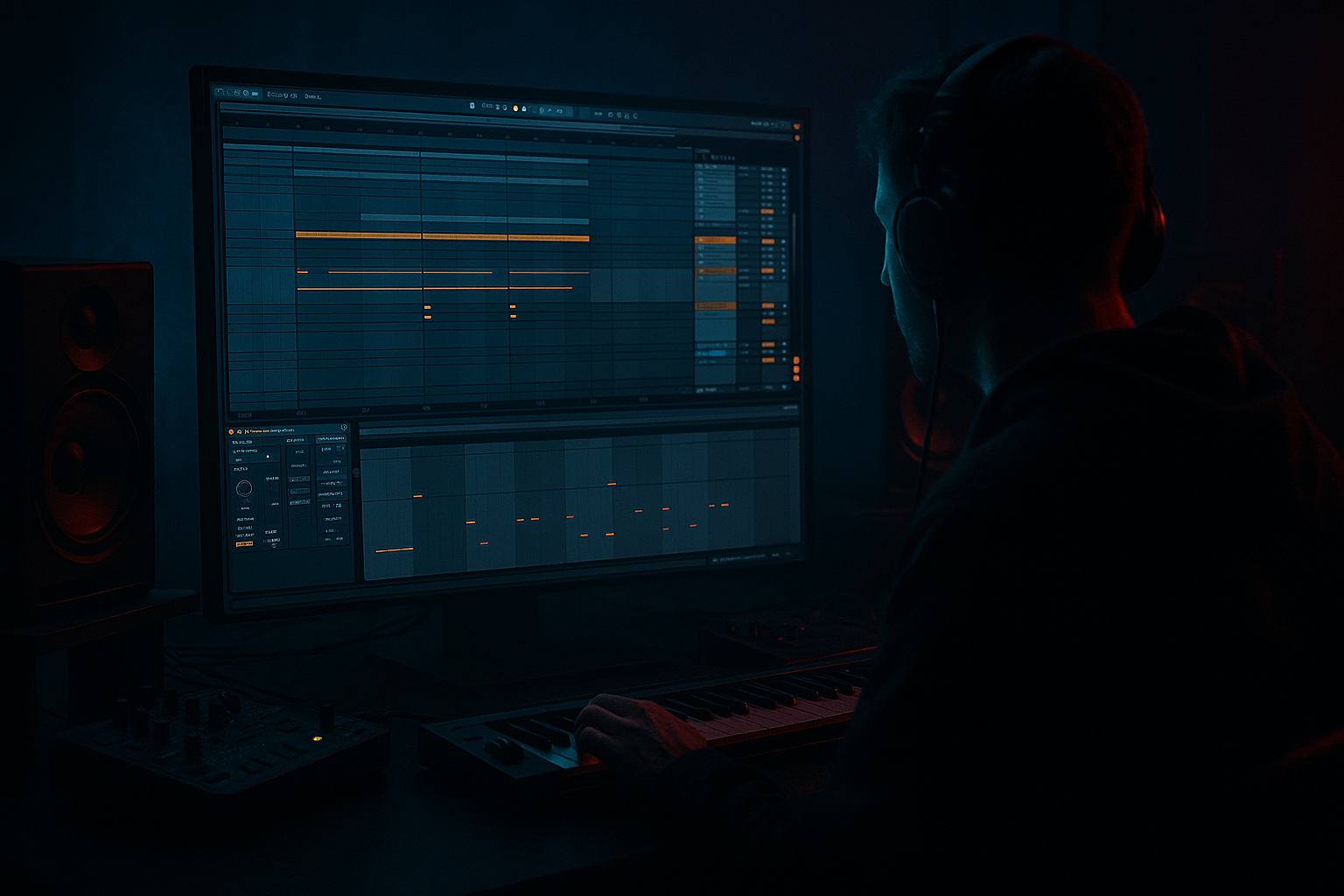
Main tutorial
```markdown
Rubber Bass in a Jungle Context (Ableton Live) 🐍🔊
Skill level: Beginner
Category: Basslines
Goal: Build that bouncy, elastic, “rubber” bass that sits under jungle breaks and rolls with the groove.
---
1. Lesson overview 🎛️
Rubber bass in jungle is all about movement: pitch glide, filter “chew,” and envelope snap—without stealing space from the break. In this lesson you’ll build a classic two-osc mono bass using Ableton stock devices, then learn how to sequence it like jungle (syncopation, call/response, negative space).
You’ll finish with a bass that:
- Feels springy (fast envelopes + subtle pitch movement)
- Stays tight with a breakbeat (sidechain + EQ discipline)
- Works in rolling 170–175 BPM jungle/DnB arrangements
- Wavetable (or Operator) for the core tone
- Saturator for harmonics
- Auto Filter for bounce + motion
- Compressor (sidechain) to tuck under the kick/snare
- EQ Eight to keep it clean
- Optional Audio Effect Rack to split sub/mids
- A 1–2 bar jungle bass pattern with classic offbeat energy
- A simple arrangement: intro → drop → variation → breakdown
- OSC 1: Sine (or Basic Shapes → Sine-ish)
- OSC 2: Saw or Square (quiet, just for bite)
- Filter type: LP24 (or LP12 for slightly looser vibe)
- Cutoff: start around 120–250 Hz
- Resonance: 15–30%
- Drive: 2–6 dB (if available)
- Env 2 Attack: 0.0–5 ms
- Decay: 120–220 ms
- Sustain: 0%
- Release: 60–120 ms
- Assign Env 2 → Filter Freq (Amount): +25 to +45
- Use Envelope 1 (Amp) normally.
- Add pitch modulation via Envelope 2:
- Notes: F1, Ab1, C2 (keep most notes around F1–C2)
- Rhythm idea (1 bar):
- Delete one or two notes where the snare hits hard (typically beat 2 and 4 in DnB phrasing).
- Add 1–2 short pickup notes right before a snare to create push.
- Main notes: 90–110
- Ghost notes/pickups: 50–75
- Mode: Soft Sine or Analog Clip
- Drive: 2–6 dB
- Output: trim to match level
- Optional: turn on Soft Clip (great for jungle bass control)
- Type: LP12
- Cutoff: 150–400 Hz (find the bounce)
- Resonance: 10–20%
- Envelope: 5–15% (small extra “wah”)
- Optional LFO: very subtle
- High-pass (if needed): 25–30 Hz (gentle)
- Cut mud: 200–350 Hz (small dip if cloudy)
- If it fights snares: dip ~180–220 Hz slightly
- If it’s too clicky: gentle dip 1–3 kHz
- Enable Sidechain → choose your Kick track (or a Ghost Kick)
- Start settings:
- Bars 1–8 (Intro): Break + filtered bass (cutoff lower, less env amount)
- Bar 9 (Drop): Full bass + full break
- Bars 9–16: Add variation:
- Bar 17 (Mini break): Remove bass for 1 bar → bring it back (classic tension trick)
- Automate Filter cutoff slightly up over 8 bars.
- Automate Env amount to increase bounce at the drop.
- Too much glide: If portamento is long, it turns into sloppy slides. Keep it <100 ms for tight jungle.
- Bass playing nonstop: Jungle needs space—let the break breathe.
- Sub is distorted: Distort mids, not the very bottom. Split bands or reduce drive.
- Fighting the snare: If the snare loses crack, your bass has too much 150–250 Hz or isn’t sidechained enough.
- Over-resonant filter: Too much resonance can whistle and dominate—great for moments, not always-on.
- Pitch the whole bass down 1–2 semitones and tighten EQ—instant weight.
- Use Roar (if you have it) in subtle mode:
- Add a quiet layer an octave up:
- Try minor 2nd movement (super dark):
- Make the bounce nastier:
- Using mono + legato + short glide for elasticity
- Shaping the “boing” with a fast filter envelope
- Adding controlled harmonics with Saturator
- Keeping it glued to the break with sidechain compression
- Sequencing with syncopation + gaps (the jungle way) 🥁
---
2. What you will build ✅
A Rubber Bass Rack made from:
You’ll also program:
---
3. Step-by-step walkthrough 🧪
Step 0 — Set your jungle session
1. Set tempo to 172 BPM (good jungle sweet spot).
2. Drop in a breakbeat loop (Amen-style / think rolling break).
- If it’s a full loop, consider adding Warp Mode: Beats and set Transient Loop = Off for more natural movement.
3. Make sure your kick/snare are hitting strong—rubber bass needs a clear drum anchor.
---
Step 1 — Create the bass instrument (Wavetable) 🎹
1. Create a new MIDI track → load Wavetable.
2. In Wavetable set:
- Mono: ON
- Legato: ON
- Glide/Portamento: 45–90 ms (start at 60 ms)
- Voices: 1
Oscillator settings (simple + effective):
- Level: ~ -6 dB
- Level: ~ -18 to -12 dB
- Detune: tiny (0.05–0.12) if needed
Why this works: Sine gives weight, a quiet bright osc gives the “rubber skin” texture for the filter to grab.
---
Step 2 — Add the “rubber” filter movement 🧽
In Wavetable’s Filter section:
Now shape it with Envelope 2 (the secret sauce):
✅ You should hear a “plop/boing” at the front of each note.
---
Step 3 — Add subtle pitch “boing” (optional but very jungly) 🌀
Still in Wavetable:
- Env 2 → OSC1 Pitch: +3 to +8 semitones (start at +4)
- Keep decay similar (120–200 ms)
This creates that elastic “doop” without turning it into a laser.
Important: Keep it subtle—rubber bass is bounce, not cartoon.
---
Step 4 — Program a jungle bassline pattern 🎼
Create a 1-bar MIDI clip (or 2 bars for more groove).
Set grid to 1/16.
Try this beginner-friendly pattern in F minor (works great in jungle):
- 1.1: F1 (1/8)
- 1.2.3: F1 (1/16)
- 1.3: Ab1 (1/8)
- 1.4.2: C2 (1/16)
- 1.4.4: F1 (1/16)
Now do the jungle trick: leave gaps so the break speaks.
Velocity:
---
Step 5 — Make it knock: process chain (stock devices) 🔥
On the bass track, add this device chain after Wavetable:
#### 1) Saturator
#### 2) Auto Filter (extra motion)
- Amount 3–8%, Rate 1/8 or 1/4, Phase 0° (keep it tight)
#### 3) EQ Eight
#### 4) Compressor (Sidechain)
- Ratio: 4:1
- Attack: 3–10 ms
- Release: 60–120 ms (set to groove with the tempo)
- Threshold: aim for 2–5 dB gain reduction on kick hits
✅ This is crucial in jungle: bass should bounce around the drums, not flatten them.
---
Step 6 — Optional: Split Sub / Mid for clean weight 🧱
If your bass is getting messy, use an Audio Effect Rack:
1. Add Audio Effect Rack after Wavetable.
2. Create 2 chains:
- SUB chain:
- EQ Eight low-pass at ~90–110 Hz (steep-ish)
- Keep it mostly clean (very light saturation if any)
- MID chain:
- EQ Eight high-pass at ~90–110 Hz
- Add Saturator drive 4–8 dB
- Optional Redux (tiny) for grit: Downsample just a touch
This gives you a stable sub and a character mid that reads on small speakers.
---
Step 7 — Arrangement ideas (jungle-friendly) 🧩
8–16 bar structure you can copy:
- Change the last 2 notes every 2 bars
- Add a 1/8 rest before a big snare fill
Automation suggestions:
---
4. Common mistakes 🚫
---
5. Pro tips for darker/heavier DnB 🌑
- Drive low, focus on mid-band character, keep sub clean.
- Duplicate the bass track, high-pass at 200 Hz, distort and filter it, keep it low in the mix.
- In F minor, use Gb as a passing note sparingly for tension.
- Slightly increase Env→Filter amount and reduce decay (snappier “thwip”).
---
6. Mini practice exercise 🧠
Do this in 15 minutes:
1. Create the rubber bass patch (Wavetable + filter env).
2. Write two 1-bar patterns:
- Pattern A: more notes (busy)
- Pattern B: fewer notes (space)
3. Arrange 8 bars:
- Bars 1–4: Pattern A
- Bars 5–8: Pattern B
4. Add sidechain compression and adjust release until the bass “nods” with the kick.
5. Bounce/export a quick loop and listen on low volume:
- Can you still feel the groove? If yes, you nailed it.
---
7. Recap ✅
You built a jungle-ready rubber bass by:
If you tell me what tempo and break you’re using (and whether you have Wavetable or prefer Operator), I can suggest a couple of ready-to-paste MIDI patterns and exact starting presets.
```

