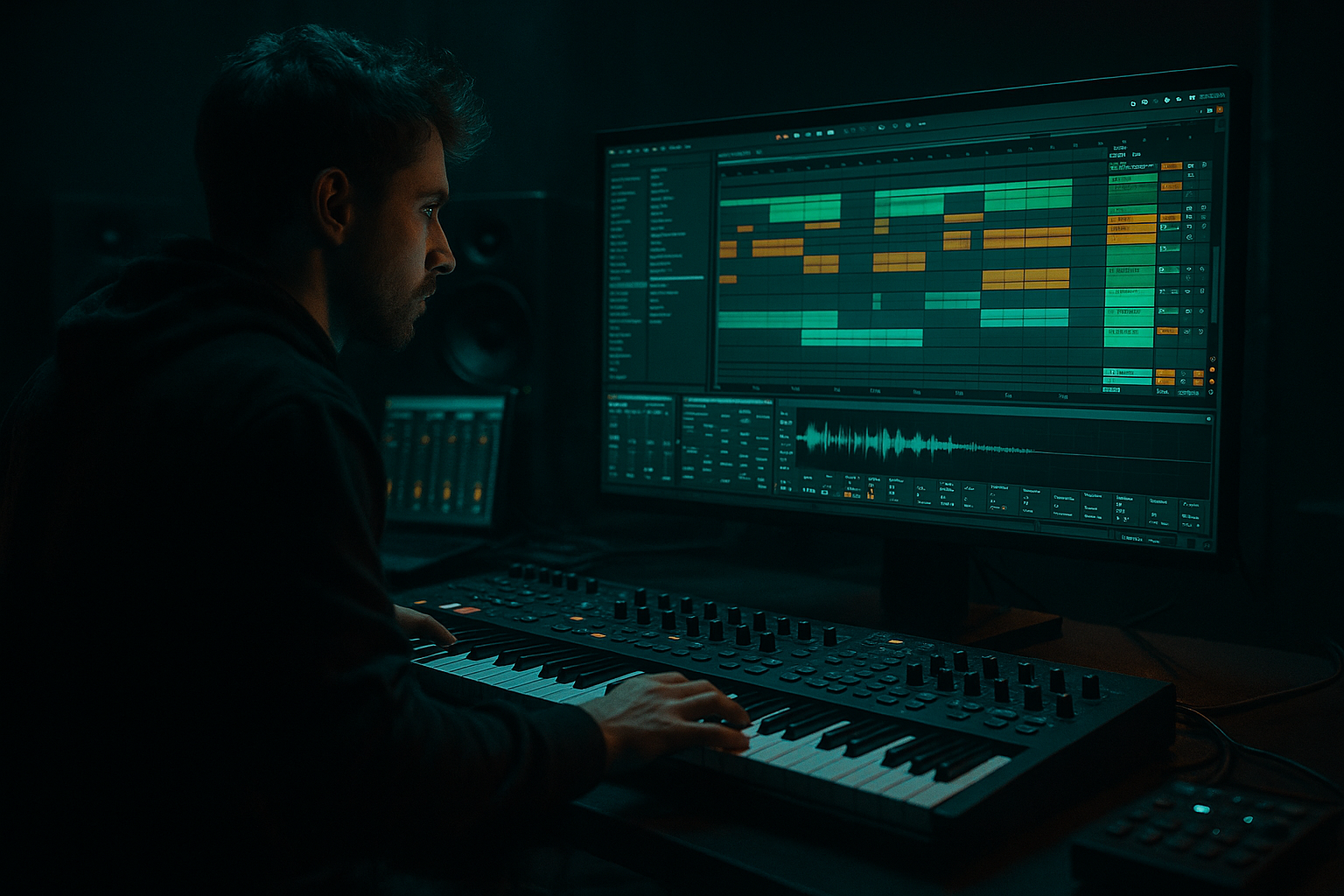
Main tutorial
Lesson Overview
This lesson is about building a Ruffneck / oldskool-influenced think-break switchup in Ableton Live 12 that feels raw, DJ-friendly, and ready for a proper mixdown transition. The goal is to take a tight 2-step or roller section and flip it into a jungle break-led moment using automation, break edits, bass call-and-response, and arrangement tricks that keep the energy moving without sounding random.
In DnB, switchups matter because they give the track contrast and identity. A good switchup is not just “more drums” or “bigger bass” — it’s a controlled change of rhythm, texture, and space that tells the listener: the drop is evolving. For oldskool jungle and ruffneck DnB, this is especially important because the style thrives on movement between solid low-end pressure and broken, chopped break tension.
This lesson fits best in the mid-section of a track, usually after the first drop has established the main groove. Think of it as a 8-, 16-, or 32-bar passage that can:
- refresh attention in a DJ set
- bridge from a roller groove into a more break-heavy passage
- create that classic “the floor lifts” moment before the next drop
- leave room for mixing, outro manipulation, or a double-drop setup
- a solid sub + reese bass foundation that temporarily thins out for tension
- a breakbeat-driven upper drum layer with edited fills, ghost notes, and pull-backs
- automation on filters, reverb sends, distortion drive, and bass tone
- a call-and-response arrangement between kick/snare weight and break fragments
- intro/outro phrasing that works for mixing, not just for standalone listening
- bars 1–8 are a rolling half-time-ish DnB groove with a murky reese
- bars 9–12 start to strip the bass and reveal chopped break energy
- bars 13–16 ramp tension into a new drop or a DJ-friendly loop-out
- Bars 1–4: keep the main groove almost intact
- Bars 5–8: begin thinning the bass and adding break fragments
- Bars 9–12: fully expose the think-break edits
- Bars 13–16: build toward the next section with fill energy
- Kick: short, punchy, tuned close to the track key
- Snare: classic crisp DnB snare with body around 180–250 Hz and crack around 2–5 kHz
- Break: load into Simpler in Slice mode or Classic mode for manual chopping
- In Simpler, use Slice by Transient
- Set Slice Sensitivity so you catch main hits without over-splitting ghost noise
- Trigger a few slices on the off-beats and before the snare to create urgency
- Duplicate a 1-bar break pattern and vary the last 2 beats every 4 bars
- Drive: around 5–15%
- Crunch: subtle, just enough to glue
- Boom: use carefully or keep it off if your sub is already strong
- Sub lane: a simple sine/triangle-based low end, preferably in a separate audio or instrument track
- Mid-bass/reese lane: detuned, gritty, mono-aware movement
- Oscillator A: sine
- Filter: minimal or none
- Volume envelope: short, controlled notes
- Mono: on
- Wavetable or dual saw-style source
- Detune: moderate, not extreme
- Filter: low-pass around 200–800 Hz depending on how murky you want it
- Add Saturator with Drive around 2–6 dB
- Use Utility to narrow the stereo width on sub frequencies and keep the low end centered
- Bars 1–4: bass phrase answers the snare
- Bars 5–8: remove the sub on select hits to make the break feel bigger
- Bars 9–12: let the bass hit only on key downbeats or syncopated stabs
- Bars 13–16: bring the bass back with more urgency, or filter-open into the next drop
- cut the loop into 1/2-bar and 1/4-bar phrases
- repeat only the most recognizable hit patterns
- leave a few gaps to preserve impact
- place ghost hits before the snare to create forward motion
- Bar 1: stable groove
- Bar 2: add a fill on beat 4
- Bar 3: remove one kick, let the break breathe
- Bar 4: full stop or snare roll into the next section
- kick pickup
- snare anticipation
- tiny hats and ghost notes
- one or two “wrong-feeling” micro-cuts for grit
- Auto Filter cutoff: close it slightly before the switchup, then open it during the fill
- Reverb wet/dry: push to 10–25% briefly on snare fills, then pull it back
- Echo on a send: use a short time like 1/8 or 1/4 dotted with low feedback for tails
- Saturator drive: increase subtly in the final 4 bars for intensity
- Utility gain: automate a tiny dip before the drop to create perceived punch on return
- Bars 1–4: dry, punchy, relatively stable
- Bars 5–8: more filter movement and a little echo on breaks
- Bars 9–12: break is more exposed, reverb tail grows slightly
- Bars 13–16: pre-drop tension with filtered bass and a fill ending
- Reverb on an FX return with short decay and filtered low end
- Echo for rhythmic smear
- Grain Delay very lightly for unstable texture
- Operator noise or sampled ambience for vinyl/dark room character
- Auto Pan slowly on a high layer for movement
- high-pass it around 300–600 Hz
- automate it up only in the last 2 or 4 bars
- bounce it if it helps keep CPU low and decisions locked in
- kick and snare are readable
- sub is not constantly changing
- the break activity ramps in after the blend begins
- reducing the break complexity
- removing the reese for one bar
- leaving only kick/snare/sub on the last hit
- using a filtered delay tail rather than a giant reverb wash
- Put your sub and bass in mono below the low band using Utility
- Check the kick and sub relationship
- Make sure the break isn’t masking the snare crack
- Pull down any harsh top-end slices that feel spitty at high volume
- sub should be stable and audible on smaller speakers without dominating
- the snare should still cut through the busiest break moments
- the reese should provide menace, not smear over the groove
- high-pass non-essential FX around 200–400 Hz
- tame harshness around 3–6 kHz on brittle break slices
- if the bass gets boxy, carve a small dip around 200–350 Hz
- Too much break all the time
- Bass never changes shape
- Reverb washes out the snare
- Break slices are too random
- Stereo low end gets messy
- No DJ-friendly exit
- Layer a quiet rattle, vinyl crackle, or room noise under the break for underground texture, but high-pass it aggressively so it doesn’t blur the kick.
- Use Saturator or Drum Buss on the break with modest drive to make oldskool drums feel more aggressive without over-compressing them.
- For a darker roller feel, automate the reese filter to open only on the last beat of the 4-bar phrase. That keeps tension alive.
- If the switchup needs more menace, use a reverse cymbal or reversed break hit into the first fill, then cut it abruptly for impact.
- Try a short delay feedback burst on one snare hit, then immediately automate it back down. That creates a flash of chaos without clutter.
- Resample the break with a bit of processing, then chop the audio instead of the MIDI if you want more attitude and less precision.
- Keep one element intentionally “dirty” — usually the break or mid-bass — while keeping sub and kick clean. That contrast is very DnB.
- Build the switchup around clear 4-bar phrasing
- Use a stable sub/reese foundation and then strategically thin it out
- Chop the break into recognizable, repeatable phrases
- Automate filters, reverb, delay, and drive to shape tension
- Keep the low end mono, controlled, and readable
- Leave DJ-friendly entry and exit points so the section works in real mixes
You’ll use Ableton Live stock tools like Drum Rack, Simpler, Audio Effect Rack, Auto Filter, Saturator, Drum Buss, Utility, Echo, Reverb, and automation lanes to build a switchup that feels authentic and practical. The focus is on structure first, sound design second, because in DnB the arrangement choices often make the idea hit harder than over-processing ever will. 🔥
What You Will Build
You will build a DJ-friendly 16-bar switchup blueprint that starts from a stable ruffneck/roller groove and morphs into a think-break section with chopped Amen-style energy. The result will include:
Musically, this could sit in a track where:
The final vibe should feel like: oldskool jungle tension with modern low-end discipline — rough around the edges, but still clean enough to survive a club system.
Step-by-Step Walkthrough
1) Set up a 16-bar switchup section with clear phrasing
Start by deciding where this switchup sits in the track. In Ableton’s Arrangement View, create a 16-bar region dedicated to the switchup. If you’re working from a drop, place it after your main groove has already played for at least 16 bars so the listener understands the original pattern before it mutates.
A strong DnB phrasing choice is:
Use locators to mark these boundaries. That makes automation and editing faster, especially if you’re revising a few times. This is a good place to commit to a tempo in the 170–174 BPM range if your project isn’t already set. That range is ideal for oldskool/jungle-adjacent ruffneck energy because it leaves enough space for break detail while keeping the push of modern DnB.
Why this works in DnB: clear 4-bar phrasing helps DJs and listeners feel the structure even when the drums get busy. You want chaos inside a grid, not chaos without a grid.
2) Build the core drum bed: kick, snare, and break layer
Create a drum group with three layers:
1. Main kick/snare for punch and consistency
2. Chopped break layer for jungle movement
3. Percussion accents for fills and lift
Use Drum Rack for your core hits. A simple setup:
For the break, choose something with strong transients and some room tone. Think in terms of an Amen, Think, Hot Pants, or a similar oldskool-style break. You don’t need to overcomplicate it: the key is to extract rhythm fragments, not just loop the full break.
Suggested starting moves:
For the drum bus, use Drum Buss lightly:
The goal is to create a “main spine” plus “broken flesh” around it. That’s what gives a think-break switchup its character.
3) Shape the bass into a call-and-response switchup
Your bass should not just keep looping the same phrase through the whole switchup. In ruffneck DnB, the bass often becomes more powerful when it drops out strategically.
Set up two bass lanes:
Use Operator for the sub if you want a pure, reliable foundation. Keep it simple:
For the reese, use Analog or Wavetable with detune and unison movement. A practical starting point:
Now arrange it as call-and-response:
Important automation idea: automate Filter Cutoff on the reese from around 200–300 Hz up to 1–2 kHz across the switchup if you want the bass to gradually open. Keep the sub steady or even reduce it briefly for tension.
4) Chop the think-break into DJ-friendly phrases
This is where the “think-break switchup” comes alive. Don’t just let the break run. Edit it like a drummer with intent.
In your break track:
A useful DnB pattern strategy:
If using Simpler Slice mode, map the slices to a MIDI track and play them in a way that emphasizes:
Then render or freeze/flatten the best 1–2 bars if needed. Resampling is highly useful here because jungle feels better when you commit to edits instead of endlessly tweaking. A chopped break with a bit of human inconsistency often feels more alive than a perfectly quantized loop.
Why this works in DnB: think-break switchups need rhythmic identity. The listener should hear the original break lineage, but also hear that it’s being reassembled for a new section.
5) Automate space, grit, and decay to create the transition
Automation is the engine of the switchup. Use it to make the section evolve instead of just repeat.
On your drum bus or selected break layer, automate:
A classic structure:
Keep automation curves deliberate. In Ableton, use drawn automation for clean ramps and MIDI clip envelopes if you want repeated patterns across clips. For DnB, small moves often beat giant sweeps. A 5–15% change can be enough if the groove is already strong.
6) Add tension FX and atmosphere without washing out the drums
The switchup needs atmosphere, but jungle and ruffneck DnB lose impact fast if the FX cloud the transients. Use FX like seasoning, not soup.
Good stock options:
A strong FX approach is to keep one atmospheric layer very quiet under the switchup:
For fills, try a 1-bar snare echo that widens briefly, then collapses back to mono. That gives the illusion of a bigger transition without permanently spreading the mix. In oldskool DnB, that little moment of widening before impact can feel huge.
7) Make the switchup DJ-friendly: intro, exit, and mix points
A premium DnB arrangement should be mixable. Even a wild switchup needs usable entry and exit points.
Make sure the first 2 bars of the section are not overloaded. If a DJ is blending into this, they need a place where:
At the tail end, leave at least 2–4 bars of cleaner groove or a simplified loop if you want DJs to mix out. You can do this by:
This is the difference between a cool album-style edit and a DJ-friendly DnB tool. For club and mix culture, you want the track to breathe enough that another tune can come in without fighting it.
8) Final balance and mono discipline for the low end
Before calling the switchup done, do a quick mix sanity check:
A practical balance target:
Use EQ Eight if needed:
Print a loop of the switchup and listen at low volume. If the rhythm and accents still read at low level, the structure is working.
Common Mistakes
Fix: mute or thin the break in the first part of the switchup so the later edits feel like a payoff.
Fix: automate filter, note spacing, or drop out the sub for a few hits to create contrast.
Fix: shorten decay, filter the return, and automate wet only on fills.
Fix: anchor the pattern around snare placement and repeat one recognizable motif every 2 or 4 bars.
Fix: keep sub mono, narrow the bass below the mids, and check phase by listening in mono.
Fix: leave a cleaner 2-bar or 4-bar stretch at the end so the section can blend naturally.
Pro Tips for Darker / Heavier DnB
Mini Practice Exercise
Set a timer for 15 minutes and build a rough switchup using only stock Ableton devices.
1. Make a 16-bar section at 172 BPM.
2. Add a kick, snare, and one chopped break in Drum Rack or Simpler.
3. Create a simple sine sub in Operator and a detuned reese in Wavetable or Analog.
4. Arrange the first 4 bars as a stable groove.
5. In bars 5–8, remove the sub on two hits and automate a low-pass filter on the reese.
6. In bars 9–12, chop the break into a busier phrase and add one snare fill.
7. In bars 13–16, automate more drive on Saturator and add a short Echo send on the final snare.
8. Listen once in mono and fix any muddy low end.
Goal: make it feel like a DJ-friendly oldskool DnB switchup, not a random drum edit. Don’t over-polish. Focus on the contrast between stable groove, break fragmentation, and bass tension.
Recap
The core idea is simple: in DnB, the best switchups don’t just sound different — they reframe the groove. If your automation, break edits, and bass contrast all point in the same direction, the transition will hit with that authentic ruffneck jungle pressure.

