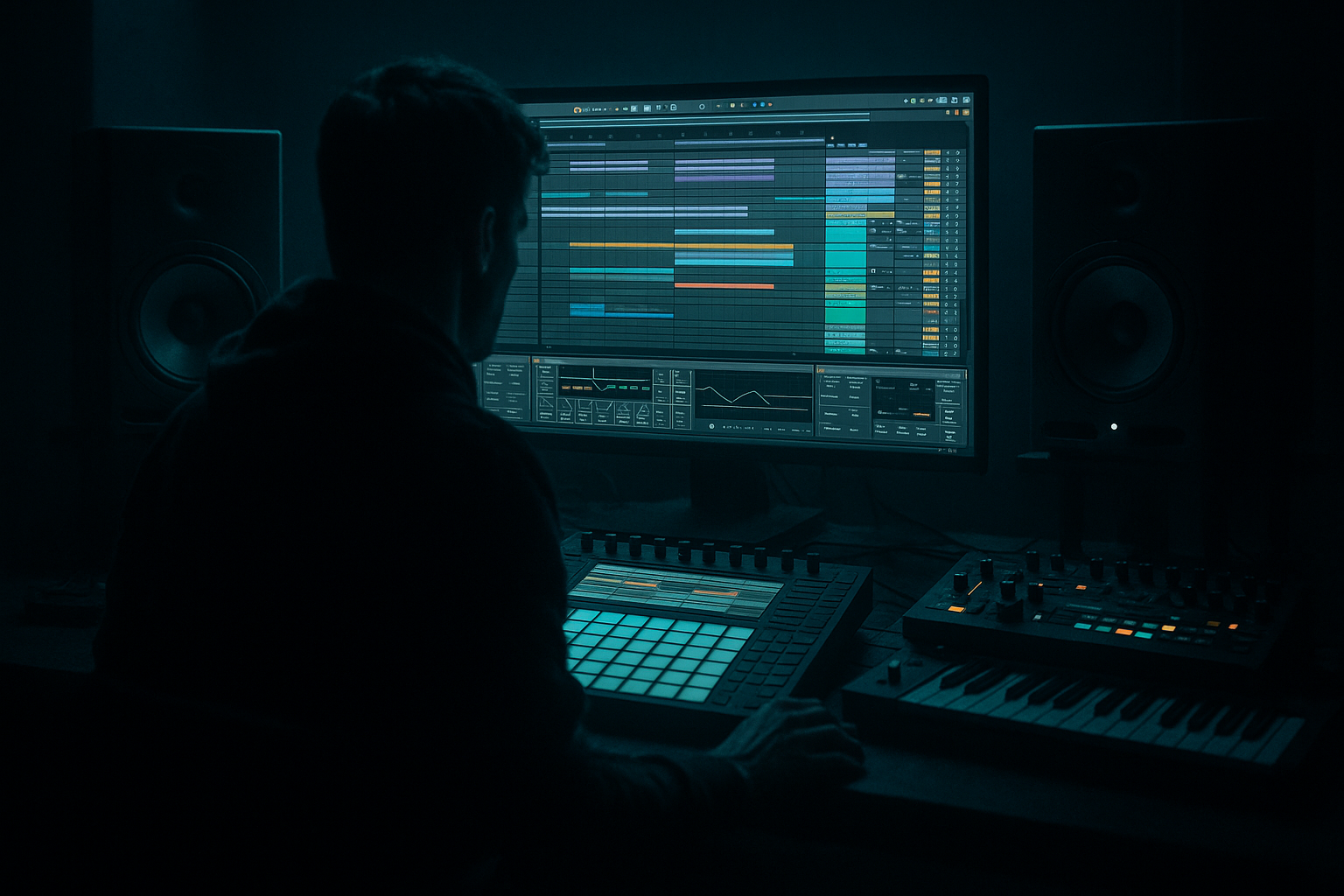
Main tutorial
Lesson Overview
This lesson is about building a Ruffneck-style Ableton Live 12 drop using resampling as the main creative engine. The target vibe is oldskool jungle energy fused with modern DnB pressure: chopped breaks, rude bass stabs, nasty edit transitions, and that slightly unstable, “machines on the edge” character that makes darker underground tunes feel alive.
In a real DnB track, this kind of drop usually sits after a DJ-friendly intro and a short tension build. The goal here is not just to write a bassline and a drum pattern — it’s to perform the arrangement through edits. That means taking your own material, resampling it, cutting it up, repitching it, reprocessing it, and turning the chaos into a controlled drop that feels hand-built rather than loop-pasted.
Why this matters: oldskool jungle and ruffneck DnB often sound compelling because the best moments are not “clean” in the usual sense. They have micro-edits, tonal changes, drum phrasing, and resampled artifacts that keep the energy moving. In Ableton Live 12, this workflow is fast, musical, and extremely effective for advanced producers who want drops that feel alive 🔥
What You Will Build
You’ll build a 16-bar drop section that includes:
- A sub-led reese / bass hybrid with resampled movement
- A broken amen or breakbeat foundation with edited fills and ghost hits
- Call-and-response bass stabs that answer the drums
- Transition edits using resampled impacts, reversed tails, and filtered pickups
- A 2-step-to-jungle switch-up that creates a drop evolution instead of a static loop
- A clean but rude low end with mono sub discipline and controlled grit
- A DJ-aware arrangement that can slot into a full track with intro, drop, and outro potential
- Making the sub too wide
- Over-editing the break until it loses groove
- Resampling too late
- Letting the bass mask the snare
- Using too much reverb on the drop
- Same 2-bar loop for 32 bars
- Use short resampled distortion prints instead of running heavy distortion constantly. Print the nasty moment, then edit it where it counts.
- Layer a mid-bass reese under a clean sub, but high-pass the reese if it starts crowding the kick/snare zone.
- For extra menace, automate Auto Filter on the bass bus with tiny cutoff moves: even 5–10% movement can make a loop feel alive.
- Try Beat Repeat only on selected fills or the last hit before a drop turn — random glitch everywhere kills impact.
- A slight pitch drop on the last bass stab before a new phrase can create oldskool tension without sounding cheesy.
- Keep break transients sharp with careful editing, but use Drum Buss or light saturation for body. The goal is crack plus weight, not washed-out spikiness.
- In heavier DnB, less low-end variation often feels bigger. Let the rhythm change while the sub stays anchored.
- Resample atmospheric noise through Reverb and Echo, then reverse it into the next section for dark momentum.
- If the drop feels too clean, add one imperfect element: a clipped snare tail, a pitched break slice, or a rough bass render with audible grit.
- Build the drop around resampling and edits, not just patterns.
- Keep sub mono, bass movement controlled, and drums punchy.
- Use resampled audio clips for variation, fills, and roughness.
- Arrange in 4-bar blocks so the drop evolves like a real DnB section.
- Treat the drum and bass bus as one rhythm machine, then refine with selective automation and micro-edits.
By the end, you’ll have a drop blueprint that feels like a cross between oldskool jungle pressure, rollers control, and darker neuro-influenced movement — but still very much rooted in authentic DnB editing workflow inside Ableton Live.
Step-by-Step Walkthrough
1. Set up a resampling-first session
Create a new Ableton Live set at your target tempo: 170–174 BPM for classic jungle/ruffneck energy, or 172–176 BPM if you want a more modern darker DnB drive. Start with a clean channel layout:
- Drum Buss
- Breaks
- Sub
- Reese
- FX / Atmos
- Resample 1
- Resample 2
- Master reference chain (for monitoring only)
Put a Utility on your bass groups from the start and set the low end to mono where needed. Keep headroom healthy: aim for the master peaking around -6 dB while writing the drop. That gives you room for resampled layers without chasing clipping later.
On the Drum group, load:
- Drum Rack for one-shots
- Simpler for break slices
- Glue Compressor lightly on the drum bus
- Saturator for subtle bite
On bass tracks, start simple:
- Wavetable or Operator for a reese/sub source
- Utility
- Saturator
- Auto Filter
The point is not to finish the sound yet. The point is to create a recording environment for your resampling process.
2. Build the core break edit and choose a “hero” loop
Drag in a classic break source or your own recorded break and open it in Simpler or Slice to New MIDI Track. If using Slice, set slicing by transient and map to MIDI. For a jungle/ruffneck vibe, the first goal is not perfection — it’s attitude.
Create a 2-bar loop with:
- Strong kick/snare anchors
- Ghost notes between main hits
- One or two deliberate “wrong” cuts that add swing and human feel
Then edit the break in detail:
- Move a few slices slightly ahead of the grid for urgency
- Nudge ghost hits late for pocket
- Use clip envelopes or Note Chance in MIDI for repeated detail variations
- Add short fades to avoid clicks on chopped transients
For the drum bus:
- Drum Buss: Drive around 5–15%, Crunch low, Boom off or very subtle
- Glue Compressor: 2:1 ratio, very light gain reduction, slow attack if you want transients to punch
- EQ Eight: high-pass below 25–30 Hz only if needed, and cut harsh top around 7–10 kHz if the break gets brittle
Why this works in DnB: the break is your rhythmic signature, and jungle-style edits create constant forward motion. The tiny timing changes are what keep the groove from sounding looped or lazy.
3. Design a rude bass source, then resample it immediately
Build a bass patch that is intentionally playable but not final. A strong approach:
- Wavetable with a saw-based or PWM-rich source
- Detune a second oscillator slightly for a reese width
- Low-pass filter around 120–250 Hz depending on the note range
- Add moderate modulation to the filter or wavetable position using an LFO
- Keep the sub separate if possible, or layer Operator sine underneath
Suggested starting values:
- Filter resonance: 10–25%
- Oscillator detune: very small, often 3–12 cents
- Saturator Drive: 2–6 dB
- Auto Filter envelope amount: subtle, enough to create phrasing, not wobble
Now resample it. Create an audio track named RZ Bass Print, set input to Resampling, arm it, and record a few bars of your bass line while you perform modulation changes live:
- Move filter cutoff between phrases
- Automate drive changes
- Open the resonance slightly on the end of a call phrase
- Let some notes ring, then choke others
After recording, commit to the audio. This is where the “edit” mentality starts: you now have editable bass material with natural movement, not just MIDI.
4. Edit the resampled bass into call-and-response phrases
Take the recorded bass audio and cut it into phrase chunks in Arrangement View. You want a pattern that answers the break instead of fighting it. Think in 1-bar and 2-bar call-and-response:
- Bar 1: bass stab on the “and” of 1 or beat 2
- Bar 2: responding bass movement on beat 3 or the last quarter-note
- Bar 3–4: a variation with a higher register bite or a filtered tail
Use these editing moves:
- Consolidate small regions into phrase clips
- Reverse selected tails for tension
- Pitch small sections up or down by 1–3 semitones for oldskool phrasing
- Use warp mode carefully; for bass, keep timing tight and avoid over-stretching low fundamentals
Put EQ Eight after the bass clip if needed:
- Cut mud around 180–350 Hz if the reese gets cloudy
- Tame harsh harmonics around 2–5 kHz if the resampled distortion gets edgy
- Keep sub energy intact by avoiding unnecessary low cuts
Add Saturator or Pedal lightly to selected clips if you want rougher edges. Clip-based processing is great here because every edit can have a different character.
5. Layer a proper sub and control stereo discipline
Your resampled bass will often have movement, grit, and width, but the sub must stay disciplined. Use a separate Operator track for sub:
- Sine wave only
- Mono with Utility
- Keep it under about 100–120 Hz as a rule of thumb
- Avoid heavy stereo processing on the sub track
Program the sub to follow the main bass rhythm, but don’t mirror every tiny ornament. In darker DnB, the sub often works best when it is:
- Simple
- Locked to kick placement
- Slightly sparse, leaving air for the drums
Add a Compressor on the sub keyed from the kick if you want the kick to breathe through the bass. Try:
- Sidechain from kick
- Attack: 1–5 ms
- Release: 60–120 ms
- Reduction: just enough to clear space, not pump obviously unless that’s the desired style
Do a mono check with Utility on the bass bus. If the low end collapses badly, you’ve got too much stereo content in the wrong place.
6. Create transition edits with resampled FX, not generic risers
This is where the course becomes “ruffneck” instead of polite. Take short sections of your break, bass, or noise layers and resample them into transition tools:
- Render a 1-bar break fill
- Resample a filter sweep of the bass
- Print a hit with Reverb tail and reverse it
- Capture a noisy stab through Echo or Delay with feedback automation
Then edit the audio into:
- Pickup stutters before the drop
- Half-bar fills at the end of phrase 4
- Reverse swell into a snare roll
- Single-hit impacts that announce a new section
Ableton stock tools that work especially well:
- Echo for space and gritty modulation
- Reverb with short decay for smeared tails
- Auto Filter for tension builds
- Beat Repeat for controlled glitch bursts
- Frequency Shifter for metallic movement if used sparingly
Keep these edits musical. A good transition in DnB usually reinforces the grid while disrupting expectation. Think: “I know where the bar is, but I don’t know exactly what will happen on it.”
7. Arrange the drop in 4-bar emotional blocks
Don’t loop the same 2 bars for the whole drop. Arrange the section like a DJ or selector would:
- Bars 1–4: establish the core break + bass hook
- Bars 5–8: add a second percussion layer or a higher bass response
- Bars 9–12: strip a kick or mute a bass hit for tension
- Bars 13–16: introduce a switch-up, fill, or reduced drum pattern before looping back
A practical arrangement example:
- Bar 1: full intro of drop with break + sub
- Bar 3: first bass reply hit
- Bar 5: open hat layer enters
- Bar 7: micro-fill using chopped break slices
- Bar 9: reese variation with more filter opening
- Bar 11: one-bar break-down in the drums, bass carries tension
- Bar 13: full reset into heavier hit pattern
This is a very DnB-specific lesson: the drop needs evolution, not just density. In jungle and rollers, the energy comes from arrangement movement, not constant max intensity.
8. Mix the drop as a rhythm section, not separate tracks
Group your drums and bass into buses and treat them as a single engine. Start by balancing kick, snare, break, and sub before focusing on bass texture.
Practical mix targets:
- Kick and snare should read clearly even when the bass is busy
- The sub should feel present, but not louder than the snare weight
- Breaks can sit slightly behind the main drum hits if they’re adding texture rather than being the main punch
On the drum bus:
- Glue Compressor for cohesion, not smash
- Saturator to thicken the midrange crack
- EQ Eight to tame resonances around 300–600 Hz if the break stacks up
On the bass bus:
- Utility for mono control
- Saturator or Roar if you want modern edge while keeping it under control
- EQ Eight for midrange sculpting, not heavy surgery
Check the mix in mono regularly. If the resampled edits disappear when summed, simplify the stereo processing. A lot of underground DnB power comes from midrange clarity plus low-end discipline.
9. Finalize with micro-edits and automation passes
Once the main loop works, do one last edit pass like a finishing engineer:
- Automate bass filter cutoff by small amounts across 4 bars
- Automate drum send levels to reverb/delay for specific fills only
- Mute one ghost snare before a big hit to create anticipation
- Add tiny pitch drops or reverses at phrase endings
- Use clip gain to make certain bass stabs feel “spoken” rather than uniform
This is where advanced editing pays off: the drop becomes a sequence of intentional moments instead of a static pattern. If a phrase repeats, change at least one thing:
- Drum density
- Bass register
- Filter state
- FX tail length
- Transition shape
That constant variation is a big part of why oldskool/jungle-influenced DnB feels so alive.
Common Mistakes
- Fix: keep sub mono, use Utility, and avoid stereo widening below the bass fundamentals.
- Fix: preserve a few anchor hits and let the break breathe. Not every slice needs to be “interesting.”
- Fix: print bass and FX early. Audio edits create decisions faster than endless MIDI tweaking.
- Fix: carve a small pocket in the bass around the snare fundamental/upper body area, and sidechain if needed.
- Fix: keep reverbs short and selective. Jungle energy needs space between hits.
- Fix: build 4-bar phrasing and one switch-up every 8 or 16 bars.
Pro Tips for Darker / Heavier DnB
Mini Practice Exercise
Spend 10–20 minutes and build this:
1. Make a 2-bar break edit with at least three chopped ghost notes.
2. Create a 4-note bass phrase in Wavetable or Operator.
3. Resample the bass phrase into audio while automating the filter.
4. Cut the resampled audio into three call-and-response clips.
5. Add one reverse tail and one fill before bar 4.
6. Duplicate to 8 bars and change one element every 4 bars.
7. Do a mono check and fix any low-end width issues.
8. Export a rough bounce and listen like a DJ: does it have clear tension and release?
Constraint: no third-party tools, only Ableton stock devices.
Recap
If you can make your own bass and break material feel editable, your ruffneck DnB drops will sound more intentional, more underground, and way more replayable.

