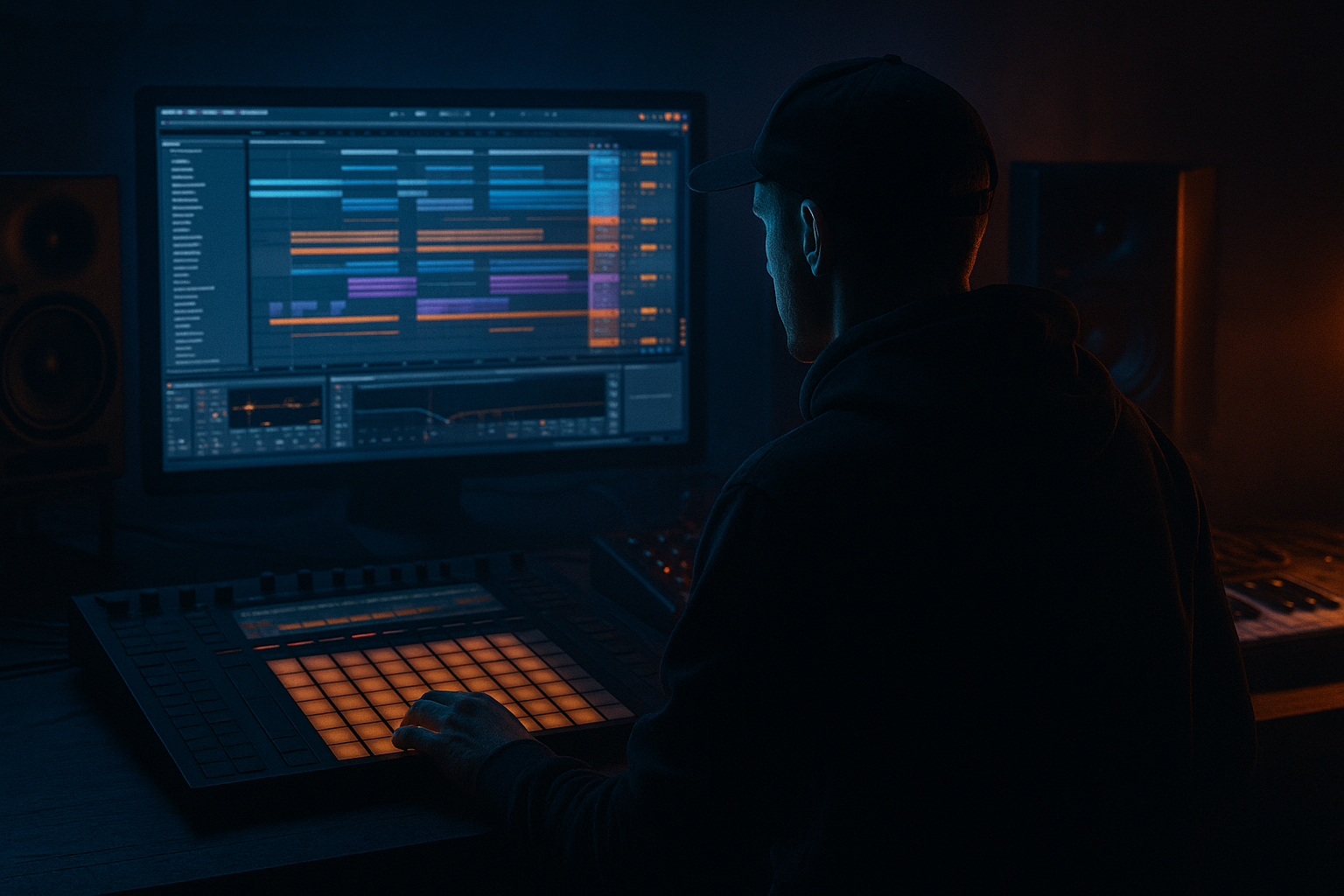
Main tutorial
Ruffneck Subsine + Crunchy Sampler Texture (Jungle Oldskool DnB) — Ableton Live 12 🎛️🔊
1) Lesson overview
In this session you’ll build a classic jungle/DnB subsine that stays clean and heavy in the lows, while adding a crunchy, sampled “hardware-ish” texture layer on top for that ruffneck, oldskool ragga-era grit. We’ll do it using Ableton Live 12 stock devices and a workflow that’s fast to arrange in a rolling track.
Skill level: Intermediate
Focus: Ragga elements vibe (grit, attitude, sound-system weight) without muddy low end
---
2) What you will build
You’ll end up with a bass group containing:
- SUB track: Pure sine (solid fundamentals, mono, controlled)
- TEXTURE track: Resampled/sampler-driven crunch (midrange character + movement)
- BASS BUS: Glue + tone + safety (EQ, saturation, transient control, mono management)
- Bars 1–8: drums + sub tease
- Bars 9–16: full bass (sub + crunch), ragga stabs/vox shots, variation fills
- Key: F or G (great for sub weight)
- Pattern idea (1 bar at 168):
- Keep most notes short (1/8 or 1/16) with occasional held notes for pressure.
- On `SOURCE`, add Saturator:
- Add Auto Filter:
- Wavetable: basic saw + lowpass, then saturate and resample.
- SUB = mono + clean + low only
- TEXTURE = gritty + animated + mostly mids
- Breakbeat + hats + small FX
- SUB plays simpler pattern (fewer notes)
- Texture muted or filtered low (highpass up around 500 Hz)
- Introduce TEXTURE in call/response with SUB
- Add ragga shot: a “hey!” or horn stab on bar 8
- Full SUB + TEXTURE
- Add a 1-bar variation every 4 bars:
- Letting the texture layer carry sub frequencies → instant mud and weak impact. High-pass it.
- Overdoing Redux → turns into fizzy noise that fights cymbals and vocals.
- No gain staging → you’ll clip the bus and wonder why it sounds small. Keep headroom.
- Sidechain too slow → bass and kick fight; groove feels “late.”
- Random slice triggering → jungle is wild, but still intentional. Make patterns that answer the drums.
- Sub discipline wins: keep SUB almost boring, then go savage with texture.
- Pitch the sub to the room: F, F#, G often translate well; avoid ultra-low notes if your system can’t reproduce them.
- Add note glides only on the texture layer:
- Parallel dirt: duplicate TEXTURE → distort harder → high-pass at 250 Hz → blend quietly for “air grit.”
- Make the bass “speak” like ragga: automate the TEXTURE filter cutoff/resonance with short, rhythmic moves (like syllables).
- Mid/Side EQ:
- Built a clean subsine in Operator with proper mono control and low-end filtering.
- Resampled for authentic crunchy sampler texture and chopped it in Simpler (Slice mode).
- Processed texture with Redux + Saturator + Auto Filter while keeping lows clean.
- Glued everything on a Bass Bus and used sidechain compression for rolling jungle bounce.
- Arranged it in a practical 8–16 bar DnB/jungle structure with variation and ragga flavor.
And a simple 8–16 bar arrangement idea:
---
3) Step-by-step walkthrough
Step A — Session setup (so the bass hits right)
1. Tempo: set to 165–170 BPM (try 168 for jungle swagger).
2. Warp mode: keep drums tight—use Beats for breaks (Transient loop off, Preserve Transients).
3. Create groups:
- DRUMS (break + tops)
- BASS (SUB + TEXTURE)
- RAGGA FX/VOX (shouts, horns, sirens)
Metering tip: Drop Spectrum on your master (stock) and watch the 45–60 Hz region for sub fundamentals.
---
Step B — Build the clean subsine (the sound system foundation) 🔥
Track: `SUB` (MIDI)
1. Load Operator (stock).
2. Operator settings:
- Osc A: Sine (default)
- Voices: 1 (mono-ish behavior)
- Glide: Off for now (we’ll add later if needed)
3. Add an Amp Envelope:
- Attack: 0–5 ms (avoid click)
- Decay: ~300 ms
- Sustain: -inf if you want short notes, or around -6 to -12 dB for held notes
- Release: 80–140 ms (prevents hard stops)
4. Add EQ Eight after Operator:
- HP filter: 24 dB/oct at 25–30 Hz (remove useless rumble)
- Optional tiny cut around 200–300 Hz if it starts sounding boxy (often not needed on pure sine)
5. Add Utility:
- Bass Mono: On (or set Width to 0%)
- Gain stage so your sub peaks nicely without clipping (aim the SUB track around -12 to -8 dB peak before the bus)
MIDI pattern (classic rolling jungle feel):
- Notes on 1, the “and” of 2, and 3 (syncopated, not constant 8ths)
---
Step C — Create the crunchy sampler texture layer (oldskool grit) 📼
This is where the “ruffneck” character lives—but we’ll keep it out of the deep sub zone.
Track: `TEXTURE` (Audio or MIDI)
We’ll do a powerful hybrid approach: resample → Simplers → distort/filter → layer.
#### C1) Make a source to resample
You can use almost anything. Here are two stock-friendly options:
Option 1 (fast): Duplicate `SUB` MIDI track → rename to `SOURCE`
- Mode: Analog Clip
- Drive: 6–12 dB
- Soft Clip: On
- Type: MS2 or OSR
- Set cutoff ~ 200–600 Hz and move it while playing (we’ll resample this movement)
Option 2 (more character): Use Wavetable or Operator with a slight harmonic
#### C2) Resample to audio (commit the grit)
1. Create a new audio track named `TEXTURE RESAMPLE`.
2. In its input chooser:
- Set Audio From: `SOURCE` (or `BASS` group if you like)
- Set monitoring to IN
3. Arm and record 4–8 bars of bass playing while you tweak filter cutoff/resonance a bit.
Now you have a “sampled” chunk—this is the essence of the crunchy jungle vibe.
#### C3) Chop it in Simpler for sampler-style texture
1. Drag the recorded audio clip into Simpler (on a MIDI track named `TEXTURE`).
2. In Simpler:
- Mode: Slice
- Slice By: Transient (adjust sensitivity until you get 8–30 slices)
- Playback: Trigger (for that choppy oldskool cadence)
3. Record a new MIDI clip triggering slices rhythmically:
- Use 16th note stabs sparingly
- Throw in triplet hits occasionally (very jungle)
#### C4) Texture processing chain (crunch without ruining sub)
On `TEXTURE`, build this chain:
1. EQ Eight (pre) — remove sub so it doesn’t fight the real sub:
- HP 24 dB/oct at 120–180 Hz
2. Redux (for crunchy sampler/bit vibe):
- Downsample: 2.0–6.0
- Bit Reduction: 8–12 bits (start at 12, go down if you want nastier)
- Keep it subtle—if you hear fizz everywhere, back it off.
3. Saturator:
- Drive: 3–8 dB
- Soft Clip: On
4. Auto Filter (movement):
- Filter type: MS2
- Cutoff: automate between 250 Hz – 3 kHz
- Resonance: 0.8–1.4
- Envelope: small amount (10–25%) for extra pluck
5. Utility:
- Width: 120–160% (texture can be wide!)
- Bass Mono off here; we already removed lows
Key concept:
---
Step D — Glue them on a Bass Bus (tight, loud, controlled)
Group `SUB` + `TEXTURE` into `BASS BUS`.
Add this chain on the BASS BUS:
1. EQ Eight
- Tiny dip at 250–400 Hz if it’s muddy (1–2 dB)
- If it’s harsh, dip 2–4 kHz gently on the texture side (or fix on TEXTURE track)
2. Glue Compressor
- Attack: 10 ms
- Release: Auto
- Ratio: 2:1
- Aim for 1–3 dB of gain reduction on peaks
3. Saturator (final density)
- Mode: Soft Sine or Analog Clip
- Drive: 1–4 dB
- Soft Clip: On
---
Step E — Sidechain the bass to your kick/snare (jungle bounce) 🥁
DnB bass needs rhythmic breathing.
1. On `BASS BUS`, add Compressor (not Glue) for classic sidechain.
2. Enable Sidechain:
- Audio From: your Kick track (or Drum Bus)
3. Settings:
- Ratio: 4:1
- Attack: 1–3 ms
- Release: 80–140 ms (tune to tempo/groove)
- Threshold: adjust until you get 2–5 dB reduction on kick hits
Alternate: sidechain to kick + snare if your snare is huge and masks the bass.
---
Step F — Arrangement ideas (8–16 bars that feel like a tune)
Here’s a practical oldskool structure:
Bars 1–4:
Bars 5–8:
Bars 9–16 (drop):
- Remove one bass hit
- Add a quick slice fill (1/16 triplets)
- Automate Auto Filter cutoff on TEXTURE for a “talking” moment
Classic jungle trick: on bar 16, do a tape-stop style moment using Delay + automation or simply mute bass for 1/2 bar, then slam back.
---
4) Common mistakes
---
5) Pro tips for darker/heavier DnB 🌑
- Use Portamento/Glide (in Operator or Simpler pitch envelopes) for quick slides without wobbling your sub fundamentals.
- Keep lows mono (SUB track).
- Let 300 Hz+ widen on the TEXTURE, but don’t over-widen 200–400 Hz if it gets cloudy.
---
6) Mini practice exercise (20 minutes)
1. Write a 2-bar sub pattern with syncopation (not straight 8ths).
2. Resample your sub through Saturator + Auto Filter for 8 bars.
3. Slice in Simpler and create a call/response:
- Bar 1: mostly sub
- Bar 2: add 3–6 texture hits (some 16ths, one triplet burst)
4. Sidechain bass bus to kick for 3–4 dB GR.
5. Export a quick loop and check:
- Sub feels centered and steady
- Texture adds aggression but doesn’t mask break/snare
---
7) Recap ✅
If you want, tell me what BPM and key you’re working in (and whether you’re using breaks or modern drums), and I’ll suggest a specific 16-bar bass MIDI pattern + automation plan that fits your groove.

