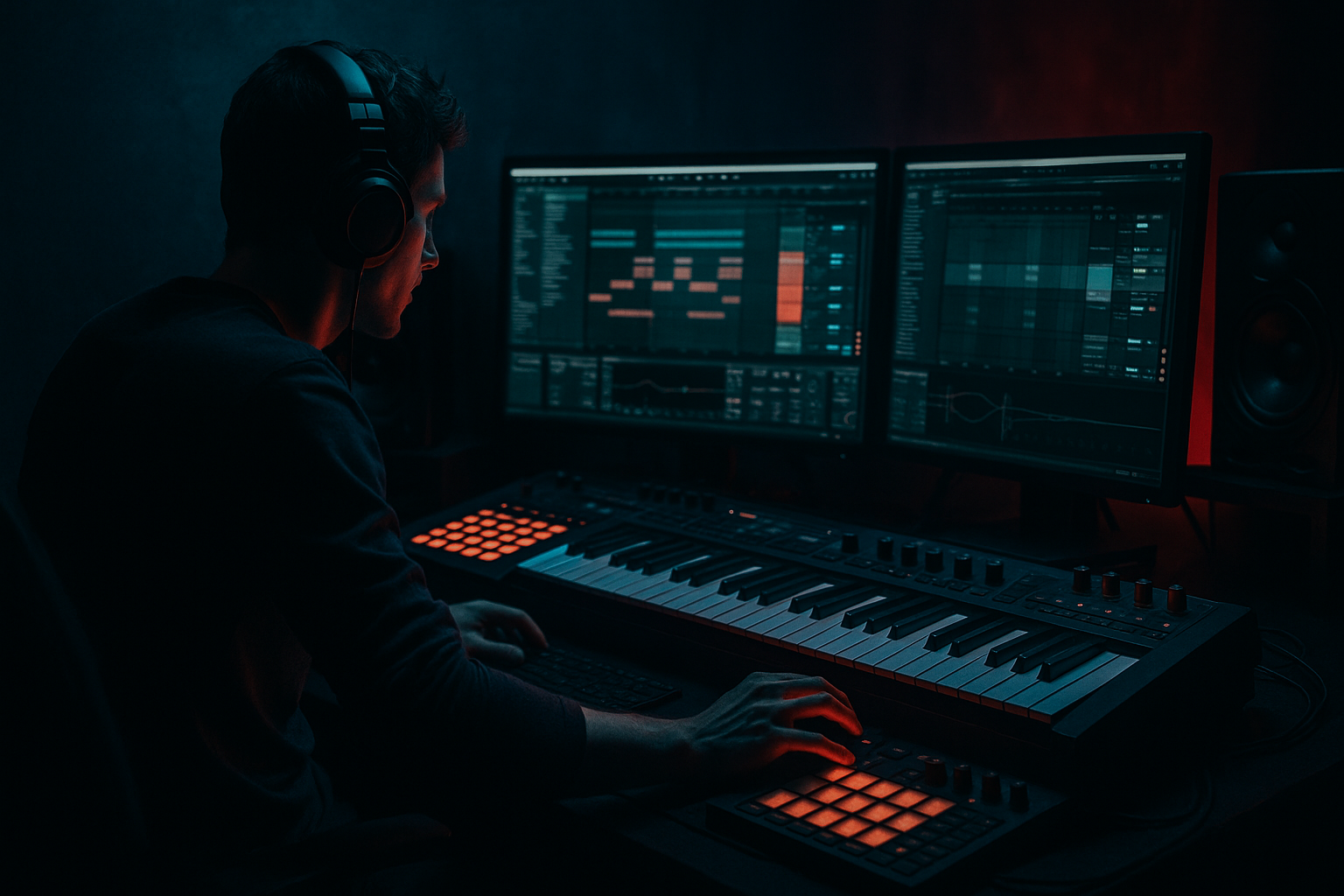
Main tutorial
Lesson Overview
This lesson shows you how to build a ruffneck oldskool DnB ride groove in Ableton Live 12 and then stretch it into an arrangement that feels like jungle-era pressure rather than a loop that just repeats. The goal is to take a simple ride pattern — that fast, skittering cymbal motion that sits on top of breakbeat drums — and turn it into a proper FX-driven energy tool for intros, build-ups, drop punctuation, and second-drop lift.
In oldskool jungle and early DnB, rides were not just “extra hats.” They were a forward-driving layer that could make a break feel wider, faster, more dangerous, and more alive. In a modern track, this technique lives right between drum programming and arrangement: it helps the loop breathe, creates movement across 4-, 8-, and 16-bar phrases, and gives you a way to raise tension without flooding the mix with melodic information.
Why it matters technically: a ride groove can easily mask snares, smear transients, or clutter the top end if it is too long, too bright, or too wide. But if you shape it properly in Ableton, it becomes a controllable energy strip that supports the break, stays DJ-friendly, and leaves room for the kick, snare, and bass to stay dominant. That’s exactly what you want for oldskool jungle, darker rollers, and ruffneck dancefloor DnB.
By the end, you should be able to hear a ride pattern that feels urgent, syncopated, and slightly feral, with enough variation to carry a phrase but not so much that it steals the track. A successful result should sound like it belongs in a real intro or drop section: grim, propulsive, and clean enough that the snare still punches through.
What You Will Build
You are going to build a retchy, oldskool-style ride groove using Ableton stock tools, then stretch it into a usable arrangement element across 8 or 16 bars. The finished result should have:
- a metallic but controlled top-end shimmer
- a slightly swung, off-grid rhythmic feel
- enough variation and automation to move from tension to release
- a role that works as a lift layer over drums, not a standalone lead
- mix readiness that keeps the low end clear and mono-safe
- For a darker feel, keep the ride slightly under-bright and let the menace come from the pattern, not just the EQ. A ride that is too shiny sounds happy; a ride with controlled bite feels more underground.
- If the groove needs more weight, layer a very quiet break-slice underneath the ride instead of making the ride itself huge. A tiny bit of hat or room from a break can give it jungle realism without wrecking the top.
- For heavier modern DnB, let the ride answer the snare, not run through every gap. The tension gets stronger when the groove has negative space.
- A subtle Drum Buss setting can add density, but keep the transient alive. If the attack disappears, back off immediately. In DnB, punch is currency.
- If your track is very bass-heavy, make sure the ride doesn’t pull attention away from the sub by constantly occupying the same “presence” zone. A small dip around 4–6 kHz can help the snare stay dominant while the ride still reads clearly.
- If you want extra menace, automate a short filter close-and-open over 1 or 2 bars before the drop. That oldskool inhale/exhale shape works because it makes the return feel physical.
- Don’t let the ride become stereo wallpaper. The most usable version in club DnB is often the one that stays focused, centered, and rhythmic while still sounding lively.
- Use only one ride sample.
- Use only Ableton stock devices.
- Make only one main processing chain: EQ Eight + Saturator + optional Auto Filter.
- Add variation only every 4 bars.
- A 16-bar clip or arrangement section with:
- Can you still clearly hear the snare?
- Does the ride make the groove feel faster without sounding noisy?
- Does the section feel like it is moving toward a drop or switch-up?
- Start with a tight, metallic ride sample that can cut without washing out the mix.
- Build a simple offbeat groove, then add just enough syncopation to feel like jungle, not generic EDM.
- Use EQ Eight, Saturator, and optionally Auto Filter to control brightness, grit, and movement.
- Stretch the idea across 4-, 8-, and 16-bar phrases so it becomes arrangement material, not just a loop.
- Always check it with drums and bass, not only in solo.
- Keep it mostly mono-safe, snare-friendly, and DJ-usable.
- The right result sounds like controlled ruffneck energy: gritty, forward, and unmistakably DnB.
In plain terms: you’ll end up with a ride part that can sit over a break and bassline, push the energy in an intro, and then evolve into a drop support element without sounding pasted on. It should feel like a real jungle-era rhythmic component — not a generic EDM crash loop.
Step-by-Step Walkthrough
1. Start with the right kind of source
In Ableton, create a new MIDI track and load Drum Rack or a simple Simpler with a ride, crash-ride, or bright cymbal sample. If you already have a breakbeat loop, you can also extract a ride-like slice from that by duplicating the break onto a new audio track and using a tiny cymbal hit from the loop.
For a beginner, keep it simple: choose a sample that already has a clear metallic tail, not a huge washed-out crash. You want something with a short attack and enough body to repeat without sounding like a white-noise blur.
Why this works in DnB: oldskool ride grooves need to cut through busy drums and bass without becoming huge. A sample with too much wash will smear the groove and make the section feel less rhythmic.
What to listen for: the hit should have a distinct “ping” at the front and enough tail to imply motion. If it sounds like a soft splash, it will disappear once the break and sub come in.
2. Program a basic 1-bar ride pattern first
In the MIDI clip, place ride hits on a simple DnB-friendly grid. A good starting point is off-beat emphasis with small syncopations: for example, hits on the “and” counts and a few 16th-note pickups around the snare.
Try this as a starting template:
- main hits on the offbeats
- one or two extra 16th notes before the snare
- leave a small pocket where the snare lands
Keep the velocity slightly uneven. In Ableton’s MIDI editor, lower some hits by a small amount so it does not sound like a rigid loop. Even a tiny velocity difference makes the groove feel more like a chopped jungle phrase and less like a programmed hat line.
What to listen for: the ride should push forward without fighting the snare. If it sounds like it’s stepping on the backbeat, remove one hit before the snare and let the snare breathe.
3. Shape the ride with a simple stock-device chain
Put these devices on the ride track, in this order:
- EQ Eight
- Saturator
- Drum Buss or Compressor if needed
Suggested starting points:
- EQ Eight: high-pass around 250–500 Hz to clear low junk
- EQ Eight: a small dip around 3–5 kHz if the stick attack feels harsh
- Saturator: Drive around 2–6 dB for grit, not destruction
- Drum Buss: Drive low, around 5–15%, if you want more bite
- Compressor: use only if the ride has too much jump between hits
The point is not to make it louder; it is to make it more present and more controlled so it sits on top of the drums like a proper FX layer.
What can go wrong: if you over-saturate, the ride becomes a splashy hiss that masks the snare and makes the mix fatiguing. If that happens, lower the drive and use EQ to tame the top instead of forcing more distortion.
4. Choose your flavour: A versus B
At this point, decide what role the ride should play:
A. Ruffer, more broken-up jungle flavour
- Keep the pattern busier
- Use shorter note lengths
- Add a few velocity variations
- Let the sample stay a bit raw
B. Cleaner, more modern roller flavour
- Use fewer hits
- Keep the rhythm tighter
- Smooth the top with EQ
- Let the ride sit more like a polished energy layer
If your track is very break-heavy and oldskool, choose A. If your track is darker and more modern with a cleaner snare, choose B.
This decision matters because the same ride pattern can either feel like a jungle rave weapon or a modern top-layer enhancer depending on how dense and raw you keep it.
5. Stretch the groove into 4, 8, and 16 bars
Now turn the one-bar loop into an arrangement element. Duplicate the clip and make small changes every 2, 4, or 8 bars. Do not just repeat the exact same loop.
A solid progression could be:
- Bars 1–4: basic ride groove, minimal variation
- Bars 5–8: add one extra pickup hit before the snare every second bar
- Bars 9–12: introduce a gap or filter drop for tension
- Bars 13–16: open the groove again with a slightly brighter version
In Ableton, you can duplicate the MIDI clip and then edit one or two hits per section. This is one of the fastest ways to make a loop feel like a real arrangement without overcomplicating the session.
Why this works in DnB: jungle and oldskool DnB rely on phrase energy, not constant variation every half-bar. You want the listener to feel a clear build over 8 or 16 bars so the drop or switch-up lands with intent.
6. Automate tension instead of adding more hits
Use Auto Filter or EQ automation on the ride track to make it evolve across the section. A very practical move is to automate a gentle filter opening:
- start with a low-pass or narrower top end around 6–8 kHz
- open it gradually toward 10–14 kHz
- bring it back down before the snare-heavy moments if needed
If you want a rougher edge, automate Saturator Drive up by a small amount in the last 2 bars of a phrase. If you want more oldskool drama, automate the ride’s volume slightly down in one bar and back up in the next to create a breathing effect.
What to listen for: the ride should feel like it is ramping tension without sounding louder in a blunt way. If it simply gets brighter and painful, the automation is too extreme.
7. Check it in context with drums and bass
This is the most important reality check. Soloing the ride is not enough. Put it back over your breakbeat and bassline and listen in context.
Ask:
- Does the ride make the break feel faster and more urgent?
- Can you still clearly hear the snare crack?
- Does the sub stay calm and stable underneath?
If the ride starts to blur the snare, reduce the ride level by a few dB and cut a little more around 4–8 kHz. If the bass feels smaller, check whether the ride is too wide or too bright and stealing attention from the midrange.
Mix-clarity note: keep this layer mostly mono-compatible. A wide ride can sound exciting in headphones, but in a club it can smear the top and weaken the center. If you use a stereo effect at all, keep it subtle and always compare it with the track in mono.
8. Build a short call-and-response with the drums
This is where the groove stops being a loop and starts feeling like DnB arrangement language. Try muting the ride for one beat or one half-bar before a snare fill, break switch, or bass drop.
A strong oldskool move is:
- ride drives for 3 bars
- last half-bar drops out or thins
- snare fill or break stutter answers it
- ride returns on the downbeat
This creates a call-and-response shape that feels authentic to jungle and ruffneck DnB. You are making space for the next event to hit harder.
Stop here if your loop already feels good in context. If the ride groove works, do not keep stacking processing just because the session is open. At this point, you should commit the feel, not keep chasing it.
9. Print or consolidate if the groove is starting to feel right
If you have automated filters, small edits, or audio warping that make the part feel alive, consider consolidating the clip or resampling it to audio. This is especially useful if you want to make tiny reverse swells, cut one-hit fills, or duplicate specific bars into the arrangement.
In Ableton, committing to audio helps you move faster. It also stops you from endlessly adjusting a pattern that already has the right character. For beginner workflow, this is a huge win: once the groove is working, freeze the decision and build the arrangement around it.
Workflow efficiency tip: name the clip something like “Ride Ruffneck 8b” and duplicate it in versions. You will thank yourself later when the track reaches the second drop and you need a variation fast.
10. Design one arrangement movement for the drop or second drop
Add a clear version change so the ride does not feel identical all track long. Good options:
- first drop: ride is filtered and thinner
- second drop: ride is brighter, busier, or has added offbeat hits
- breakdown: ride disappears entirely, then returns with a small pickup
A simple 8-bar arrangement example:
- Bars 1–4: ride starts filtered and sparse
- Bars 5–6: filter opens, one extra pickup each bar
- Bar 7: brief dropout before the snare fill
- Bar 8: full return into the drop
This gives the listener a clear sense of motion. In DnB, that motion is not decoration — it helps the DJ and the dancer feel where the phrase is going.
Common Mistakes
1. Using a ride sample that is too long and wash-heavy
- Why it hurts: it blurs the snare and turns the top end into a noisy cloud.
- Fix in Ableton: shorten the sample in Simpler, fade the tail, or pick a tighter cymbal and high-pass it around 250–500 Hz.
2. Making the ride too loud in the soloed loop
- Why it hurts: solo mode lies. In context, the ride steals focus from the break and bass.
- Fix in Ableton: drop the track gain a few dB and re-check with drums and sub playing.
3. Over-filtering the top so the ride loses its job
- Why it hurts: if it becomes too dull, it no longer creates tension or lift.
- Fix in Ableton: open the filter slightly or restore some top with EQ around 8–12 kHz.
4. Putting stereo widening on the ride without checking mono
- Why it hurts: the ride may sound huge in headphones but weak or smeared on a club system.
- Fix in Ableton: keep it mostly centered, reduce widening, and check the track in mono if you use any stereo processing.
5. Overloading the groove with too many extra hits
- Why it hurts: the ride becomes clutter, and the break loses its snap.
- Fix in Ableton: remove one pickup hit per phrase and let the snare create the impact.
6. Using the exact same 1-bar loop for the whole arrangement
- Why it hurts: it stops feeling like a real track and starts feeling like a loop demo.
- Fix in Ableton: change one or two hits every 4 or 8 bars, or automate filter movement.
7. Driving the saturator too hard
- Why it hurts: harsh top-end distortion can make the mix tiring and mask the snare attack.
- Fix in Ableton: reduce Saturator Drive to a more modest range and use EQ to shape the tone instead.
Pro Tips for Darker / Heavier DnB
Mini Practice Exercise
Goal: Build a 16-bar ruffneck ride groove that evolves without overpowering the drums.
Time box: 15 minutes.
Constraints:
Deliverable:
- one basic 1-bar ride pattern
- one filtered variation
- one dropout or fill moment
- one return with slightly more energy
Quick self-check:
If the answer is yes, you’ve got a usable DnB arrangement layer.

