Main tutorial
Lesson Overview
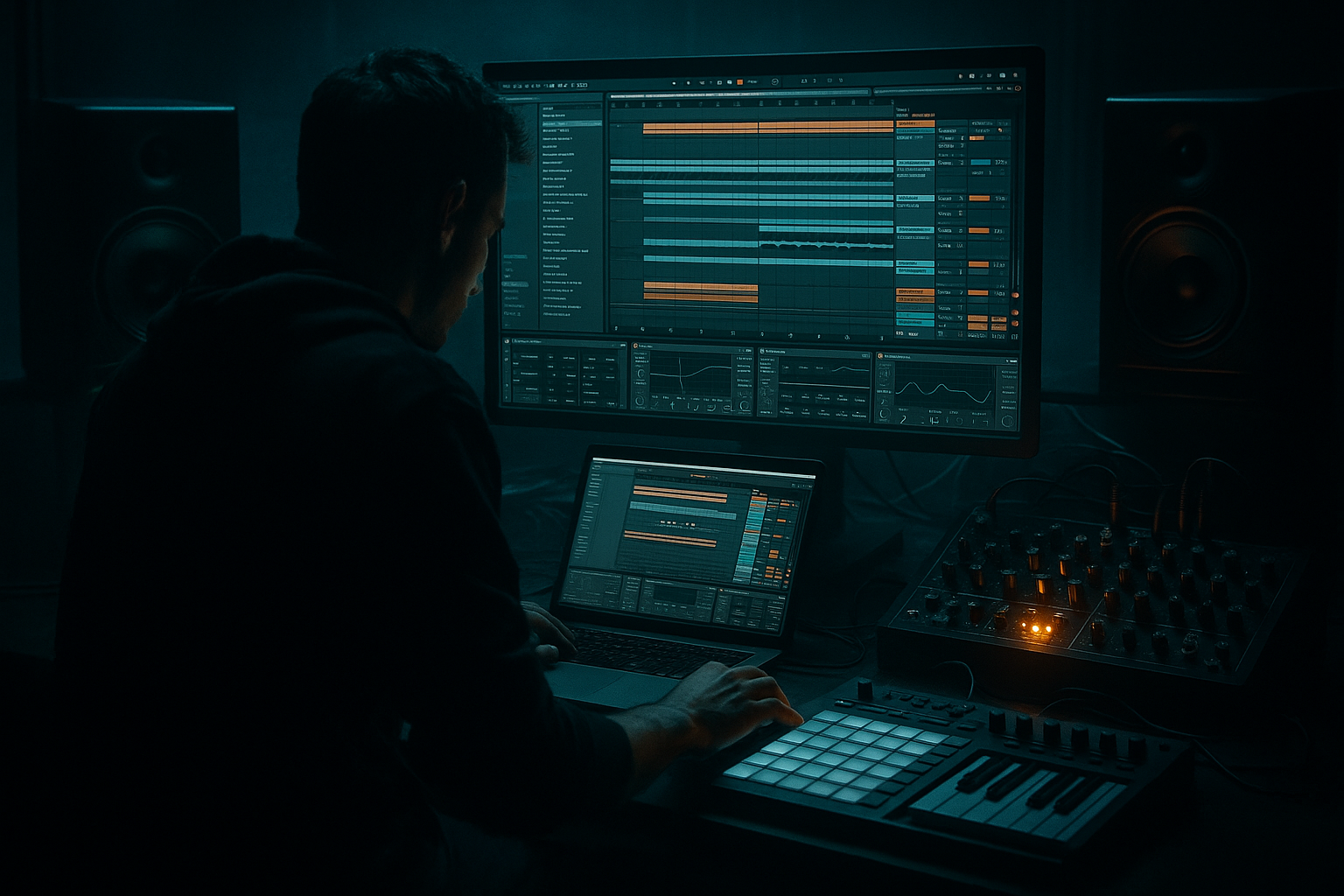
This lesson is about building a ruffneck-style top loop swing in Ableton Live 12: a gritty, syncopated high-end drum loop that sits above your main kick, snare, and sub, and gives the track that restless, rolling DnB momentum. In practice, this lives in the drum tops layer: hats, shakers, break shards, rim ticks, tiny ghost hits, and cut-up percussion that create forward motion without stepping on the core drum pattern.
Why it matters: a top loop can make a looped 2-step drum pattern feel alive, dangerous, and DJ-ready. In darker DnB, jungle, rollers, and rough neuro-adjacent tracks, the top loop is often what makes the groove feel like it’s “talking” to the listener instead of just repeating. Technically, it also helps you fill space without adding muddy low-mid content, so your sub and snare still hit cleanly.
By the end, you should be able to hear a tight, rude, swinging top loop that:
- locks to your drum groove rather than floating on top of it
- adds bounce and pressure in the upper percussion range
- feels human and slightly unstable, but still controlled
- works in a loop, under a drop, and as a foundation for arrangement changes
- a rough, syncopated rhythmic feel
- a slightly shuffled or off-grid pocket
- crisp but controlled high-end energy
- enough grit to feel underground
- a mix-ready role as the “movement layer” above your main drums
- Use asymmetry on purpose. A loop that repeats perfectly every bar can sound too polite. Try one bar with a slightly different pickup or a missing ghost hit. That tiny imbalance creates menace without clutter.
- Put the nastiest transient on a weak part of the bar. In a heavy DnB drop, a sharp tick or break shard just before the snare or just after a kick can make the whole loop feel more aggressive. The trick is to place it where it pushes, not where it masks.
- Treat grit like seasoning. A little saturation from Saturator or Drum Buss on the top loop gives attitude. Too much turns the hi-end into hash and kills the drum detail. The sweet spot is when the loop feels closer and dirtier, but still separated from cymbal fizz.
- Use filter motion sparingly for tension. If the loop starts feeling static, automate Auto Filter very slightly across 1–2 bars: open it a touch into the drop, then close it a little for the turnaround. This creates movement without needing extra notes.
- Build contrast between main loop and fill loop. Keep the main top loop relatively repeatable, then create a second version for the last bar of an 8-bar phrase with one extra reverse hit, a tiny break chop, or a short gap before the snare. That contrast makes the drop feel intentional.
- Resample one version with heavier drive. Keep a clean top loop and a dirtier alternate. The dirty version can sit under the clean one at lower level, giving the track underground texture while the clean layer preserves articulation.
- Watch the 2–5 kHz range. That area is where hats can sound exciting, but it is also where harshness builds fast. If your loop stings instead of cuts, use a gentle EQ dip rather than lowering everything.
- Use only Ableton stock devices
- Use no more than 8 top-loop hits in the bar
- Keep all content above roughly 180 Hz
- Make one version with a straighter feel and one with more swing
- two audio clips of the same loop: Version A = tighter, Version B = looser
- one 8-bar arrangement where the loop changes slightly in bars 5–8
This is best suited to roller, jungle-influenced, dark halftime-feeling DnB, and heavier club-oriented cuts where the drums need movement but the low end must stay disciplined.
What You Will Build
You’re going to build a ruffneck top loop made from short percussion hits and/or sliced break tops, processed in Ableton so it has:
The finished result should feel like a loop that can sit behind your snare and bass without crowding them. It should sound alive, nasty, and forward-driving, but still clean enough that the kick and snare remain the obvious anchors.
Success sounds like this: when the loop is playing with the drums and bass, you can feel the groove becoming more urgent and human, but the main backbeat still reads clearly. If the top loop is good, you notice the track feels more expensive and more locked-in without sounding busier for the sake of it.
Step-by-Step Walkthrough
1. Start with the right drum context, not the loop alone
Put your main kick and snare pattern down first. For a beginner-friendly DnB start, use a standard 2-step: kick on the first beat, snare on beat 2 and beat 4, with room for a pickup kick or ghost hit before the snare if that suits the tune. Keep the sub bass simple for now.
Now decide where the top loop lives: it should support the groove, not replace it. A top loop in DnB usually works best when the core drum pattern is already telling the story. The loop is there to add pressure, swing, and texture.
Why this matters in DnB: if you build the top loop first, it often becomes too busy and fights the snare impact. DnB needs a clear drum hierarchy: kick/snare first, movement layer second.
What to listen for: with the base drums playing, the track should already feel like it wants to move. If it feels flat, the top loop will help. If the base drums are already crowded, fix that before adding more top detail.
2. Choose your source: sliced break tops or one-shot percussion
In Ableton, drag in either:
- a short break from your own sample library and slice out the top end, or
- a set of clean one-shots like hats, shakers, rim ticks, and tiny ghost percussion hits
For a ruffneck feel, both are valid. Here’s the A versus B decision:
- A: Break-top route — better for jungle grit, old-school swing, and organic chaos
- B: One-shot route — better for tighter rollers, cleaner modern punch, and easier control
If you’re a beginner, start with one-shots because it’s easier to hear what each hit is doing. Then later, try a sliced break for more character.
Practical Ableton move: load the material into a Simpler or onto separate audio clips on a new audio track. Keep the material short and focused on the top end. You do not need the full break body if the kick and snare are already in the main kit.
3. Build a 1-bar or 2-bar pattern with intentional gaps
Program a top loop that doesn’t hit on every subdivision. In DnB, too many hats in the top layer can blur the groove and flatten the snare. Start with a sparse pattern like:
- offbeat hats
- a few 16th-note ghost ticks
- one or two syncopated accents before the snare
- a tiny push or pickup at the end of the bar
If you’re using MIDI, draw notes into a clip. If you’re using audio slices, place the hits manually. Aim for space between accents so the loop can breathe.
A good beginner target is a 1-bar loop with 4–8 active top hits, then duplicate it to 2 bars and vary one or two hits in bar 2. That tiny change keeps the loop from feeling robotic.
What to listen for: the top loop should feel like it’s propelling the snare, not clashing with it. If the snare loses authority, remove notes before you add processing.
4. Create swing with timing, not just groove presets
The “ruffneck” feel comes from slight timing displacement. In Ableton Live 12, use the MIDI note grid or clip timing to nudge a few top hits late or early. Do not offset everything equally.
Start with these practical ideas:
- move some 16ths slightly late for laid-back drag
- move a pickup hit slightly early to create anticipation
- leave the snare completely solid
- keep the main kick stable unless you are intentionally humanizing a full break feel
A useful range is very small: think in terms of a few milliseconds, not obvious delay. On a 170–174 BPM track, tiny changes are enough to create swing.
Why this works in DnB: the genre is fast, so even small timing differences create a strong physical feel. A top loop that leans slightly behind the beat can make the whole drum bed feel heavier.
Workflow tip: if you find yourself dragging notes around endlessly, stop and duplicate the clip. Make one version more straight and one version more swung. That gives you fast comparison instead of endless micro-editing.
5. Shape the loop with stock Ableton devices
Build a simple processing chain to keep the loop rude but controlled. Two reliable stock-device chains:
Chain 1: EQ Eight → Drum Buss → Saturator
- EQ Eight: high-pass around 180–300 Hz to clear space for kick, snare body, and bass
- if the loop has harsh fizz, gently dip around 6–10 kHz
- Drum Buss: use light drive, around 5–15%, to add density and knock into the transient
- Saturator: use subtle drive, roughly 1–4 dB, for grit and edge
Chain 2: Auto Filter → Glue Compressor → Saturator
- Auto Filter: use a high-pass if the source is too full, or a band-pass if you want a narrower, more lo-fi ruffneck top
- Glue Compressor: light control with a slow-ish attack so the transient still pops
- Saturator: push until the loop gets attitude, then pull back slightly
Don’t over-process yet. The goal is definition, not volume. The top loop should sound bigger because it is clearer and more energetic, not because it is louder.
What to listen for: when you toggle the processing on and off, the loop should feel more focused and more present without getting splattery or brittle.
6. Lock the loop into the drum pocket
Bring the top loop into context with kick and snare. This is the checkpoint where the idea either becomes a real DnB groove or stays as a cool sound design exercise.
Listen in the full drum loop:
- does the top loop reinforce the snare lift?
- does it create forward motion into the next beat?
- does it leave enough negative space for the kick to punch?
If the groove feels too stiff, move one or two top hits a little earlier or later. If it feels too messy, delete the least important hit rather than compressing everything harder.
Stop here if: your top loop is still fighting the snare. Fix the rhythm first. Processing a bad pattern harder only makes a bad pattern louder.
Also check the loop with bass on. If your bass is very syncopated, the top loop should be slightly simpler. If your bass is sparse, the top loop can carry more rhythmic information.
7. Use groove and shuffle carefully, not blindly
Ableton’s Groove Pool can help, but in DnB it’s easy to overdo shuffle and lose the straight-forward physical drive. If you use groove, apply it lightly and then compare it to the straight version.
Good approach:
- try a groove with a small amount of swing
- apply it mostly to the top loop, not the kick/snare anchor
- keep the amount subtle enough that the snare still lands like a brick
If you’re after a more old-school jungle feel, a little extra shuffle can help. If you’re after modern rollers or darker neuro tension, keep the loop tighter and let the off-grid feel come from note placement rather than heavy swing settings.
Decision point:
- More swing = looser, more ruffneck, more jungle energy
- Less swing = tighter, more modern, more surgical pressure
8. Commit the loop to audio once the rhythm is right
When the loop works, render it or resample it to audio. This is a real finishing workflow move, not a fancy extra.
Why commit:
- you can see the waveform and edit tiny transient issues faster
- you can slice, reverse, or reorder sections more easily
- you stop endlessly tweaking MIDI and start working like a track builder
In Ableton, bounce the loop to audio and keep the original MIDI version muted in case you need to return. Once printed, you can:
- trim silent edges
- add tiny fades
- reverse one hit before a transition
- chop out a single bar for arrangement variation
Workflow efficiency tip: name the printed version clearly, like “TOP LOOP swing A” and “TOP LOOP swing B.” That makes A/B checks fast when the arrangement gets crowded.
9. Add movement without destroying mono compatibility
Ruffneck top loops can get wide and messy very quickly. If you want a heavier, more club-safe result, keep the low-end out of the loop and be careful with stereo width.
Use these practical rules:
- high-pass the loop so no low-mid mud remains
- keep the core hits centered if possible
- if you widen the loop, do it lightly and check mono
- avoid stereo effects that smear the transient too much
In a club context, mono compatibility matters because the top loop should still read when the system folds in or when the DJ is checking a crowded room. A top loop that disappears in mono is not a strong top loop.
If you want width, aim for texture width, not rhythmic width. That means the sound can spread a little, but the timing and punch stay centered.
10. Arrange the loop like a real drop tool
Don’t leave the loop repeating the same way for 16 bars. Build it as an arrangement device.
A simple DnB phrasing example:
- Bars 1–4: full top loop, restrained
- Bars 5–8: add one extra ghost hit or open hat to increase pressure
- Bars 9–12: remove one element to create a breath before the next phrase
- Bars 13–16: bring in a variation with a fill or reverse hit
This works well in a drop because the listener feels development without the low end changing every bar. In darker DnB, that subtle evolution is often what keeps a loop from getting stale.
You can also use the top loop for second-drop evolution: print a new version with a harsher transient, a different shuffle, or one extra broken hit. Same groove, more attitude.
Common Mistakes
1. Making the top loop too busy
- Why it hurts: too many hits blur the snare and remove the ruffneck space that makes DnB feel heavy.
- Fix in Ableton: delete 1–3 of the least important hits, then compare the pattern with drums only. If the groove still moves, the extra hits were unnecessary.
2. Leaving too much low-mid content in the loop
- Why it hurts: the loop masks kick body and bass articulation, especially in the 150–400 Hz range.
- Fix in Ableton: use EQ Eight with a high-pass around 180–300 Hz, then sweep carefully for any boxy resonance and cut gently.
3. Over-shuffling the groove
- Why it hurts: the loop turns mushy and loses the hard DnB push.
- Fix in Ableton: reduce Groove Pool amount, or remove swing entirely and manually move only a couple of notes.
4. Processing before the rhythm is right
- Why it hurts: distortion and compression make bad timing sound more obvious, not better.
- Fix in Ableton: mute all processing, fix the pattern, then bring the chain back in one device at a time.
5. Using wide stereo effects on the core hits
- Why it hurts: the loop becomes unfocused and can smear in mono.
- Fix in Ableton: keep the main hit centered, use width lightly if at all, and check the result in mono by listening to the summed feel of the track.
6. Ignoring the snare relationship
- Why it hurts: the top loop can compete with the snare’s attack, which is the emotional anchor in most DnB.
- Fix in Ableton: move or remove hits around the snare lane, or cut a little level in the 2–5 kHz area if the loop is masking the crack.
7. Never printing the loop to audio
- Why it hurts: endless MIDI tweaking slows arrangement and keeps you stuck in loop mode.
- Fix in Ableton: once the swing feels right, commit to audio and start arranging with variations.
Pro Tips for Darker / Heavier DnB
Mini Practice Exercise
Goal: build a 1-bar ruffneck top loop that swings against a standard DnB drum pattern without masking the snare.
Time box: 15 minutes
Constraints:
Deliverable:
Quick self-check:
Play both versions with kick, snare, and bass. Choose the one where the snare still feels dominant, the loop adds momentum instead of noise, and the groove makes your head nod forward rather than just sounding busy.
Recap
A ruffneck top loop in DnB is not just a hat pattern — it is a movement layer that adds swing, grit, and tension above your core drums. Build the rhythm first, keep the snare clear, use only enough processing to add attitude, and check the loop in context with bass and arrangement. The best result feels rude, controlled, and inevitable: the track moves harder without losing punch.

