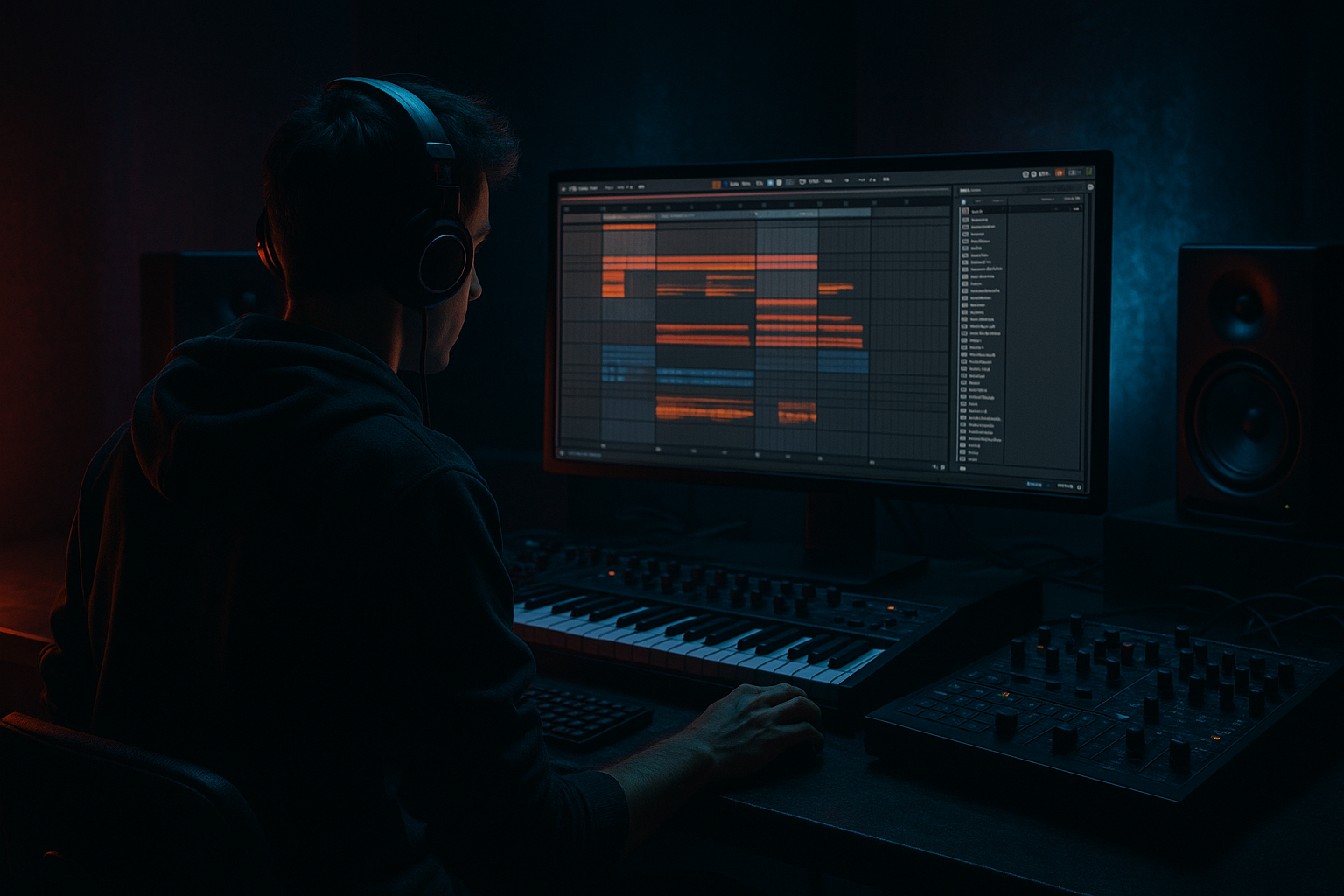
Main tutorial
Lesson Overview
The ruffneck approach is a classic jungle-to-DnB tension trick: a fast, swinging arp-like motion that feels half-melody, half-rhythm, and creates that “leaning forward” energy before a drop or switch-up. In modern Ableton Live 12, this works brilliantly as a riser because you can combine pitch movement, rhythmic gating, resampling, and automation to make something that feels raw, urgent, and distinctly underground.
In Drum & Bass, a good riser isn’t just “noise going up.” It should pull the listener into the next section. The ruffneck style does this especially well because the swing and short-note phrasing make the tension feel human and broken, like a jungle edit that got pushed through a modern club system. That makes it ideal for:
- 8-bar or 16-bar build-ups into a drop
- transition moments between first and second drop
- tension layers over drum breaks
- breakdowns that need movement without sounding cinematic or generic
- a midrange arpeggio pattern with jungle bounce and off-grid feel
- a rising pitch or filter contour over 8 or 16 bars
- a layered noise and texture lift
- optional re-sampled grit for extra attitude
- a riser that can sit under:
- Making the arp too straight
- Using too much low end in the riser
- Over-blurring the build with too much reverb
- Letting the riser clash with the bass drop
- Choosing a sound that is too lush or cinematic
- Overusing Beat Repeat or stutter effects
- Use call-and-response phrasing
- Print two versions of the riser
- Automate stereo width carefully
- Add subtle pitch tension
- Distort before the filter for extra aggression
- Use breakbeat fragments underneath
- Keep the drop headroom in mind
Why this technique matters: in DnB, energy changes need to happen fast. You often don’t have room for huge melodic development. A swung arp riser gives you motion, urgency, and identity in a very short space, while still leaving room for kick, snare, break edits, and bass impact.
What You Will Build
You’ll build a swinging jungle-style arp riser in Ableton Live 12 that sounds like a ruffneck tension layer: sharp but musical, gritty but controlled, and designed to ramp into a drop without stepping on the kick/snare or bass.
The finished result will be:
- breakbeat fills
- reese bass pre-drop movement
- vocal chops or stabs
- impact hits into a drop
Musically, think of it as a syncopated tension engine: not a smooth EDM sweep, but a more ragged, ruffneck rise that feels at home in jungle, dark rollers, and neuro-influenced DnB.
Step-by-Step Walkthrough
1. Set the musical context and choose the right section length
Start in Arrangement View and decide where the riser will live. For this technique, the sweet spot is usually 4, 8, or 16 bars before a drop. For a more authentic DnB arrangement, use:
- 8 bars for a standard build
- 4 bars for a quick DJ-friendly switch
- 16 bars when you want tension to evolve more slowly in a darker track
Set your tempo around your project target, often 172–174 BPM for jungle/DnB. Drop a marker at the downbeat where the next section lands. This matters because the ruffneck arp should feel like it’s already in motion before the drop arrives.
A strong arrangement context example: if your second drop is heavier and more neuro-leaning, use the riser in the last 8 bars after a breakdown where the drums thin out, then let the arp + break edit + sub fill the space before the drop slam.
2. Build the core arp with a simple instrument
Create a new MIDI track and load Analog, Operator, or Wavetable. For a classic jungle-adjacent starting point:
- Use a saw wave or saw + square blend
- Keep the patch mono or unison-light
- Add a short envelope so it feels plucky, not pad-like
Good starting settings:
- Attack: 0–5 ms
- Decay: 180–450 ms
- Sustain: 0–20%
- Release: 40–120 ms
If you want a more metallic or ruffneck stab feel, use Operator with a simple harmonic-rich timbre and slightly detune the oscillators. If you want a warmer jungle feel, use Analog with a low-pass filter and moderate resonance.
Then program a tight 1-bar or 2-bar MIDI phrase using short notes. Keep the rhythm syncopated, not straight 16ths all the way through. A good starting pattern is:
- notes placed on 1, 1.3, 2&, 3, 3.2, 4&
- some notes held just long enough to create overlap
- occasional rests to let the groove breathe
Why this works in DnB: jungle and rollers thrive on push-pull rhythm. A perfectly even riser feels too clean. A slightly broken arp feels like it belongs to the drum break culture.
3. Apply swing with Groove Pool, not just note offsets
Open the Groove Pool and try a swung 16th groove from Ableton’s stock groove library. Start gently:
- Swing amount: 54–58%
- Timing: 20–50%
- Random: 0–8%
- Velocity: 5–15%
Then apply the groove to the MIDI clip and adjust until it feels like it “leans” without becoming sloppy.
If the groove feels too soft against your breakbeat, quantize the clip first to tighten it, then add groove after. This is especially useful in DnB because the riser should lock with the drums but still have a human-feeling lilt.
Practical note: the ruffneck feel usually works best when the swing is most obvious in the midrange arp, while the kick/snare grid stays much more rigid. That contrast creates the tension.
4. Shape the arp with note length, velocity, and octave movement
Now add phrasing so the line rises naturally. In the MIDI editor:
- shorten some notes to create stabs
- lengthen the final notes of each bar slightly
- automate or draw velocity changes so the phrase opens up over time
Useful approach:
- Bars 1–2: mostly lower register, quieter velocities, more rests
- Bars 3–4: add octave jumps
- Bars 5–6: increase density and brightness
- Bars 7–8: move into a higher octave and increase note repetition
Try these concrete ranges:
- Velocity start: 55–75
- Velocity end: 85–110
- Octave spread: 1–2 octaves maximum
Don’t over-spread it. In DnB, a riser that becomes too wide can clash with your bass or wash out the drop. Keep the arp relatively focused so the movement feels intentional.
5. Use a filter and automation to create the rise
Add Auto Filter after your instrument. This is the core of the riser shape. Use:
- Filter type: Low-pass 24 dB
- Resonance: 15–35%
- Drive: slight to moderate
Automate the cutoff from fairly closed to much brighter over the build:
- start around 200 Hz to 800 Hz
- end around 8 kHz to 16 kHz
If the patch gets too fizzy, ease off resonance or slightly reduce the top end before the drop. You want tension, not painful harshness.
For extra motion, try automating the LFO rate or amount in Wavetable, or use Auto Filter’s envelope follower subtly on the arp layer. But keep the main movement readable: the listener should feel the tension rising without wondering where the tone is going.
6. Add rhythmic gate or repeat energy with stock devices
To make it feel more like a ruffneck jungle riser and less like a generic synth sweep, add rhythmic gating or stutter-style motion. Two good Ableton stock options:
- Auto Pan set to Phase 0° for tremolo-style gating
- Beat Repeat for more aggressive, broken-up lift
Suggested settings:
Auto Pan:
- Rate: 1/8 or 1/16
- Amount: 20–60%
- Phase: 0°
- Shape: sine for smooth, square-ish for choppy
Beat Repeat:
- Interval: 1/4 or 1/8
- Grid: 1/16
- Chance: 10–35%
- Variation: small to moderate
- Filter: high-pass the repeats a bit so they don’t muddy the build
Use one or the other first. If you stack both, keep the settings subtle. The goal is tension and swing, not rhythmic chaos.
7. Layer noise, texture, or resampled grit
A good DnB riser often needs a second layer that carries the air and aggression. Add a new audio or MIDI track with:
- Operator noise
- a filtered Analog noise patch
- or a resampled version of the arp processed through distortion
Then process that layer with:
- Saturator or Overdrive
- EQ Eight
- Auto Filter
- optional Corpus or Redux for texture if used lightly
Useful settings:
Saturator:
- Drive: 2–8 dB
- Soft Clip: on if needed
EQ Eight:
- high-pass around 200–500 Hz
- tame harshness around 3–6 kHz if necessary
This layer should support the riser, not replace it. In darker DnB, a little grime is useful. Just make sure the sub and low-mid zones stay clear for the drop.
8. Resample the riser for a more authentic jungle attitude
This is where it gets proper ruffneck. Route the MIDI arp to an audio track, or use Resampling from Ableton’s audio input, then print the riser as audio. Once printed, you can:
- reverse small sections
- cut and re-stitch phrases
- warp lightly if needed
- add a second distortion pass
- automate filter moves more aggressively
Why this works in DnB: resampling turns a clean synth idea into something with character and edge. Jungle and darker DnB often sound better when the transition element has a slightly imperfect, edited, “worked-on” quality.
A strong move is to duplicate the printed audio, keep one copy clean-ish, and heavily process the other with:
- Redux for subtle bit reduction
- Glue Compressor for density
- Echo for a short pre-drop smear
- Reverb with short decay and high-pass filtering
Blend them until the riser has both definition and atmosphere.
9. Automate the final approach into the drop
The last 1–2 bars should be about release and focus. Use automation lanes on:
- filter cutoff
- reverb send
- distortion drive
- stereo width
- output gain on the riser bus
A strong DnB build often does this:
- the riser gets brighter and denser
- the drums get more exposed
- the bass stays controlled or drops out
- a short impact or snare fill marks the final bar
Add an impact hit on the downbeat of the drop and maybe a downlifter on the last half-bar. If the riser is too busy right up to the drop, it will blur the impact. Leave a tiny amount of space for the drop to feel bigger.
10. Group the build elements and check the mix in context
Group the arp, noise layer, and printed audio into a Riser Bus. On the group, use:
- EQ Eight to remove unnecessary low end
- Glue Compressor for gentle cohesion
- a utility tool to check mono compatibility
Good bus starting points:
- Low-cut everything below 120–200 Hz
- Glue Compressor ratio 2:1
- Attack 10–30 ms
- Release Auto or 0.3–0.6 s
Then audition it with drums and bass active. Make sure the riser doesn’t mask:
- the kick punch
- the snare crack
- the bass re-entry on the drop
In a proper DnB context, the riser should feel exciting even at moderate volume. If you have to turn it up too far to notice it, reshape the rhythm or automation rather than just boosting level.
Common Mistakes
- Fix: add swing in Groove Pool and vary note lengths/velocities.
- Fix: high-pass aggressively on all riser layers below 120–200 Hz.
- Fix: use short decay, high-pass the reverb return, and automate it down near the drop.
- Fix: thin out the final bar, reduce width, and leave space for the bass re-entry.
- Fix: go for a raw saw, gritty stab, or noise-inflected tone with tighter envelope shaping.
- Fix: keep the rhythm readable. In DnB, the drums already create enough complexity.
Pro Tips for Darker / Heavier DnB
- Let the arp answer a break fill or snare pickup. One bar of arp tension, one bar of drum pressure = classic jungle movement.
- One clean and one destroyed. Blend them for control and attitude.
- Keep the low-mid core centered. Widen only the top texture as the build progresses.
- A small pitch rise on the last 2 bars can work well, but keep it restrained so it doesn’t become trancey.
- Saturation before Auto Filter can make the sweep feel more urgent and harmonically rich.
- A chopped break ghost layer under the arp can make the riser feel embedded in the rhythm of the track, not pasted on top.
- Don’t let the riser peak too hot. Leave room so the drop feels bigger and the sub hits harder.
Mini Practice Exercise
Spend 15 minutes making a ruffneck swing riser from scratch:
1. Set Ableton Live to 174 BPM.
2. Create a new MIDI track with Operator or Wavetable.
3. Program a 2-bar arp phrase using a saw-based tone and short notes.
4. Apply a Groove Pool swing around 56%.
5. Add Auto Filter and automate the cutoff from low to high over 8 bars.
6. Duplicate the track and make a second layer with noise or a more distorted version.
7. Add Saturator and lightly drive the second layer.
8. Resample the combined result to audio.
9. Cut the final bar so it leaves a tiny pocket of space before the drop.
10. Listen with a kick, snare, and reese bass loop to check if the riser lifts the section without muddying it.
Goal: finish with one usable 8-bar riser and one alternate, dirtier version.
Recap
The ruffneck jungle arp swing riser works because it combines swing, motion, grit, and tension in a way that suits Drum & Bass arrangement language. Keep the core sound simple, use Groove Pool for feel, automate a clear rise, and add just enough distortion and texture to make it feel alive. For the best results, think like a DnB producer: tight low end, moving mids, controlled top end, and a drop that has room to hit.

