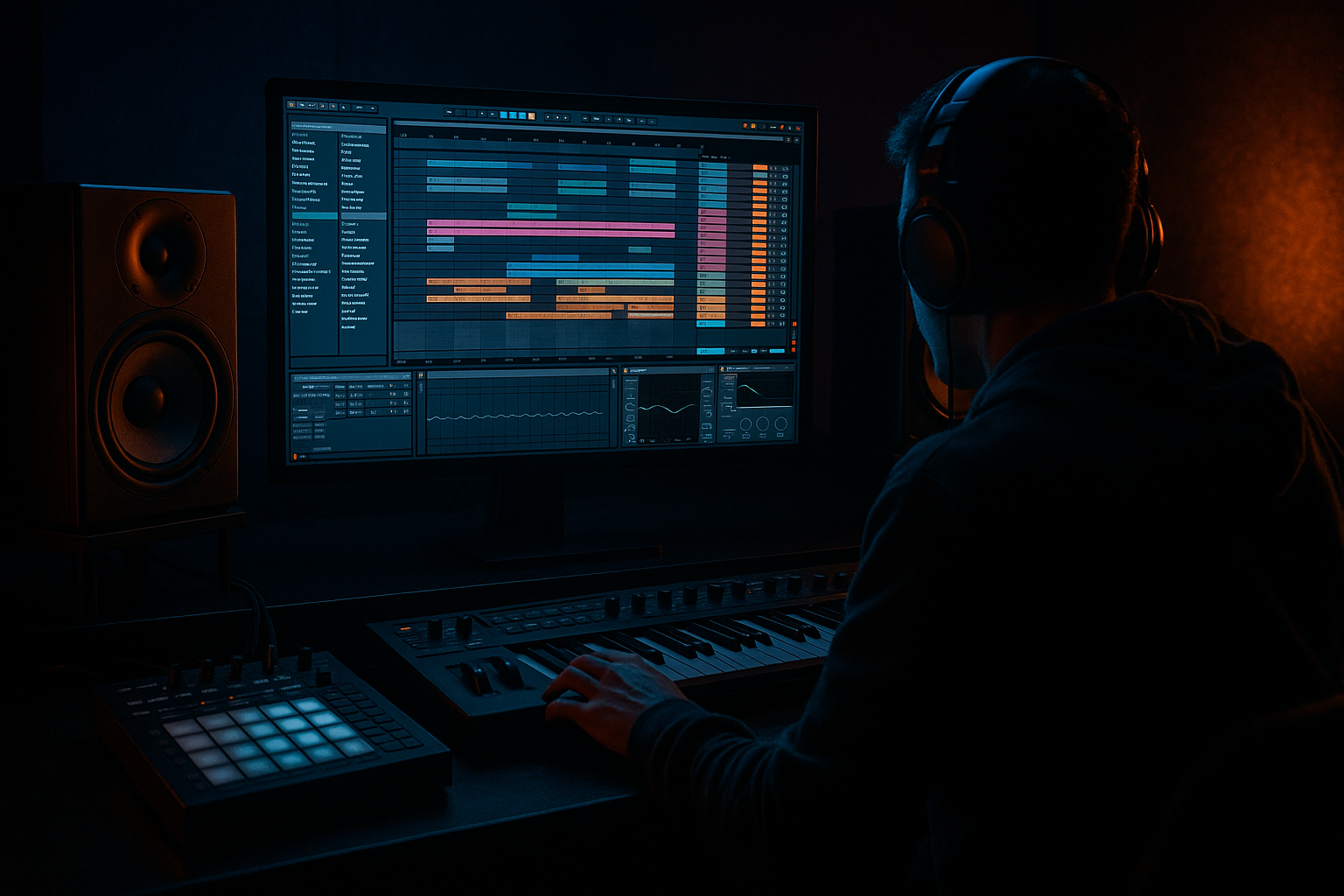
Main tutorial
Ruffneck Drop Arrangement (Without Losing Headroom) in Ableton Live 12
Beginner • DJ Tools • Jungle / Oldskool DnB vibes 🔥🧨
---
1. Lesson overview
In jungle/oldskool DnB, the drop hits hard because arrangement, contrast, and density are managed like a DJ would manage energy—without smashing the master into clipping.
This lesson shows you how to arrange a ruffneck-style drop in Ableton Live 12 while keeping clean headroom and avoiding the classic beginner trap: “make it louder” instead of “make it hit harder.” 🎛️
You’ll learn:
- A simple gain staging system that keeps your master safe
- A drop arrangement blueprint (intro → tension → impact → roll)
- How to use stock Ableton devices (Utility, EQ Eight, Glue Compressor, Drum Buss, Saturator, Limiter)
- How to create perceived loudness with space + contrast instead of clipping
- DJ-friendly intro (beats + atmos)
- 8-bar build (filter + tension)
- Drop impact moment (crash, sub hit, bass comes in clean)
- 16-bar rolling drop (breaks + bass + stabs) that stays under control
- Put a Limiter on the Master only as a safety:
- Drums Group: Utility
- Bass Group: Utility
- Music/Stabs Group: Utility
- FX/Atmos Group: Utility
- Kick/Breaks group peak: around -10 to -6 dB
- Bass group peak: around -12 to -8 dB
- Music/stabs peak: around -18 to -12 dB
- FX peak: around -18 to -12 dB
- If your master is clipping: turn down the groups, not the master fader.
- Keep the master fader at 0.0 dB while building.
- Sub (clean, mono)
- Mid bass / reese layer (grit, stereo-safe)
- SUB
- MID BASS
- Sidechain: From KICK (or from a “DRUMS” trigger track)
- Ratio: 3:1
- Attack: 2–10 ms
- Release: 60–140 ms (match groove)
- Threshold: adjust for 2–5 dB gain reduction on hits
- Create a hidden ghost kick MIDI track feeding a short kick sample (muted output), and sidechain from that. Classic DnB trick. 👌
- Bars 1–16: Intro (DJ mix-in friendly)
- Bars 17–24: Build / tension (8 bars)
- Bar 25: Drop hit (impact moment)
- Bars 25–40: Drop groove (16 bars)
- Break loop (filtered)
- Atmos pad / vinyl noise
- A tiny hint of stab
- On DRUMS group: Auto Filter
- Snare build (every 2 bars → every bar → every 1/2)
- Riser (noise or reese pitch)
- Small fills (break edits)
- Stop/kill the build reverb tail (or swap to a shorter tail)
- Bring in Sub + Mid bass + full breaks
- Add Crash + short impact (not 4 layered booms)
- Crash (high-pass it at 300–600 Hz so it doesn’t add low mush)
- One impact that’s mostly mid/high
- Optional: short sub “thump” (very controlled)
- Breaks are constant
- Bass phrases leave gaps
- Stabs answer the bass
- FX punctuate every 4 or 8 bars
- Bars 25–32: Main bass riff A (simple)
- Bars 33–40: Variation (add a stab rhythm + break fill at bar 40)
- Use mutes and gaps (silence hits hard)
- Alternate bass notes vs. stabs (don’t stack constantly)
- Add a fill by editing the break, not by adding 5 extra drum layers
- Shorter notes, less overlap
- Velocity control
- Lighter distortion
- Intro has clear drums and not too much sub
- Build doesn’t jump in loudness
- Drop hits with clarity (kick/break + bass separation)
- Add a reference jungle track (turn it down!)
- Level-match it with Utility so your track isn’t “winning” by being louder
- Compare:
- Make the mid-bass aggressive, keep the sub disciplined.
- Use “controlled distortion” chains:
- Automate tiny changes every 4 bars
- Mono-check your low end
- Dark space without mud
- Headroom in a ruffneck jungle drop comes from arrangement contrast + controlled low end, not master limiting. ✅
- Use group Utilities for clean gain staging.
- Build tension using filters, reverb sends, and small edits—not volume.
- Make the drop hit by removing build clutter, bringing in bass cleanly, and managing peaks on groups.
- Sidechain bass to drums for clarity and punch that translates in DJ sets. 🎚️
---
2. What you will build
A short 32–48 bar arrangement with:
Target vibe: ruffneck jungle—think crunchy breaks, gritty bass, oldskool stabs, tight low-end. 🥁🦴
---
3. Step-by-step walkthrough
Step 0 — Project setup (so you don’t fight your mix later)
1. Tempo: 165–174 BPM (try 170 BPM).
2. Meter: 4/4.
3. Warp mode for breaks: Usually Beats (Preserve Transients) or Complex Pro if it’s a full loop with tone. For classic breaks, start with Beats.
4. Master headroom goal: Your Master peak should land around -6 dB during the drop while producing.
- This gives space for later loudness or mastering.
Quick safety:
- Ceiling: -0.3 dB
- Lookahead: default
- Don’t push into it—use it to catch accidents, not to make it loud.
---
Step 1 — Gain staging (the “ruffneck but clean” foundation) ✅
This is the easiest way to keep headroom as your drop gets busy.
On every major track group, add: _Utility_ last in the chain.
Suggested starting levels (not rules—good beginner targets):
Workflow:
---
Step 2 — Build a proper oldskool drum foundation (break + punch)
#### A) Create a Drum Group
1. Create Group Track: “DRUMS”
2. Inside:
- Track 1: Break loop (Amen / Think / etc.)
- Track 2: Kick one-shot (optional, for weight)
- Track 3: Snare one-shot (optional, for crack)
- Track 4: Hats/Shakers (light)
#### B) Break loop processing (stock chain)
On the Break track, try:
1. EQ Eight
- High-pass: 25–35 Hz (remove rumble)
- If it’s boxy: dip around 250–450 Hz slightly
- If too harsh: dip around 6–9 kHz gently
2. Drum Buss
- Drive: 5–15%
- Crunch: small amount (start 5–10%)
- Boom: 0–10% (be careful—can eat headroom fast)
- Trim: adjust so it’s not getting louder just from the device
3. Glue Compressor (optional)
- Attack: 3 ms
- Release: Auto
- Ratio: 2:1
- Aim for 1–2 dB gain reduction max
Key headroom principle:
Crunch comes from harmonics + transient control, not from turning everything up.
---
Step 3 — Bass that drops hard without eating the entire mix
Oldskool jungle bass often works great as two lanes:
#### A) Create a Bass Group
Tracks:
#### B) SUB chain (simple + safe)
On SUB:
1. Instrument (Operator is perfect)
- Osc A: Sine
2. EQ Eight
- Low-pass around 80–120 Hz (keep it clean)
3. Utility
- Width: 0% (mono)
- Gain: adjust so the sub feels strong but not ridiculous
Tip: If the sub is huge, it will destroy headroom. In jungle, a controlled sub hits harder.
#### C) MID BASS chain (classic ruffneck grit)
On MID BASS:
1. Instrument (Wavetable / Operator / Analog)
2. Saturator
- Mode: Analog Clip (or Soft Sine)
- Drive: 2–6 dB
- Output: compensate so it’s not louder just because of drive
3. EQ Eight
- High-pass around 120–180 Hz (make room for sub)
4. Utility
- Width: 80–120% (don’t go crazy)
---
Step 4 — Sidechain the bass to the drums (DJ-tool clarity) 🎚️
This is a “drop hits harder” cheat that also saves headroom.
On Bass Group, add Compressor (Ableton stock):
If you’re mainly using breaks with no steady kick:
---
Step 5 — The drop arrangement blueprint (this is the main lesson)
We’ll build an 8-bar build + 16-bar drop that feels ruffneck but stays clean.
#### A) Layout (example)
#### B) Intro (Bars 1–16)
Keep it simple:
Devices:
- Mode: Low-pass
- Start cutoff: ~1–2 kHz, slowly open over 16 bars
This creates energy growth without adding more loud elements.
#### C) Build (Bars 17–24): tension without volume
Goal: more excitement, same headroom.
Add:
Tension tools:
1. Auto Filter on the Master of MUSIC group (stabs/atmos)
- Automate cutoff up slightly
2. Reverb throws:
- Put Reverb on a return track (Return A)
- During build, send snare hits more into Reverb
3. Utility automation (super important):
- On the DRUMS group Utility, automate -1 to -2 dB down in the final 1–2 bars before the drop
This creates a “suction” effect—drop feels bigger without actually being louder. 🧠
#### D) The drop impact (Bar 25): hit hard, stay clean
At the exact drop point:
Impact moment recipe (clean):
Headroom trick:
Right at the drop, remove something that was eating space in the build (big reverb, pad low end). The mix can feel larger while staying the same peak level.
#### E) Drop groove (Bars 25–40): density with control
Classic jungle drop is about call and response:
Example 16-bar drop structure:
Arrangement moves that don’t cost headroom:
---
Step 6 — Control peaks where they actually happen (instead of limiting the master)
#### A) Drum Group peak control
On DRUMS group chain (suggested order):
1. EQ Eight (cleanup)
2. Glue Compressor (light)
3. Drum Buss (character)
4. Limiter (only if needed, gentle)
- Aim for 1–2 dB limiting max
#### B) Bass Group peak control
On BASS group:
1. EQ Eight (sub cleanup if needed)
2. Saturator (very light if needed)
3. Compressor sidechain
4. Utility (final level)
Important: If your bass is huge and inconsistent, fix it with:
Not by smashing the master.
---
Step 7 — Quick “DJ tool” check: how it behaves in a mix 🎧
A drop arrangement should DJ well:
Test in Ableton:
- Is your drop louder, or just messier?
- Does your bass swallow the break transients?
---
4. Common mistakes
1. Turning up the master instead of balancing groups
→ Master at 0.0 dB, fix levels upstream.
2. Too much sub during the build
→ Keep build lean; let sub arrive at the drop.
3. Layering impacts with full low end
→ High-pass crashes/impacts so they don’t stack with sub.
4. Reverb tails masking the drop
→ Automate reverb sends down right before the drop.
5. Over-compressing breaks
→ If your breaks lose bite, ease off Glue/Drum Buss and use EQ + transient-preserving settings.
---
5. Pro tips for darker/heavier DnB (still oldskool-rooted) 🖤
Dark = harmonics + movement, not pure sub volume.
- Saturator (Drive 3–6 dB) → EQ Eight (tame fizz) → Utility (level match)
Filter the stab slightly, add a small reverse cymbal, or do a break micro-edit. Keeps energy high without extra loudness.
- Utility on Master (temporary): Width 0% to check if bass disappears or gets louder/weirder.
- Keep sub mono always.
- Reverb: high-pass the reverb input (or EQ the return) around 200–400 Hz.
---
6. Mini practice exercise (15–25 minutes)
1. Create a 16-bar loop drop:
- Break loop + sub + mid bass + one stab.
2. Set your levels so the Master peaks around -6 dB.
3. Create an 8-bar build before it:
- Filtered drums + snare build + riser.
4. Automate:
- DRUMS Utility down -1.5 dB in the last 2 bars of build
- Reverb send down to near zero right at the drop
5. At the drop, add:
- One crash (high-passed)
- Bass enters full
6. Export a quick bounce and check:
- Does the drop feel bigger even though it isn’t louder?
---
7. Recap
If you want, tell me what you’re using for drums (Amen? Think?) and what bass style you want (pure sub + stab? reese?) and I’ll give you a specific 32-bar arrangement map with exact automation lanes.

