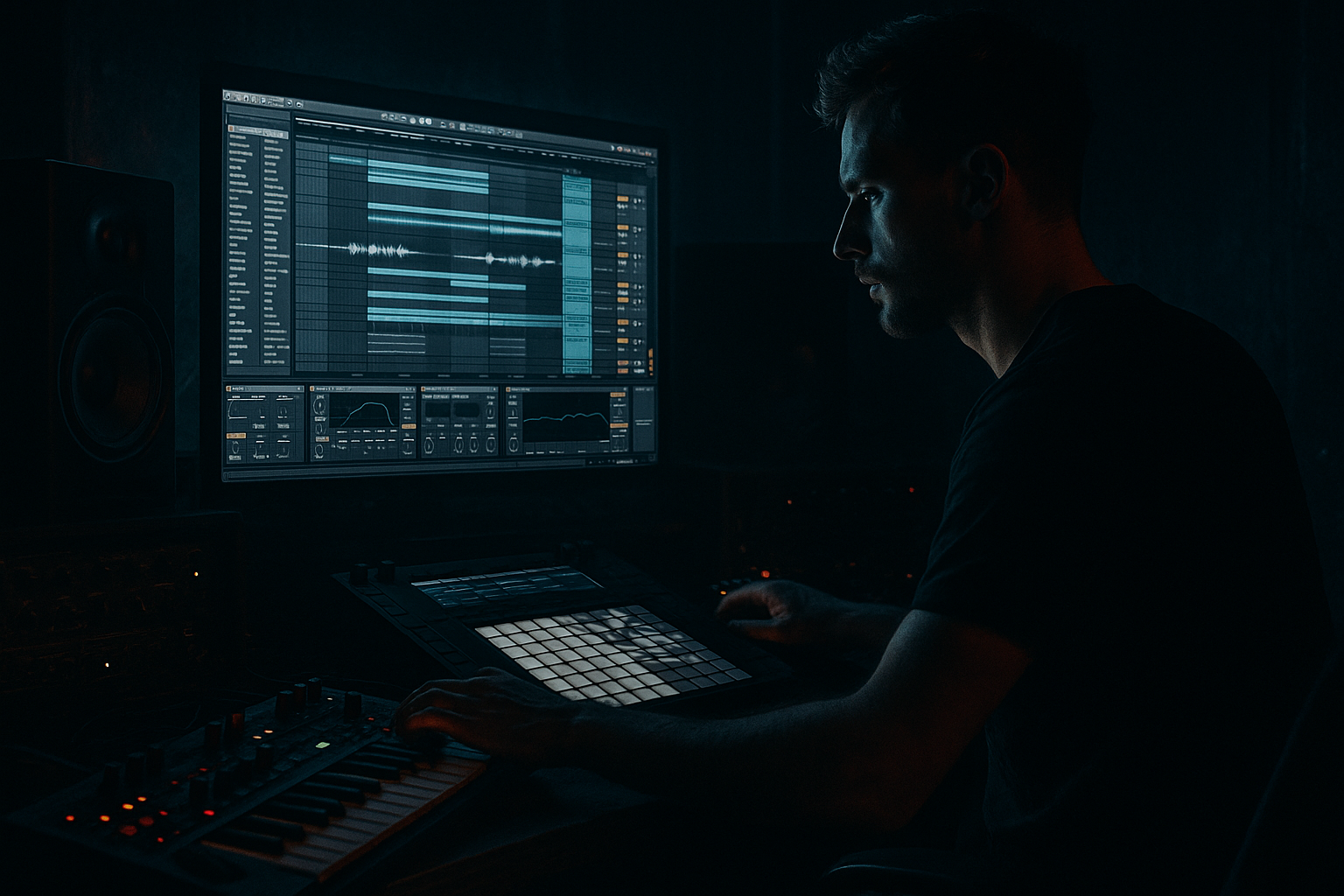
Main tutorial
```markdown
Sample Interpolation Choices for an Old School DnB Sound (Ableton Live) 🥁🧪
1) Lesson overview
Old school jungle / early DnB has a very specific edge: crunchy transients, slightly “glued” top end, and that familiar alias-y brightness when samples are pitched or stretched. A lot of that vibe comes from how the sampler interpolates audio when you change pitch or timing.
In Ableton Live, you can’t directly pick “linear/cubic/Sinc interpolation” as a single knob like in some samplers—but you can control the result through:
- Warp modes (and when to disable Warp)
- Repitch vs time-stretch decisions
- Complex/Pro vs Beats vs Tones behavior
- Sampler/Simpler playback + pitch
- Resampling + bit/ SR reduction (Redux) to mimic vintage interpolation artifacts
- Clean modern interpolation (tight and hi-fi)
- Authentic old-school roughness (crunch/aliasing, especially when pitching)
- Hybrid (modern low-end stability + vintage top-end attitude)
- A break in 2–3 variations (clean, “Akai-ish”, and brutally crunchy)
- A simple 8/16-bar rolling arrangement with resampled edits and fills
- A repeatable device chain you can drop into any DnB session
- For most authentic pitchy old-school: turn Warp OFF and pitch the clip via Transpose.
- For tight modern grid control: keep Warp ON and pick the right mode.
- Click the clip → Warp:
- Clip view → Warp Off
- Use Transpose:
- Warp On
- Mode: Beats
- Preserve: Transients
- Try these settings:
- Envelope: 0–20% (lower = more “hard slice” character)
- Warp On
- Mode: Re-Pitch
- Complex / Complex Pro: smooth, modern, can smear transients.
- Tones: can introduce tonal artifacts—sometimes great on reese resamples, usually weird on breaks unless you want “ringy” hats.
- When you pitch a slice in Simpler, you’re hearing Ableton’s resampling/interpolation approach for that instrument playback—very different from Warp stretching.
- This is often closer to “sampler vibe” than heavy Warp processing.
- Pick 4–8 key slices (kick, snare, hat runs).
- In each Simpler:
- Bars 1–8: Clean break (Beats mode) + bass minimal
- Bars 9–16: Introduce Resampled/Redux break quietly under the clean (parallel grit)
- Bars 17–24: Full swap: mostly crunchy resample + extra ghost hits
- Bars 25–32: Drop fill:
- Using Complex/Pro on breaks and wondering why it sounds “soft.”
- Warping + heavy processing before you decide on pitch.
- Redux too early in the chain (especially before EQ/dynamics).
- Downsampling the whole mix because the break is gritty.
- Over-chopping without groove.
- Parallel “clean low / dirty top” break bussing
- Sub stability: don’t let interpolation wreck the bottom
- Use Re-Pitch for “tape violence” on fills
- Resample your bass with “wrong” settings
- Glue the whole drum bus like a 90s record
- In Ableton, “interpolation choice” is mostly Warp strategy + repitch vs stretch + resample/degrade workflow.
- For old-school jungle/DnB:
- Commit to audio, print variations, and arrange with swaps/edits—classic DnB energy comes from decisive resampling moves.
This lesson shows you a practical workflow to deliberately get that old school grit while staying in control. ⚙️
---
2) What you will build
You’ll build a classic jungle break manipulation chain and a bass resample workflow that lets you choose between:
Deliverables:
---
3) Step-by-step walkthrough
Step A — Prep your break like a jungle producer 🎛️
1. Choose a break (Amen, Think, Hot Pants, Funky Drummer…)
2. Drag it into an Audio Track.
3. Set tempo around 165–174 BPM.
Now decide your first “interpolation choice”: Warp or no Warp?
Do this:
- Create Version 1 (No Warp / Pitchy): Duplicate the track, turn Warp OFF.
- Create Version 2 (Warped / Controlled): Duplicate again, Warp ON.
---
Step B — Understand Warp modes as “interpolation flavors” 🍬
#### Version 1: Warp OFF (old-school pitch + tempo together)
This mimics classic sampler behavior: speed change = pitch change.
- Try -2 to -5 semitones for deeper, slower, grimier breaks.
- Try +2 for manic, early jungle energy.
Why it feels old school: playback is straightforward and the “artifact” is mostly from pitching + any later bit/SR reduction, like older hardware.
✅ Best for: authentic jungle pitching, fast resample workflow, gritty top end.
---
#### Version 2: Warp ON → Beats mode (classic chopped feel)
Beats mode is your DnB workhorse for breaks.
- 1/16 for tight, snappy rolls
- 1/8 for chunkier old-school movement
Why it feels old school: transients stay punchy; tail handling can get a bit “steppy” in a good way—especially on hats/ghost notes.
✅ Best for: tight rolling edits, avoiding mush, controlled grid chops.
---
#### Version 3: Warp ON → Re-Pitch (the golden “tape” option) 📼
This changes speed and pitch together while still letting you warp to grid. It’s the closest “old sampler/timebase” vibe in Live.
✅ Best for: authentic tempo moves while keeping arrangement workable.
---
#### Modes to use sparingly (but intentionally)
- If you must: turn Formants OFF, start with Complex Pro, Envelope ~ 64–128 (depending on clip), and compare.
---
Step C — Move the break into Simpler for classic pitch workflow 🎚️
For old-school sound design, Simpler/Sampler pitching is a huge part of the vibe.
1. Right-click your break clip → Slice to New MIDI Track
2. Slicing preset:
- Transient (most jungle-friendly)
- Create one slice per transient
3. Ableton makes a Drum Rack with Simplers.
Key concept: Simpler pitch = interpolation character
Practical move:
- Turn Warp OFF inside Simpler (if available in your version/mode) or avoid time-stretch features.
- Pitch a couple slices -1 to -3 st for weight, leave others original for snap.
---
Step D — “Old-school interpolation” via resampling + Redux (the secret sauce) 🧱
If you want that crunchy, slightly “steppy” high end associated with older samplers, you can commit to it.
Create a resample print:
1. Make a new Audio Track called RESAMPLE BREAK
2. Set Audio From = your break track (or Drum Rack track)
3. Arm RESAMPLE BREAK
4. Record 8 bars of your break edits.
Now degrade like vintage playback:
On the resampled audio clip (or on the track), add:
Device chain (classic):
1. EQ Eight
- HP at 25–35 Hz (clean sub rumble)
- Optional: small dip 250–400 Hz if boxy
2. Redux (this is your “interpolation vibe” maker)
- Downsample ON
- Start at 12–18 kHz for subtle grit
- Push to 6–10 kHz for gnarly jungle fizz
- Bit Reduction: try 12-bit feel (set around 10–14 bits)
3. Saturator
- Mode: Analog Clip
- Drive: 2–6 dB
- Soft Clip: On
4. Drum Buss
- Drive: 5–15%
- Crunch: 0–20% (small moves)
- Boom: Off or very subtle (Boom can blur break low end)
5. Limiter (only if you’re printing loud)
- Ceiling: -0.8 dB
- Aim for 2–4 dB of GR max
Why this works: older samplers often had lower effective bandwidth + quantization artifacts. Redux + resample gives you that “hardware edge” without guessing.
---
Step E — Arrangement ideas: make it feel like a proper roller 🏁
A classic old-school arrangement trick is variation through resampling, not endless plugins.
Try this 32-bar structure:
- last 1 bar: Re-Pitch version, pitch down -2 st for a “tape drag” vibe
- or reverse a snare slice and slam back into bar 1
Ableton workflow tip:
Use Consolidate (Cmd/Ctrl+J) on resampled edits so you’re committing to the texture—very old-school mindset.
---
4) Common mistakes
Great for pads/vocals, often wrong for jungle transients.
Pitch decisions first; then degrade/shape.
It can exaggerate junk frequencies—control first, then crush.
Keep the grunge targeted: break bus, hat bus, or parallel layer.
Jungle swing often comes from small timing offsets + ghost notes, not just random slices.
---
5) Pro tips for darker/heavier DnB 🌑
- Duplicate break:
- LOW break: EQ Eight low-pass around 4–7 kHz, keep punch
- TOP break: EQ Eight high-pass around 200–400 Hz, then Redux harder
Blend to taste for weight + crunch without losing kick/snare body.
If pitching the break down, the low end can get messy.
Use EQ Eight to carve a pocket around 45–80 Hz and let your sub own that space.
Automate clip Warp mode (duplicate clip with Re-Pitch) and pitch down at the end of phrases.
For reese/hoover layers:
- Resample the bass at different pitches, then bring back to key.
- Add Redux Downsample 10–14 kHz just on the mid layer.
This can add that early techstep edge without killing sub.
Try Glue Compressor on Drum Bus:
- Attack 3–10 ms
- Release Auto or 0.1–0.3s
- Ratio 2:1
- 1–3 dB GR
---
6) Mini practice exercise (20–30 minutes) ⏱️
1. Load an Amen break at 174 BPM.
2. Create three versions:
- A) Warp OFF, transpose -3 st
- B) Beats, Preserve Transients, 1/16, Envelope 10%
- C) Re-Pitch, no extra processing
3. Resample 8 bars of each version.
4. On each resample, apply:
- Redux: Downsample 12 kHz, Bits 12
- Saturator: Drive 4 dB, Soft Clip On
5. Arrange a 16-bar loop:
- Bars 1–8: Version B
- Bars 9–16: Version A layered with Version B at -10 dB
6. Add one fill using Version C (Re-Pitch) in the last half-bar.
Goal: hear how “interpolation choices” change the vibe, not just the fidelity.
---
7) Recap ✅
- Warp OFF and Re-Pitch get you authentic pitch/tempo behavior 📼
- Beats mode keeps transients crisp and choppy 🥁
- Resampling + Redux recreates vintage grit and bandwidth limits 🧱
If you want, tell me your Live version (11/12) and whether you’re using Simpler or Sampler, and I’ll tailor a “break bus rack” with mapped macros for clean ↔ crunchy interpolation-style control.
```

