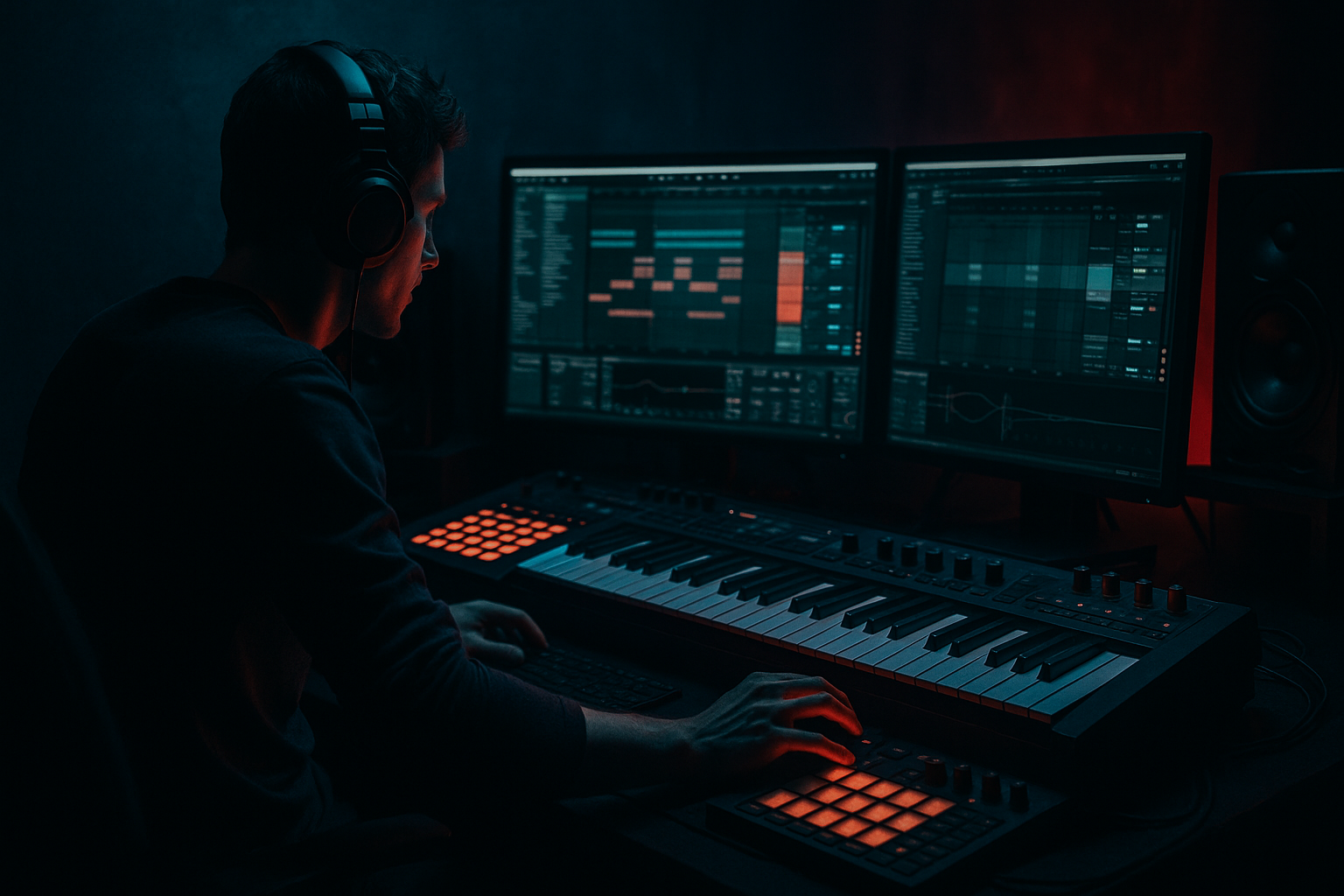
Main tutorial
Sampler Rack Arrange Breakdown (Stock Only) — Jungle / Oldskool DnB Edits in Ableton Live 12 🥁🔪
1) Lesson overview
In this lesson you’ll learn a beginner-friendly, repeatable workflow for creating classic jungle / oldskool DnB arrangement breakdowns using a Sampler-based rack and only stock Ableton Live 12 devices.
Goal: make your drums drop out, glitch, pitch, reverse, filter, and re-enter with that gritty “tape/splice” energy—without needing any third‑party plugins.
You’ll build a rack that lets you perform breakdown edits with Macros, then you’ll place those edits into a 16–32 bar breakdown that feels authentic to jungle/DnB.
---
2) What you will build
You’ll end up with:
- A “Breakdown Edit Rack” built around Sampler (and a few stock FX)
- Macro knobs that control:
- A practical arrangement template for a jungle breakdown:
- Map Auto Filter Frequency
- Auto Filter settings:
- Macro range suggestion:
- Add a second Auto Filter OR change to Bandpass.
- If using a second Auto Filter:
- In Sampler, map Transpose (or Detune) to Macro 3.
- Range suggestion:
- Optional: Add Portamento/Glide feel by automating smoothly (Arrangement automation curve) rather than stepping.
- Use Gate to create rhythmic chopping:
- Map Gate Threshold to Macro 4
- Gate settings to start:
- Macro range:
- Map Reverb Dry/Wet to Macro 5
- Reverb settings:
- Macro range:
- Map Redux Downsample OR Bit Reduction
- Starting points:
- Also map Saturator Drive to the same Macro (optional).
- Use Delay:
- Map Delay Dry/Wet to Macro 7
- Range: `0% → 35%`
- Full drums + bass as normal (we’re setting context).
- Bar 17: Automate Macro 1 (HP Sweep) slowly up to thin the break.
- Bar 19: Use Macro 2 (LP Muffle) briefly for a “telephone” moment.
- Bar 21: Pull drums down:
- Bar 23: Add Macro 7 (Dub Throw) on the final snare.
- Use 2-beat stutters:
- Sprinkle reverse hits from your reversed track:
- Push Macro 5 (Reverb) during gaps for wash
- Bar 29: Increase HP Sweep (Macro 1) near max (thin!)
- Bar 31 (last 1–2 beats): Do the pitch drop
- Last beat before drop: Hard mute (silence) or a single snare hit with huge reverb
- Bar 33: Drop slams back in (reset macros to neutral)
- Over-filtering everything: If you HP sweep to 6 kHz for too long, the groove disappears. Use it as tension, not the whole breakdown.
- Too much reverb on breaks: Reverb builds mud fast. High-cut the reverb and keep Dry/Wet under control.
- Stutter for too long: Stutters work best as accents (1 beat, 2 beats, 1 bar). Long stutters feel gimmicky.
- No reset before the drop: If the drop hits while your HP filter is still up, it’ll feel weak. Always “zero out” macros right before the drop.
- Clipping from Saturator/Redux: Crunch is good; uncontrolled digital clipping is not (unless intentional). Watch levels.
- Add a second parallel chain in the rack (Audio Effect Rack style):
- Use EQ Eight after distortion:
- Use Auto Filter resonance sparingly:
- Fake old sampler vibe:
- Punch through the breakdown:
- You built a Sampler-based edit rack using stock devices only.
- You mapped Macros for the key jungle breakdown moves: filter tension, pitch drops, stutters, dub throws, grit.
- You applied it to a real DnB arrangement (breakdown → pre-drop fill → drop).
- You learned the most important habit: reset your macros before the drop so the impact hits full-force.
- HP/LP filter sweep (classic tension builder)
- Tape stop / pitch drop style moment
- Reverse + reverb wash
- Stutter / gated repeats
- Lo‑fi grit (Redux/Saturator)
- Drop → breakdown → pre-drop fill → drop
---
3) Step-by-step walkthrough
Step 0 — Set the scene (tempo + basic loop)
1. Set tempo to 165–172 BPM (classic jungle: 165–170; modern rollers: 172–174).
2. In Arrangement View, make an 8-bar loop of your main drum groove:
- Ideally a breakbeat (Amen/Think/Funky Drummer etc.).
3. Consolidate a clean 2-bar section of your break:
- Select 2 bars of the best groove
- Press Cmd/Ctrl + J to Consolidate
- This becomes your “source” for edits.
Tip: If your break is in audio, make sure it’s warped cleanly (usually Beats warp mode works for breaks; set Preserve to 1/16 for tightness).
---
Step 1 — Create a Sampler instrument from your break
1. Drag your consolidated 2‑bar break audio into a new MIDI track.
2. When Live asks, choose Sampler (not Simpler).
3. Open Sampler:
- Set Voices: `8–16` (to avoid voice stealing when you stutter/retrigger)
- Set Filter: enable it (we’ll macro it later)
Why Sampler? It gives you deeper control (multi‑sample zones, modulation, filter types, etc.), perfect for “rack performance” style edits.
---
Step 2 — Put Sampler into a Drum Rack-style “edit performance” setup
We’ll build an Instrument Rack that contains Sampler + stock FX.
1. Select the Sampler device.
2. Press Cmd/Ctrl + G to Group into an Instrument Rack.
3. Rename the rack: `Jungle Breakdown Edit Rack`.
Now add devices after Sampler in this order (all stock):
1. Auto Filter
2. Redux
3. Saturator
4. Gate
5. Reverb
6. Delay (or Echo if you want—Echo is stock, but Delay is simpler)
This chain is intentionally “oldskool-friendly”: filter movement, bit grit, drive, rhythmic gating, space, and dubby throws.
---
Step 3 — Assign Macros (your “breakdown control panel”) 🎛️
Click Macro button on the rack, then map:
#### Macro 1: “HP Sweep (Tension)”
- Filter type: Highpass (12 or 24 dB)
- Resonance: `0.70–1.20` (don’t overdo, jungle gets harsh fast)
- Min: 80 Hz
- Max: 3.5–6 kHz
Use this to “remove the weight” and build anticipation.
#### Macro 2: “LP Muffle (Telephone)”
- Set to Lowpass 24 dB
- Map Frequency to Macro 2
- Range: 800 Hz → 18 kHz
This is that classic “everything goes underwater” breakdown vibe.
#### Macro 3: “Tape Down (Pitch Drop)”
We’ll fake a tape stop/pitch fall using Sampler pitch.
- Min: `0 st`
- Max: `-12 st` (one octave down) or `-7 st` (perfect fifth down)
DnB move: Do a quick pitch drop right before a drum mute, then wash into reverb.
#### Macro 4: “Stutter Gate”
- Gate mode: standard Gate
- Turn on sidechain? (Not needed here; we’re gating the break itself)
- Return (Hysteresis): small (default ok)
- Attack: `0.1–1 ms`
- Hold: `0–10 ms`
- Release: `30–120 ms`
- Threshold from low (open) to high (choppy)
This gives “cut-up” energy fast, like you’re slicing with a crossfader.
#### Macro 5: “Reverse Wash”
Sampler doesn’t have a one‑knob reverse, so we’ll do a practical stock workflow:
Option A (best beginner workflow): Duplicate the track for reverse hits
1. Duplicate your break track: `Cmd/Ctrl + D`
2. On the duplicate, reverse the audio source:
- If it’s still a Sampler chain, simpler approach:
- Create a quick reversed audio clip: Flatten the MIDI to audio (right-click track → Freeze → Flatten), then Reverse the clip.
3. Keep this reversed track muted until breakdown moments.
Then for the rack itself:
- Size: `60–90`
- Decay Time: `2.5–6 s`
- Predelay: `10–25 ms`
- High Cut: `3–8 kHz` (oldskool darker air)
- Dry/Wet: `0% → 45%`
Now you can sprinkle reversed hits (track) while pushing Macro 5 for wash.
#### Macro 6: “Grit (Lo-fi)”
- Downsample: `1.0 → 6.0`
- Bit Reduction: `12 → 6`
- Drive: `0 → +6 dB`
- Turn on Soft Clip in Saturator ✅
Old jungle loves a little crunch—just keep it controlled.
#### Macro 7: “Dub Throw”
- Time: try 1/8 or 3/16
- Feedback: `25–55%`
- Filter: roll off low end (avoid bass mud)
Use this on the last snare before a drop for that pirate-radio vibe 📻.
---
Step 4 — Create “breakdown edit lanes” in Arrangement View
Now we’ll actually arrange a breakdown like a real DnB track.
Here’s a clean 32-bar example (adjust to taste):
#### Bars 1–16: Drop (baseline reference)
#### Bars 17–24: Breakdown Part A (remove weight, keep identity)
- Either mute kick layer or mute the whole break for 1/2 bar
Arrangement idea: Keep a hat loop or shaker quietly running so the groove doesn’t die.
#### Bars 25–28: Breakdown Part B (edit showcase)
- Automate Macro 4 (Stutter Gate) for 1 beat on / 1 beat off
- Place reversed cymbals/snares leading into downbeats
Classic jungle feel: Edits happen in short bursts—don’t stutter for 8 bars straight.
#### Bars 29–32: Pre-drop tension + fill
- Macro 3 from `0` down to `-7` or `-12` quickly
Workflow tip: In Ableton, hit A to show automation lanes, and draw clean ramps. Jungle edits are often about fast, intentional automation moves.
---
Step 5 — Make it playable (record your macro performance) 🎚️
Instead of drawing everything:
1. Arm automation recording:
- Click Automation Arm (top bar)
2. Hit record and perform Macro moves live:
- Filter sweep
- Quick stutter bursts
- Reverb/delay throws on fills
3. After recording:
- Right-click automation → Simplify Envelope if it’s too wiggly
This gives more human “DJ hands on mixer” energy.
---
4) Common mistakes
---
5) Pro tips for darker/heavier DnB 🕶️
- Chain 1: “Clean”
- Chain 2: “Crush” with Redux + Saturator + EQ Eight
- Blend with Chain Volume for controlled brutality.
- Pull harshness around 3–6 kHz if it gets painful
- High-pass the reverb send area around 150–250 Hz
- Dark rollers want weight, not whistling resonant peaks.
- Mild Redux Downsample (1.5–3) + Saturator Soft Clip
- Optional: slight Chorus-Ensemble very low mix for width (careful on drums).
- Keep a quiet ride/hat loop or a ghost snare ticking—jungle often stays rhythmic even in breakdowns.
---
6) Mini practice exercise (15 minutes) ⏱️
1. Take a 2‑bar break and loop it for 8 bars.
2. Build the rack and map these 4 macros only:
- HP Sweep (Auto Filter)
- Tape Down (Sampler Transpose)
- Stutter Gate (Gate Threshold)
- Dub Throw (Delay Dry/Wet)
3. Create a 4‑bar breakdown:
- Bar 1–2: HP Sweep up
- Bar 3: Stutter for 1 beat every bar
- Bar 4: Pitch drop last 2 beats + delay throw on final snare
4. Duplicate it and make Variation B by changing timing (not devices).
If you can make two different breakdowns with the same rack, you’re learning the real skill: arrangement control.
---
7) Recap ✅
If you want, tell me what break you’re using (Amen/Think/etc.) and your tempo, and I’ll suggest a specific 16-bar breakdown automation script (exact bar-by-bar macro moves) for that vibe.

